Submitted by: Submitted to:
Mayank Sharma(10EJCEE032) Mr. S.N. Jhanwar
VIIIth Sem. H.O.D.(EE Dept.)
J.E.C.R.C.,Jaipur
Introduction:
 The electrical load schedule is an estimate of the
instantaneous electrical loads operating in a facility, in
terms of active, reactive and apparent power (measured in
kW, kVAR and kVA respectively).
 The load schedule is usually categorised by switchboard
or occasionally by sub-facility / area.
 A key feature of this divisible load distribution scheduling
theory (known as DLT) is that it uses a linear
mathematical model.
Need Of load Scheduling:
 Essential for some of the key electrical design activities
(such as equipment sizing and power system studies)
 It provides the preliminary details of process / building /
Organisation Load.
 The electrical load schedule can typically be started with a
preliminary key single line diagram (or at least an idea of
the main voltage levels in the system)
Procedure to calculate the load
Scheduling:
 Step 1: Collect a list of the expected electrical loads in the
facility
 Step 2: For each load, collect the electrical parameters,
e.g. nominal / absorbed ratings, power factor, efficiency,
etc
 Step 3: Classify each of the loads in terms of switchboard
location, load duty and load criticality
 Step 4: For each load, calculate the expected consumed
load
 Step 5: For each switchboard and the overall system,
calculate operating, peak and design load
Step 1: Collect list of loads
 Process loads - are the loads that are directly relevant to
the facility.
Example-Motors, Heaters, Compressors, Conveyors.
• Non-process loads - are the auxiliary loads that are
necessary to run the facility.
• Example-lighting, utility systems (power and water),
DCS/PLC control systems, fire safety systems
Step 2: Collect electrical load
parameters
 Rated power is the full load or nameplate rating of the load
and represents the maximum continuous power output of the
load. For motor loads, the rated power corresponds to the
standard motor size (e.g. 11kW, 37kW, 75kW, etc).
 Absorbed power is the expected power that will be drawn by
the load.
 Power factor of the load is necessary to determine the reactive
components of the load schedule. Typically 0.85 for motor
loads >7.5kW, 1.0 for heater loads and 0.8 for all other loads).
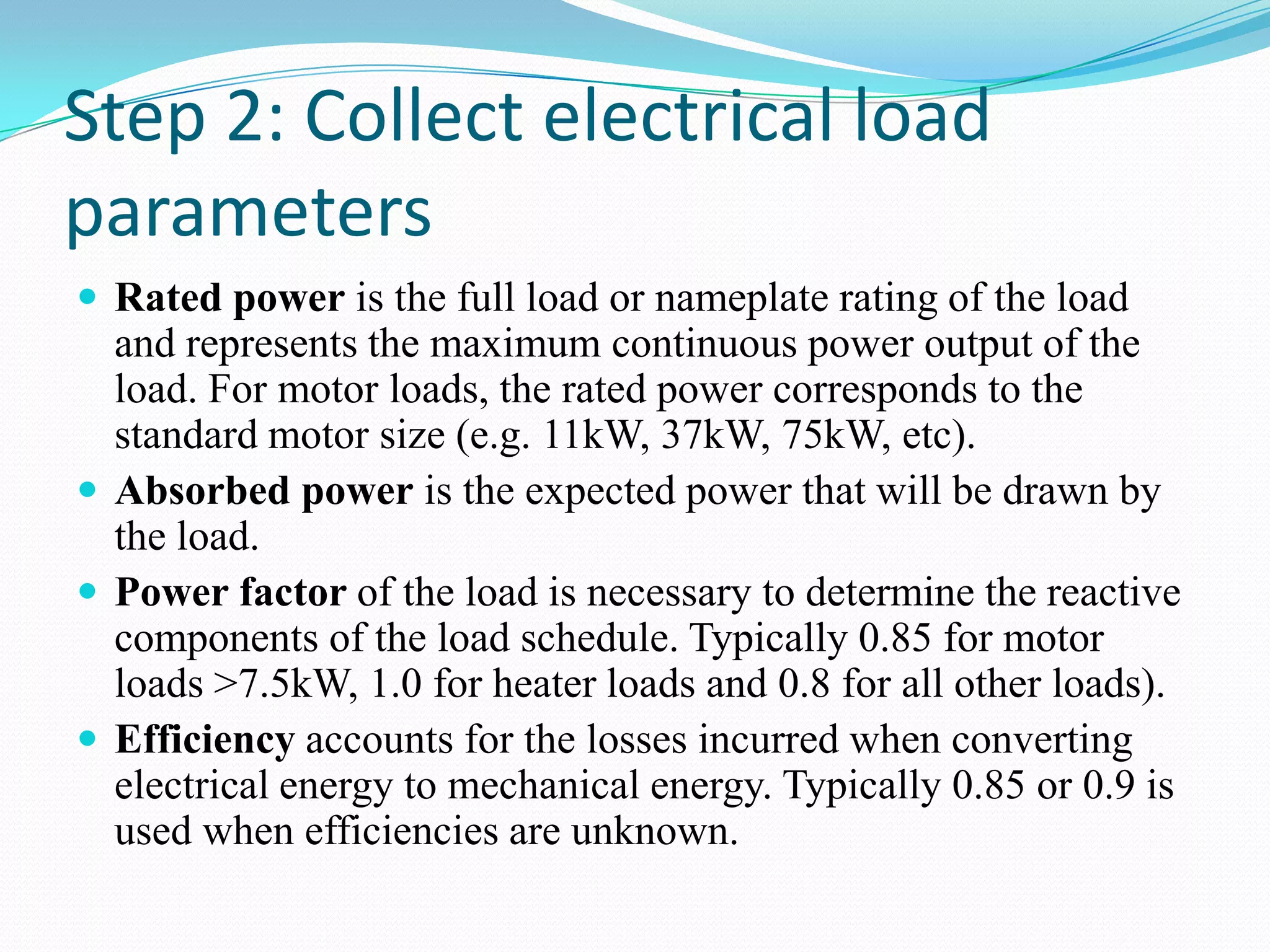
 Efficiency accounts for the losses incurred when converting
electrical energy to mechanical energy. Typically 0.85 or 0.9 is
used when efficiencies are unknown.
Step 3: Classify the loads
 Voltage Level :What voltage level and which switchboard
should the load be located?
Loads <150kW-LV System (400V - 690V)
150KW<Load<10 MW- MV System (3.3kV - 6.6kV)
Loads >10MW-HV Distribution System (11kV - 33kV)
 Load duty-
Continuous loads -are those that normally operate
continuously over a 24 hour period.eg. process loads,
control systems, lighting and small power distribution
boards, UPS systems.
Step 3(2):
Intermittent loads -only operate a fraction of a 24 hour period,
e.g. intermittent pumps and process loads, automatic doors and
gates.
Standby loads -are those that are on standby or rarely operate
under normal conditions, e.g. standby loads, emergency systems.
 Load criticality-
Normal loads-run under normal operating conditions.
Essential loads are those necessary under emergency conditions,
when the main power supply is disconnected and the system is
being supported by an emergency generator, e.g. emergency
lighting, key process loads that operate during emergency
conditions, fire and safety systems
Critical Loads-are those critical for the operation of safety systems
and normally supplied through a U.P.S. Battery.eg. Escape
lightning .
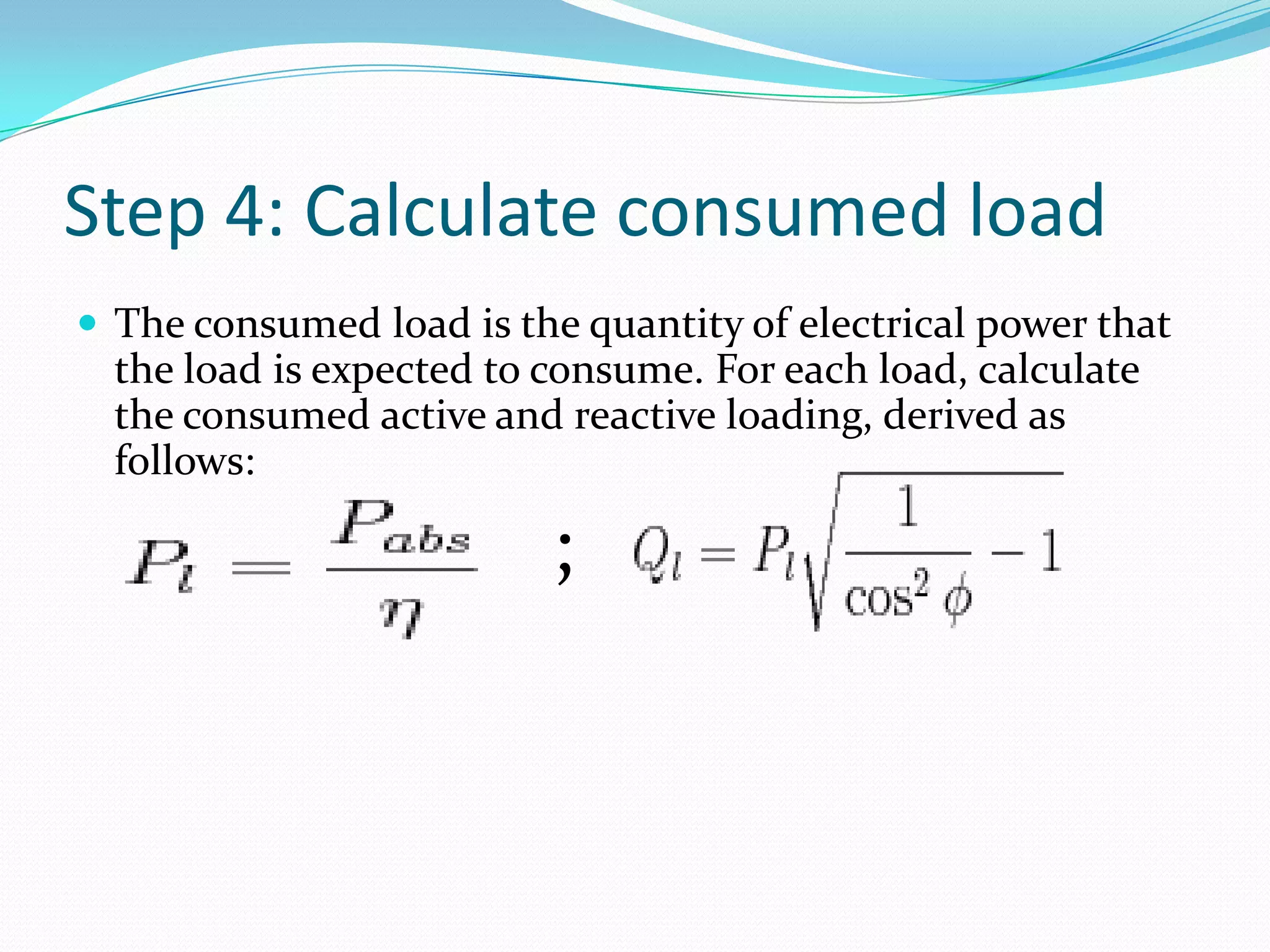
Step 4: Calculate consumed load
 The consumed load is the quantity of electrical power that
the load is expected to consume. For each load, calculate
the consumed active and reactive loading, derived as
follows:
;
Step 5: Calculate operating, peak
and design loads
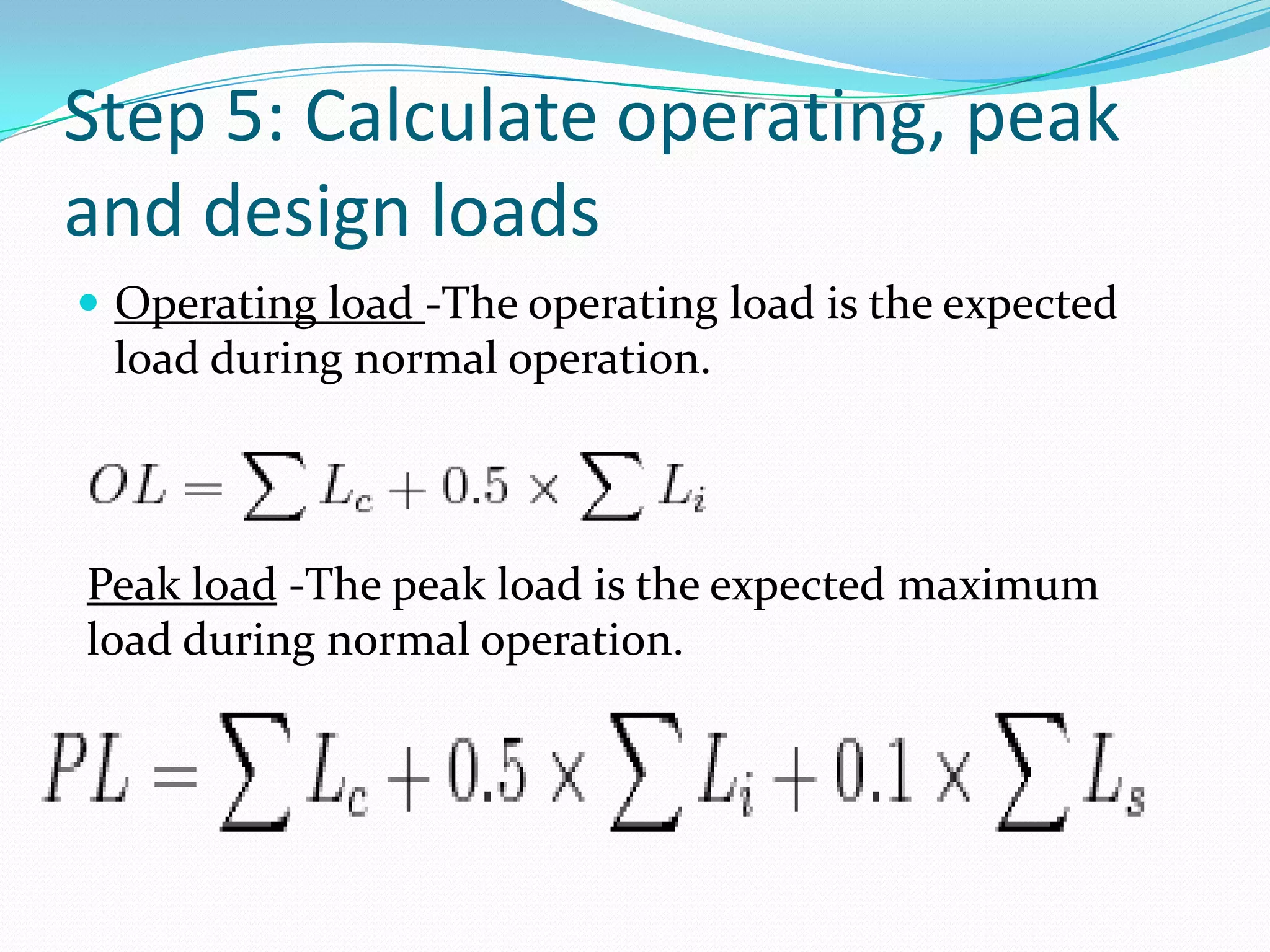
 Operating load -The operating load is the expected
load during normal operation.
Peak load -The peak load is the expected maximum
load during normal operation.
Step 5(2):
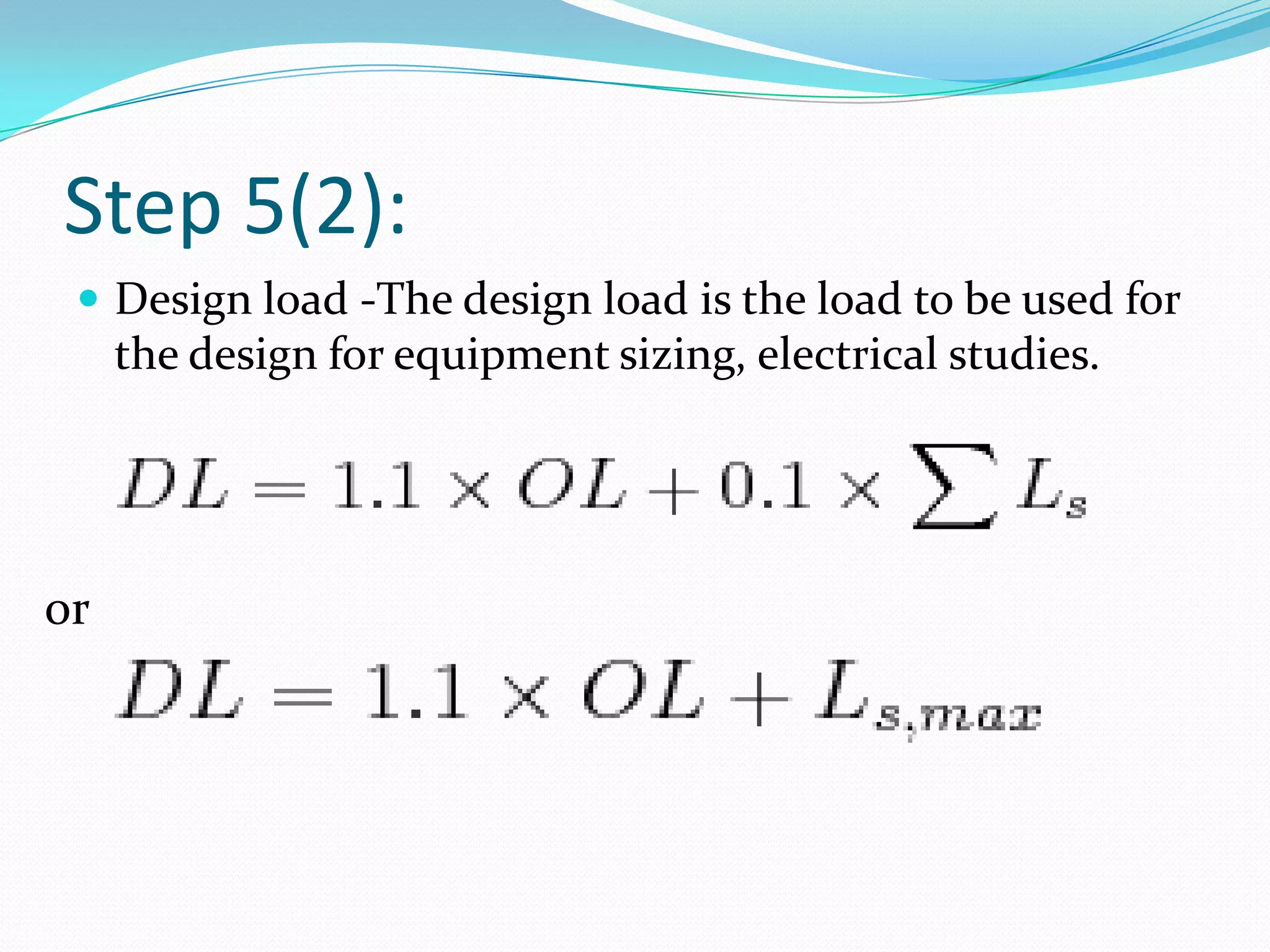
 Design load -The design load is the load to be used for
the design for equipment sizing, electrical studies.
or
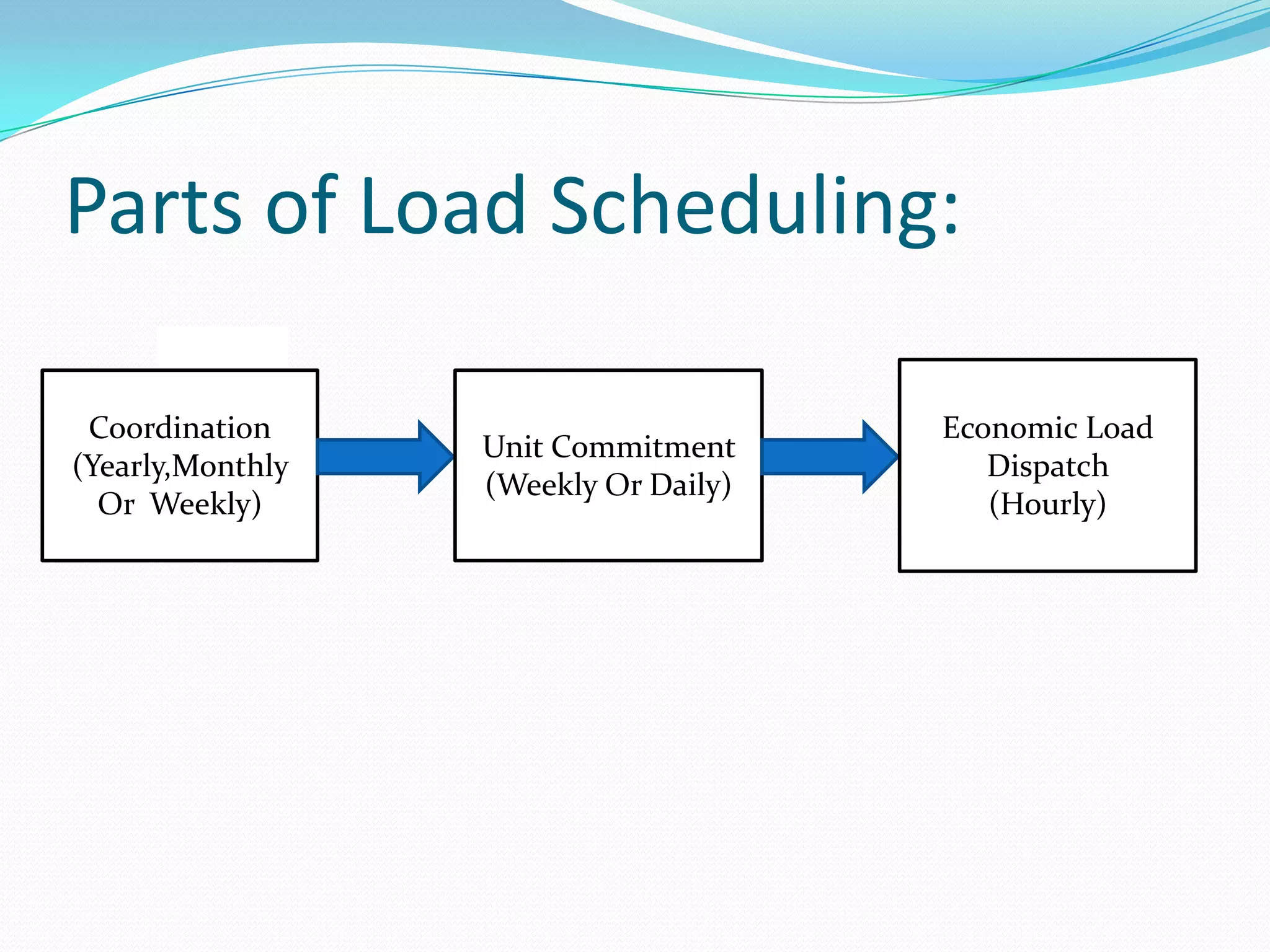
Parts of Load Scheduling:
Coordination
(Yearly,Monthly
Or Weekly)
Unit Commitment
(Weekly Or Daily)
Economic Load
Dispatch
(Hourly)
Hydrothermal Coordination
problem:
 It is the first stage in the solution of the hydrothermal
generation scheduling problem. The HCP consists of
determining the optimal amounts of hydro and
thermal generation to be used during a scheduling
period .The HCP is also decomposed in three Parts.
depending on the reservoirs storage capacity.
1.Long Term
2.Mid Term
3.Short Term
Unit Commitment-
 The electrical unit commitment problem is the
problem of deciding which electricity generating units
should be running in each period so as to satisfy
predictibly varying demand of electricity.
 Load of power system varies through out of the
demand reaches a different peak value from one day to
another. so which generator to start up and the
sequence in which units should be operate and for
how long.The computational procedure for making
such decision is called unit commitment
Economic Load Dispatch
 In power generation our main aim is to generate the
required amount of power with minimum cost.
 Economic load dispatch means that the generator’s
real and reactive power are allowed to vary within
certain limits so as to meet a particular load demand
with minimum fuel cost
 This allocation of loads are based on some
constraints.
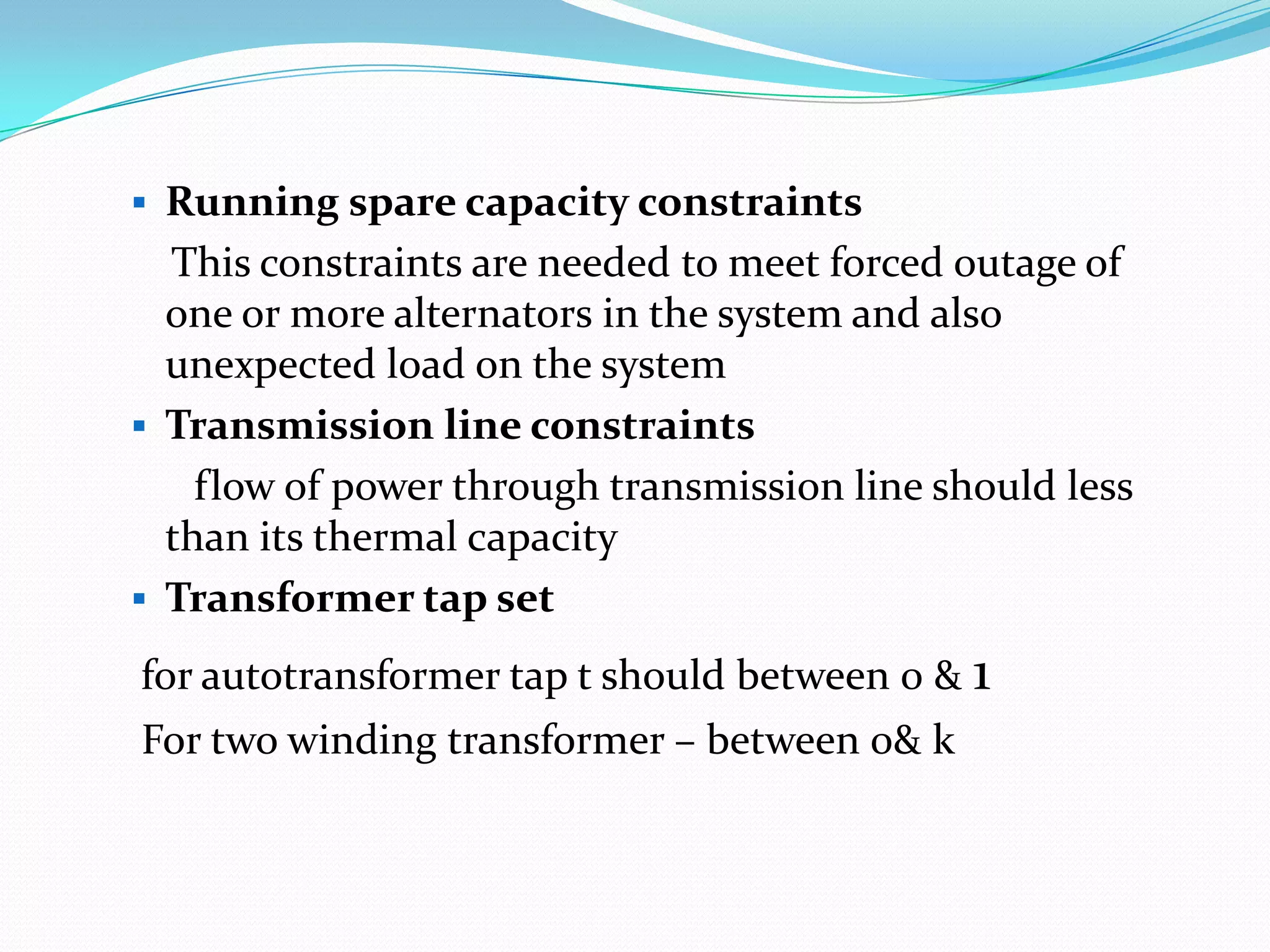
DIFFERENT CONSTRAINTS IN
ECONOMIC LOAD DISPATCH
 INEQUALITY CONSTRAINTS
 Voltage constraints
Vmin ≤ V ≤ Vmax ,
δmin ≤ δ ≤ δmax
 Generator constraints
KVA loading of generator should not exceed prescribed
value
Pmin ≤ P ≤ Pmax
Qmin ≤ Q ≤ Qmax
 Running spare capacity constraints
This constraints are needed to meet forced outage of
one or more alternators in the system and also
unexpected load on the system
 Transmission line constraints
flow of power through transmission line should less
than its thermal capacity
 Transformer tap set
for autotransformer tap t should between 0 & 1
For two winding transformer – between 0& k
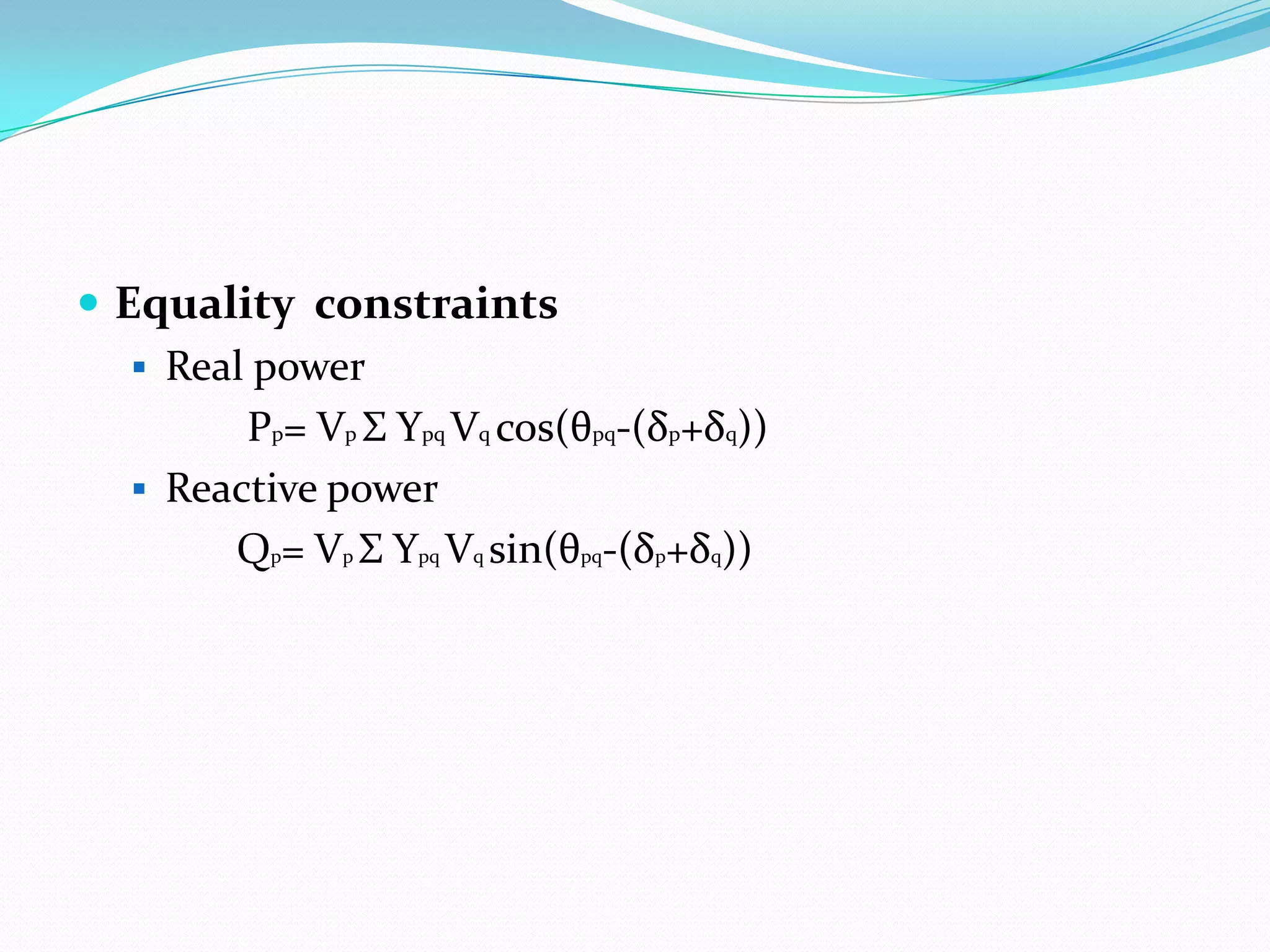
 Equality constraints
 Real power
Pp= Vp Σ Ypq Vq cos(θpq-(δp+δq))
 Reactive power
Qp= Vp Σ Ypq Vq sin(θpq-(δp+δq))
OPERATING COST OF THERMAL
PLANT
 The factors influencing power generation at minimum
cost are operating efficiencies of generators, fuel cost,
and transmission losses.
 The most efficient generator in the system does not
guarantee minimum cost as it may be located in an
area where fuel cost is high.
 If the plant is located far from the load center,
transmission losses may be considerably higher and
hence the plant may be overly uneconomical.
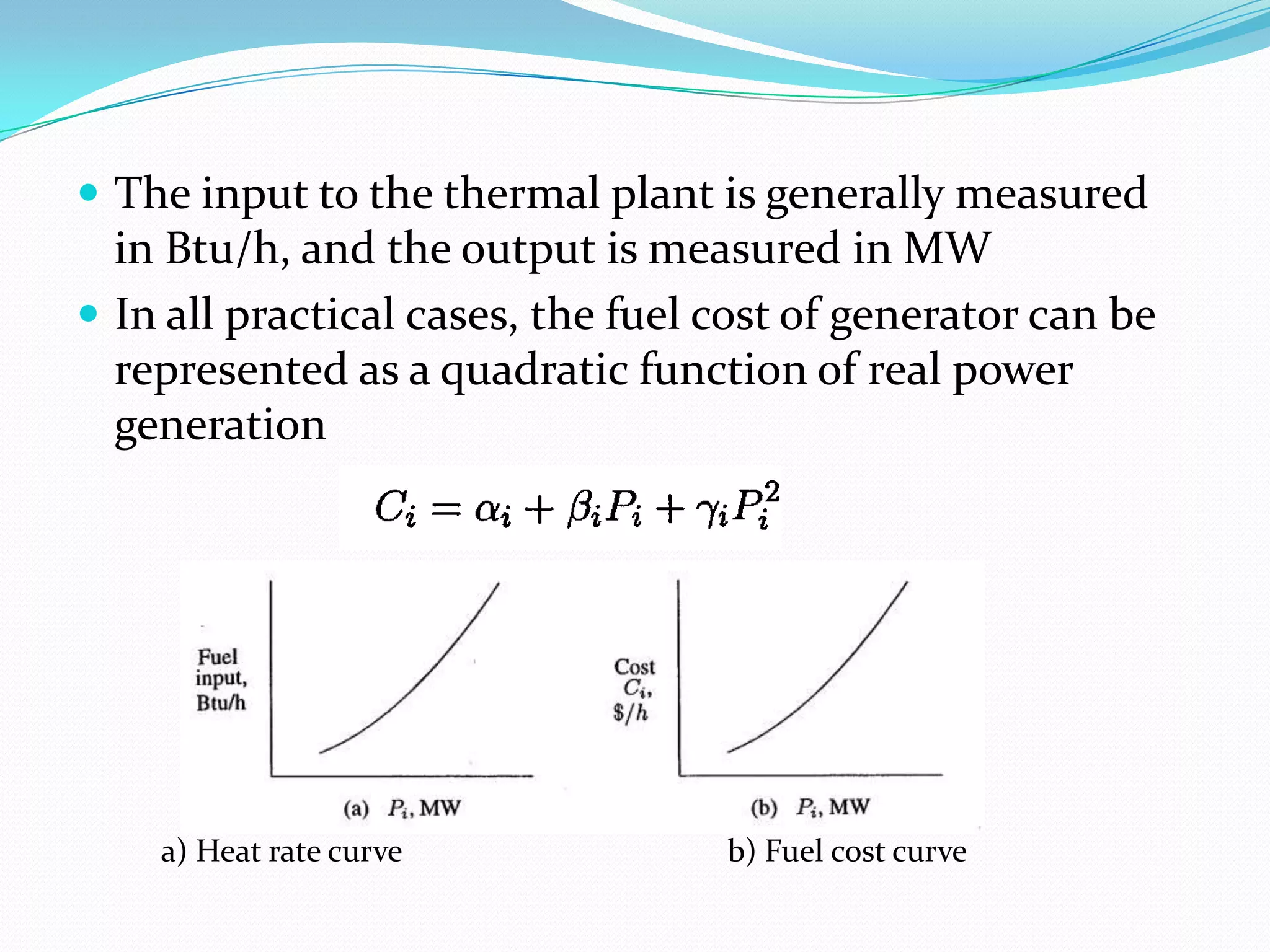
 The input to the thermal plant is generally measured
in Btu/h, and the output is measured in MW
 In all practical cases, the fuel cost of generator can be
represented as a quadratic function of real power
generation
a) Heat rate curve b) Fuel cost curve
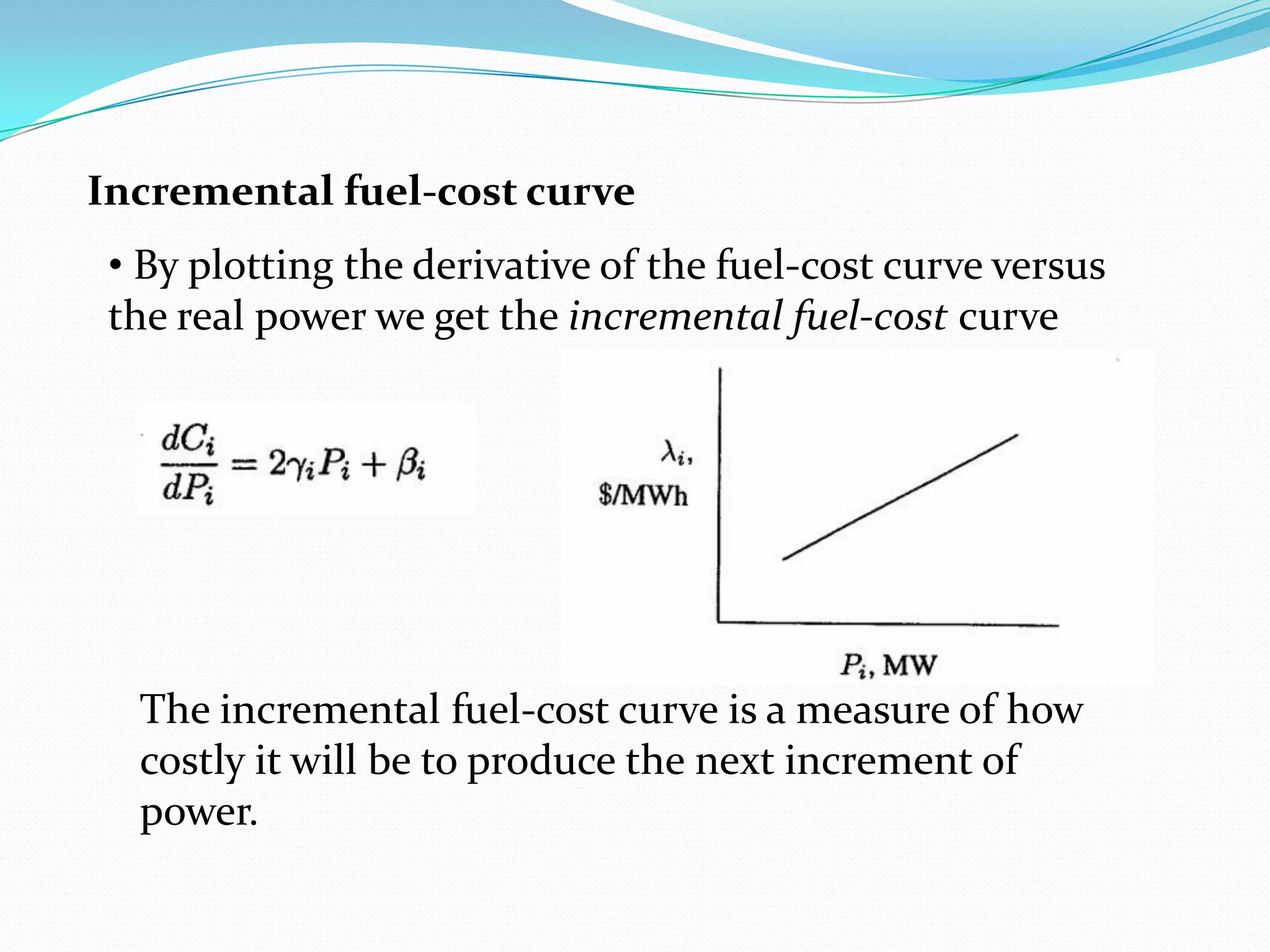
• By plotting the derivative of the fuel-cost curve versus
the real power we get the incremental fuel-cost curve
Incremental fuel-cost curve
The incremental fuel-cost curve is a measure of how
costly it will be to produce the next increment of
power.
ECONOMIC DISPATCH NEGLECTING
LOSSES
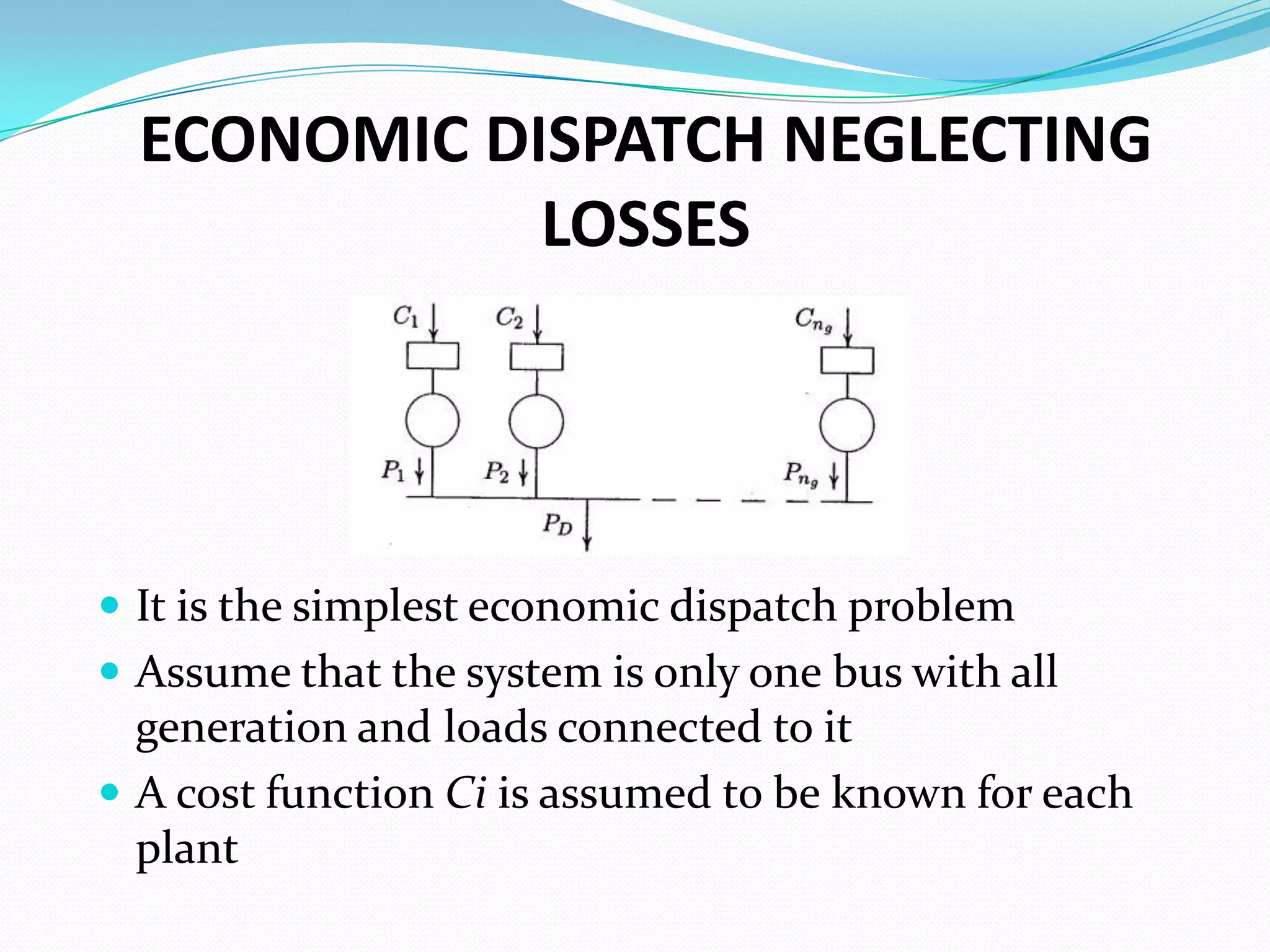
 It is the simplest economic dispatch problem
 Assume that the system is only one bus with all
generation and loads connected to it
 A cost function Ci is assumed to be known for each
plant
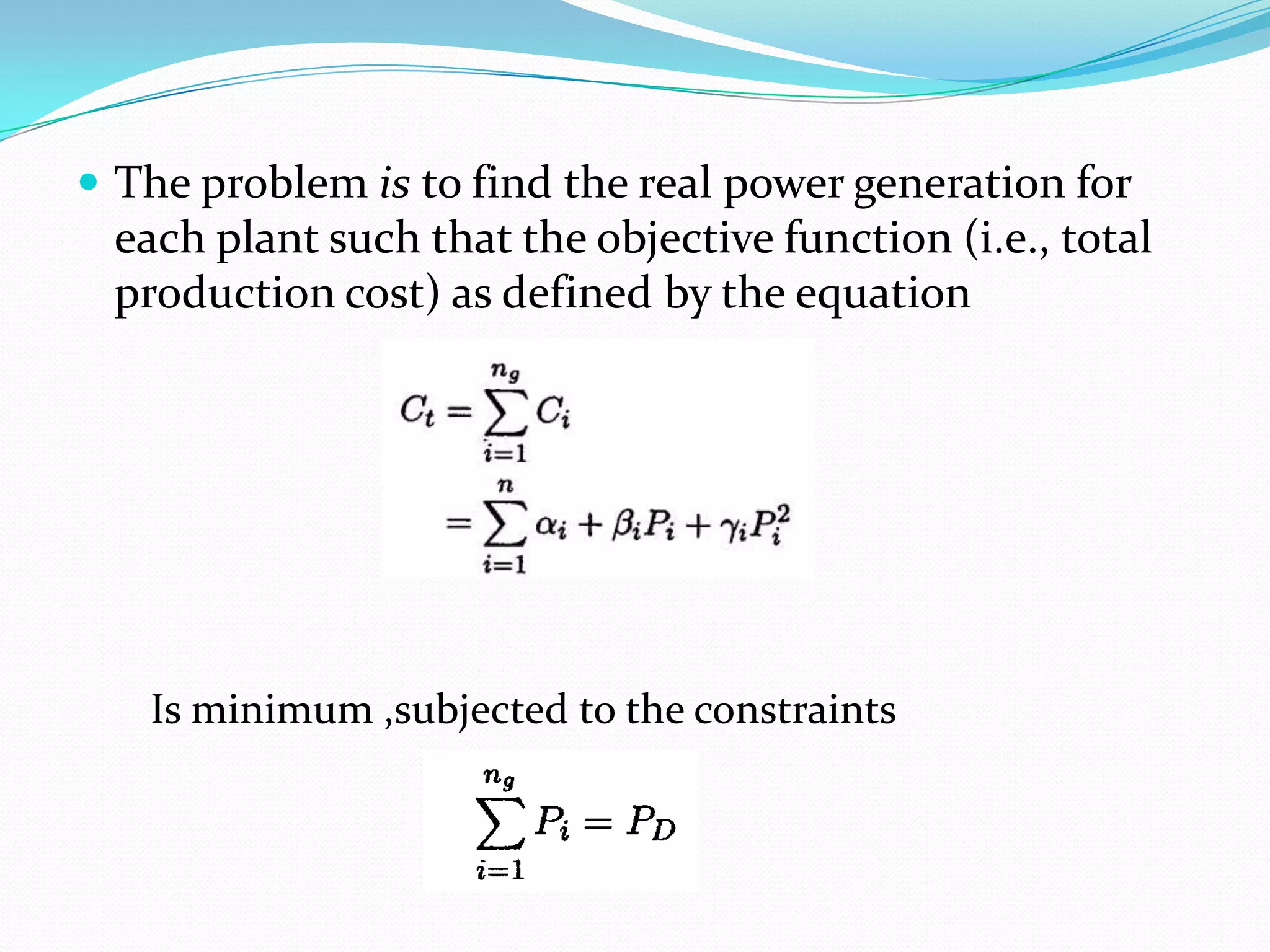
 The problem is to find the real power generation for
each plant such that the objective function (i.e., total
production cost) as defined by the equation
Is minimum ,subjected to the constraints
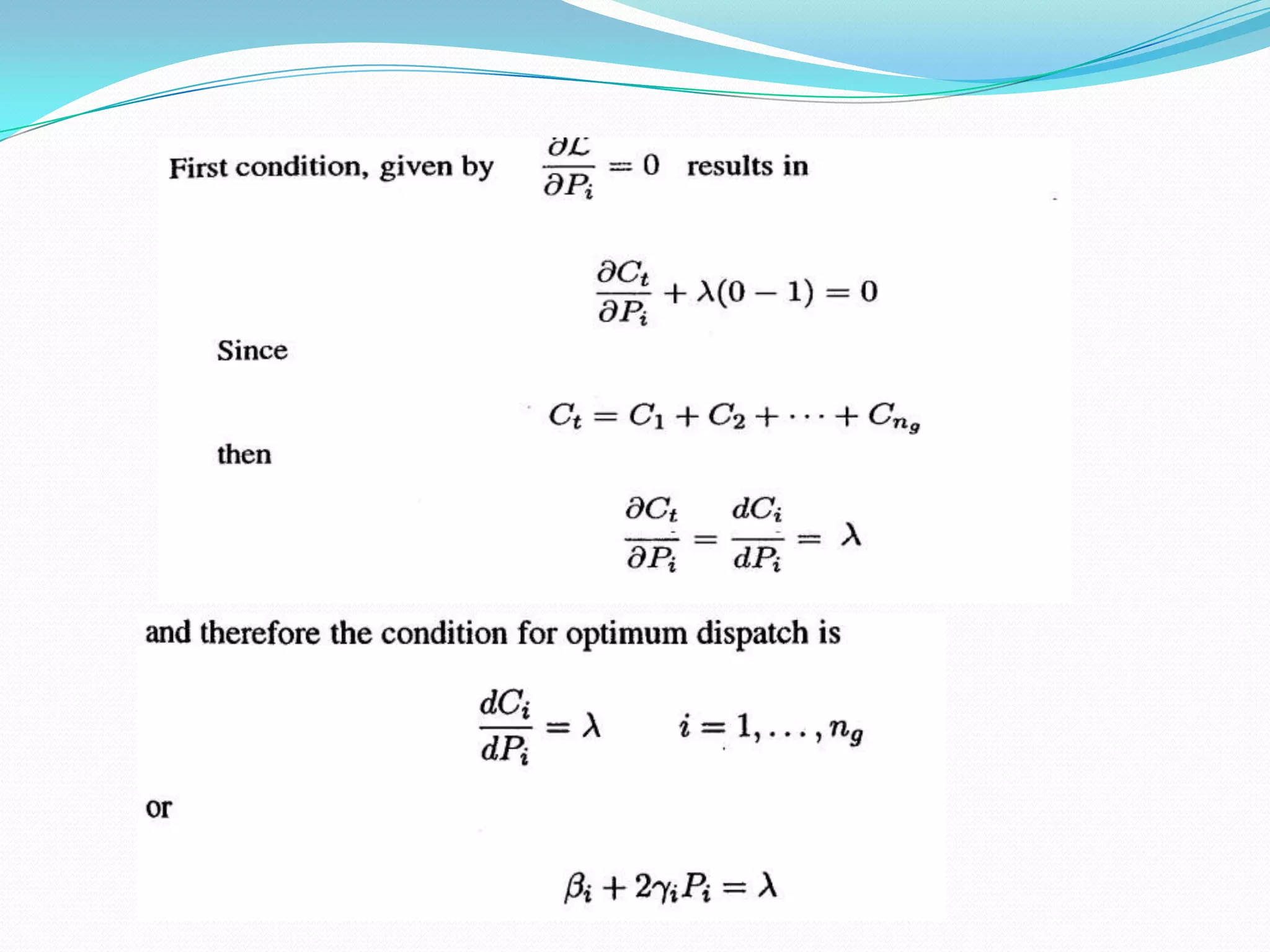
 when losses are neglected with no generator limits, for
most economic operation. all plants must operate at
equal incremental production cost
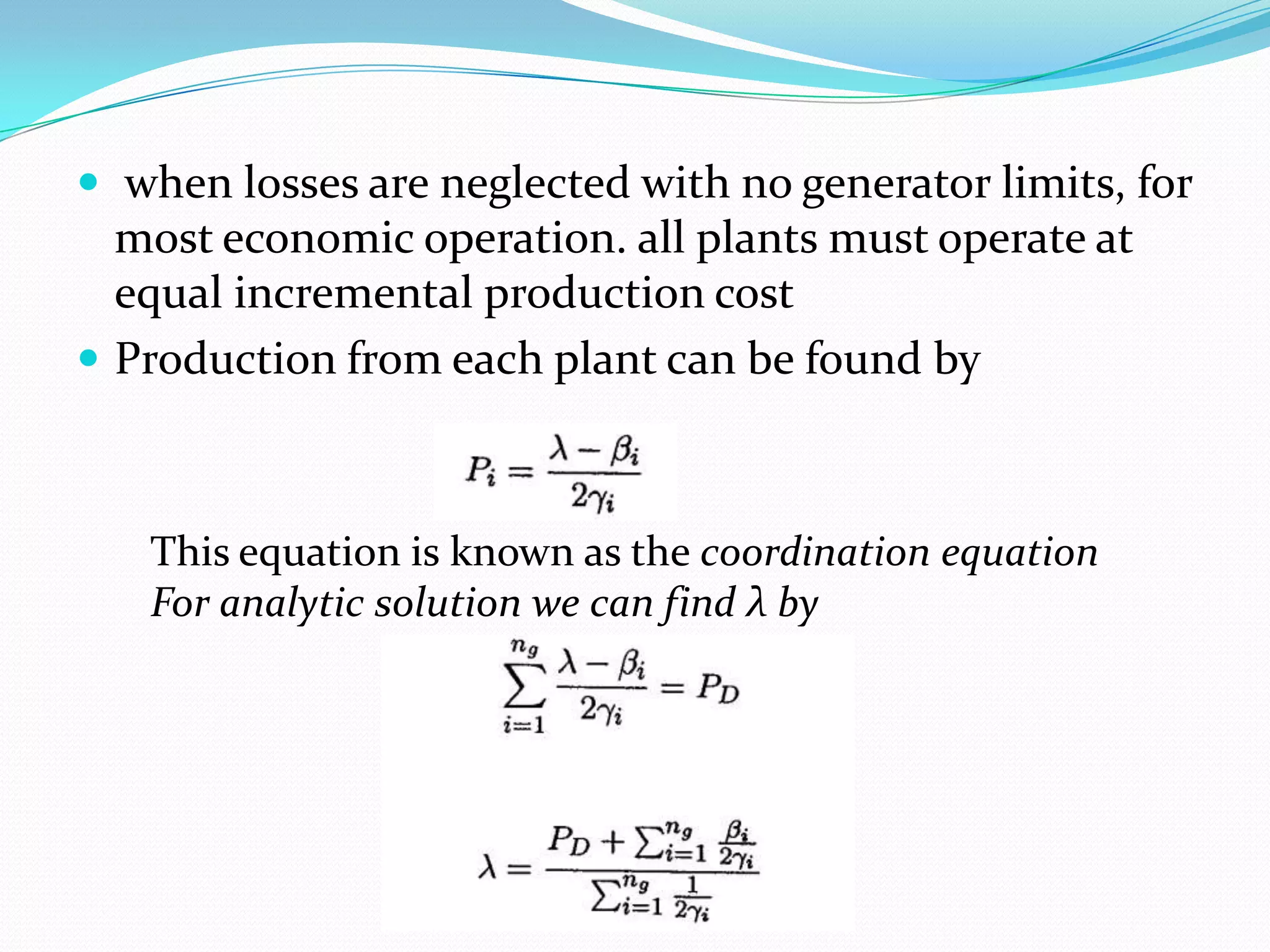
 Production from each plant can be found by
This equation is known as the coordination equation
For analytic solution we can find λ by
REFERENCES
 Power System Analysis - Hadi Saadat
 Power system Analysis - Nagrath and Kothari
 Openelectrical.org/load scheduling
THANKS

Optimal load scheduling

  • 1.
    Submitted by: Submittedto: Mayank Sharma(10EJCEE032) Mr. S.N. Jhanwar VIIIth Sem. H.O.D.(EE Dept.) J.E.C.R.C.,Jaipur
  • 2.
    Introduction:  The electricalload schedule is an estimate of the instantaneous electrical loads operating in a facility, in terms of active, reactive and apparent power (measured in kW, kVAR and kVA respectively).  The load schedule is usually categorised by switchboard or occasionally by sub-facility / area.  A key feature of this divisible load distribution scheduling theory (known as DLT) is that it uses a linear mathematical model.
  • 3.
    Need Of loadScheduling:  Essential for some of the key electrical design activities (such as equipment sizing and power system studies)  It provides the preliminary details of process / building / Organisation Load.  The electrical load schedule can typically be started with a preliminary key single line diagram (or at least an idea of the main voltage levels in the system)
  • 4.
    Procedure to calculatethe load Scheduling:  Step 1: Collect a list of the expected electrical loads in the facility  Step 2: For each load, collect the electrical parameters, e.g. nominal / absorbed ratings, power factor, efficiency, etc  Step 3: Classify each of the loads in terms of switchboard location, load duty and load criticality  Step 4: For each load, calculate the expected consumed load  Step 5: For each switchboard and the overall system, calculate operating, peak and design load
  • 5.
    Step 1: Collectlist of loads  Process loads - are the loads that are directly relevant to the facility. Example-Motors, Heaters, Compressors, Conveyors. • Non-process loads - are the auxiliary loads that are necessary to run the facility. • Example-lighting, utility systems (power and water), DCS/PLC control systems, fire safety systems
  • 6.
    Step 2: Collectelectrical load parameters  Rated power is the full load or nameplate rating of the load and represents the maximum continuous power output of the load. For motor loads, the rated power corresponds to the standard motor size (e.g. 11kW, 37kW, 75kW, etc).  Absorbed power is the expected power that will be drawn by the load.  Power factor of the load is necessary to determine the reactive components of the load schedule. Typically 0.85 for motor loads >7.5kW, 1.0 for heater loads and 0.8 for all other loads).  Efficiency accounts for the losses incurred when converting electrical energy to mechanical energy. Typically 0.85 or 0.9 is used when efficiencies are unknown.
  • 7.
    Step 3: Classifythe loads  Voltage Level :What voltage level and which switchboard should the load be located? Loads <150kW-LV System (400V - 690V) 150KW<Load<10 MW- MV System (3.3kV - 6.6kV) Loads >10MW-HV Distribution System (11kV - 33kV)  Load duty- Continuous loads -are those that normally operate continuously over a 24 hour period.eg. process loads, control systems, lighting and small power distribution boards, UPS systems.
  • 8.
    Step 3(2): Intermittent loads-only operate a fraction of a 24 hour period, e.g. intermittent pumps and process loads, automatic doors and gates. Standby loads -are those that are on standby or rarely operate under normal conditions, e.g. standby loads, emergency systems.  Load criticality- Normal loads-run under normal operating conditions. Essential loads are those necessary under emergency conditions, when the main power supply is disconnected and the system is being supported by an emergency generator, e.g. emergency lighting, key process loads that operate during emergency conditions, fire and safety systems Critical Loads-are those critical for the operation of safety systems and normally supplied through a U.P.S. Battery.eg. Escape lightning .
  • 9.
    Step 4: Calculateconsumed load  The consumed load is the quantity of electrical power that the load is expected to consume. For each load, calculate the consumed active and reactive loading, derived as follows: ;
  • 10.
    Step 5: Calculateoperating, peak and design loads  Operating load -The operating load is the expected load during normal operation. Peak load -The peak load is the expected maximum load during normal operation.
  • 11.
    Step 5(2):  Designload -The design load is the load to be used for the design for equipment sizing, electrical studies. or
  • 12.
    Parts of LoadScheduling: Coordination (Yearly,Monthly Or Weekly) Unit Commitment (Weekly Or Daily) Economic Load Dispatch (Hourly)
  • 13.
    Hydrothermal Coordination problem:  Itis the first stage in the solution of the hydrothermal generation scheduling problem. The HCP consists of determining the optimal amounts of hydro and thermal generation to be used during a scheduling period .The HCP is also decomposed in three Parts. depending on the reservoirs storage capacity. 1.Long Term 2.Mid Term 3.Short Term
  • 14.
    Unit Commitment-  Theelectrical unit commitment problem is the problem of deciding which electricity generating units should be running in each period so as to satisfy predictibly varying demand of electricity.  Load of power system varies through out of the demand reaches a different peak value from one day to another. so which generator to start up and the sequence in which units should be operate and for how long.The computational procedure for making such decision is called unit commitment
  • 15.
    Economic Load Dispatch In power generation our main aim is to generate the required amount of power with minimum cost.  Economic load dispatch means that the generator’s real and reactive power are allowed to vary within certain limits so as to meet a particular load demand with minimum fuel cost  This allocation of loads are based on some constraints.
  • 16.
    DIFFERENT CONSTRAINTS IN ECONOMICLOAD DISPATCH  INEQUALITY CONSTRAINTS  Voltage constraints Vmin ≤ V ≤ Vmax , δmin ≤ δ ≤ δmax  Generator constraints KVA loading of generator should not exceed prescribed value Pmin ≤ P ≤ Pmax Qmin ≤ Q ≤ Qmax
  • 17.
     Running sparecapacity constraints This constraints are needed to meet forced outage of one or more alternators in the system and also unexpected load on the system  Transmission line constraints flow of power through transmission line should less than its thermal capacity  Transformer tap set for autotransformer tap t should between 0 & 1 For two winding transformer – between 0& k
  • 18.
     Equality constraints Real power Pp= Vp Σ Ypq Vq cos(θpq-(δp+δq))  Reactive power Qp= Vp Σ Ypq Vq sin(θpq-(δp+δq))
  • 19.
    OPERATING COST OFTHERMAL PLANT  The factors influencing power generation at minimum cost are operating efficiencies of generators, fuel cost, and transmission losses.  The most efficient generator in the system does not guarantee minimum cost as it may be located in an area where fuel cost is high.  If the plant is located far from the load center, transmission losses may be considerably higher and hence the plant may be overly uneconomical.
  • 20.
     The inputto the thermal plant is generally measured in Btu/h, and the output is measured in MW  In all practical cases, the fuel cost of generator can be represented as a quadratic function of real power generation a) Heat rate curve b) Fuel cost curve
  • 21.
    • By plottingthe derivative of the fuel-cost curve versus the real power we get the incremental fuel-cost curve Incremental fuel-cost curve The incremental fuel-cost curve is a measure of how costly it will be to produce the next increment of power.
  • 22.
    ECONOMIC DISPATCH NEGLECTING LOSSES It is the simplest economic dispatch problem  Assume that the system is only one bus with all generation and loads connected to it  A cost function Ci is assumed to be known for each plant
  • 23.
     The problemis to find the real power generation for each plant such that the objective function (i.e., total production cost) as defined by the equation Is minimum ,subjected to the constraints
  • 26.
     when lossesare neglected with no generator limits, for most economic operation. all plants must operate at equal incremental production cost  Production from each plant can be found by This equation is known as the coordination equation For analytic solution we can find λ by
  • 27.
    REFERENCES  Power SystemAnalysis - Hadi Saadat  Power system Analysis - Nagrath and Kothari  Openelectrical.org/load scheduling
  • 28.