UNIT-IV
UNIT COMMITMENT AND
ECONOMIC DISPATCH
1
Thermal unit constraints
 A thermal unit can with stand only
graded temperature charges and is
required to take some hours to bring
the unit on-line.
 For thermal plants, one hour is the
smallest time period that should be
considered for unit commitment
solution as the start-up and shut-down
time for many units is of this order. 2
 Minimum up time
 Once the unit is running, it should not
be turned off immediately
 Minimum down time:
 Once the unit is decommitted, there is
a minimum time before it can be
recommitted.
 Crew constraints:
 If a plant consist of two or more units,
they cannot both be turned on at the
same time. Since there are not
enough crew members to attend both
units while starting up 3
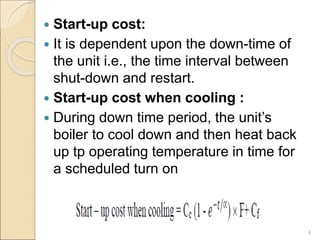
 Start-up cost:
 It is dependent upon the down-time of
the unit i.e., the time interval between
shut-down and restart.
 Start-up cost when cooling :
 During down time period, the unit’s
boiler to cool down and then heat back
up tp operating temperature in time for
a scheduled turn on
4
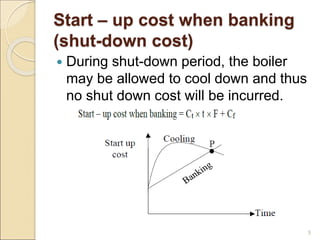
Start – up cost when banking
(shut-down cost)
 During shut-down period, the boiler
may be allowed to cool down and thus
no shut down cost will be incurred.
5
Hydro constraints
 In hydro-thermal scheduling, to
allocate maximum hydro units during
rainy seasons and to allocate thermal
units during remaining periods.
Fuel constraints:
If thermal and hydro sources are
available, a combined operation is
economic and advantageous i.e., to
minimize the fuel cost of thermal unit
over a commitment period.
6
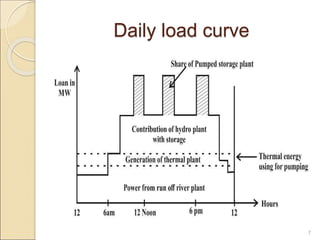
Daily load curve
7
UNIT COMMITMENT
SOLUTION METHODS
 To form loading pattern for M –
Periods using load curve.
 • Commit possible number of units to
be operated to meet out the load.
 • To determine the load dispatch for all
feasible combination of solution for
each load level and satisfying
operating limits of each units.
8
Brute Force Technique or
Simple Priority List scheme
9
Peak – Valley” pattern
10
If the operation of the system is to be optimized, units must be shut down as
the load gets down and then recommitted as it goes back up
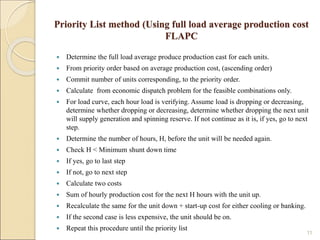
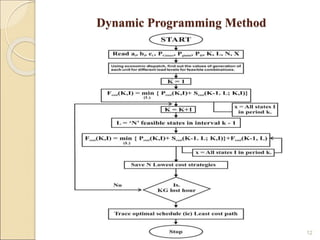
Priority List method (Using full load average production cost
FLAPC
 Determine the full load average produce production cast for each units.
 From priority order based on average production cost, (ascending order)
 Commit number of units corresponding, to the priority order.
 Calculate from economic dispatch problem for the feasible combinations only.
 For load curve, each hour load is verifying. Assume load is dropping or decreasing,
determine whether dropping or decreasing, determine whether dropping the next unit
will supply generation and spinning reserve. If not continue as it is, if yes, go to next
step.
 Determine the number of hours, H, before the unit will be needed again.
 Check H < Minimum shunt down time
 If yes, go to last step
 If not, go to next step
 Calculate two costs
 Sum of hourly production cost for the next H hours with the unit up.
 Recalculate the same for the unit down + start-up cost for either cooling or banking.
 If the second case is less expensive, the unit should be on.
 Repeat this procedure until the priority list
11
Dynamic Programming Method
12
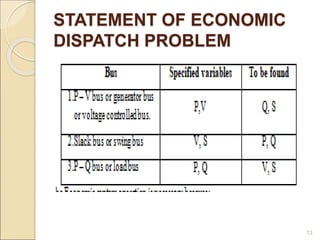
STATEMENT OF ECONOMIC
DISPATCH PROBLEM
13
Necessity of economic
dispatch
 In many cases economic factor and the availability of priority essentials
such as coal, water etc. dictate that new generating plants is located at
greater distances from the load centers.
 The installation of larger blocks of power has resulted in the necessity of
transmitting power out of a given area until the load in that area is equal to
the new block of installed capacity.
 Power systems are inter connecting for purposes of economy interchange
and reduction of reserve capacity.
 In a number of areas of the country, the cost of fuel is rapidly increasing
14
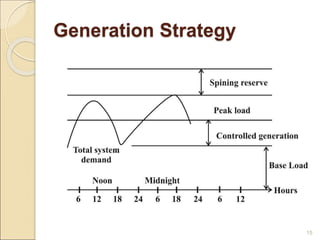
Generation Strategy
15
Daily load curve
 Base load units
 Intermediate units
 Peaking units
 Reserve units
16
Base load units
 Nuclear units full under this category.
It is necessary to maintain the thermal
balance of the nuclear reactor and
steam system. Hence it is desirable to
maintain the megawatt output of such
units at a constants level.
17
Intermediate units
 Hydro powered units are best suited in
cases where the power output has to
be regulated. The output is controlled
by changing the water flow through
the turbine. In the absence of hydro
power thermal units has to be used
18
Peaking units
 In case of sudden increase in the load
the best choice is the gas – tubing
driving generators pumped hydro
storage and compressed gas are the
special type of peaking equipment
which can be used for this purpose
19
Reserve units:
Generators which are maintained at partial output and generators which are
ready for operation comes under this category
Problems involved:
 Hourly shifting of the power demand
 Generating unit must be regularly
maintained and, in case of nuclear units, it
must be refueled.
 Ability of the system to match the
generation to the load not only over the 24
hours daily time span but over seasons
and years
20
Economic Dispatch
 The purpose of economic dispatch or
optimal dispatch is to reduce fuel cost
for the power system. By economic
load scheduling, we mean to find the
generation of the different generations
of plants, so that the total fuel cost is
minimum and at the same time the
total demand and losses at any instant
must be met by the total generation
21
Methods
 Base load method: where the most
efficient unit is loaded to its maximum
capability, then the second most
efficient unit is loaded etc.
 Best point loading: (Incremental
method) where units are successively
loaded to their lowest heat rate point
beginning with the most efficient unit
and working down to the least efficient
unit.
22
23
OPTIMAL OPERATION OF
GENERATORS ON A BUSBAR
 Generator Operating Cost :
 The total generator operating cost
includes fuel cost, cost of transmission
loss, labour and maintenance cost.
For simplicity, fuel, cost is considered
to be variable
24
Cost of generation depends on
operating constraints or system
constraints
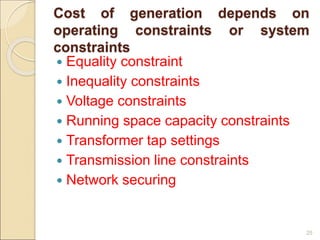
 Equality constraint
 Inequality constraints
 Voltage constraints
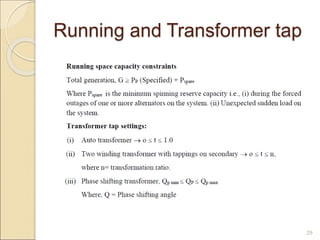
 Running space capacity constraints
 Transformer tap settings
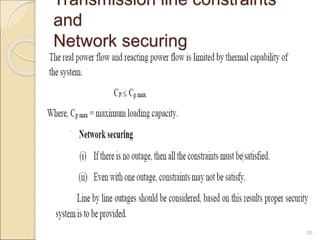
 Transmission line constraints
 Network securing
25
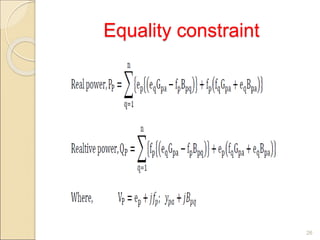
Equality constraint
26
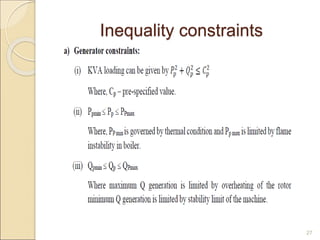
Inequality constraints
27
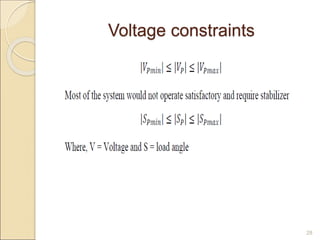
Voltage constraints
28
Running and Transformer tap
29
Transmission line constraints
and
Network securing
30
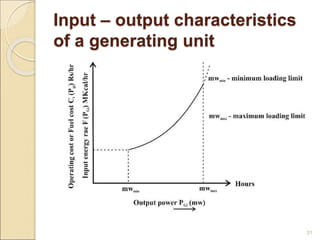
Input – output characteristics
of a generating unit
31
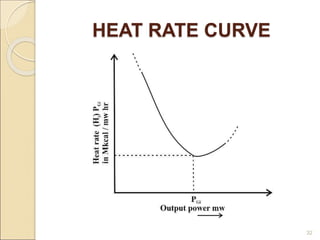
HEAT RATE CURVE
32
33
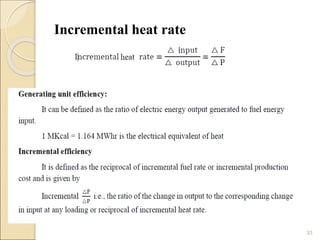
Incremental heat rate
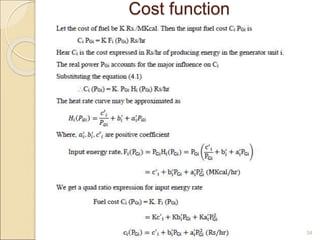
Cost function
34
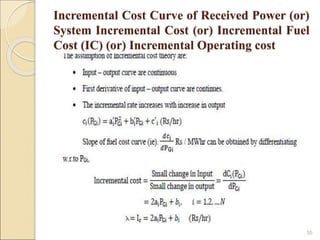
Incremental Cost Curve of Received Power (or)
System Incremental Cost (or) Incremental Fuel
Cost (IC) (or) Incremental Operating cost
35
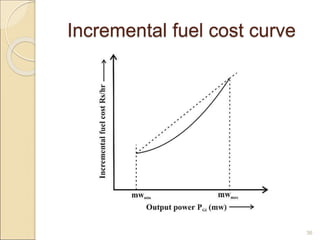
Incremental fuel cost curve
36
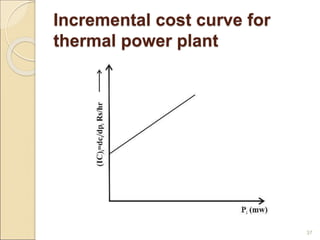
Incremental cost curve for
thermal power plant
37
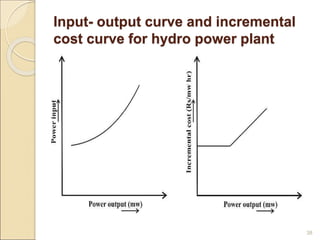
Input- output curve and incremental
cost curve for hydro power plant
38
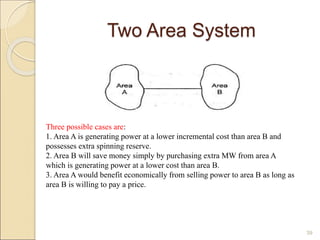
Two Area System
39
Three possible cases are:
1. Area A is generating power at a lower incremental cost than area B and
possesses extra spinning reserve.
2. Area B will save money simply by purchasing extra MW from area A
which is generating power at a lower cost than area B.
3. Area A would benefit economically from selling power to area B as long as
area B is willing to pay a price.
Economic Dispatch:
Formulation
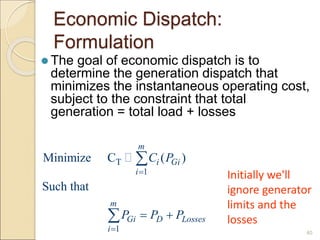
 The goal of economic dispatch is to
determine the generation dispatch that
minimizes the instantaneous operating cost,
subject to the constraint that total
generation = total load + losses
40
T
1
1
Minimize C ( )
Such that
m
i Gi
i
m
Gi D Losses
i
C P
P P P


 


Initially we'll
ignore generator
limits and the
losses
Unconstrained Minimization
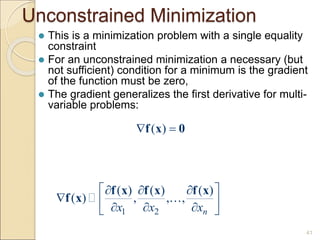
 This is a minimization problem with a single equality
constraint
 For an unconstrained minimization a necessary (but
not sufficient) condition for a minimum is the gradient
of the function must be zero,
 The gradient generalizes the first derivative for multi-
variable problems:
41
1 2
( ) ( ) ( )
( ) , , ,
n
x x x
 
  
  
  
 
f x f x f x
f x
( )
 
f x 0
Minimization with Equality
Constraint
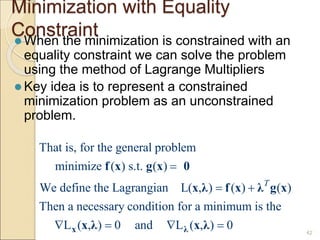
 When the minimization is constrained with an
equality constraint we can solve the problem
using the method of Lagrange Multipliers
 Key idea is to represent a constrained
minimization problem as an unconstrained
problem.
42
That is, for the general problem
minimize ( ) s.t. ( )
We define the Lagrangian L( , ) ( ) ( )
Then a necessary condition for a minimum is the
L ( , ) 0 and L ( , ) 0
T

 
   
x λ
f x g x 0
x λ f x λ g x
x λ x λ
Economic Dispatch
Lagrangian
43
G
1 1
G
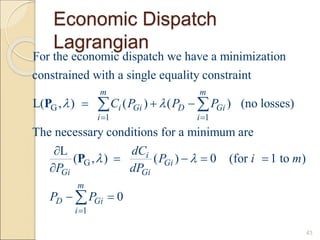
For the economic dispatch we have a minimization
constrained with a single equality constraint
L( , ) ( ) ( ) (no losses)
The necessary conditions for a minimum are
L
( , )
m m
i Gi D Gi
i i
Gi
C P P P
dC
P
 

 
  



 
P
P
1
( ) 0 (for 1 to )
0
i
Gi
Gi
m
D Gi
i
P i m
dP
P P


  
 

Economic Dispatch Example
44
1 2
2
1 1 1 1
2
2 2 2 2
1
1
1
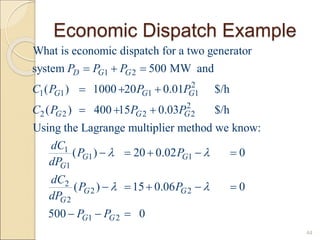
What is economic dispatch for a two generator
system 500 MW and
( ) 1000 20 0.01 $/h
( ) 400 15 0.03 $/h
Using the Lagrange multiplier method we know:
( ) 20 0.0
D G G
G G G
G G G
G
G
P P P
C P P P
C P P P
dC
P
dP

  
  
  
   1
2
2 2
2
1 2
2 0
( ) 15 0.06 0
500 0
G
G G
G
G G
P
dC
P P
dP
P P

 
 
    
  
Economic Dispatch Example,
cont’d
45
1
2
1 2
1
2
1
2
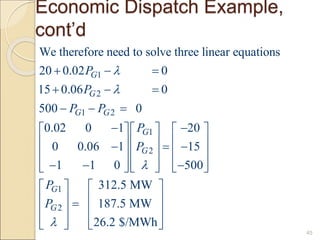
We therefore need to solve three linear equations
20 0.02 0
15 0.06 0
500 0
0.02 0 1 20
0 0.06 1 15
1 1 0 500
312.5 MW
187.5 MW
26.2 $/MW
G
G
G G
G
G
G
G
P
P
P P
P
P
P
P




  
  
  
 
    
    
  
    
  
    
    
 
  
 
 
  h
 
 
 
 
 
Inequality constraints
46
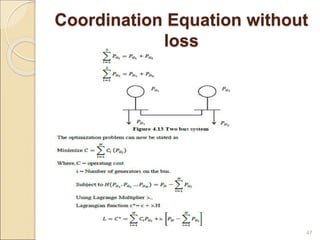
Coordination Equation without
loss
47
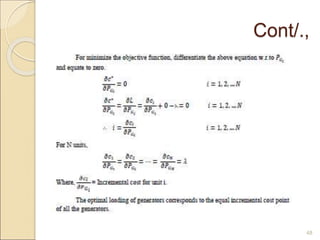
Cont/.,
48
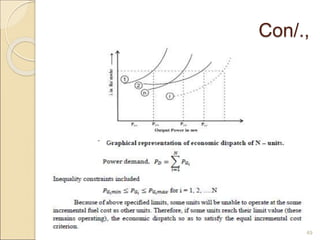
Con/.,
49
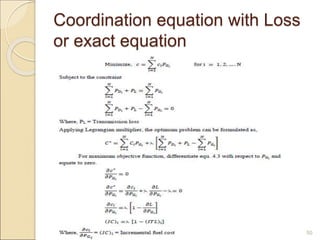
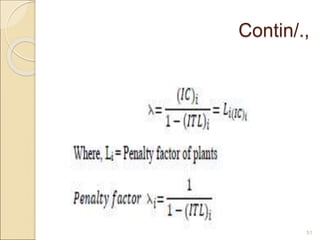
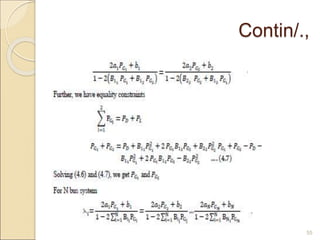
Coordination equation with Loss
or exact equation
50
Contin/.,
51
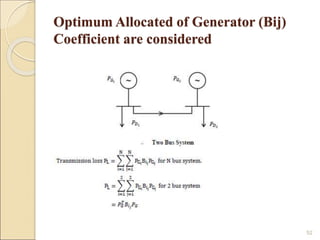
Optimum Allocated of Generator (Bij)
Coefficient are considered
52
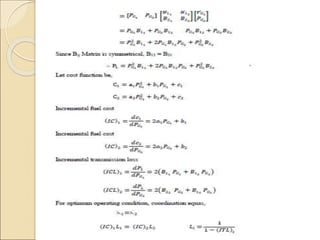
Contin/.,
53
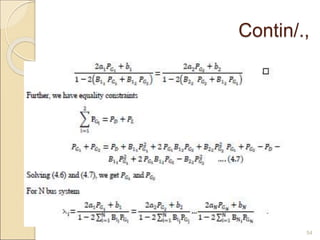
Contin/.,
54
Contin/.,
55
56
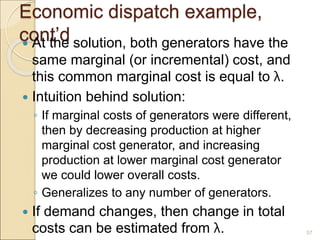
Economic dispatch example,
cont’d
 At the solution, both generators have the
same marginal (or incremental) cost, and
this common marginal cost is equal to λ.
 Intuition behind solution:
◦ If marginal costs of generators were different,
then by decreasing production at higher
marginal cost generator, and increasing
production at lower marginal cost generator
we could lower overall costs.
◦ Generalizes to any number of generators.
 If demand changes, then change in total
costs can be estimated from λ. 57
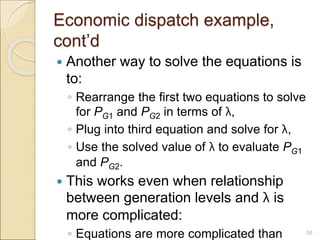
Economic dispatch example,
cont’d
 Another way to solve the equations is
to:
◦ Rearrange the first two equations to solve
for PG1 and PG2 in terms of λ,
◦ Plug into third equation and solve for λ,
◦ Use the solved value of λ to evaluate PG1
and PG2.
 This works even when relationship
between generation levels and λ is
more complicated:
◦ Equations are more complicated than 58
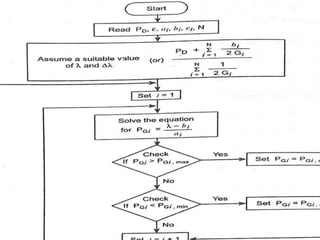
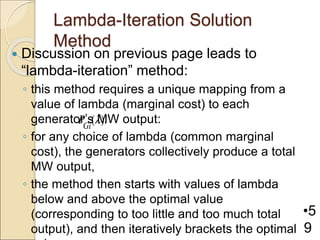
Lambda-Iteration Solution
Method
 Discussion on previous page leads to
“lambda-iteration” method:
◦ this method requires a unique mapping from a
value of lambda (marginal cost) to each
generator’s MW output:
◦ for any choice of lambda (common marginal
cost), the generators collectively produce a total
MW output,
◦ the method then starts with values of lambda
below and above the optimal value
(corresponding to too little and too much total
output), and then iteratively brackets the optimal
•5
9
( ).
Gi
P 
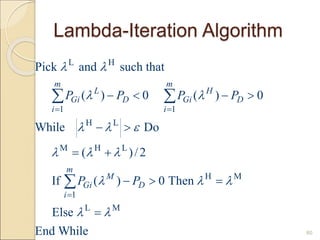
Lambda-Iteration Algorithm
60
L H
1 1
H L
M H L
H M
1
L M
Pick and such that
( ) 0 ( ) 0
While Do
( )/2
If ( ) 0 Then
Else
End While
m m
L H
Gi D Gi D
i i
m
M
Gi D
i
P P P P
P P
 
 
  
  
  
 
 

   
 
 
  

 

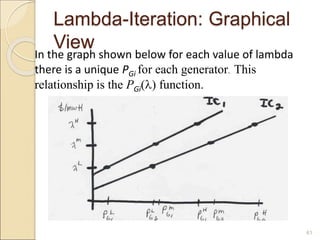
Lambda-Iteration: Graphical
View
61
In the graph shown below for each value of lambda
there is a unique PGi for each generator. This
relationship is the PGi() function.
Lambda-Iteration Example
62
1 1 1
2 2 2
3 3 3
1 2 3
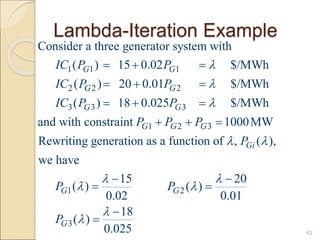
Consider a three generator system with
( ) 15 0.02 $/MWh
( ) 20 0.01 $/MWh
( ) 18 0.025 $/MWh
and with constraint 1000MW
Rewriting generation as a function of , (
G G
G G
G G
G G G
Gi
IC P P
IC P P
IC P P
P P P
P




  
  
  
  
1 2
3
),
we have
15 20
( ) ( )
0.02 0.01
18
( )
0.025
G G
G
P P
P

 
 


 
 


Lambda-Iteration Example,
cont’d
63
m
i=1
m
i=1
1
H
1
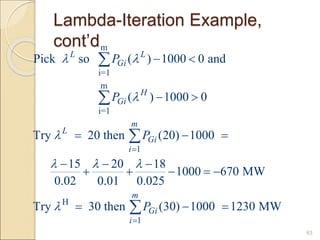
Pick so ( ) 1000 0 and
( ) 1000 0
Try 20 then (20) 1000
15 20 18
1000 670 MW
0.02 0.01 0.025
Try 30 then (30) 1000 1230 MW
L L
Gi
H
Gi
m
L
Gi
i
m
Gi
i
P
P
P
P
 


  



 
 
  
  
    
  




Lambda-Iteration Example,
cont’d
64
1
1
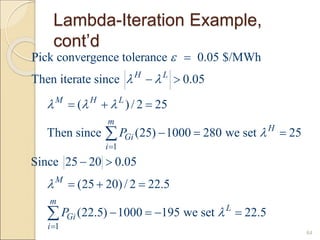
Pick convergence tolerance 0.05 $/MWh
Then iterate since 0.05
( )/ 2 25
Then since (25) 1000 280 we set 25
Since 25 20 0.05
(25 20)/ 2 22.5
(22.5) 1000 195 we set 2
H L
M H L
m
H
Gi
i
M
m
L
Gi
i
P
P

 
  






 
  
  
 
  
   

 2.5
Lambda-Iteration Example,
cont’d
65
H
*
*
1
2
3
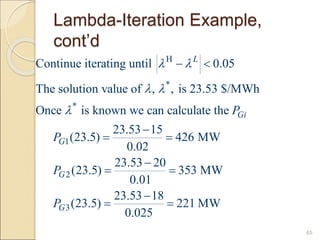
Continue iterating until 0.05
The solution value of , , is 23.53 $/MWh
Once is known we can calculate the
23.53 15
(23.5) 426 MW
0.02
23.53 20
(23.5) 353 MW
0.01
23.53 18
(23.5)
0.025
L
Gi
G
G
G
P
P
P
P
 
 

 

 

 

 221 MW

Thirty Bus ED Example
66
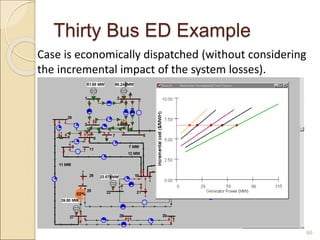
Case is economically dispatched (without considering
the incremental impact of the system losses).
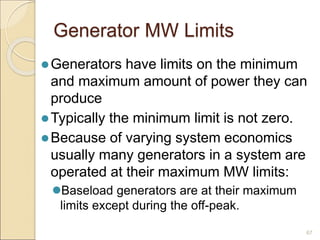
Generator MW Limits
Generators have limits on the minimum
and maximum amount of power they can
produce
Typically the minimum limit is not zero.
Because of varying system economics
usually many generators in a system are
operated at their maximum MW limits:
Baseload generators are at their maximum
limits except during the off-peak.
67
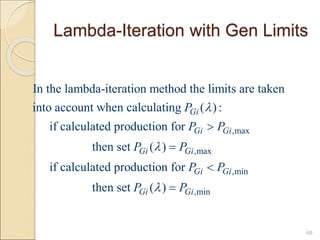
Lambda-Iteration with Gen Limits
68
,max
,max
In the lambda-iteration method the limits are taken
into account when calculating ( ) :
if calculated production for
then set ( )
if calculated production for
Gi
Gi Gi
Gi Gi
P
P P
P P




,min
,min
then set ( )
Gi Gi
Gi Gi
P P
P P



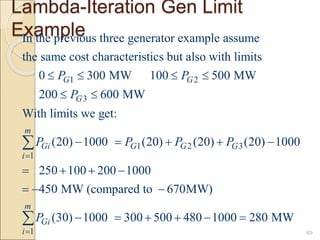
Lambda-Iteration Gen Limit
Example
69
1 2
3
1 2 3
1
In the previous three generator example assume
the same cost characteristics but also with limits
0 300 MW 100 500 MW
200 600 MW
With limits we get:
(20) 1000 (20) (20) (20) 10
G G
G
m
Gi G G G
i
P P
P
P P P P

   
 
    

1
00
250 100 200 1000
450 MW (compared to 670MW)
(30) 1000 300 500 480 1000 280 MW
m
Gi
i
P

   
  
     

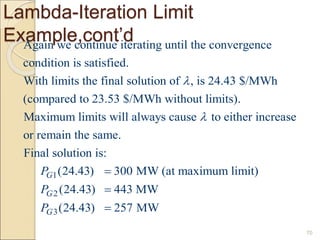
Lambda-Iteration Limit
Example,cont’d
70
Again we continue iterating until the convergence
condition is satisfied.
With limits the final solution of , is 24.43 $/MWh
(compared to 23.53 $/MWh without limits).
Maximum limits will always caus

1
2
3
e to either increase
or remain the same.
Final solution is:
(24.43) 300 MW (at maximum limit)
(24.43) 443 MW
(24.43) 257 MW
G
G
G
P
P
P




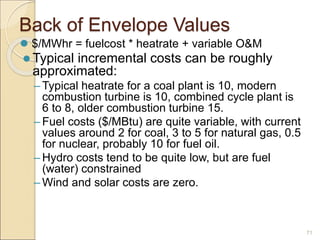
Back of Envelope Values
 $/MWhr = fuelcost * heatrate + variable O&M
 Typical incremental costs can be roughly
approximated:
– Typical heatrate for a coal plant is 10, modern
combustion turbine is 10, combined cycle plant is
6 to 8, older combustion turbine 15.
– Fuel costs ($/MBtu) are quite variable, with current
values around 2 for coal, 3 to 5 for natural gas, 0.5
for nuclear, probably 10 for fuel oil.
– Hydro costs tend to be quite low, but are fuel
(water) constrained
– Wind and solar costs are zero.
71
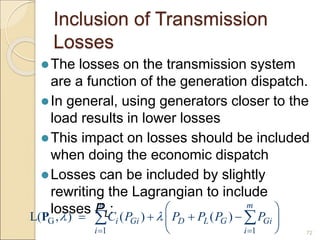
Inclusion of Transmission
Losses
The losses on the transmission system
are a function of the generation dispatch.
In general, using generators closer to the
load results in lower losses
This impact on losses should be included
when doing the economic dispatch
Losses can be included by slightly
rewriting the Lagrangian to include
losses PL:
72
G
1 1
L( , ) ( ) ( )
m m
i Gi D L G Gi
i i
C P P P P P
 
 
 
   
 
 
 
P
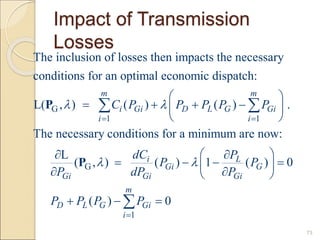
Impact of Transmission
Losses
73
G
1 1
G
The inclusion of losses then impacts the necessary
conditions for an optimal economic dispatch:
L( , ) ( ) ( ) .
The necessary conditions for a minimum are now:
L
(
m m
i Gi D L G Gi
i i
Gi
C P P P P P
P
 
 
 
   
 
 


 
P
P
1
, ) ( ) 1 ( ) 0
( ) 0
i L
Gi G
Gi Gi
m
D L G Gi
i
dC P
P P
dP P
P P P P
 

 

   
 

 
  

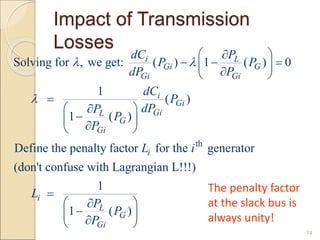
Impact of Transmission
Losses
74
th
Solving for , we get: ( ) 1 ( ) 0
1
( )
1 ( )
Define the penalty factor for the generator
(don't confuse with Lagrangian L!!!)
1
1 ( )
i L
Gi G
Gi Gi
i
Gi
Gi
L
G
Gi
i
i
L
G
Gi
dC P
P P
dP P
dC
P
dP
P
P
P
L i
L
P
P
P
 

 

  
 

 

 


 

 

 

 




The penalty factor
at the slack bus is
always unity!
Impact of Transmission
Losses
75
1 1 1 2 2 2
The condition for optimal dispatch with losses is then
( ) ( ) ( )
1
. So, if increasing increases
1 ( )
the losses then ( ) 0 1.0
This makes generator
G G m m Gm
i Gi
L
G
Gi
L
G i
Gi
L IC P L IC P L IC P
L P
P
P
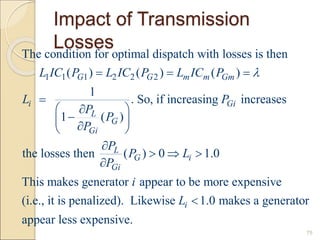
P
P
P L
P

  

 


 

 

  

appear to be more expensive
(i.e., it is penalized). Likewise 1.0 makes a generator
appear less expensive.
i
i
L 
Calculation of Penalty Factors
76
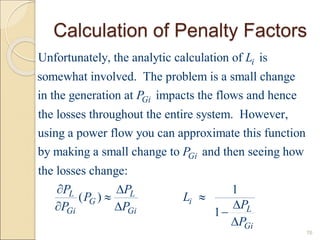
Unfortunately, the analytic calculation of is
somewhat involved. The problem is a small change
in the generation at impacts the flows and hence
the losses throughout the entire system. However,
i
Gi
L
P
using a power flow you can approximate this function
by making a small change to and then seeing how
the losses change:
1
( )
1
Gi
L L
G i
L
Gi Gi
Gi
P
P P
P L
P
P P
P
 
 

  

Two Bus Penalty Factor
Example
77
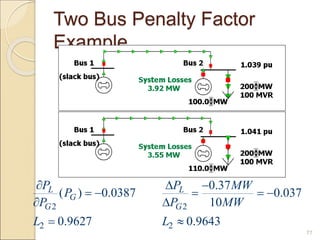
2 2
2 2
0.37
( ) 0.0387 0.037
10
0.9627 0.9643
L L
G
G G
P P MW
P
P P MW
L L
  
    
 
 
Thirty Bus ED Example
78
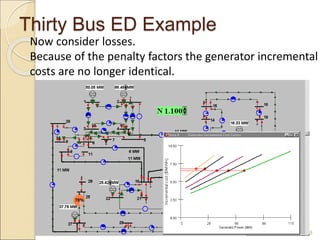
Now consider losses.
Because of the penalty factors the generator incremental
costs are no longer identical.
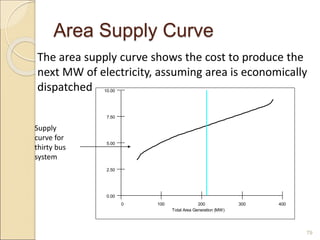
Area Supply Curve
79
0 100 200 300 400
Total Area Generation (MW)
0.00
2.50
5.00
7.50
10.00
The area supply curve shows the cost to produce the
next MW of electricity, assuming area is economically
dispatched
Supply
curve for
thirty bus
system
Economic Dispatch -
Summary
 Economic dispatch determines the best way
to minimize the current generator operating
costs.
 The lambda-iteration method is a good
approach for solving the economic dispatch
problem:
– generator limits are easily handled,
– penalty factors are used to consider the impact of
losses.
 Economic dispatch is not concerned with
determining which units to turn on/off (this is
the unit commitment problem).
 Basic form of economic dispatch ignores the
80
Security Constrained ED
or Optimal Power Flow
Transmission constraints often limit ability to
use lower cost power.
Such limits require deviations from what
would otherwise be minimum cost dispatch
in order to maintain system “security.”
Need to solve or approximate power flow in
order to consider transmission constraints.
81
Security Constrained ED
or Optimal Power Flow
The goal of a security constrained ED or
optimal power flow (OPF) is to determine
the “best” way to instantaneously operate
a power system, considering transmission
limits.
Usually “best” = minimizing operating cost,
while keeping flows on transmission below
limits.
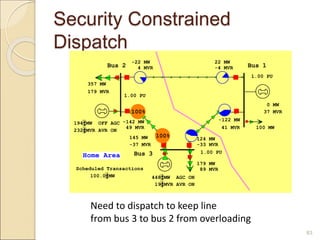
In three bus case the generation at bus 3
must be limited to avoid overloading the
82
Security Constrained
Dispatch
Bus 2 Bus 1
Bus 3
Home Area
Scheduled Transactions
357 MW
179 MVR
194 MW
448 MW
19 MVR
232 MVR
179 MW
89 MVR
1.00 PU
-22 MW
4 MVR
22 MW
-4 MVR
-142 MW
49 MVR
145 MW
-37 MVR
124 MW
-33 MVR
-122 MW
41 MVR
1.00 PU
1.00 PU
0 MW
37 MVR
100%
100%
100 MW
OFF AGC
AVR ON
AGC ON
AVR ON
100.0 MW
83
Need to dispatch to keep line
from bus 3 to bus 2 from overloading
Multi-Area Operation
 In multi-area system, “rules” have been established
regarding transactions on tie-lines:
– In Eastern interconnection, in principle, up to “nominal”
thermal interconnection capacity,
– In Western interconnection there are more complicated
rules
 The actual power that flows through the entire
network depends on the impedance of the
transmission lines, and ultimately determine what
are acceptable patterns of dispatch:
Can result in need to “curtail” transactions that
otherwise satisfy rules.
 Economically uncompensated flow through other
areas is known as “parallel path” or “loop flows.”
 Since ERCOT is one area, all of the flows on AC
lines are inside ERCOT and there is no
uncompensated flow on AC lines.
84
Seven Bus Case: One-line
Top Area Cost
Left Area Cost Right Area Cost
1
2
3 4
5
6 7
106 MW
168 MW
200 MW 201 MW
110 MW
40 MVR
80 MW
30 MVR
130 MW
40 MVR
40 MW
20 MVR
1.00 PU
1.01 PU
1.04 PU
1.04 PU
1.04 PU
0.99 PU
1.05 PU
62 MW
-61 MW
44 MW -42 MW -31 MW 31 MW
38 MW
-37 MW
79 MW -77 MW
-32 MW
32 MW
-14 MW
-39 MW
40 MW
-20 MW
20 MW
40 MW
-40 MW
94 MW
200 MW
0 MVR
200 MW
0 MVR
20 MW -20 MW
AGC ON
AGC ON
AGC ON
AGC ON
AGC ON
8029 $/MWH
4715 $/MWH
4189 $/MWH
Case Hourly Cost
16933 $/MWH
85
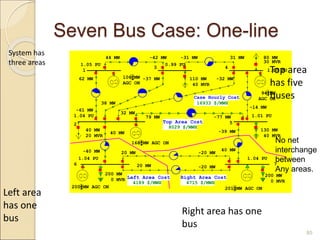
System has
three areas
Left area
has one
bus
Right area has one
bus
Top area
has five
buses
No net
interchange
between
Any areas.
Seven Bus Case: Area View
Area Losses
Area Losses Area Losses
Top
Left Right
-40.1 MW
0.0 MW
0.0 MW
0.0 MW
40.1 MW
40.1 MW
7.09 MW
0.33 MW 0.65 MW
86
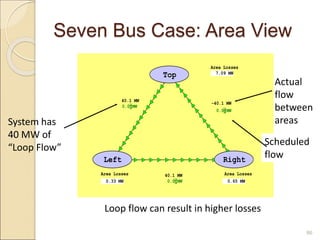
System has
40 MW of
“Loop Flow”
Actual
flow
between
areas
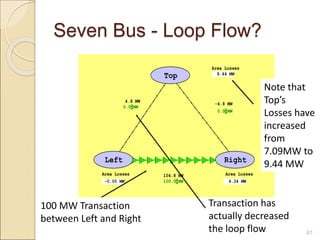
Loop flow can result in higher losses
Scheduled
flow
Seven Bus - Loop Flow?
Area Losses
Area Losses Area Losses
Top
Left Right
-4.8 MW
0.0 MW
100.0 MW
0.0 MW
104.8 MW
4.8 MW
9.44 MW
-0.00 MW 4.34 MW
87
100 MW Transaction
between Left and Right
Transaction has
actually decreased
the loop flow
Note that
Top’s
Losses have
increased
from
7.09MW to
9.44 MW

UNIT-4-PPT.ppt

  • 1.
  • 2.
    Thermal unit constraints A thermal unit can with stand only graded temperature charges and is required to take some hours to bring the unit on-line.  For thermal plants, one hour is the smallest time period that should be considered for unit commitment solution as the start-up and shut-down time for many units is of this order. 2
  • 3.
     Minimum uptime  Once the unit is running, it should not be turned off immediately  Minimum down time:  Once the unit is decommitted, there is a minimum time before it can be recommitted.  Crew constraints:  If a plant consist of two or more units, they cannot both be turned on at the same time. Since there are not enough crew members to attend both units while starting up 3
  • 4.
     Start-up cost: It is dependent upon the down-time of the unit i.e., the time interval between shut-down and restart.  Start-up cost when cooling :  During down time period, the unit’s boiler to cool down and then heat back up tp operating temperature in time for a scheduled turn on 4
  • 5.
    Start – upcost when banking (shut-down cost)  During shut-down period, the boiler may be allowed to cool down and thus no shut down cost will be incurred. 5
  • 6.
    Hydro constraints  Inhydro-thermal scheduling, to allocate maximum hydro units during rainy seasons and to allocate thermal units during remaining periods. Fuel constraints: If thermal and hydro sources are available, a combined operation is economic and advantageous i.e., to minimize the fuel cost of thermal unit over a commitment period. 6
  • 7.
  • 8.
    UNIT COMMITMENT SOLUTION METHODS To form loading pattern for M – Periods using load curve.  • Commit possible number of units to be operated to meet out the load.  • To determine the load dispatch for all feasible combination of solution for each load level and satisfying operating limits of each units. 8
  • 9.
    Brute Force Techniqueor Simple Priority List scheme 9
  • 10.
    Peak – Valley”pattern 10 If the operation of the system is to be optimized, units must be shut down as the load gets down and then recommitted as it goes back up
  • 11.
    Priority List method(Using full load average production cost FLAPC  Determine the full load average produce production cast for each units.  From priority order based on average production cost, (ascending order)  Commit number of units corresponding, to the priority order.  Calculate from economic dispatch problem for the feasible combinations only.  For load curve, each hour load is verifying. Assume load is dropping or decreasing, determine whether dropping or decreasing, determine whether dropping the next unit will supply generation and spinning reserve. If not continue as it is, if yes, go to next step.  Determine the number of hours, H, before the unit will be needed again.  Check H < Minimum shunt down time  If yes, go to last step  If not, go to next step  Calculate two costs  Sum of hourly production cost for the next H hours with the unit up.  Recalculate the same for the unit down + start-up cost for either cooling or banking.  If the second case is less expensive, the unit should be on.  Repeat this procedure until the priority list 11
  • 12.
  • 13.
  • 14.
    Necessity of economic dispatch In many cases economic factor and the availability of priority essentials such as coal, water etc. dictate that new generating plants is located at greater distances from the load centers.  The installation of larger blocks of power has resulted in the necessity of transmitting power out of a given area until the load in that area is equal to the new block of installed capacity.  Power systems are inter connecting for purposes of economy interchange and reduction of reserve capacity.  In a number of areas of the country, the cost of fuel is rapidly increasing 14
  • 15.
  • 16.
    Daily load curve Base load units  Intermediate units  Peaking units  Reserve units 16
  • 17.
    Base load units Nuclear units full under this category. It is necessary to maintain the thermal balance of the nuclear reactor and steam system. Hence it is desirable to maintain the megawatt output of such units at a constants level. 17
  • 18.
    Intermediate units  Hydropowered units are best suited in cases where the power output has to be regulated. The output is controlled by changing the water flow through the turbine. In the absence of hydro power thermal units has to be used 18
  • 19.
    Peaking units  Incase of sudden increase in the load the best choice is the gas – tubing driving generators pumped hydro storage and compressed gas are the special type of peaking equipment which can be used for this purpose 19
  • 20.
    Reserve units: Generators whichare maintained at partial output and generators which are ready for operation comes under this category Problems involved:  Hourly shifting of the power demand  Generating unit must be regularly maintained and, in case of nuclear units, it must be refueled.  Ability of the system to match the generation to the load not only over the 24 hours daily time span but over seasons and years 20
  • 21.
    Economic Dispatch  Thepurpose of economic dispatch or optimal dispatch is to reduce fuel cost for the power system. By economic load scheduling, we mean to find the generation of the different generations of plants, so that the total fuel cost is minimum and at the same time the total demand and losses at any instant must be met by the total generation 21
  • 22.
    Methods  Base loadmethod: where the most efficient unit is loaded to its maximum capability, then the second most efficient unit is loaded etc.  Best point loading: (Incremental method) where units are successively loaded to their lowest heat rate point beginning with the most efficient unit and working down to the least efficient unit. 22
  • 23.
  • 24.
    OPTIMAL OPERATION OF GENERATORSON A BUSBAR  Generator Operating Cost :  The total generator operating cost includes fuel cost, cost of transmission loss, labour and maintenance cost. For simplicity, fuel, cost is considered to be variable 24
  • 25.
    Cost of generationdepends on operating constraints or system constraints  Equality constraint  Inequality constraints  Voltage constraints  Running space capacity constraints  Transformer tap settings  Transmission line constraints  Network securing 25
  • 26.
  • 27.
  • 28.
  • 29.
  • 30.
  • 31.
    Input – outputcharacteristics of a generating unit 31
  • 32.
  • 33.
  • 34.
  • 35.
    Incremental Cost Curveof Received Power (or) System Incremental Cost (or) Incremental Fuel Cost (IC) (or) Incremental Operating cost 35
  • 36.
  • 37.
    Incremental cost curvefor thermal power plant 37
  • 38.
    Input- output curveand incremental cost curve for hydro power plant 38
  • 39.
    Two Area System 39 Threepossible cases are: 1. Area A is generating power at a lower incremental cost than area B and possesses extra spinning reserve. 2. Area B will save money simply by purchasing extra MW from area A which is generating power at a lower cost than area B. 3. Area A would benefit economically from selling power to area B as long as area B is willing to pay a price.
  • 40.
    Economic Dispatch: Formulation  Thegoal of economic dispatch is to determine the generation dispatch that minimizes the instantaneous operating cost, subject to the constraint that total generation = total load + losses 40 T 1 1 Minimize C ( ) Such that m i Gi i m Gi D Losses i C P P P P       Initially we'll ignore generator limits and the losses
  • 41.
    Unconstrained Minimization  Thisis a minimization problem with a single equality constraint  For an unconstrained minimization a necessary (but not sufficient) condition for a minimum is the gradient of the function must be zero,  The gradient generalizes the first derivative for multi- variable problems: 41 1 2 ( ) ( ) ( ) ( ) , , , n x x x              f x f x f x f x ( )   f x 0
  • 42.
    Minimization with Equality Constraint When the minimization is constrained with an equality constraint we can solve the problem using the method of Lagrange Multipliers  Key idea is to represent a constrained minimization problem as an unconstrained problem. 42 That is, for the general problem minimize ( ) s.t. ( ) We define the Lagrangian L( , ) ( ) ( ) Then a necessary condition for a minimum is the L ( , ) 0 and L ( , ) 0 T        x λ f x g x 0 x λ f x λ g x x λ x λ
  • 43.
    Economic Dispatch Lagrangian 43 G 1 1 G Forthe economic dispatch we have a minimization constrained with a single equality constraint L( , ) ( ) ( ) (no losses) The necessary conditions for a minimum are L ( , ) m m i Gi D Gi i i Gi C P P P dC P              P P 1 ( ) 0 (for 1 to ) 0 i Gi Gi m D Gi i P i m dP P P        
  • 44.
    Economic Dispatch Example 44 12 2 1 1 1 1 2 2 2 2 2 1 1 1 What is economic dispatch for a two generator system 500 MW and ( ) 1000 20 0.01 $/h ( ) 400 15 0.03 $/h Using the Lagrange multiplier method we know: ( ) 20 0.0 D G G G G G G G G G G P P P C P P P C P P P dC P dP              1 2 2 2 2 1 2 2 0 ( ) 15 0.06 0 500 0 G G G G G G P dC P P dP P P             
  • 45.
    Economic Dispatch Example, cont’d 45 1 2 12 1 2 1 2 We therefore need to solve three linear equations 20 0.02 0 15 0.06 0 500 0 0.02 0 1 20 0 0.06 1 15 1 1 0 500 312.5 MW 187.5 MW 26.2 $/MW G G G G G G G G P P P P P P P P                                                          h          
  • 46.
  • 47.
  • 48.
  • 49.
  • 50.
    Coordination equation withLoss or exact equation 50
  • 51.
  • 52.
    Optimum Allocated ofGenerator (Bij) Coefficient are considered 52
  • 53.
  • 54.
  • 55.
  • 56.
  • 57.
    Economic dispatch example, cont’d At the solution, both generators have the same marginal (or incremental) cost, and this common marginal cost is equal to λ.  Intuition behind solution: ◦ If marginal costs of generators were different, then by decreasing production at higher marginal cost generator, and increasing production at lower marginal cost generator we could lower overall costs. ◦ Generalizes to any number of generators.  If demand changes, then change in total costs can be estimated from λ. 57
  • 58.
    Economic dispatch example, cont’d Another way to solve the equations is to: ◦ Rearrange the first two equations to solve for PG1 and PG2 in terms of λ, ◦ Plug into third equation and solve for λ, ◦ Use the solved value of λ to evaluate PG1 and PG2.  This works even when relationship between generation levels and λ is more complicated: ◦ Equations are more complicated than 58
  • 59.
    Lambda-Iteration Solution Method  Discussionon previous page leads to “lambda-iteration” method: ◦ this method requires a unique mapping from a value of lambda (marginal cost) to each generator’s MW output: ◦ for any choice of lambda (common marginal cost), the generators collectively produce a total MW output, ◦ the method then starts with values of lambda below and above the optimal value (corresponding to too little and too much total output), and then iteratively brackets the optimal •5 9 ( ). Gi P 
  • 60.
    Lambda-Iteration Algorithm 60 L H 11 H L M H L H M 1 L M Pick and such that ( ) 0 ( ) 0 While Do ( )/2 If ( ) 0 Then Else End While m m L H Gi D Gi D i i m M Gi D i P P P P P P                                 
  • 61.
    Lambda-Iteration: Graphical View 61 In thegraph shown below for each value of lambda there is a unique PGi for each generator. This relationship is the PGi() function.
  • 62.
    Lambda-Iteration Example 62 1 11 2 2 2 3 3 3 1 2 3 Consider a three generator system with ( ) 15 0.02 $/MWh ( ) 20 0.01 $/MWh ( ) 18 0.025 $/MWh and with constraint 1000MW Rewriting generation as a function of , ( G G G G G G G G G Gi IC P P IC P P IC P P P P P P                 1 2 3 ), we have 15 20 ( ) ( ) 0.02 0.01 18 ( ) 0.025 G G G P P P             
  • 63.
    Lambda-Iteration Example, cont’d 63 m i=1 m i=1 1 H 1 Pick so( ) 1000 0 and ( ) 1000 0 Try 20 then (20) 1000 15 20 18 1000 670 MW 0.02 0.01 0.025 Try 30 then (30) 1000 1230 MW L L Gi H Gi m L Gi i m Gi i P P P P                                
  • 64.
    Lambda-Iteration Example, cont’d 64 1 1 Pick convergencetolerance 0.05 $/MWh Then iterate since 0.05 ( )/ 2 25 Then since (25) 1000 280 we set 25 Since 25 20 0.05 (25 20)/ 2 22.5 (22.5) 1000 195 we set 2 H L M H L m H Gi i M m L Gi i P P                                2.5
  • 65.
    Lambda-Iteration Example, cont’d 65 H * * 1 2 3 Continue iteratinguntil 0.05 The solution value of , , is 23.53 $/MWh Once is known we can calculate the 23.53 15 (23.5) 426 MW 0.02 23.53 20 (23.5) 353 MW 0.01 23.53 18 (23.5) 0.025 L Gi G G G P P P P                221 MW 
  • 66.
    Thirty Bus EDExample 66 Case is economically dispatched (without considering the incremental impact of the system losses).
  • 67.
    Generator MW Limits Generatorshave limits on the minimum and maximum amount of power they can produce Typically the minimum limit is not zero. Because of varying system economics usually many generators in a system are operated at their maximum MW limits: Baseload generators are at their maximum limits except during the off-peak. 67
  • 68.
    Lambda-Iteration with GenLimits 68 ,max ,max In the lambda-iteration method the limits are taken into account when calculating ( ) : if calculated production for then set ( ) if calculated production for Gi Gi Gi Gi Gi P P P P P     ,min ,min then set ( ) Gi Gi Gi Gi P P P P   
  • 69.
    Lambda-Iteration Gen Limit Example 69 12 3 1 2 3 1 In the previous three generator example assume the same cost characteristics but also with limits 0 300 MW 100 500 MW 200 600 MW With limits we get: (20) 1000 (20) (20) (20) 10 G G G m Gi G G G i P P P P P P P              1 00 250 100 200 1000 450 MW (compared to 670MW) (30) 1000 300 500 480 1000 280 MW m Gi i P               
  • 70.
    Lambda-Iteration Limit Example,cont’d 70 Again wecontinue iterating until the convergence condition is satisfied. With limits the final solution of , is 24.43 $/MWh (compared to 23.53 $/MWh without limits). Maximum limits will always caus  1 2 3 e to either increase or remain the same. Final solution is: (24.43) 300 MW (at maximum limit) (24.43) 443 MW (24.43) 257 MW G G G P P P    
  • 71.
    Back of EnvelopeValues  $/MWhr = fuelcost * heatrate + variable O&M  Typical incremental costs can be roughly approximated: – Typical heatrate for a coal plant is 10, modern combustion turbine is 10, combined cycle plant is 6 to 8, older combustion turbine 15. – Fuel costs ($/MBtu) are quite variable, with current values around 2 for coal, 3 to 5 for natural gas, 0.5 for nuclear, probably 10 for fuel oil. – Hydro costs tend to be quite low, but are fuel (water) constrained – Wind and solar costs are zero. 71
  • 72.
    Inclusion of Transmission Losses Thelosses on the transmission system are a function of the generation dispatch. In general, using generators closer to the load results in lower losses This impact on losses should be included when doing the economic dispatch Losses can be included by slightly rewriting the Lagrangian to include losses PL: 72 G 1 1 L( , ) ( ) ( ) m m i Gi D L G Gi i i C P P P P P                 P
  • 73.
    Impact of Transmission Losses 73 G 11 G The inclusion of losses then impacts the necessary conditions for an optimal economic dispatch: L( , ) ( ) ( ) . The necessary conditions for a minimum are now: L ( m m i Gi D L G Gi i i Gi C P P P P P P                   P P 1 , ) ( ) 1 ( ) 0 ( ) 0 i L Gi G Gi Gi m D L G Gi i dC P P P dP P P P P P                   
  • 74.
    Impact of Transmission Losses 74 th Solvingfor , we get: ( ) 1 ( ) 0 1 ( ) 1 ( ) Define the penalty factor for the generator (don't confuse with Lagrangian L!!!) 1 1 ( ) i L Gi G Gi Gi i Gi Gi L G Gi i i L G Gi dC P P P dP P dC P dP P P P L i L P P P                                   The penalty factor at the slack bus is always unity!
  • 75.
    Impact of Transmission Losses 75 11 1 2 2 2 The condition for optimal dispatch with losses is then ( ) ( ) ( ) 1 . So, if increasing increases 1 ( ) the losses then ( ) 0 1.0 This makes generator G G m m Gm i Gi L G Gi L G i Gi L IC P L IC P L IC P L P P P P P P L P                    appear to be more expensive (i.e., it is penalized). Likewise 1.0 makes a generator appear less expensive. i i L 
  • 76.
    Calculation of PenaltyFactors 76 Unfortunately, the analytic calculation of is somewhat involved. The problem is a small change in the generation at impacts the flows and hence the losses throughout the entire system. However, i Gi L P using a power flow you can approximate this function by making a small change to and then seeing how the losses change: 1 ( ) 1 Gi L L G i L Gi Gi Gi P P P P L P P P P         
  • 77.
    Two Bus PenaltyFactor Example 77 2 2 2 2 0.37 ( ) 0.0387 0.037 10 0.9627 0.9643 L L G G G P P MW P P P MW L L            
  • 78.
    Thirty Bus EDExample 78 Now consider losses. Because of the penalty factors the generator incremental costs are no longer identical.
  • 79.
    Area Supply Curve 79 0100 200 300 400 Total Area Generation (MW) 0.00 2.50 5.00 7.50 10.00 The area supply curve shows the cost to produce the next MW of electricity, assuming area is economically dispatched Supply curve for thirty bus system
  • 80.
    Economic Dispatch - Summary Economic dispatch determines the best way to minimize the current generator operating costs.  The lambda-iteration method is a good approach for solving the economic dispatch problem: – generator limits are easily handled, – penalty factors are used to consider the impact of losses.  Economic dispatch is not concerned with determining which units to turn on/off (this is the unit commitment problem).  Basic form of economic dispatch ignores the 80
  • 81.
    Security Constrained ED orOptimal Power Flow Transmission constraints often limit ability to use lower cost power. Such limits require deviations from what would otherwise be minimum cost dispatch in order to maintain system “security.” Need to solve or approximate power flow in order to consider transmission constraints. 81
  • 82.
    Security Constrained ED orOptimal Power Flow The goal of a security constrained ED or optimal power flow (OPF) is to determine the “best” way to instantaneously operate a power system, considering transmission limits. Usually “best” = minimizing operating cost, while keeping flows on transmission below limits. In three bus case the generation at bus 3 must be limited to avoid overloading the 82
  • 83.
    Security Constrained Dispatch Bus 2Bus 1 Bus 3 Home Area Scheduled Transactions 357 MW 179 MVR 194 MW 448 MW 19 MVR 232 MVR 179 MW 89 MVR 1.00 PU -22 MW 4 MVR 22 MW -4 MVR -142 MW 49 MVR 145 MW -37 MVR 124 MW -33 MVR -122 MW 41 MVR 1.00 PU 1.00 PU 0 MW 37 MVR 100% 100% 100 MW OFF AGC AVR ON AGC ON AVR ON 100.0 MW 83 Need to dispatch to keep line from bus 3 to bus 2 from overloading
  • 84.
    Multi-Area Operation  Inmulti-area system, “rules” have been established regarding transactions on tie-lines: – In Eastern interconnection, in principle, up to “nominal” thermal interconnection capacity, – In Western interconnection there are more complicated rules  The actual power that flows through the entire network depends on the impedance of the transmission lines, and ultimately determine what are acceptable patterns of dispatch: Can result in need to “curtail” transactions that otherwise satisfy rules.  Economically uncompensated flow through other areas is known as “parallel path” or “loop flows.”  Since ERCOT is one area, all of the flows on AC lines are inside ERCOT and there is no uncompensated flow on AC lines. 84
  • 85.
    Seven Bus Case:One-line Top Area Cost Left Area Cost Right Area Cost 1 2 3 4 5 6 7 106 MW 168 MW 200 MW 201 MW 110 MW 40 MVR 80 MW 30 MVR 130 MW 40 MVR 40 MW 20 MVR 1.00 PU 1.01 PU 1.04 PU 1.04 PU 1.04 PU 0.99 PU 1.05 PU 62 MW -61 MW 44 MW -42 MW -31 MW 31 MW 38 MW -37 MW 79 MW -77 MW -32 MW 32 MW -14 MW -39 MW 40 MW -20 MW 20 MW 40 MW -40 MW 94 MW 200 MW 0 MVR 200 MW 0 MVR 20 MW -20 MW AGC ON AGC ON AGC ON AGC ON AGC ON 8029 $/MWH 4715 $/MWH 4189 $/MWH Case Hourly Cost 16933 $/MWH 85 System has three areas Left area has one bus Right area has one bus Top area has five buses No net interchange between Any areas.
  • 86.
    Seven Bus Case:Area View Area Losses Area Losses Area Losses Top Left Right -40.1 MW 0.0 MW 0.0 MW 0.0 MW 40.1 MW 40.1 MW 7.09 MW 0.33 MW 0.65 MW 86 System has 40 MW of “Loop Flow” Actual flow between areas Loop flow can result in higher losses Scheduled flow
  • 87.
    Seven Bus -Loop Flow? Area Losses Area Losses Area Losses Top Left Right -4.8 MW 0.0 MW 100.0 MW 0.0 MW 104.8 MW 4.8 MW 9.44 MW -0.00 MW 4.34 MW 87 100 MW Transaction between Left and Right Transaction has actually decreased the loop flow Note that Top’s Losses have increased from 7.09MW to 9.44 MW