A Report on Digital protection
Electrical Relays
6th December 2017
By
Mahmoud Magdi Mohamed
Prof. Hany M. Amin Elghazaly
ELECTRIC POWER AND MACHINES DEPARTMENT
Digital protection
What is The Relay?
Relay is a device that sense volt and current values & compare
them with the setting values so the circuit breaker will be able
to make a decision by tripping or not as quickly as possible to
return the power system to its normal state .
Digital Protection
What are the relay generations?
1.Fuse
The most ancient type of relays works as
a relay and a circuit breaker in the same time.
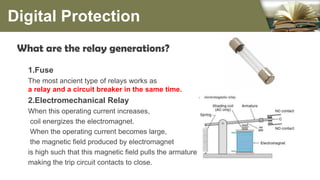
2.Electromechanical Relay
When this operating current increases,
coil energizes the electromagnet.
When the operating current becomes large,
the magnetic field produced by electromagnet
is high such that this magnetic field pulls the armature
making the trip circuit contacts to close.
Digital Protection
Electromechanical Relay
Disadvantages :
Electromechanical relays are prone to failures due to factors that may not affect s
olid-state or digital relays such as:
1. Aging that change a component’s characteristic (for example moving springs force) d
ue to temperature variations, dirt on discs, oxides that increase the resistance
2. High burden level instrument transformers are required
(CTs and PTs of high burden is required for operating the electromagnetic relays
compared to static relays.)
3. The directional feature is absent in electromagnetic relay.
4. The operating time is relatively slow due to friction issue.
5. Multifunctioning is not possible. One relay can perform only one function
Digital Protection
What are the relay generations?
3.Solid state or Static Relay
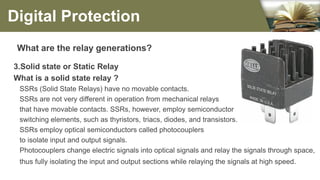
What is a solid state relay ?
SSRs (Solid State Relays) have no movable contacts.
SSRs are not very different in operation from mechanical relays
that have movable contacts. SSRs, however, employ semiconductor
switching elements, such as thyristors, triacs, diodes, and transistors.
SSRs employ optical semiconductors called photocouplers
to isolate input and output signals.
Photocouplers change electric signals into optical signals and relay the signals through space,
thus fully isolating the input and output sections while relaying the signals at high speed.
Digital Protection
Solid state relays and optocouplers
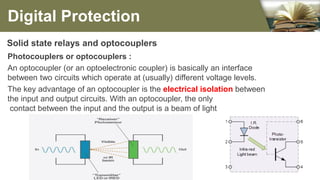
Photocouplers or optocouplers :
An optocoupler (or an optoelectronic coupler) is basically an interface
between two circuits which operate at (usually) different voltage levels.
The key advantage of an optocoupler is the electrical isolation between
the input and output circuits. With an optocoupler, the only
contact between the input and the output is a beam of light
Digital Protection
What are the relay generations?
3. Solid state or Static Relay
What is a solid state relay ?
SSRs consist of electronic parts with no mechanical contacts.
Therefore, SSRs have a variety of features that mechanical relays doesn’t have.
The greatest feature of SSRs is that SSRs do not use switching contacts
that will physically wear out.
SSRs are ideal for a wide range of applications due to the following performance characteristics.
・ They provide high-speed, high-frequency switching operations.
・ They have no contact failures.
・ They generate little noise.
・ They have no operation noise
Digital Protection
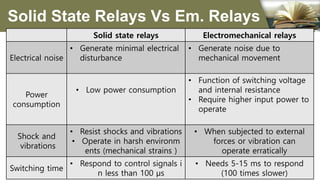
Solid state relays Electromechanical relays
Electrical noise
• Generate minimal electrical
disturbance
• Generate noise due to
mechanical movement
Power
consumption
• Low power consumption
• Function of switching voltage
and internal resistance
• Require higher input power to
operate
Shock and
vibrations
• Resist shocks and vibrations
• Operate in harsh environm
ents (mechanical strains )
• When subjected to external
forces or vibration can
operate erratically
Switching time
• Respond to control signals i
n less than 100 µs
• Needs 5-15 ms to respond
(100 times slower)
Solid State Relays Vs Em. Relays
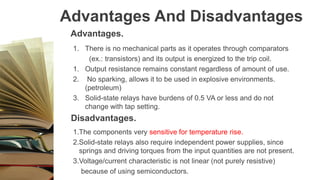
Advantages And Disadvantages
Advantages.
1. There is no mechanical parts as it operates through comparators
(ex.: transistors) and its output is energized to the trip coil.
1. Output resistance remains constant regardless of amount of use.
2. No sparking, allows it to be used in explosive environments.
(petroleum)
3. Solid-state relays have burdens of 0.5 VA or less and do not
change with tap setting.
Disadvantages.
1.The components very sensitive for temperature rise.
2.Solid-state relays also require independent power supplies, since
springs and driving torques from the input quantities are not present.
3.Voltage/current characteristic is not linear (not purely resistive)
because of using semiconductors.
What are the relay generations?
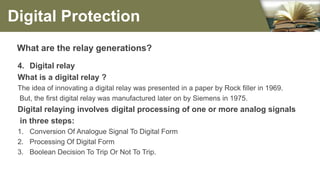
4. Digital relay
What is a digital relay ?
The idea of innovating a digital relay was presented in a paper by Rock filler in 1969.
But, the first digital relay was manufactured later on by Siemens in 1975.
Digital relaying involves digital processing of one or more analog signals
in three steps:
1. Conversion Of Analogue Signal To Digital Form
2. Processing Of Digital Form
3. Boolean Decision To Trip Or Not To Trip.
Digital Protection
What are the relay generations?
4. Digital relay
What is a digital relay ?
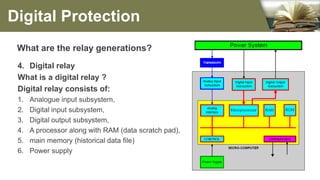
Digital relay consists of:
1. Analogue input subsystem,
2. Digital input subsystem,
3. Digital output subsystem,
4. A processor along with RAM (data scratch pad),
5. main memory (historical data file)
6. Power supply
Digital Protection
What are the relay generations?
4. Digital relay
How does it work ?
• The Microprocessor sends command signal to read input data.
• The Input data is fed to analog to digital converter (ADC) to obtain signal in
digital form.
• Microprocessor then compares the data with pick-up value.
• If the input is greater than pick-up value the microprocessor send a trip
signal to circuit breaker of the desired circuit.
Digital Protection
What are the relay generations?
4. Digital relay
Why Numerical Relaying?
• Numerical relays permit much more flexibility than their electromechanical and solid state
counterparts.
• The digital relay can emulate functions of many discrete electromechanical relays in one device,
simplifying protection design and maintenance.
• Each digital relay can run self-test routines to confirm its readiness and alarm if a fault is
detected and hence it is more reliable.
• Digital relays can, for example, store multiple sets of protection parameters, which allows the
behavior of the relay to be changed during maintenance of attached equipment.
Digital Protection
What are the relay generations?
4. Digital relay
In A Nutshell
• Additional monitoring functions
• Functional flexibility.
• Capable of working under a wide range of temperatures.
• They can implement more complex function and are generally more accurate
• Self-checking and self-adaptability.
• Able to communicate with other digital equipment (pear to pear).
• Less sensitive to temperature, aging
Watchdog property !!!
Digital Protection
Watchdog property !!!
• During normal operation, the computer regularly restarts the watchdog timer
to prevent it
from elapsing, or "timing out".
• If, due to a hardware fault or program error, the computer fails to restart the
watchdog,
• the timer will elapse and generate a timeout signal.
• The timeout signal is used to initiate corrective action or actions.
• The corrective actions typically include placing the computer system in a sa
fe state and restoring normal system operation
Digital Protection
What are the relay generations?
4. Digital relay
Limitations of Digital Relay
• Short lifetime due to the continuous development of new technologies.
The devices become obsolete rapidly.
• Susceptibility to power system transients.
• As digital systems become increasingly more complex they require specially trained staff for
Operation. Proper maintenance of the settings and monitoring data.
Digital Protection
What are the relay generations?
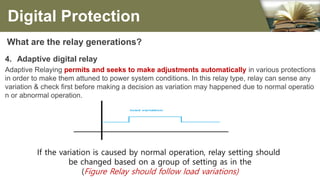
4. Adaptive digital relay
Adaptive Relaying permits and seeks to make adjustments automatically in various protections
in order to make them attuned to power system conditions. In this relay type, relay can sense any
variation & check first before making a decision as variation may happened due to normal operatio
n or abnormal operation.
Digital Protection
If the variation is caused by normal operation, relay setting should
be changed based on a group of setting as in the
(Figure Relay should follow load variations)
What are the relay generations?
4. Adaptive digital relay
Conventional relays have fixed setting parameters and therefore it becomes difficult to comply with
the protection requirements in variable operation conditions in a power system. A solution to this
problem is the adaptive protection, which can vary its setting parameters or its operating
characteristics in response to changes in the power system.
Adaptive protection is defined as “a protection philosophy which permits and seeks to make
adjustments to various protection functions in order to make them more attuned to
prevailing power system conditions.”
. This change in power system topology is mainly due to the following reasons :
1. Deliberate system switching, for example, isolation of a part of the equipment for
maintenance.
2. Unplanned system switching, for example, removal of a fault by a relay from a healthy
power system.
Digital Protection
What are the relay generations?
4. Adaptive digital relay
In these cases, the power system topology gets changed but the system protection settings
remain the same as they before the modifications, which is why the latter may not be able to
adequately protect the current system.
Adaptive relaying can be utilized in the following areas:
• Automatic circuit breaker reclosing control.
• Power transformer protection.
• Multi-terminal transmission line protection. If both the relays sense a fault in their respective
zones of protection. The relay with the shorter time delay or the relay subject to the longer fault
current should trip first.
• Relay settings. As the power system topology changes, the relay will automatically switch to the
appropriate relay group for proper power system protection.
Digital Protection
What are the relay generations?
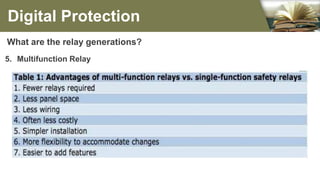
5. Multifunction Relay
A multifunction digital relay is a microprocessor-based unit that uses Digital Signal Processing
technology in order to provide multiple protective relaying functions for protection in one unit.
This will lead to decrease panel space and wiring is required than would be if individual relays
were used
Advantages
• Decreasing the number of wiring and also the time of maintenance.
• provide a high level of protection at a very attractive cost
Disadvantage
• Power supply loss failure (can be solved by using a backup power supply).
• Subroutine failure ( can be solved by using electromagnetic as a backup protection)
Digital Protection
What are the relay generations?
5. Multifunction Relay
Digital Protection
What are the relay generations?
6. Intelligent Relay
Intelligent (numerical) relays are micro processor based relays and having the features of customer
changed functions.
Digital Protection
Thank you

Relay Generation and history

  • 1.
    A Report onDigital protection Electrical Relays 6th December 2017 By Mahmoud Magdi Mohamed Prof. Hany M. Amin Elghazaly ELECTRIC POWER AND MACHINES DEPARTMENT
  • 2.
  • 3.
    What is TheRelay? Relay is a device that sense volt and current values & compare them with the setting values so the circuit breaker will be able to make a decision by tripping or not as quickly as possible to return the power system to its normal state . Digital Protection
  • 4.
    What are therelay generations? 1.Fuse The most ancient type of relays works as a relay and a circuit breaker in the same time. 2.Electromechanical Relay When this operating current increases, coil energizes the electromagnet. When the operating current becomes large, the magnetic field produced by electromagnet is high such that this magnetic field pulls the armature making the trip circuit contacts to close. Digital Protection
  • 5.
    Electromechanical Relay Disadvantages : Electromechanicalrelays are prone to failures due to factors that may not affect s olid-state or digital relays such as: 1. Aging that change a component’s characteristic (for example moving springs force) d ue to temperature variations, dirt on discs, oxides that increase the resistance 2. High burden level instrument transformers are required (CTs and PTs of high burden is required for operating the electromagnetic relays compared to static relays.) 3. The directional feature is absent in electromagnetic relay. 4. The operating time is relatively slow due to friction issue. 5. Multifunctioning is not possible. One relay can perform only one function Digital Protection
  • 6.
    What are therelay generations? 3.Solid state or Static Relay What is a solid state relay ? SSRs (Solid State Relays) have no movable contacts. SSRs are not very different in operation from mechanical relays that have movable contacts. SSRs, however, employ semiconductor switching elements, such as thyristors, triacs, diodes, and transistors. SSRs employ optical semiconductors called photocouplers to isolate input and output signals. Photocouplers change electric signals into optical signals and relay the signals through space, thus fully isolating the input and output sections while relaying the signals at high speed. Digital Protection
  • 7.
    Solid state relaysand optocouplers Photocouplers or optocouplers : An optocoupler (or an optoelectronic coupler) is basically an interface between two circuits which operate at (usually) different voltage levels. The key advantage of an optocoupler is the electrical isolation between the input and output circuits. With an optocoupler, the only contact between the input and the output is a beam of light Digital Protection
  • 8.
    What are therelay generations? 3. Solid state or Static Relay What is a solid state relay ? SSRs consist of electronic parts with no mechanical contacts. Therefore, SSRs have a variety of features that mechanical relays doesn’t have. The greatest feature of SSRs is that SSRs do not use switching contacts that will physically wear out. SSRs are ideal for a wide range of applications due to the following performance characteristics. ・ They provide high-speed, high-frequency switching operations. ・ They have no contact failures. ・ They generate little noise. ・ They have no operation noise Digital Protection
  • 9.
    Solid state relaysElectromechanical relays Electrical noise • Generate minimal electrical disturbance • Generate noise due to mechanical movement Power consumption • Low power consumption • Function of switching voltage and internal resistance • Require higher input power to operate Shock and vibrations • Resist shocks and vibrations • Operate in harsh environm ents (mechanical strains ) • When subjected to external forces or vibration can operate erratically Switching time • Respond to control signals i n less than 100 µs • Needs 5-15 ms to respond (100 times slower) Solid State Relays Vs Em. Relays
  • 10.
    Advantages And Disadvantages Advantages. 1.There is no mechanical parts as it operates through comparators (ex.: transistors) and its output is energized to the trip coil. 1. Output resistance remains constant regardless of amount of use. 2. No sparking, allows it to be used in explosive environments. (petroleum) 3. Solid-state relays have burdens of 0.5 VA or less and do not change with tap setting. Disadvantages. 1.The components very sensitive for temperature rise. 2.Solid-state relays also require independent power supplies, since springs and driving torques from the input quantities are not present. 3.Voltage/current characteristic is not linear (not purely resistive) because of using semiconductors.
  • 11.
    What are therelay generations? 4. Digital relay What is a digital relay ? The idea of innovating a digital relay was presented in a paper by Rock filler in 1969. But, the first digital relay was manufactured later on by Siemens in 1975. Digital relaying involves digital processing of one or more analog signals in three steps: 1. Conversion Of Analogue Signal To Digital Form 2. Processing Of Digital Form 3. Boolean Decision To Trip Or Not To Trip. Digital Protection
  • 12.
    What are therelay generations? 4. Digital relay What is a digital relay ? Digital relay consists of: 1. Analogue input subsystem, 2. Digital input subsystem, 3. Digital output subsystem, 4. A processor along with RAM (data scratch pad), 5. main memory (historical data file) 6. Power supply Digital Protection
  • 13.
    What are therelay generations? 4. Digital relay How does it work ? • The Microprocessor sends command signal to read input data. • The Input data is fed to analog to digital converter (ADC) to obtain signal in digital form. • Microprocessor then compares the data with pick-up value. • If the input is greater than pick-up value the microprocessor send a trip signal to circuit breaker of the desired circuit. Digital Protection
  • 14.
    What are therelay generations? 4. Digital relay Why Numerical Relaying? • Numerical relays permit much more flexibility than their electromechanical and solid state counterparts. • The digital relay can emulate functions of many discrete electromechanical relays in one device, simplifying protection design and maintenance. • Each digital relay can run self-test routines to confirm its readiness and alarm if a fault is detected and hence it is more reliable. • Digital relays can, for example, store multiple sets of protection parameters, which allows the behavior of the relay to be changed during maintenance of attached equipment. Digital Protection
  • 15.
    What are therelay generations? 4. Digital relay In A Nutshell • Additional monitoring functions • Functional flexibility. • Capable of working under a wide range of temperatures. • They can implement more complex function and are generally more accurate • Self-checking and self-adaptability. • Able to communicate with other digital equipment (pear to pear). • Less sensitive to temperature, aging Watchdog property !!! Digital Protection
  • 16.
    Watchdog property !!! •During normal operation, the computer regularly restarts the watchdog timer to prevent it from elapsing, or "timing out". • If, due to a hardware fault or program error, the computer fails to restart the watchdog, • the timer will elapse and generate a timeout signal. • The timeout signal is used to initiate corrective action or actions. • The corrective actions typically include placing the computer system in a sa fe state and restoring normal system operation Digital Protection
  • 17.
    What are therelay generations? 4. Digital relay Limitations of Digital Relay • Short lifetime due to the continuous development of new technologies. The devices become obsolete rapidly. • Susceptibility to power system transients. • As digital systems become increasingly more complex they require specially trained staff for Operation. Proper maintenance of the settings and monitoring data. Digital Protection
  • 18.
    What are therelay generations? 4. Adaptive digital relay Adaptive Relaying permits and seeks to make adjustments automatically in various protections in order to make them attuned to power system conditions. In this relay type, relay can sense any variation & check first before making a decision as variation may happened due to normal operatio n or abnormal operation. Digital Protection If the variation is caused by normal operation, relay setting should be changed based on a group of setting as in the (Figure Relay should follow load variations)
  • 19.
    What are therelay generations? 4. Adaptive digital relay Conventional relays have fixed setting parameters and therefore it becomes difficult to comply with the protection requirements in variable operation conditions in a power system. A solution to this problem is the adaptive protection, which can vary its setting parameters or its operating characteristics in response to changes in the power system. Adaptive protection is defined as “a protection philosophy which permits and seeks to make adjustments to various protection functions in order to make them more attuned to prevailing power system conditions.” . This change in power system topology is mainly due to the following reasons : 1. Deliberate system switching, for example, isolation of a part of the equipment for maintenance. 2. Unplanned system switching, for example, removal of a fault by a relay from a healthy power system. Digital Protection
  • 20.
    What are therelay generations? 4. Adaptive digital relay In these cases, the power system topology gets changed but the system protection settings remain the same as they before the modifications, which is why the latter may not be able to adequately protect the current system. Adaptive relaying can be utilized in the following areas: • Automatic circuit breaker reclosing control. • Power transformer protection. • Multi-terminal transmission line protection. If both the relays sense a fault in their respective zones of protection. The relay with the shorter time delay or the relay subject to the longer fault current should trip first. • Relay settings. As the power system topology changes, the relay will automatically switch to the appropriate relay group for proper power system protection. Digital Protection
  • 21.
    What are therelay generations? 5. Multifunction Relay A multifunction digital relay is a microprocessor-based unit that uses Digital Signal Processing technology in order to provide multiple protective relaying functions for protection in one unit. This will lead to decrease panel space and wiring is required than would be if individual relays were used Advantages • Decreasing the number of wiring and also the time of maintenance. • provide a high level of protection at a very attractive cost Disadvantage • Power supply loss failure (can be solved by using a backup power supply). • Subroutine failure ( can be solved by using electromagnetic as a backup protection) Digital Protection
  • 22.
    What are therelay generations? 5. Multifunction Relay Digital Protection
  • 23.
    What are therelay generations? 6. Intelligent Relay Intelligent (numerical) relays are micro processor based relays and having the features of customer changed functions. Digital Protection
  • 24.