PRESENTED BY
           DEEPAK JOHN
           S1 M. Tech
           POWER SYSTEM
CONTENTS
 INTRODUCTION
 DIFFERENT CONSTRAINTS IN ECONOMIC LOAD
  DISPATCH
 OPERATING COST OF THERMAL PLANT
 ECONOMIC DISPATCH NEGLECTING
  LOSSES
 ECONOMIC DISPATCH INCLUDING
  LOSSES
 REFERENCES
INTRODUCTION
 In power generation our main aim is to generate the
  required amount of power with minimum cost.
 Economic load dispatch means that the generator’s
  real and reactive power are allowed to vary within
  certain limits so as to meet a particular load demand
  with minimum fuel cost
 This allocation of loads are based on some
  constraints.
DIFFERENT CONSTRAINTS IN
     ECONOMIC LOAD DISPATCH
 INEQUALITY CONSTRAINTS
    Voltage constraints
        Vmin ≤ V ≤ Vmax ,
        δmin ≤ δ ≤ δmax
    Generator constraints
      KVA loading of generator should not exceed prescribed
     value
        Pmin ≤ P ≤ Pmax
        Qmin ≤ Q ≤ Qmax
 Running spare capacity constraints
  This constraints are needed to meet forced outage of
  one or more alternators in the system and also
  unexpected load on the system
 Transmission line constraints
    flow of power through transmission line should less
  than its thermal capacity
 Transformer tap set

for autotransformer tap t should between 0 & 1
For two winding transformer – between 0& k
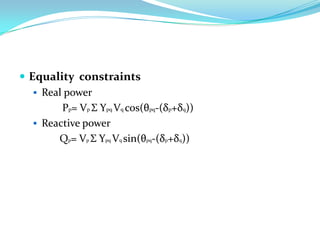
 Equality constraints
    Real power
         Pp= Vp Σ Ypq Vq cos(θpq-(δp+δq))
    Reactive power
        Qp= Vp Σ Ypq Vq sin(θpq-(δp+δq))
OPERATING COST OF THERMAL
            PLANT
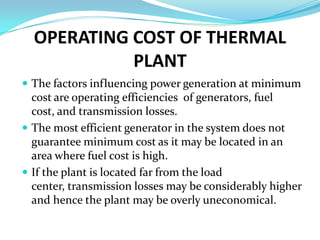
 The factors influencing power generation at minimum
  cost are operating efficiencies of generators, fuel
  cost, and transmission losses.
 The most efficient generator in the system does not
  guarantee minimum cost as it may be located in an
  area where fuel cost is high.
 If the plant is located far from the load
  center, transmission losses may be considerably higher
  and hence the plant may be overly uneconomical.
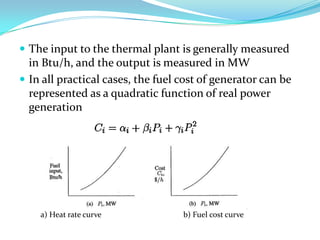
 The input to the thermal plant is generally measured
  in Btu/h, and the output is measured in MW
 In all practical cases, the fuel cost of generator can be
  represented as a quadratic function of real power
  generation


    a) Heat rate curve             b) Fuel cost curve
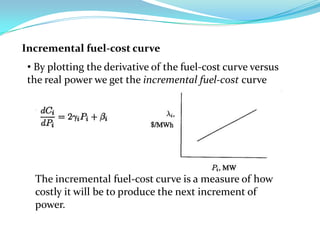
Incremental fuel-cost curve
 • By plotting the derivative of the fuel-cost curve versus
 the real power we get the incremental fuel-cost curve


  The incremental fuel-cost curve is a measure of how
  costly it will be to produce the next increment of
  power.
ECONOMIC DISPATCH NEGLECTING
             LOSSES


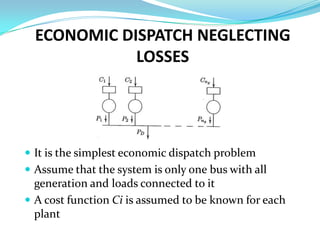
 It is the simplest economic dispatch problem
 Assume that the system is only one bus with all
  generation and loads connected to it
 A cost function Ci is assumed to be known for each
  plant
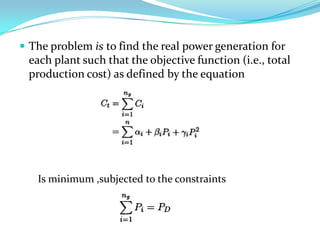
 The problem is to find the real power generation for
 each plant such that the objective function (i.e., total
 production cost) as defined by the equation


   Is minimum ,subjected to the constraints
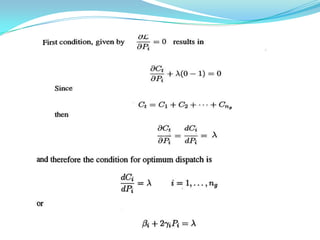
 when losses are neglected with no generator limits, for
  most economic operation. all plants must operate at
  equal incremental production cost
 Production from each plant can be found by


   This equation is known as the coordination equation
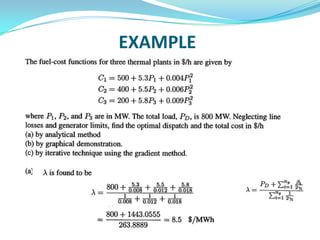
   For analytic solution we can find λ by
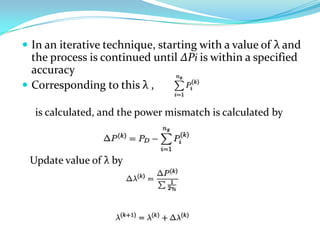
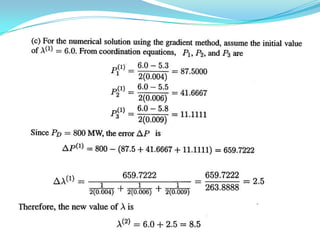
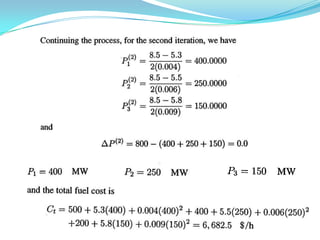
 In an iterative technique, starting with a value of λ and
  the process is continued until ∆Pi is within a specified
  accuracy
 Corresponding to this λ ,

  is calculated, and the power mismatch is calculated by


 Update value of λ by
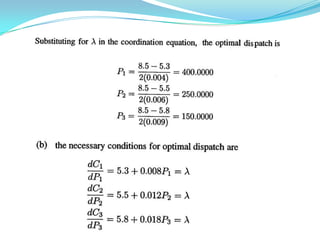
EXAMPLE
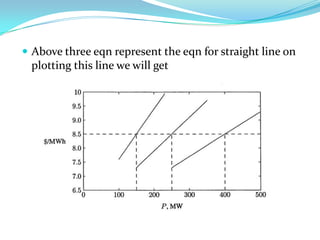
 Above three eqn represent the eqn for straight line on
 plotting this line we will get
ECONOMIC DISPATCH INCLUDING
           LOSSES
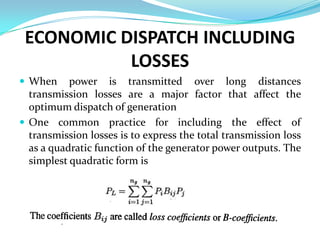
 When     power is transmitted over long distances
  transmission losses are a major factor that affect the
  optimum dispatch of generation
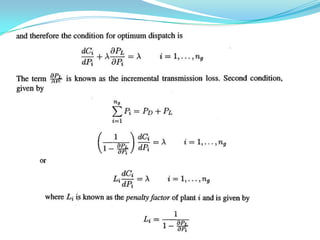
 One common practice for including the effect of
  transmission losses is to express the total transmission loss
  as a quadratic function of the generator power outputs. The
  simplest quadratic form is
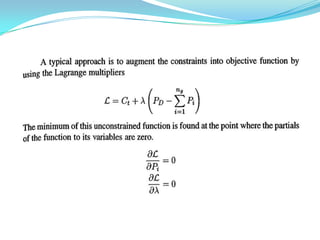
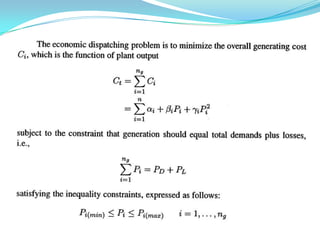
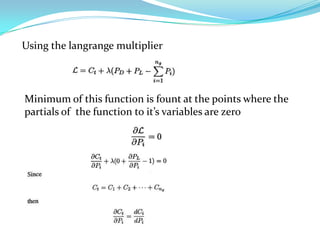
Using the langrange multiplier


Minimum of this function is fount at the points where the
partials of the function to it’s variables are zero
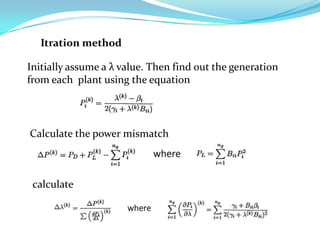
Itration method

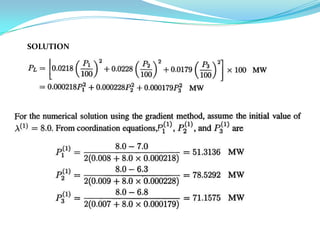
Initially assume a λ value. Then find out the generation
from each plant using the equation


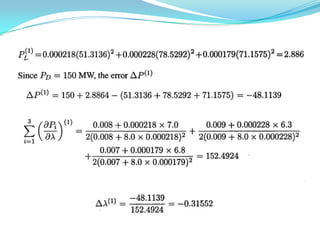
Calculate the power mismatch


 calculate
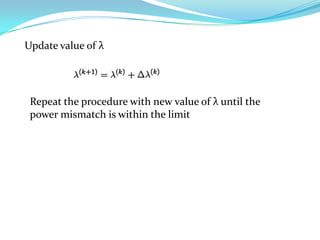
Update value of λ


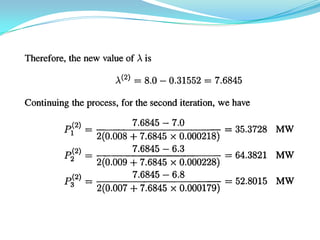
 Repeat the procedure with new value of λ until the
 power mismatch is within the limit
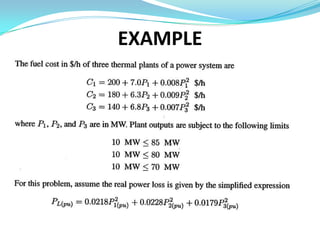
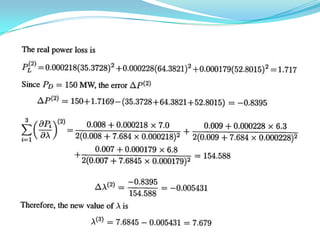
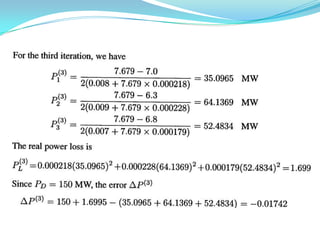
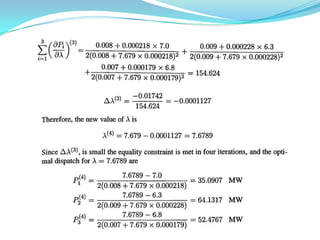
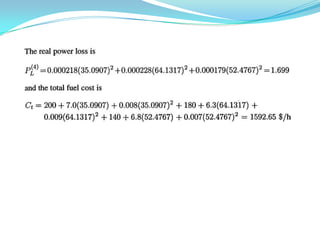
EXAMPLE
SOLUTION
REFERENCES
 Power System Analysis - Hadi Saadat
 power system analysis by nagrath and kothari
THANKS

Economic load dispatch

  • 1.
    PRESENTED BY DEEPAK JOHN S1 M. Tech POWER SYSTEM
  • 2.
    CONTENTS  INTRODUCTION  DIFFERENTCONSTRAINTS IN ECONOMIC LOAD DISPATCH  OPERATING COST OF THERMAL PLANT  ECONOMIC DISPATCH NEGLECTING LOSSES  ECONOMIC DISPATCH INCLUDING LOSSES  REFERENCES
  • 3.
    INTRODUCTION  In powergeneration our main aim is to generate the required amount of power with minimum cost.  Economic load dispatch means that the generator’s real and reactive power are allowed to vary within certain limits so as to meet a particular load demand with minimum fuel cost  This allocation of loads are based on some constraints.
  • 4.
    DIFFERENT CONSTRAINTS IN ECONOMIC LOAD DISPATCH  INEQUALITY CONSTRAINTS  Voltage constraints Vmin ≤ V ≤ Vmax , δmin ≤ δ ≤ δmax  Generator constraints KVA loading of generator should not exceed prescribed value Pmin ≤ P ≤ Pmax Qmin ≤ Q ≤ Qmax
  • 5.
     Running sparecapacity constraints This constraints are needed to meet forced outage of one or more alternators in the system and also unexpected load on the system  Transmission line constraints flow of power through transmission line should less than its thermal capacity  Transformer tap set for autotransformer tap t should between 0 & 1 For two winding transformer – between 0& k
  • 6.
     Equality constraints  Real power Pp= Vp Σ Ypq Vq cos(θpq-(δp+δq))  Reactive power Qp= Vp Σ Ypq Vq sin(θpq-(δp+δq))
  • 7.
    OPERATING COST OFTHERMAL PLANT  The factors influencing power generation at minimum cost are operating efficiencies of generators, fuel cost, and transmission losses.  The most efficient generator in the system does not guarantee minimum cost as it may be located in an area where fuel cost is high.  If the plant is located far from the load center, transmission losses may be considerably higher and hence the plant may be overly uneconomical.
  • 8.
     The inputto the thermal plant is generally measured in Btu/h, and the output is measured in MW  In all practical cases, the fuel cost of generator can be represented as a quadratic function of real power generation a) Heat rate curve b) Fuel cost curve
  • 9.
    Incremental fuel-cost curve • By plotting the derivative of the fuel-cost curve versus the real power we get the incremental fuel-cost curve The incremental fuel-cost curve is a measure of how costly it will be to produce the next increment of power.
  • 10.
    ECONOMIC DISPATCH NEGLECTING LOSSES  It is the simplest economic dispatch problem  Assume that the system is only one bus with all generation and loads connected to it  A cost function Ci is assumed to be known for each plant
  • 11.
     The problemis to find the real power generation for each plant such that the objective function (i.e., total production cost) as defined by the equation Is minimum ,subjected to the constraints
  • 14.
     when lossesare neglected with no generator limits, for most economic operation. all plants must operate at equal incremental production cost  Production from each plant can be found by This equation is known as the coordination equation For analytic solution we can find λ by
  • 15.
     In aniterative technique, starting with a value of λ and the process is continued until ∆Pi is within a specified accuracy  Corresponding to this λ , is calculated, and the power mismatch is calculated by Update value of λ by
  • 16.
  • 18.
     Above threeeqn represent the eqn for straight line on plotting this line we will get
  • 21.
    ECONOMIC DISPATCH INCLUDING LOSSES  When power is transmitted over long distances transmission losses are a major factor that affect the optimum dispatch of generation  One common practice for including the effect of transmission losses is to express the total transmission loss as a quadratic function of the generator power outputs. The simplest quadratic form is
  • 23.
    Using the langrangemultiplier Minimum of this function is fount at the points where the partials of the function to it’s variables are zero
  • 25.
    Itration method Initially assumea λ value. Then find out the generation from each plant using the equation Calculate the power mismatch calculate
  • 26.
    Update value ofλ Repeat the procedure with new value of λ until the power mismatch is within the limit
  • 27.
  • 28.
  • 35.
    REFERENCES  Power SystemAnalysis - Hadi Saadat  power system analysis by nagrath and kothari
  • 36.