POWER SYSTEM OPERATION
AND CONTROL
By
Dr. V SEKHAR
AssociateProfessor
UNIT-1
2
Economic Operation of Power
Systems
Power System Economic Operation
• Different generation technologies vary in the:
– capital costs necessary to build the generator
– fuel costs to actually produce electric power
• For example:
– nuclear and hydro have high capital costs and low operating costs.
– Natural gas generators have low capital costs, and (with gas available
from fracking) moderate operating costs.
3
Power System Economic Operation
• Fuel cost to generate a MWh can vary widely from technology to
technology.
• For some types of units, such as hydro, “fuel” costs are zero but the limit
on total available water gives it an implicit value.
• For thermal units it is much easier to characterize costs.
• We will focus on minimizing the variable operating costs (primarily fuel
costs) to meet demand.
4
Power System Economic Operation
• Power system loads are cyclical.
• Therefore the installed generation capacity is usually much greater than the
current load.
• This means that there are typically many ways we could meet the current
load.
• Since different states have different mixes of generation, we will consider
how generally to minimize the variable operating costs given an arbitrary,
specified portfolio of generators.
5
Thermal versus Other Generation
 The main types of generating units are thermal and hydro, with wind and
solar rapidly growing.
 For hydro the fuel (water) is free but there may be many constraints on
operation:
– fixed amounts of water available,
– reservoir levels must be managed and coordinated,
– downstream flow rates for fish and navigation.
 Hydro optimization is typically longer term (many months or years).
 We will concentrate on dispatchable thermal units, looking at short-term
optimization:
 Non-dispatchable wind and solar can be incorporated by subtracting from
load.
6
Generator types
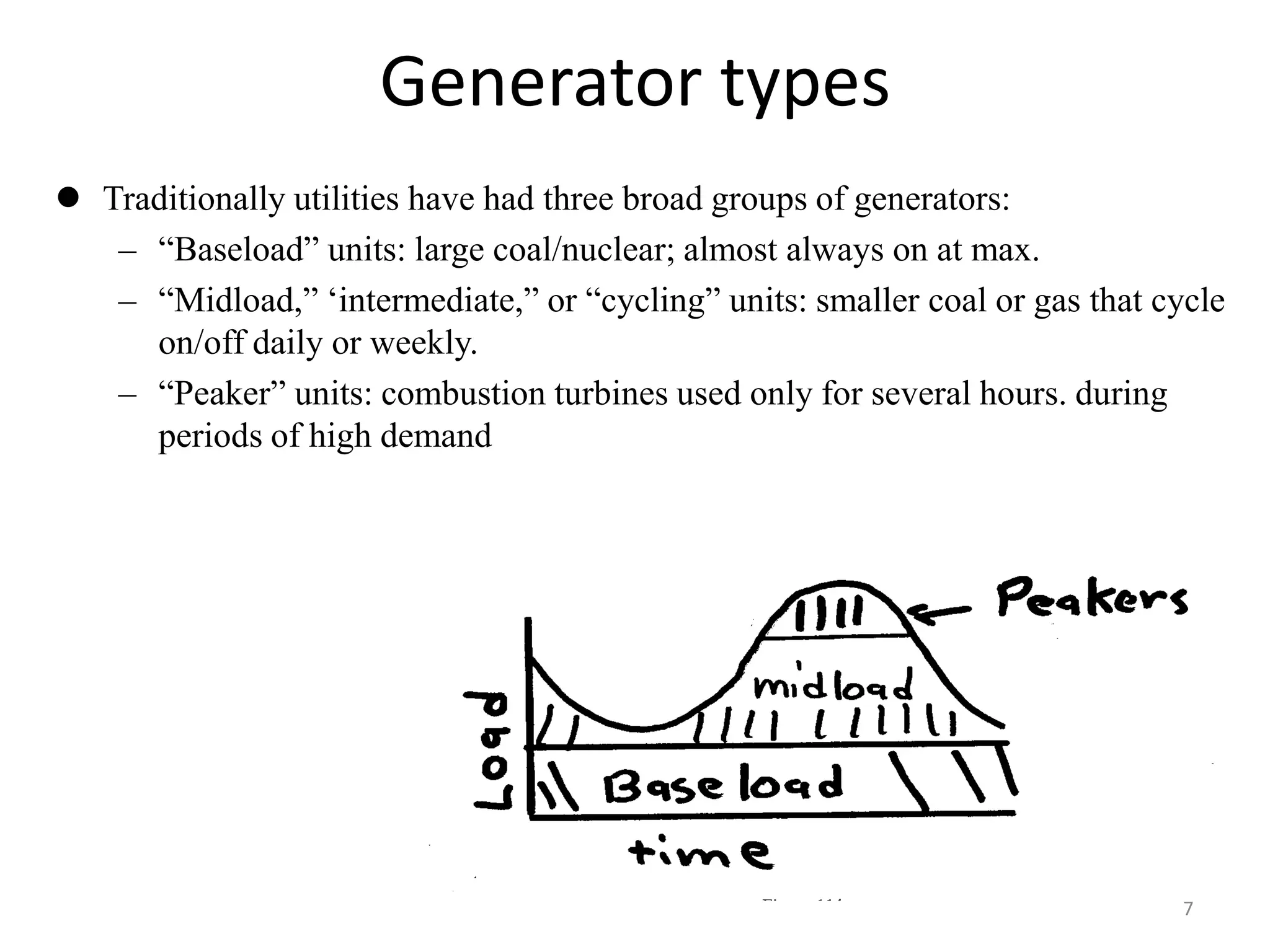
 Traditionally utilities have had three broad groups of generators:
– “Baseload” units: large coal/nuclear; almost always on at max.
– “Midload,” ‘intermediate,” or “cycling” units: smaller coal or gas that cycle
on/off daily or weekly.
– “Peaker” units: combustion turbines used only for several hours. during
periods of high demand
7
Block Diagram of Thermal Unit
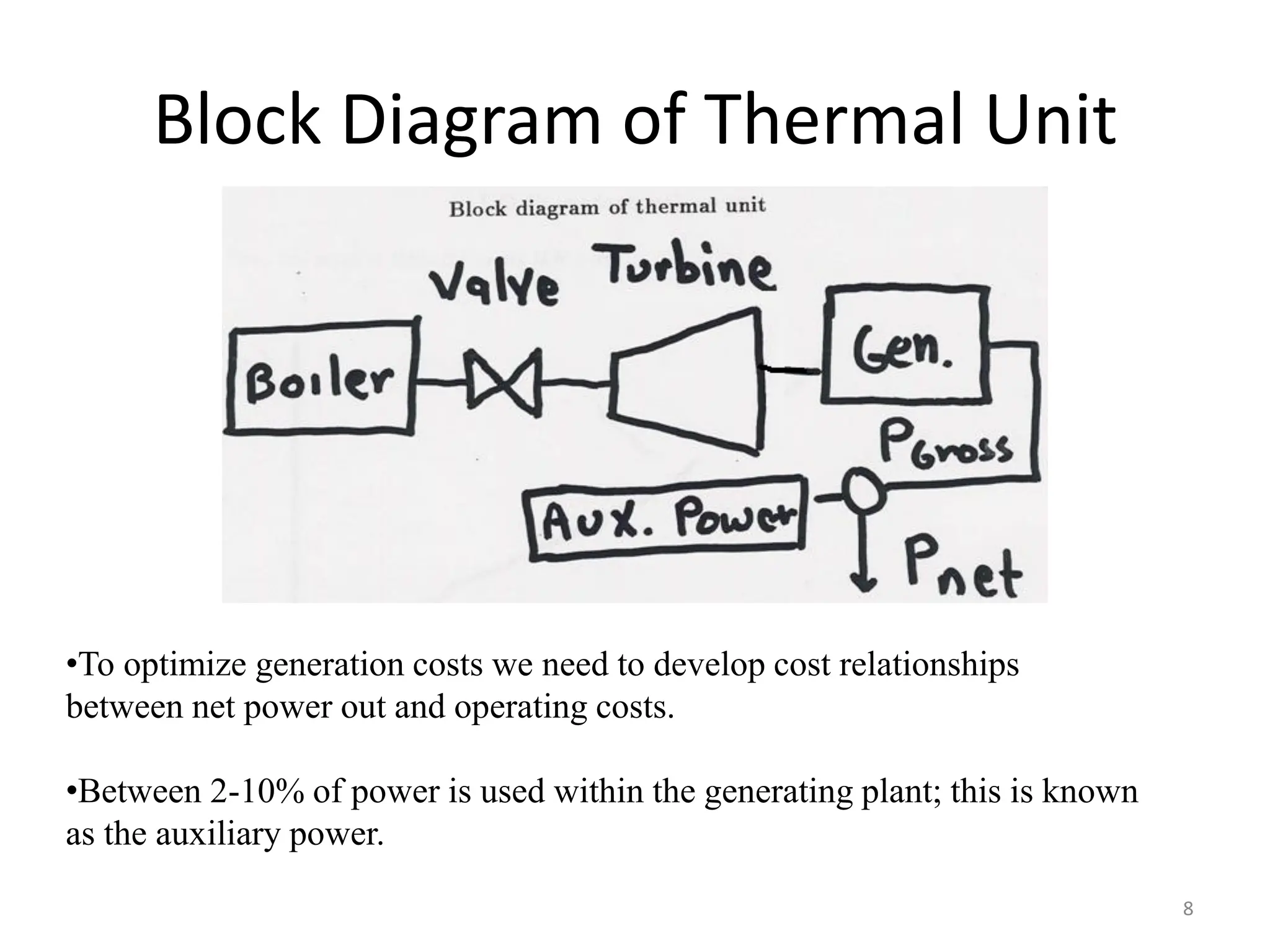
•To optimize generation costs we need to develop cost relationships
between net power out and operating costs.
•Between 2-10% of power is used within the generating plant; this is known
as the auxiliary power.
8
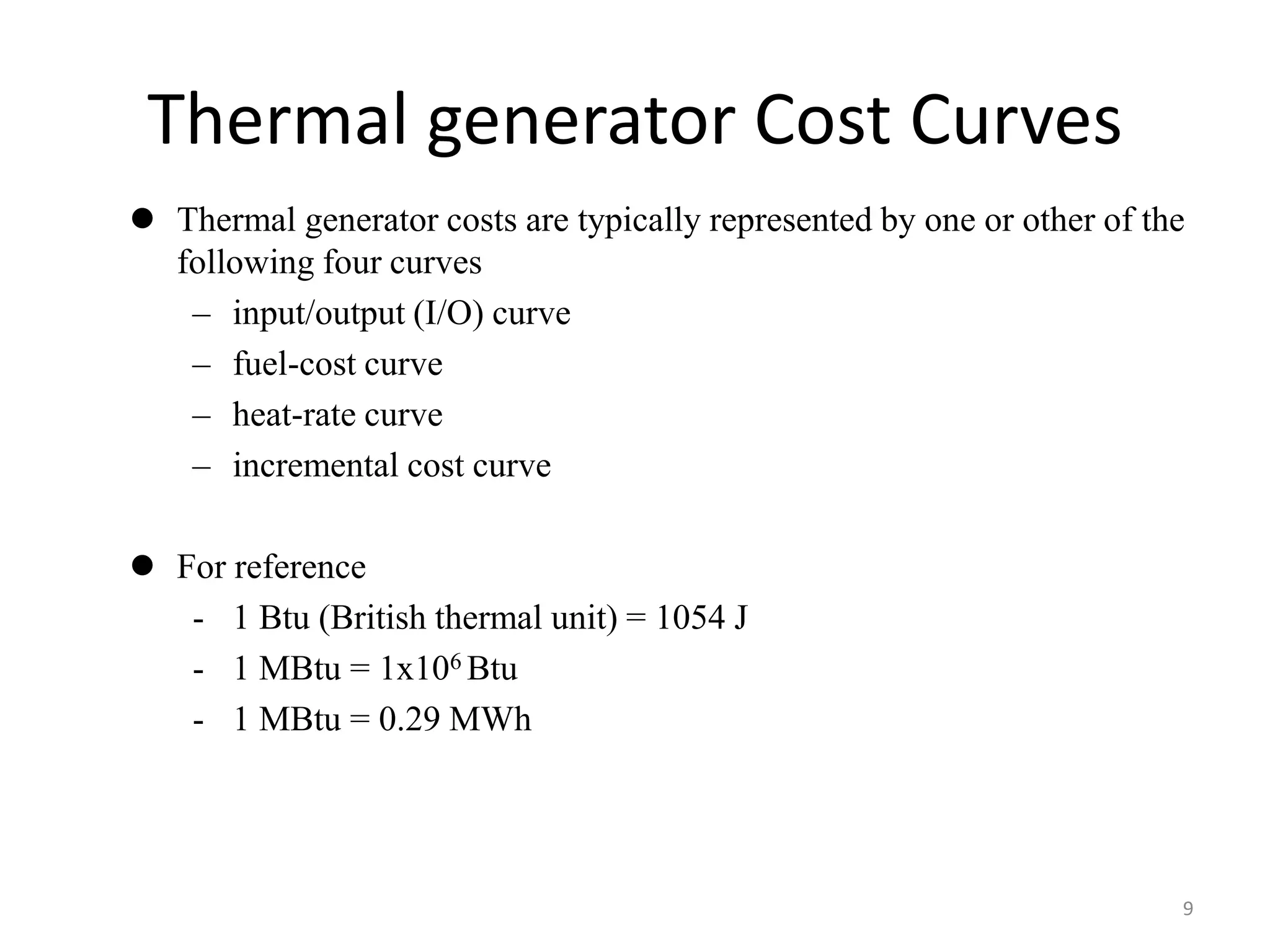
Thermal generator Cost Curves
 Thermal generator costs are typically represented by one or other of the
following four curves
– input/output (I/O) curve
– fuel-cost curve
– heat-rate curve
– incremental cost curve
 For reference
- 1 Btu (British thermal unit) = 1054 J
- 1 MBtu = 1x10⁶ Btu
- 1 MBtu = 0.29 MWh
9
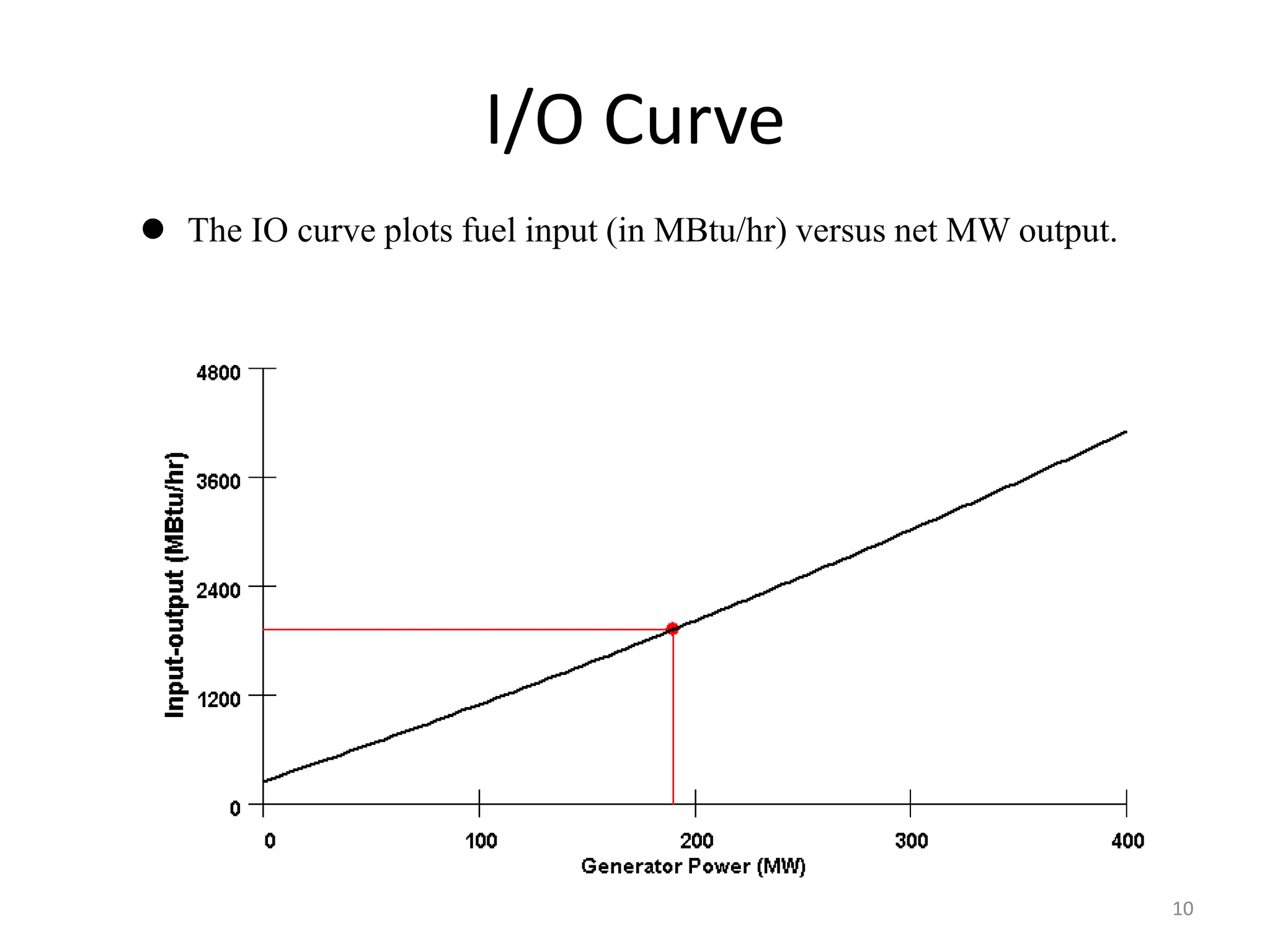
I/O Curve
 The IO curve plots fuel input (in MBtu/hr) versus net MW output.
10
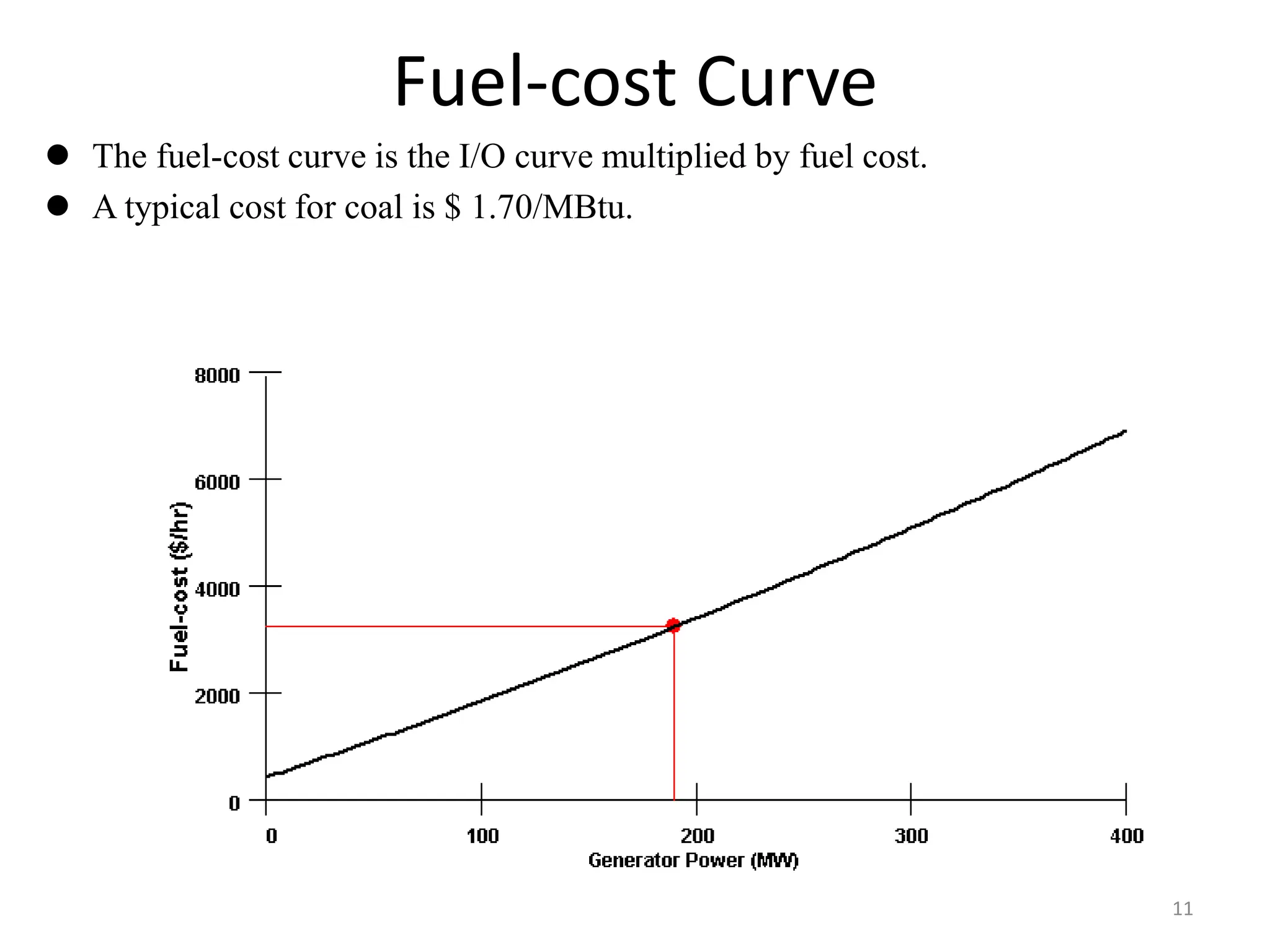
Fuel-cost Curve
 The fuel-cost curve is the I/O curve multiplied by fuel cost.
 A typical cost for coal is $ 1.70/MBtu.
11
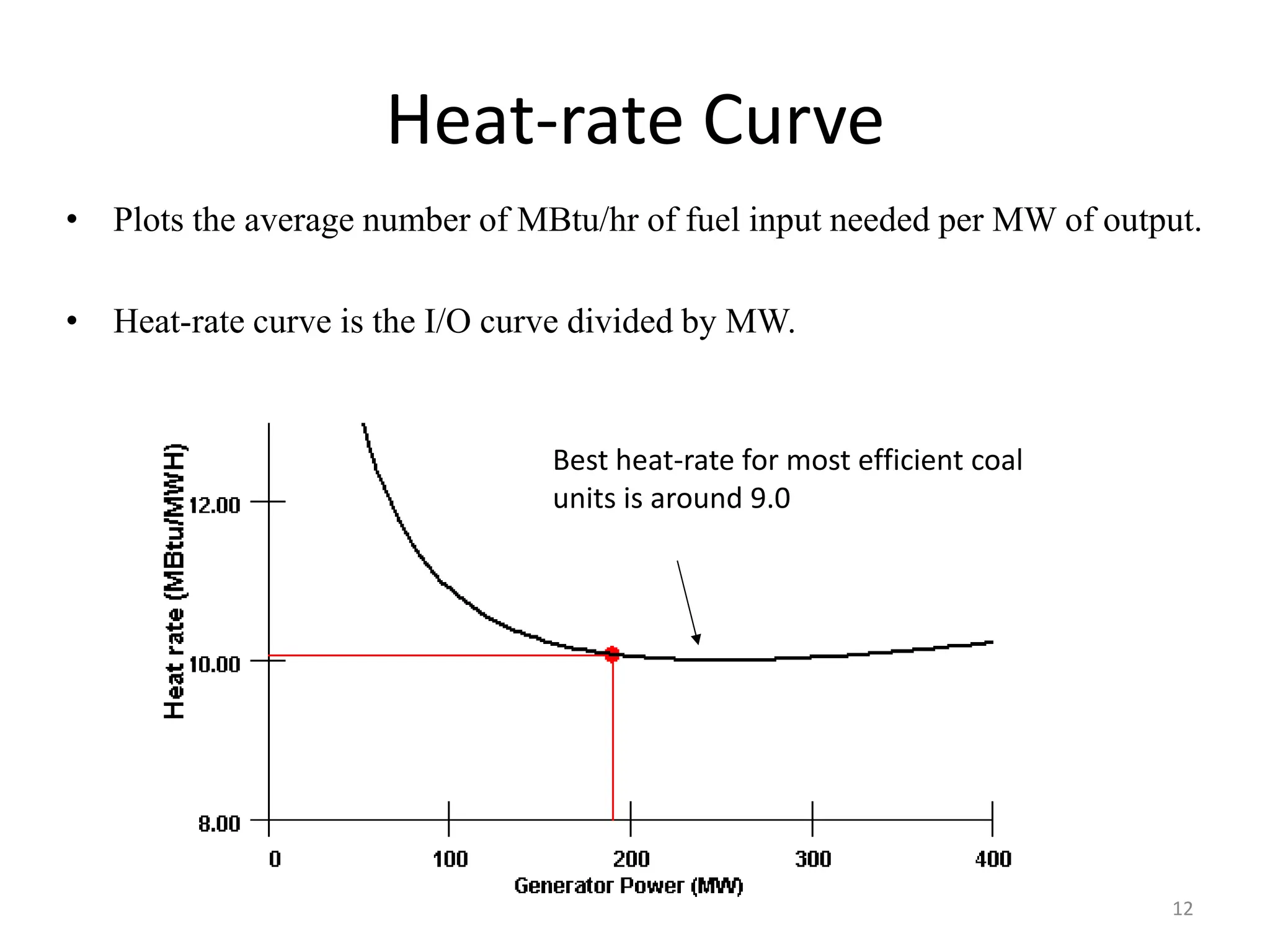
Heat-rate Curve
• Plots the average number of MBtu/hr of fuel input needed per MW of output.
• Heat-rate curve is the I/O curve divided by MW.
Best heat-rate for most efficient coal
units is around 9.0
12
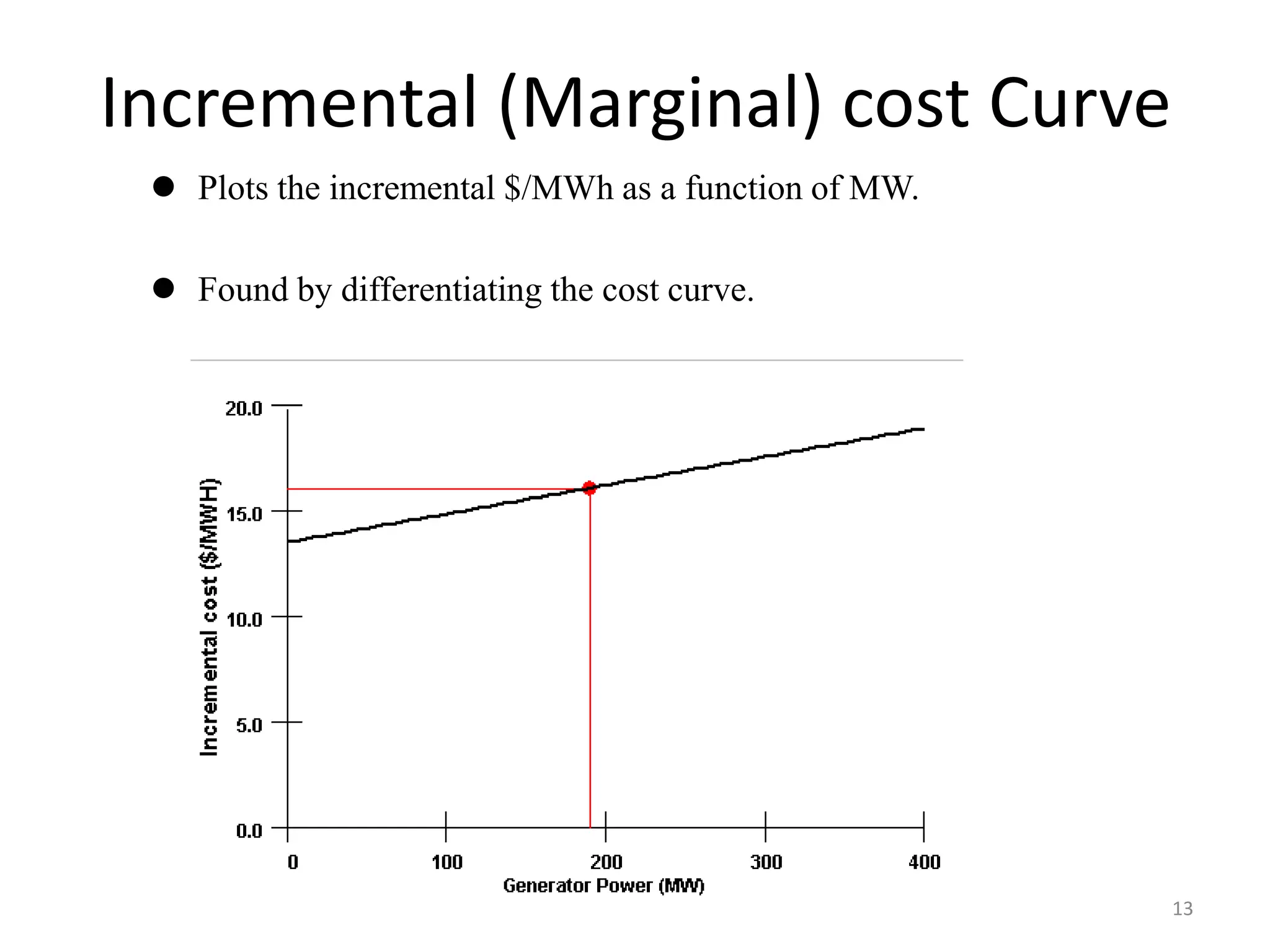
Incremental (Marginal) cost Curve
 Plots the incremental $/MWh as a function of MW.
 Found by differentiating the cost curve.
13
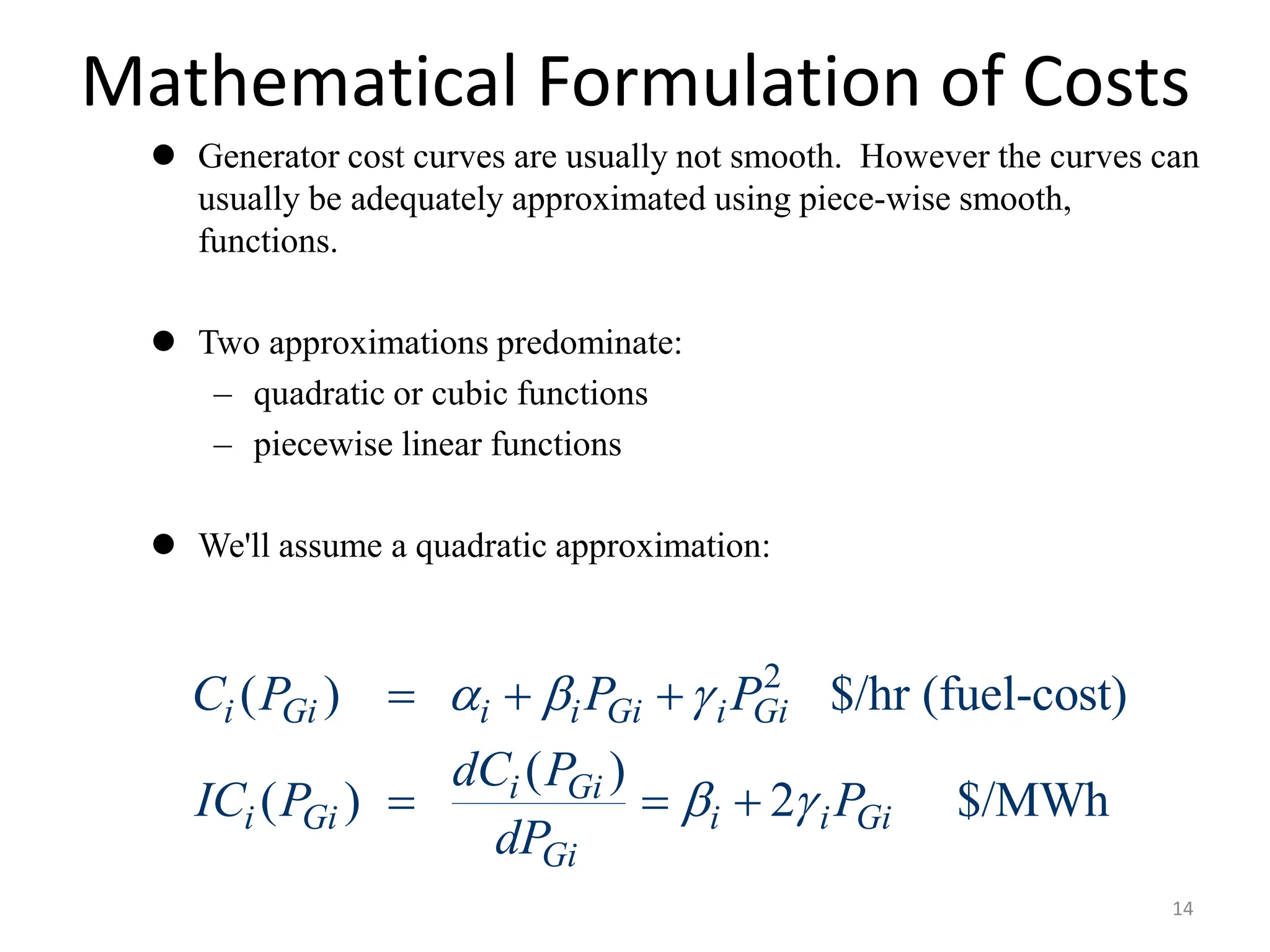
Mathematical Formulation of Costs
 Generator cost curves are usually not smooth. However the curves can
usually be adequately approximated using piece-wise smooth,
functions.
 Two approximations predominate:
– quadratic or cubic functions
– piecewise linear functions
 We'll assume a quadratic approximation:
2
( ) $/hr (fuel-cost)
( )
( ) 2 $/MWh
i Gi i i Gi i Gi
i Gi
i Gi i i Gi
Gi
C P P P
dC P
IC P P
dP
  
 
  
  
14
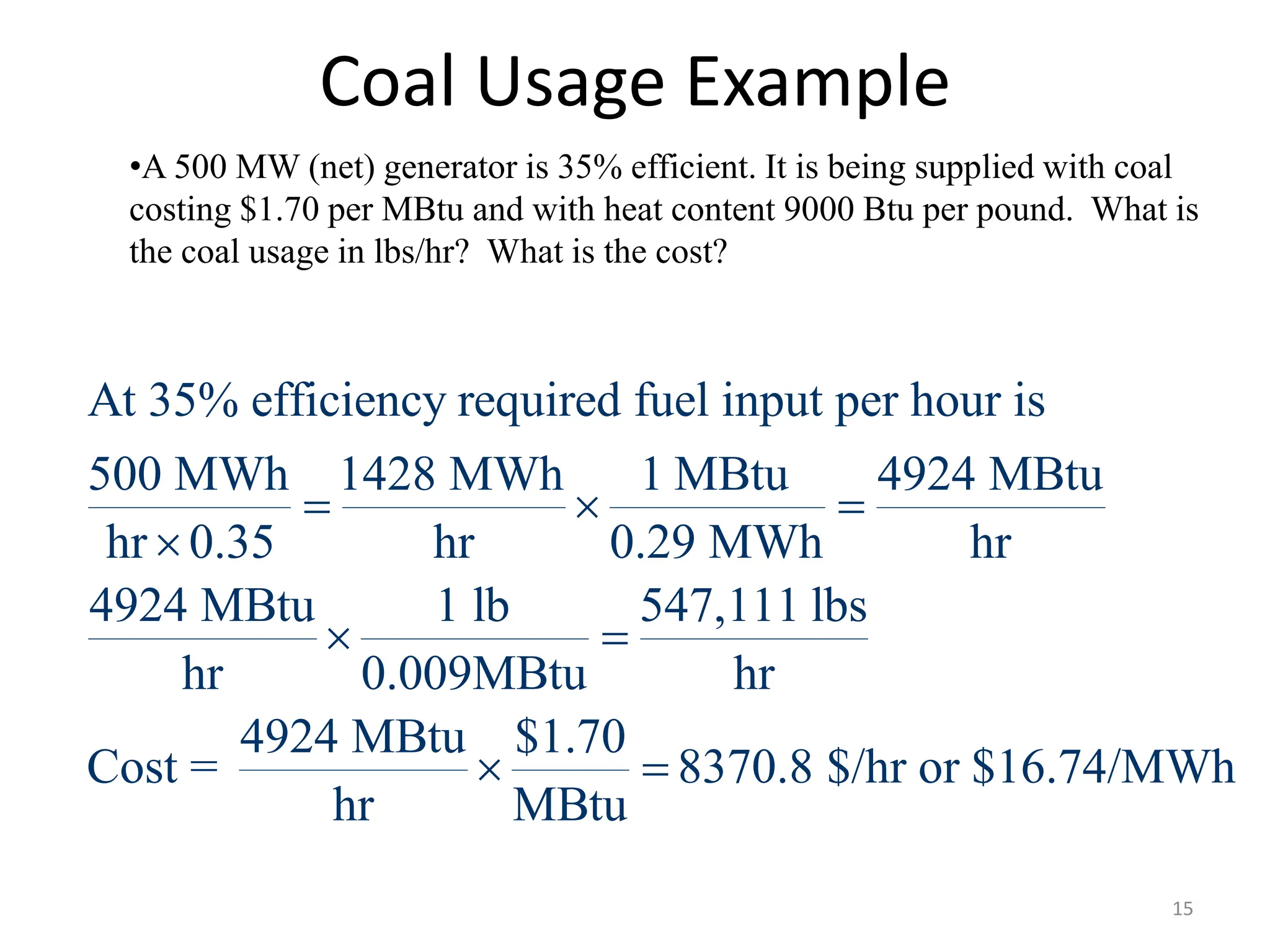
Coal Usage Example
•A 500 MW (net) generator is 35% efficient. It is being supplied with coal
costing $1.70 per MBtu and with heat content 9000 Btu per pound. What is
the coal usage in lbs/hr? What is the cost?
At 35% efficiency required fuel input per hour is
500 MWh 1428 MWh 1 MBtu 4924 MBtu
hr 0.35 hr 0.29 MWh hr
4924 MBtu 1 lb 547,111 lbs
hr 0.009MBtu hr
4924 MBtu $1.70
Cost = 8370.8 $/hr or $16.74/MWh
hr MBtu
  

 
 
15
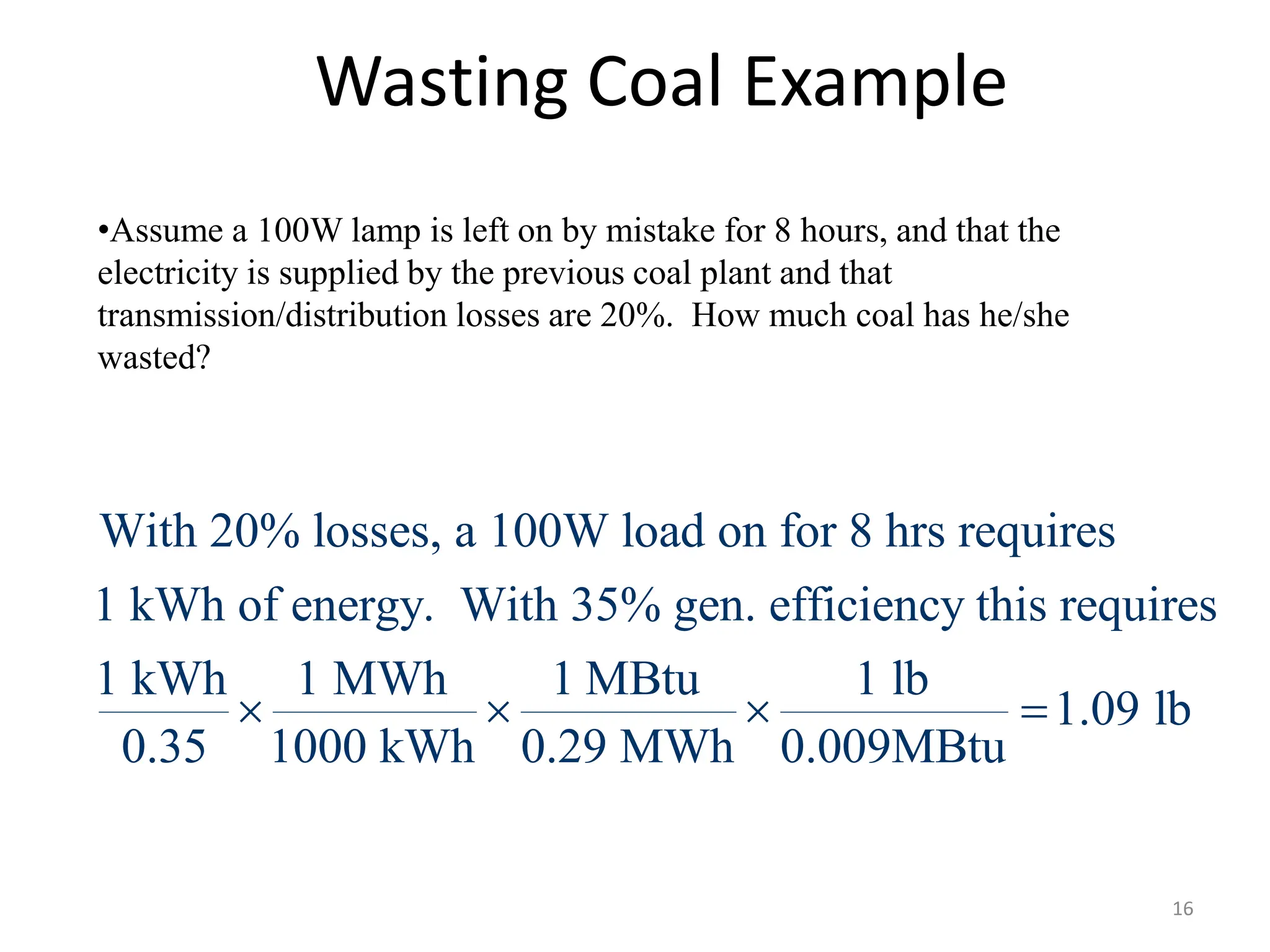
Wasting Coal Example
•Assume a 100W lamp is left on by mistake for 8 hours, and that the
electricity is supplied by the previous coal plant and that
transmission/distribution losses are 20%. How much coal has he/she
wasted?
With 20% losses, a 100W load on for 8 hrs requires
1 kWh of energy. With 35% gen. efficiency this requires
1 kWh 1 MWh 1 MBtu 1 lb
1.09 lb
0.35 1000 kWh 0.29 MWh 0.009MBtu
   
16
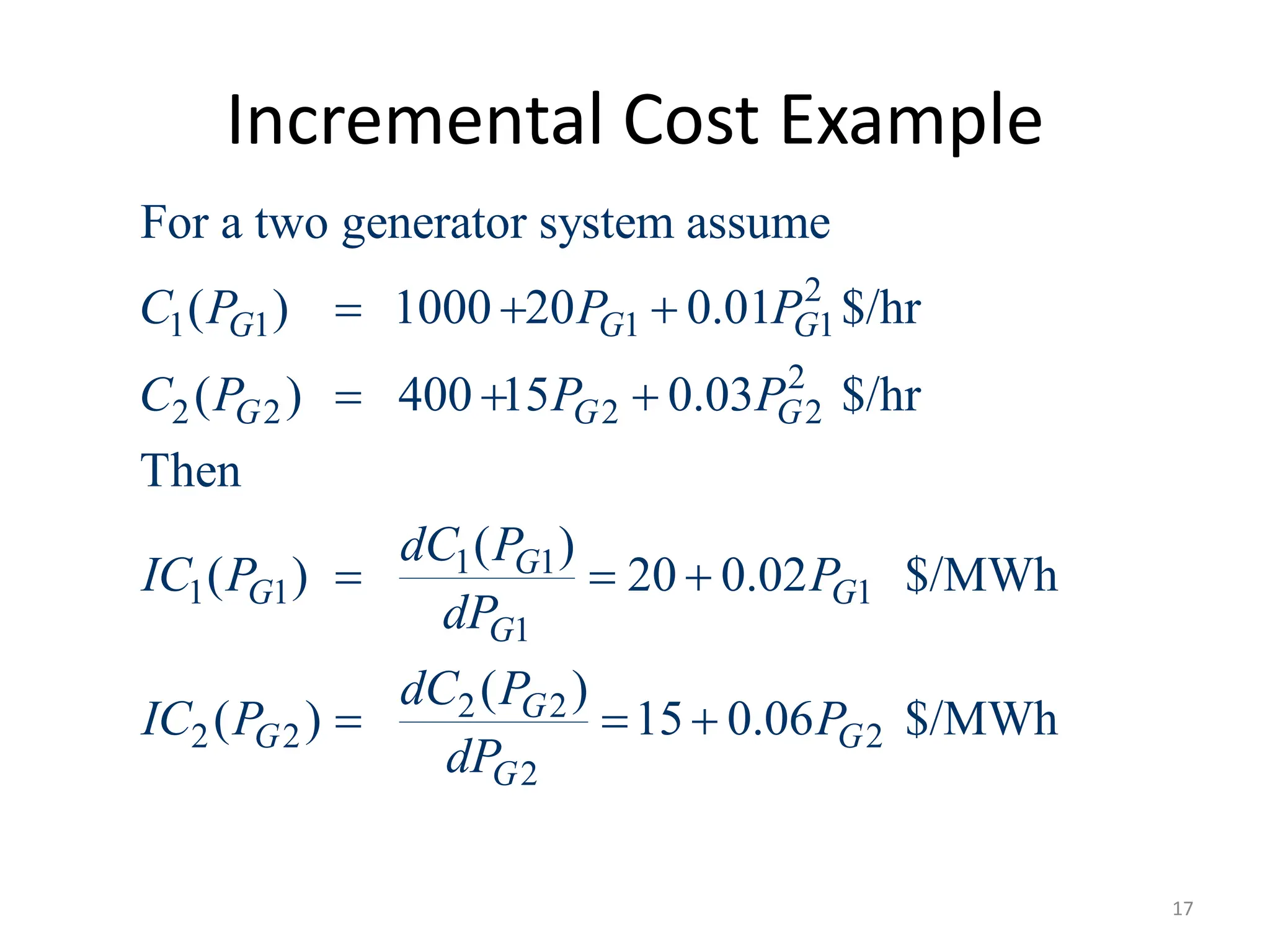
Incremental Cost Example
2
1 1 1 1
2
2 2 2 2
1 1
1 1 1
1
2 2
2 2 2
2
For a two generator system assume
( ) 1000 20 0.01 $/hr
( ) 400 15 0.03 $/hr
Then
( )
( ) 20 0.02 $/MWh
( )
( ) 15 0.06 $/MWh
G G G
G G G
G
G G
G
G
G G
G
C P P P
C P P P
dC P
IC P P
dP
dC P
IC P P
dP
  
  
  
  
17
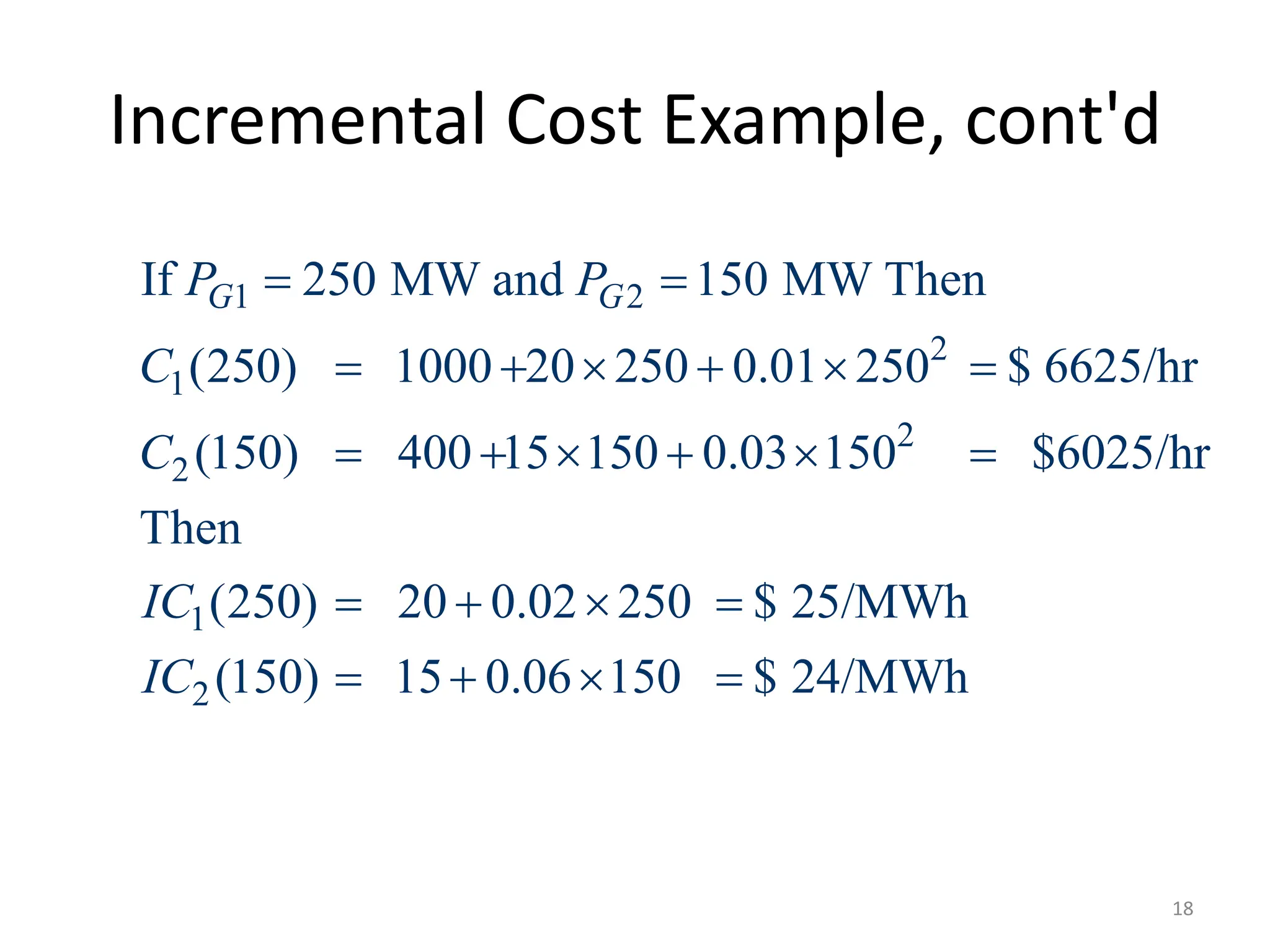
Incremental Cost Example, cont'd
1 2
2
1
2
2
1
2
If 250 MW and 150 MW Then
(250) 1000 20 250 0.01 250 $ 6625/hr
(150) 400 15 150 0.03 150 $6025/hr
Then
(250) 20 0.02 250 $ 25/MWh
(150) 15 0.06 150 $ 24/MWh
G G
P P
C
C
IC
IC
 
     
     
   
   
18
Hydrothermal Scheduling
19
UNIT-2
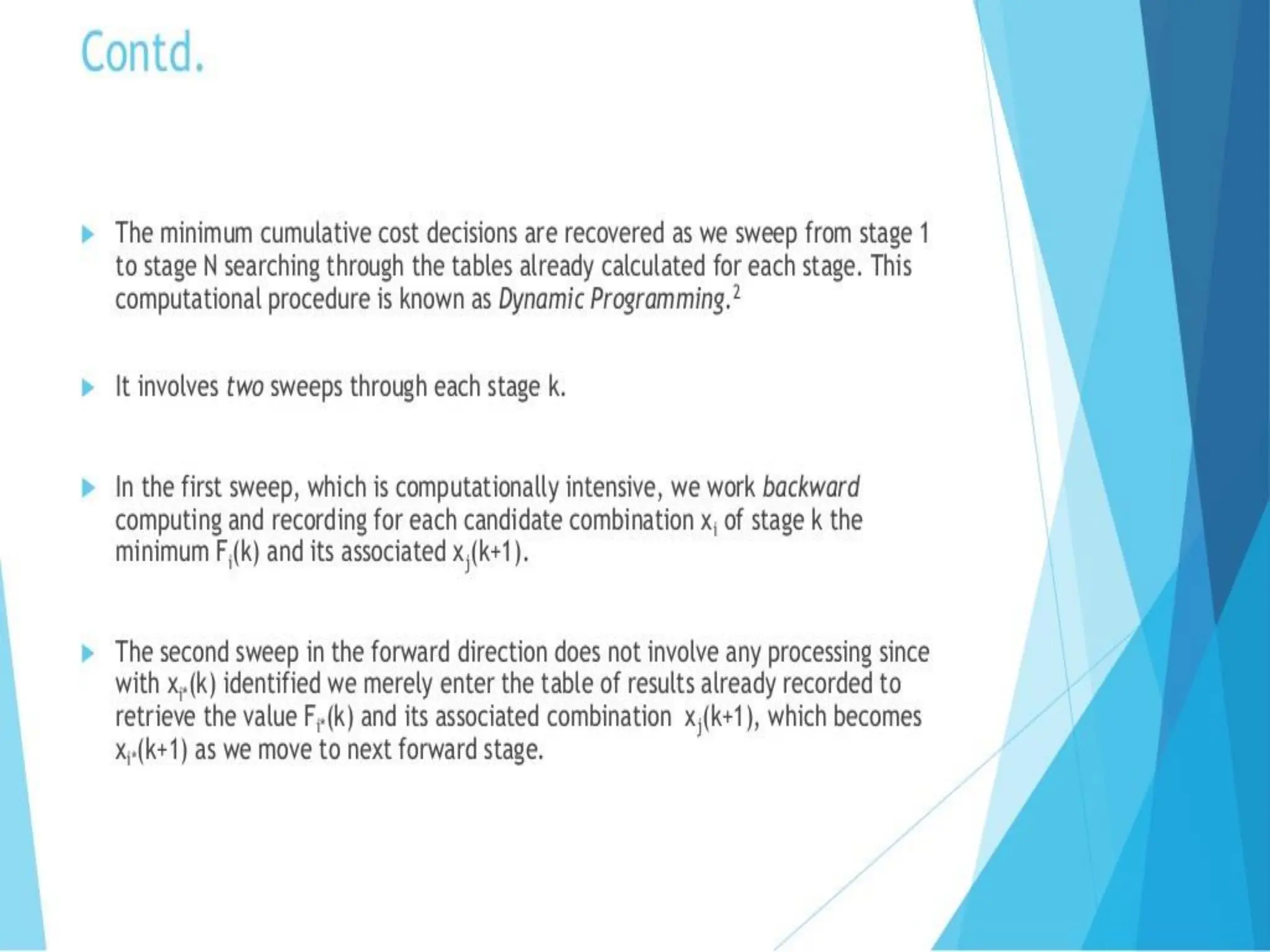
From an overall systems view, the single most important attribute of
hydroelectric plants is that there is no fuel cost, therefore production costs,
relative to that of thermal plants, are very small.
There are three basic types of hydroelectric plants: run-of-river, pumped
storage, and reservoir systems. We will just introduce the first two in this
section, and then the remainder of these notes will be dedicated to
understanding reservoir systems.
Introduction
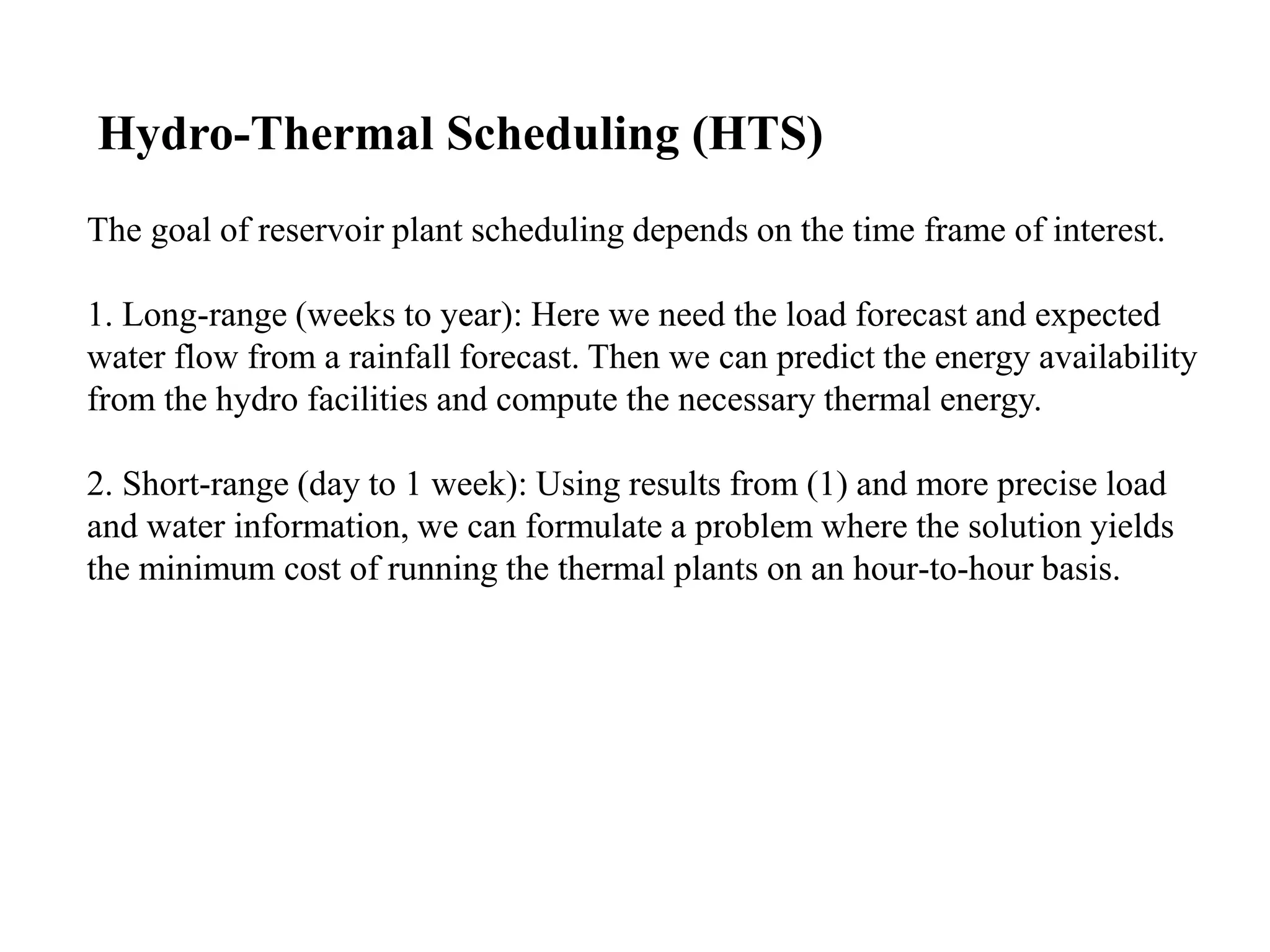
The goal of reservoir plant scheduling depends on the time frame of interest.
1. Long-range (weeks to year): Here we need the load forecast and expected
water flow from a rainfall forecast. Then we can predict the energy availability
from the hydro facilities and compute the necessary thermal energy.
2. Short-range (day to 1 week): Using results from (1) and more precise load
and water information, we can formulate a problem where the solution yields
the minimum cost of running the thermal plants on an hour-to-hour basis.
Hydro-Thermal Scheduling (HTS)
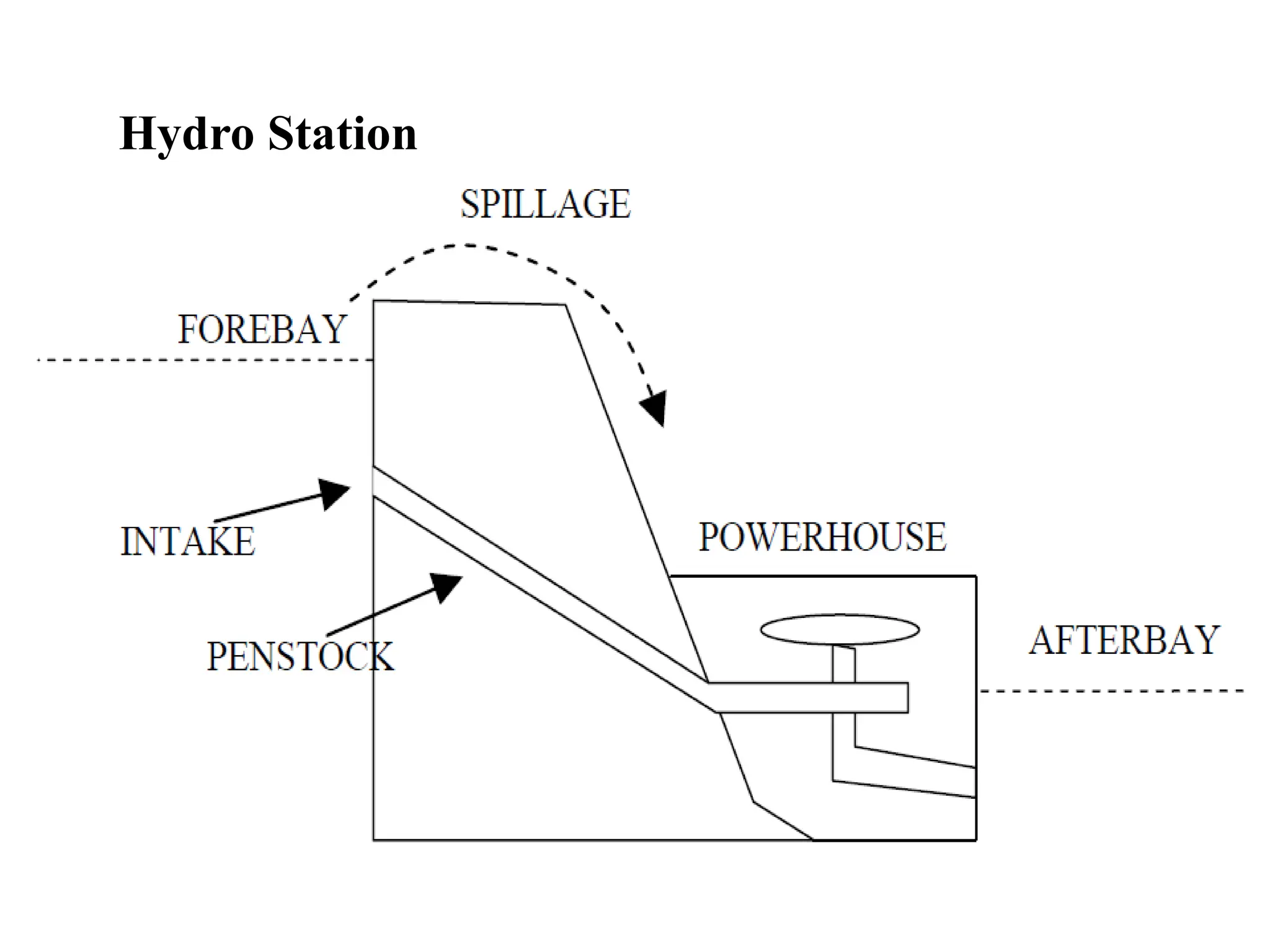
Hydro Station
Forebay: A lake or water impoundment (reservoir) before the entrance to the
power plant.
Afterbay: A lake or water impoundment downstream from the power plant
that receives the water after it has passed through the turbines.
Penstock: The pipe leading from the water intake to the turbine.
Intake: The entrance from the forebay to the penstock.
Spillage: releasing water over the dam rather than through the penstock.
Some dams have spillways, as shown in Fig. 17, which allow smolts
(adolescent salmon) to pass without transiting through the turbines.
Terminology
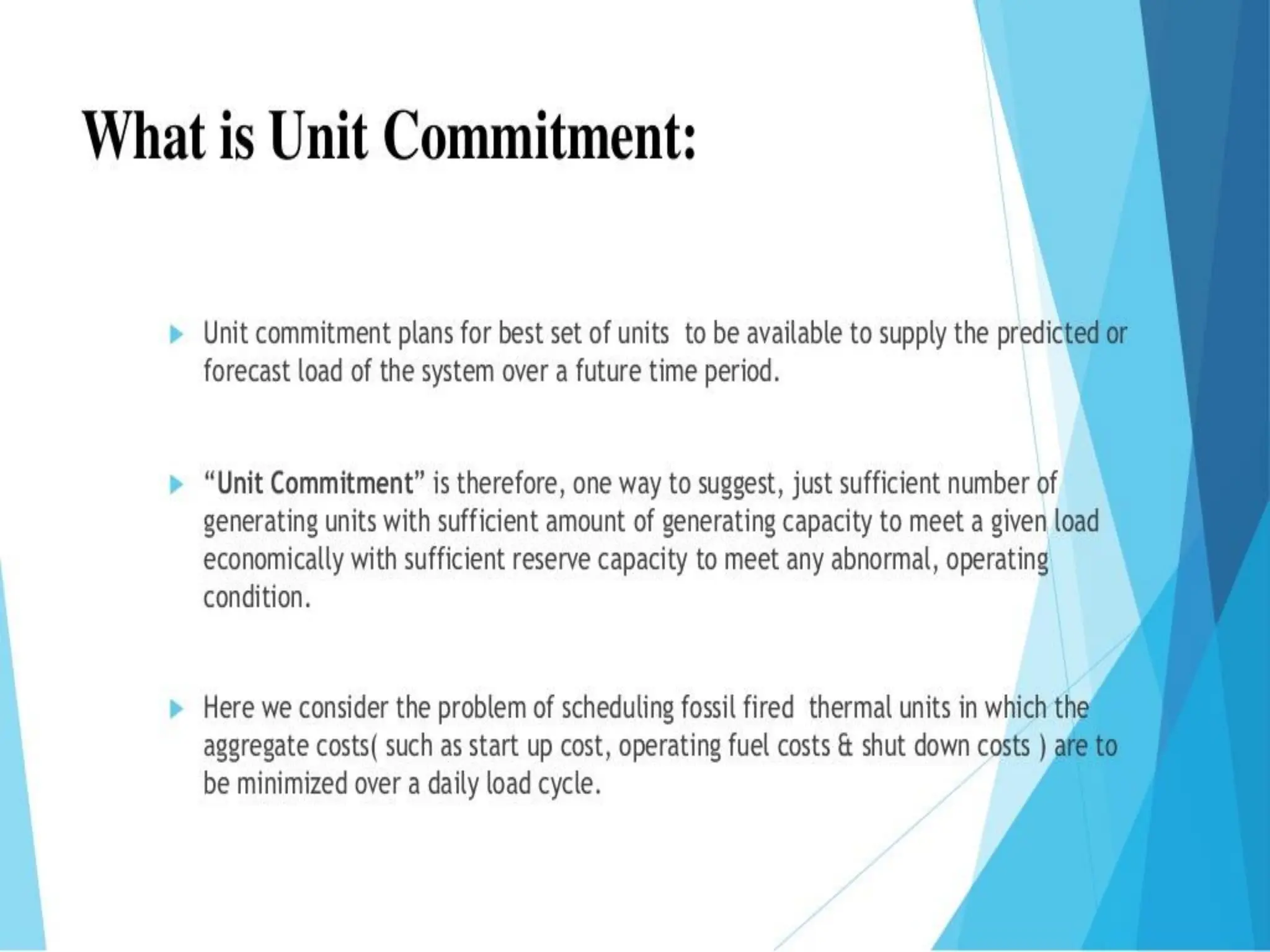
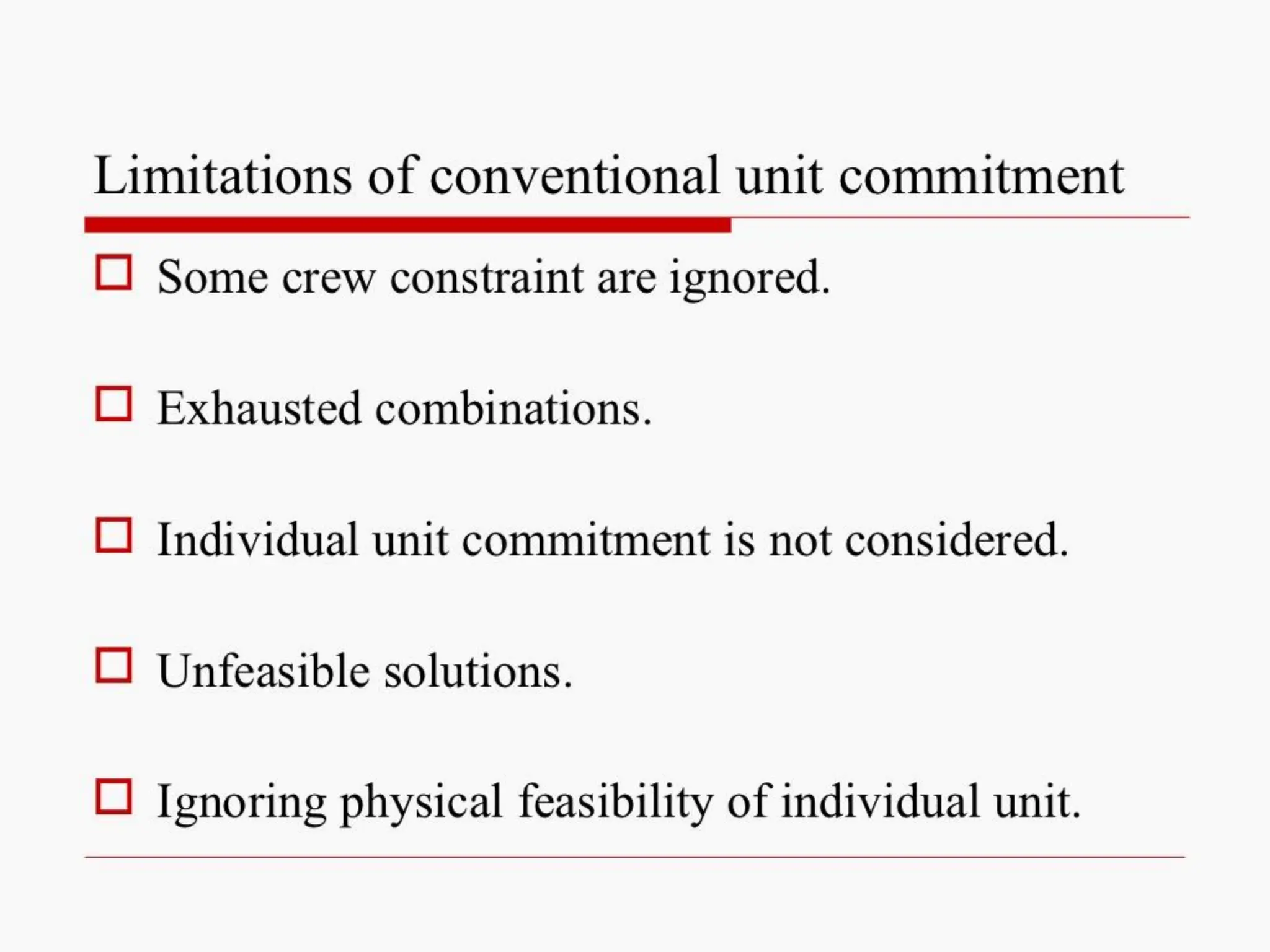
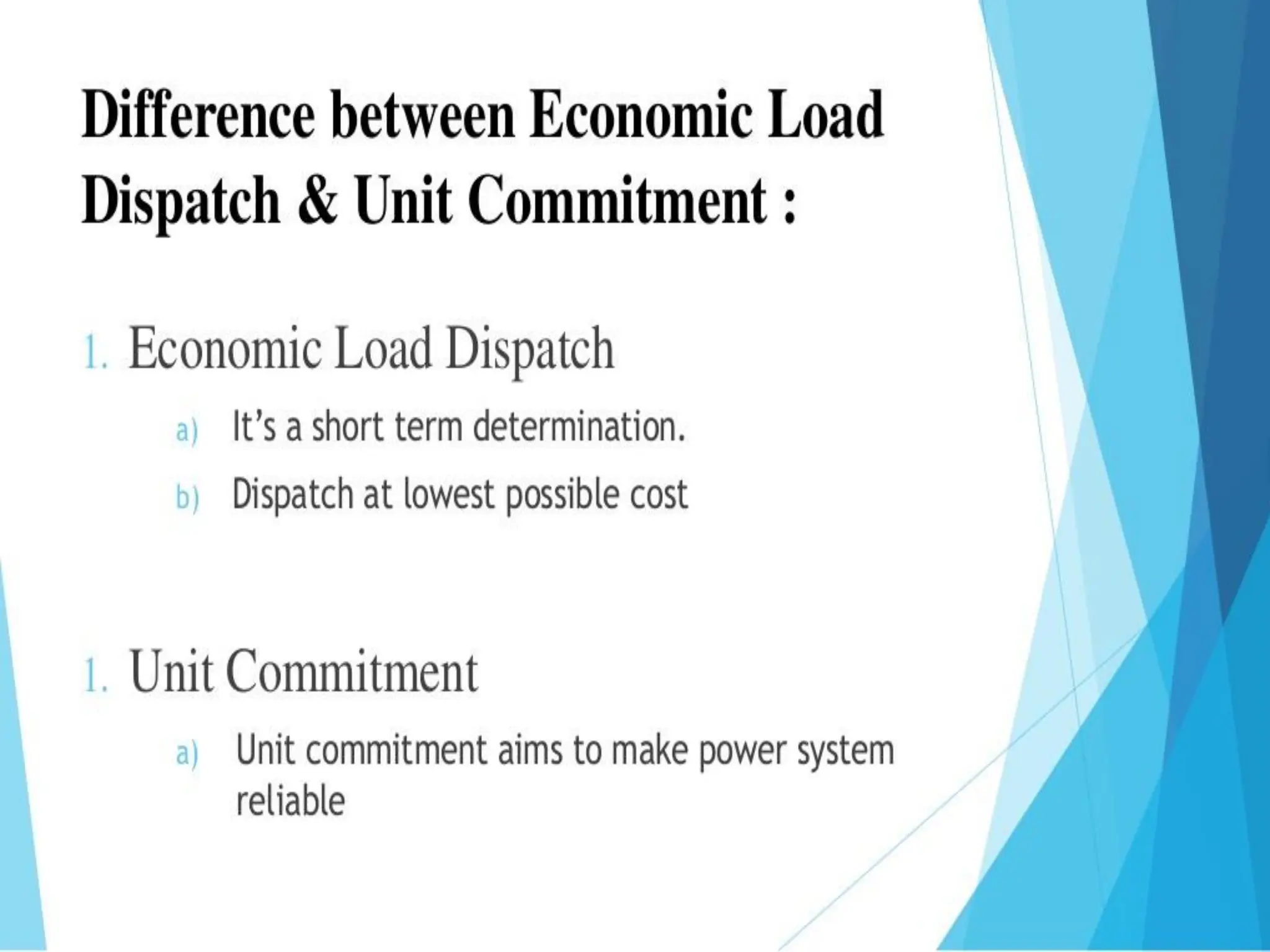
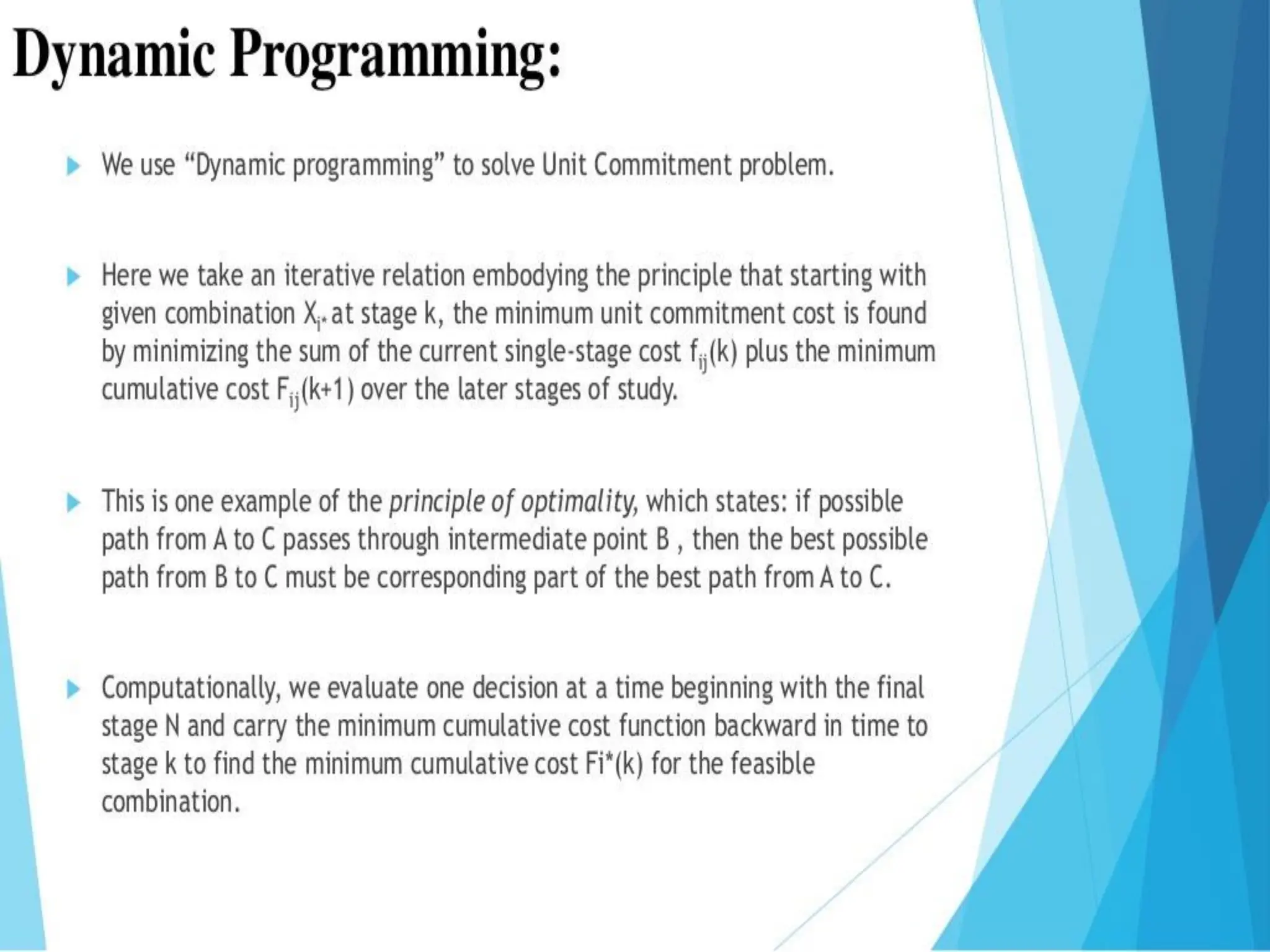
UNIT COMMITMENT
UNIT-3
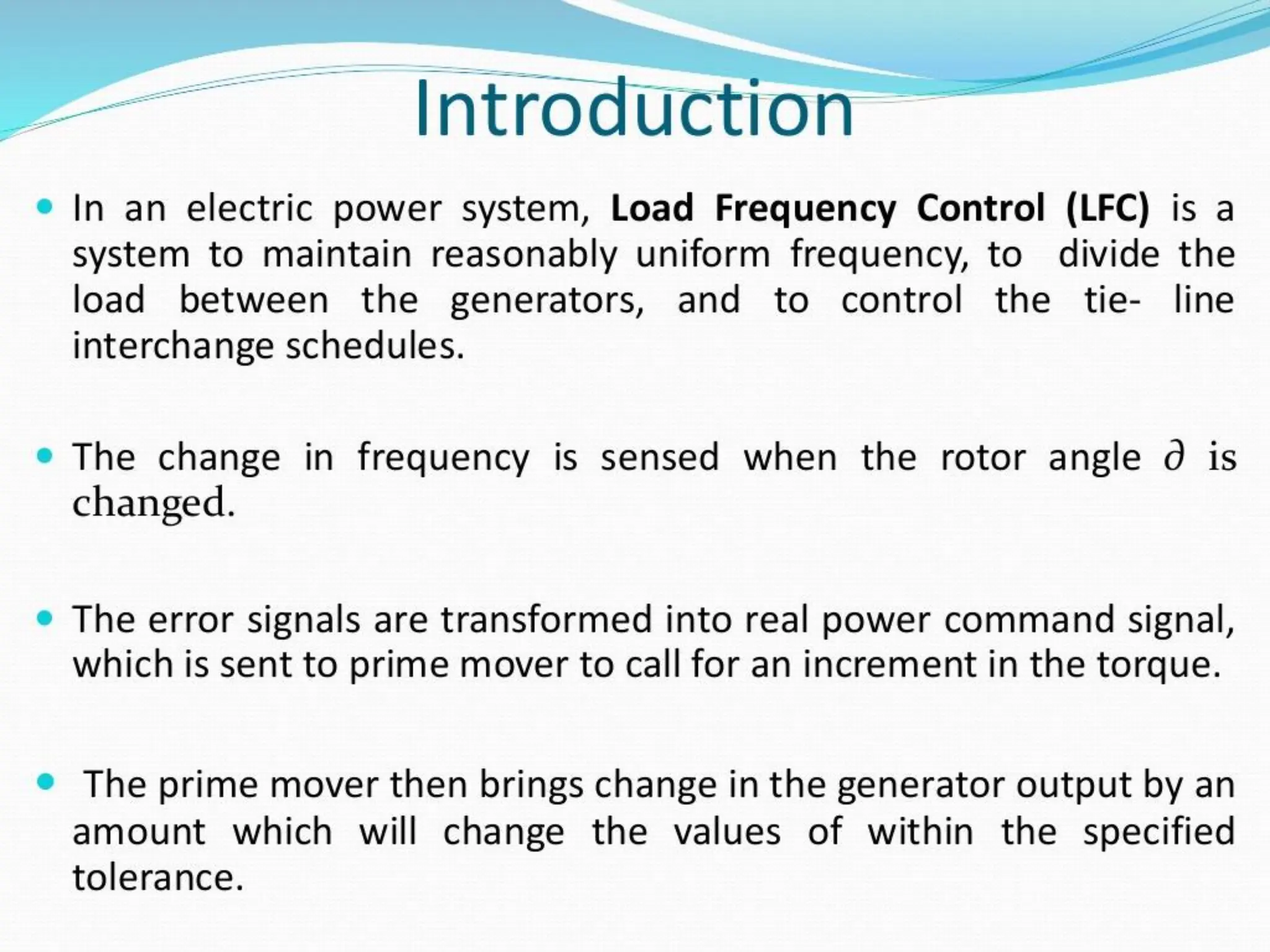
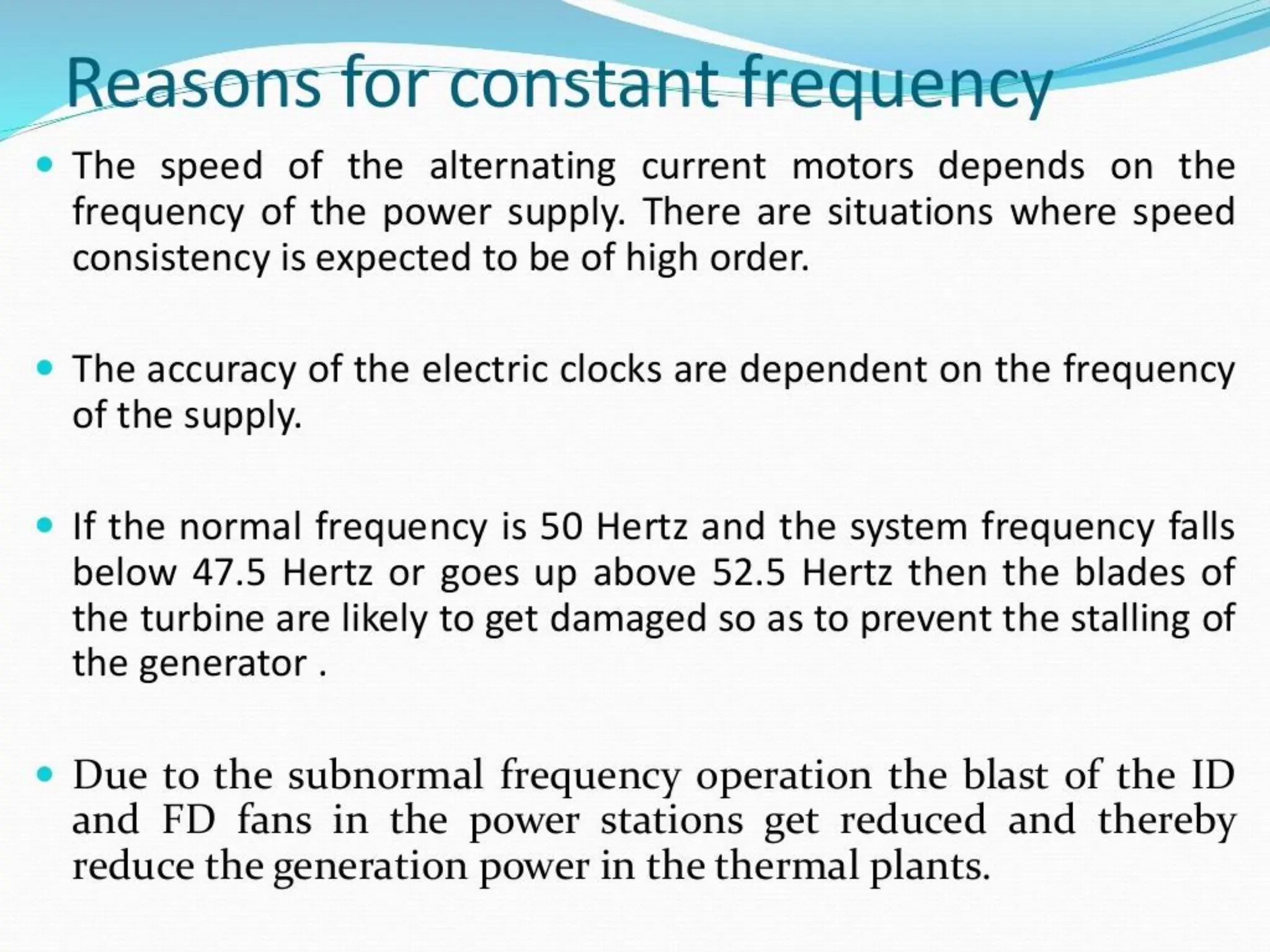
LOAD FREQUENCY CONTROL
UNIT-4
LOAD FREQUENCY CONTROLLER
UNIT-5
REACTIVE POWER CONTROL
UNIT-6
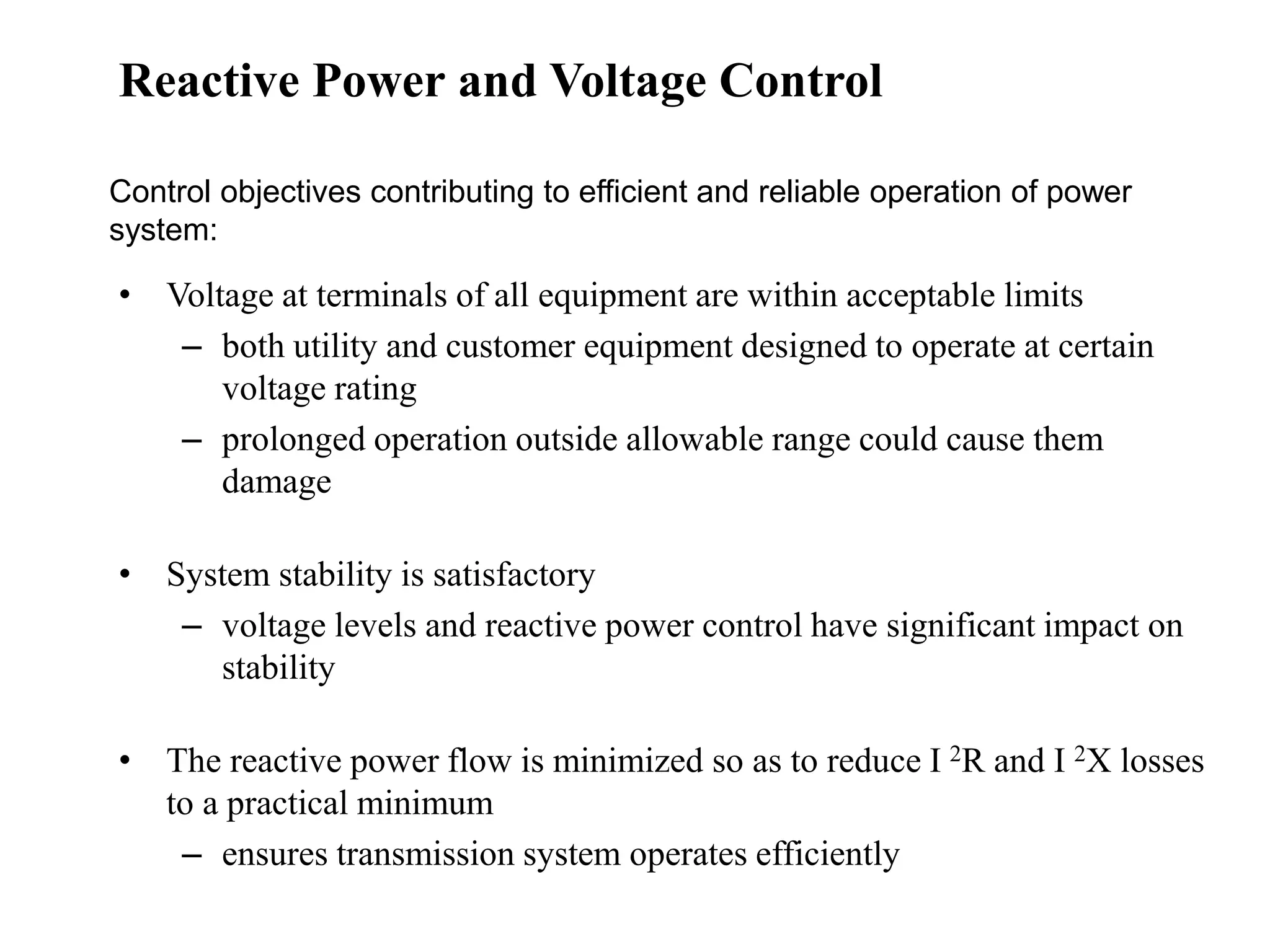
• Voltage at terminals of all equipment are within acceptable limits
– both utility and customer equipment designed to operate at certain
voltage rating
– prolonged operation outside allowable range could cause them
damage
• System stability is satisfactory
– voltage levels and reactive power control have significant impact on
stability
• The reactive power flow is minimized so as to reduce I 2R and I 2X losses
to a practical minimum
– ensures transmission system operates efficiently
Control objectives contributing to efficient and reliable operation of power
system:
Reactive Power and Voltage Control
• Synchronous Generators
– can generate or absorb Q depending on
excitation
– capability limited by field current, armature
current, and end-region heating limits
– automatic voltage regulator continuously adjusts
excitation to control armature voltage
– primary source of voltage support!
• Overhead lines
– at loads below natural or surge impedance load
(SIL), produce Q
– at loads above SIL, absorb Q
Production and Absorption of Reactive Power (Q)
• Underground cables
– have high SIL due to high capacitance
– always loaded below SIL, and hence generate Q
Transformers
absorb Q due to shunt magnetizing reactance and series leakage
inductance
Loads
a typical "load bus" is composed of a large number of devices
composite characteristics are normally such that a load bus absorbs Q
industrial loads usually have shunt capacitors to improve power factor
As power flow conditions vary, reactive power requirements of
transmission network vary
Since Q cannot be transmitted over long distances, voltage control has to
be effected using special devices dispersed throughout the system
Methods of Voltage Control
• Control of voltage levels is accomplished by controlling the production,
absorption, and flow of reactive power at all levels in the system
• Generating units provide the basic means of voltage control
• Additional means are usually required to control voltage throughout the
system:
– sources or sinks of reactive power, such as shunt capacitors, shunt
reactors, synchronous condensers, and static var compensators
(SVCs)
– line reactance compensators, such as series capacitors
– regulating transformers, such as tap-changing transformers and
boosters
• Shunt capacitors and reactors, and series capacitors provide passive
compensation
– are either permanently connected to the transmission and distribution
system, or switched
– contribute to voltage control by modifying the network
characteristics
• Synchronous condensers and SVCs provide active compensation; the
reactive power absorbed/ supplied by them are automatically adjusted so
as to maintain voltages of the buses to which they are connected
– together with the generating units, they establish voltages at specific
points in the system
– voltages at other locations in the system are determined by active and
reactive power flows through various circuit elements, including the
passive compensating devices
Methods of Voltage Control
• To control voltage and/or improve maximum power transfer
capability
• Achieved by modifying effective line parameters:
– characteristic impedance,
– electrical length, θ = βl
• The voltage profile is determined by ZC
• The maximum power that can be transmitted depends on ZC as well
as β
Objectives of Reactive Power Compensation
• Used to compensate the undesirable voltage effects associated with line
capacitance
– limit voltage rise on open circuit or light load
• Shunt compensation with reactors:
– increases effective ZC
– reduces the effective natural load , i.e., voltage at which flat voltage
profile is achieved
• They are connected either:
– directly to the lines at the ends, or
– to transformer tertiary windings; conveniently switched as var
requirements vary
• Line reactors assist in limiting switching surges
• In very long lines, at least some reactors are required to be connected to
lines
Shunt Reactors
• Used in transmission systems to compensate for I 2X losses
• Connected either directly to H.V. bus or to tertiary winding of
transformers
• Normally distributed throughout the system so as to minimize losses and
voltage drops
• Usually switched: a convenient means of controlling voltage
• Shunt capacitor compensation of transmission lines in effect
– decreases ZC
– increases θ, i.e., electrical length
• Advantages: low cost and flexibility of installation and operating
• Disadvantages: Q output is proportional to square of the voltage; hence
Q output reduced at low voltages
• Shunt capacitors are used extensively in distribution systems for power
factor correction and feeder voltage control
Shunt Capacitors
• Connected in series with the line
• Used to reduce effective inductive reactance of line
– increases maximum power
– reduces I 2X loss
• Series capacitive compensation in effect reduces both:
– characteristic impedance ZC, and
– electrical length θ
• Reactive power produced increases with increasing power transfer
– Self regulating !
• Typical applications
– improve power transfer compatibility
– alter load division among parallel lines
– voltage regulation
Series Capacitors
• A synchronous machine running without a prime mover or a
mechanical load
• Depending on field excitation, it can either absorb or generate vars
• With a voltage regulator, it can automatically adjust vars to maintain
constant voltage
• Started as an induction motor and then synchronized
• Normally connected to tertiary windings of transformers
• Unlike a SVC, a synchronous condenser has an internal voltage
• Speed of response not as fast as that of an SVC
Synchronous Condenser
• Shunt connected static var generators and/or absorbers whose outputs
are varied so as to control specific power system quantities
• The term static is used to denote that there are no moving or rotating
components
• Basic types of SVCs:
– thyristor-controlled reactor
– thyristor-switched capacitor
– saturated reactor
• A static var system (SVS) is an aggregation of SVCs and mechanically
switched capacitors or reactors whose outputs are coordinated
• When operating at its capacitive limit, an SVC behaves like a simple
capacitor
Static VAR Compensators (SVC)
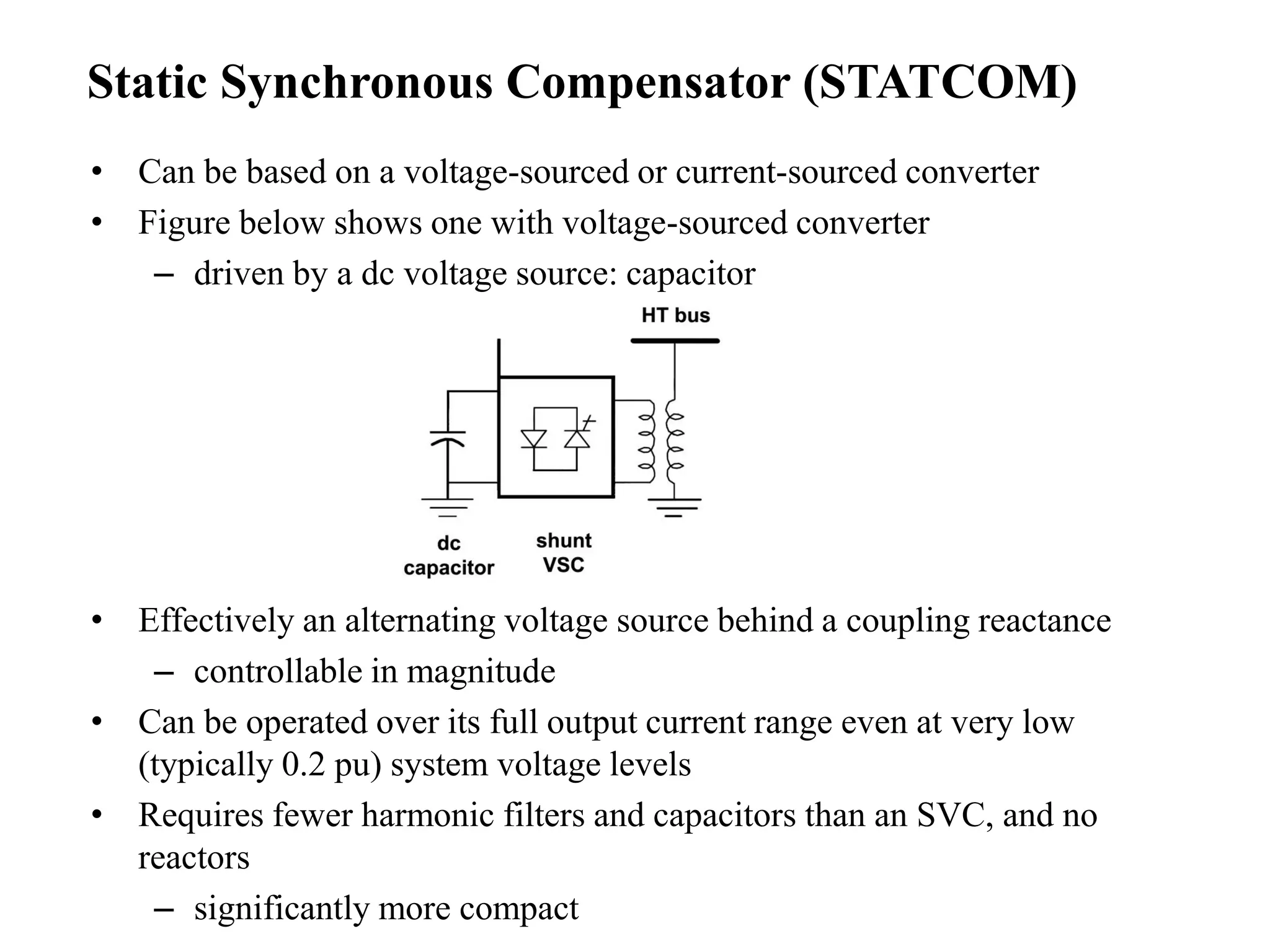
• Can be based on a voltage-sourced or current-sourced converter
• Figure below shows one with voltage-sourced converter
– driven by a dc voltage source: capacitor
• Effectively an alternating voltage source behind a coupling reactance
– controllable in magnitude
• Can be operated over its full output current range even at very low
(typically 0.2 pu) system voltage levels
• Requires fewer harmonic filters and capacitors than an SVC, and no
reactors
– significantly more compact
Static Synchronous Compensator (STATCOM)
• Transformer with tap-changing facilities constitute an important means
of controlling voltages throughout the power system
• Control of a single transformer will cause changes in voltages at its
terminals
– in turn this influences reactive power flow
– resulting effect on the voltages at other buses will depend on network
configuration and load/generation distribution
• Coordinated control of the tap changers of all transformers
interconnecting the subsystems required to achieve overall desired effect
• During high system load conditions, network voltages are kept at highest
practical level to
– minimize reactive power requirements
– increase effectiveness of shunt capacitors and line charging
Tap-Changing Transformers
• The highest allowable operating voltage of the transmission network is
governed by
– requirement that insulation levels of equipment not be exceeded
– need to take into consideration possible switching operations and
outage conditions
• During light load conditions, it is usually required to lower network
voltages
– reduce line charging
– avoid underexcited operation of generators
• Transformers with under-load tap-changers (ULTC) are used to take care
of daily, hourly, and minute-by-minute variations in system conditions
• Off-load tap-changing transformers used to take care of long-term
variations due to system expansion, load growth, or seasonal changes

EEE-Power System Operation and ControlUNIT WISE NOTES

  • 1.
    POWER SYSTEM OPERATION ANDCONTROL By Dr. V SEKHAR AssociateProfessor
  • 2.
  • 3.
    Power System EconomicOperation • Different generation technologies vary in the: – capital costs necessary to build the generator – fuel costs to actually produce electric power • For example: – nuclear and hydro have high capital costs and low operating costs. – Natural gas generators have low capital costs, and (with gas available from fracking) moderate operating costs. 3
  • 4.
    Power System EconomicOperation • Fuel cost to generate a MWh can vary widely from technology to technology. • For some types of units, such as hydro, “fuel” costs are zero but the limit on total available water gives it an implicit value. • For thermal units it is much easier to characterize costs. • We will focus on minimizing the variable operating costs (primarily fuel costs) to meet demand. 4
  • 5.
    Power System EconomicOperation • Power system loads are cyclical. • Therefore the installed generation capacity is usually much greater than the current load. • This means that there are typically many ways we could meet the current load. • Since different states have different mixes of generation, we will consider how generally to minimize the variable operating costs given an arbitrary, specified portfolio of generators. 5
  • 6.
    Thermal versus OtherGeneration  The main types of generating units are thermal and hydro, with wind and solar rapidly growing.  For hydro the fuel (water) is free but there may be many constraints on operation: – fixed amounts of water available, – reservoir levels must be managed and coordinated, – downstream flow rates for fish and navigation.  Hydro optimization is typically longer term (many months or years).  We will concentrate on dispatchable thermal units, looking at short-term optimization:  Non-dispatchable wind and solar can be incorporated by subtracting from load. 6
  • 7.
    Generator types  Traditionallyutilities have had three broad groups of generators: – “Baseload” units: large coal/nuclear; almost always on at max. – “Midload,” ‘intermediate,” or “cycling” units: smaller coal or gas that cycle on/off daily or weekly. – “Peaker” units: combustion turbines used only for several hours. during periods of high demand 7
  • 8.
    Block Diagram ofThermal Unit •To optimize generation costs we need to develop cost relationships between net power out and operating costs. •Between 2-10% of power is used within the generating plant; this is known as the auxiliary power. 8
  • 9.
    Thermal generator CostCurves  Thermal generator costs are typically represented by one or other of the following four curves – input/output (I/O) curve – fuel-cost curve – heat-rate curve – incremental cost curve  For reference - 1 Btu (British thermal unit) = 1054 J - 1 MBtu = 1x10⁶ Btu - 1 MBtu = 0.29 MWh 9
  • 10.
    I/O Curve  TheIO curve plots fuel input (in MBtu/hr) versus net MW output. 10
  • 11.
    Fuel-cost Curve  Thefuel-cost curve is the I/O curve multiplied by fuel cost.  A typical cost for coal is $ 1.70/MBtu. 11
  • 12.
    Heat-rate Curve • Plotsthe average number of MBtu/hr of fuel input needed per MW of output. • Heat-rate curve is the I/O curve divided by MW. Best heat-rate for most efficient coal units is around 9.0 12
  • 13.
    Incremental (Marginal) costCurve  Plots the incremental $/MWh as a function of MW.  Found by differentiating the cost curve. 13
  • 14.
    Mathematical Formulation ofCosts  Generator cost curves are usually not smooth. However the curves can usually be adequately approximated using piece-wise smooth, functions.  Two approximations predominate: – quadratic or cubic functions – piecewise linear functions  We'll assume a quadratic approximation: 2 ( ) $/hr (fuel-cost) ( ) ( ) 2 $/MWh i Gi i i Gi i Gi i Gi i Gi i i Gi Gi C P P P dC P IC P P dP            14
  • 15.
    Coal Usage Example •A500 MW (net) generator is 35% efficient. It is being supplied with coal costing $1.70 per MBtu and with heat content 9000 Btu per pound. What is the coal usage in lbs/hr? What is the cost? At 35% efficiency required fuel input per hour is 500 MWh 1428 MWh 1 MBtu 4924 MBtu hr 0.35 hr 0.29 MWh hr 4924 MBtu 1 lb 547,111 lbs hr 0.009MBtu hr 4924 MBtu $1.70 Cost = 8370.8 $/hr or $16.74/MWh hr MBtu         15
  • 16.
    Wasting Coal Example •Assumea 100W lamp is left on by mistake for 8 hours, and that the electricity is supplied by the previous coal plant and that transmission/distribution losses are 20%. How much coal has he/she wasted? With 20% losses, a 100W load on for 8 hrs requires 1 kWh of energy. With 35% gen. efficiency this requires 1 kWh 1 MWh 1 MBtu 1 lb 1.09 lb 0.35 1000 kWh 0.29 MWh 0.009MBtu     16
  • 17.
    Incremental Cost Example 2 11 1 1 2 2 2 2 2 1 1 1 1 1 1 2 2 2 2 2 2 For a two generator system assume ( ) 1000 20 0.01 $/hr ( ) 400 15 0.03 $/hr Then ( ) ( ) 20 0.02 $/MWh ( ) ( ) 15 0.06 $/MWh G G G G G G G G G G G G G G C P P P C P P P dC P IC P P dP dC P IC P P dP             17
  • 18.
    Incremental Cost Example,cont'd 1 2 2 1 2 2 1 2 If 250 MW and 150 MW Then (250) 1000 20 250 0.01 250 $ 6625/hr (150) 400 15 150 0.03 150 $6025/hr Then (250) 20 0.02 250 $ 25/MWh (150) 15 0.06 150 $ 24/MWh G G P P C C IC IC                       18
  • 19.
  • 20.
    From an overallsystems view, the single most important attribute of hydroelectric plants is that there is no fuel cost, therefore production costs, relative to that of thermal plants, are very small. There are three basic types of hydroelectric plants: run-of-river, pumped storage, and reservoir systems. We will just introduce the first two in this section, and then the remainder of these notes will be dedicated to understanding reservoir systems. Introduction
  • 21.
    The goal ofreservoir plant scheduling depends on the time frame of interest. 1. Long-range (weeks to year): Here we need the load forecast and expected water flow from a rainfall forecast. Then we can predict the energy availability from the hydro facilities and compute the necessary thermal energy. 2. Short-range (day to 1 week): Using results from (1) and more precise load and water information, we can formulate a problem where the solution yields the minimum cost of running the thermal plants on an hour-to-hour basis. Hydro-Thermal Scheduling (HTS)
  • 22.
  • 23.
    Forebay: A lakeor water impoundment (reservoir) before the entrance to the power plant. Afterbay: A lake or water impoundment downstream from the power plant that receives the water after it has passed through the turbines. Penstock: The pipe leading from the water intake to the turbine. Intake: The entrance from the forebay to the penstock. Spillage: releasing water over the dam rather than through the penstock. Some dams have spillways, as shown in Fig. 17, which allow smolts (adolescent salmon) to pass without transiting through the turbines. Terminology
  • 24.
  • 30.
  • 41.
  • 45.
  • 46.
    • Voltage atterminals of all equipment are within acceptable limits – both utility and customer equipment designed to operate at certain voltage rating – prolonged operation outside allowable range could cause them damage • System stability is satisfactory – voltage levels and reactive power control have significant impact on stability • The reactive power flow is minimized so as to reduce I 2R and I 2X losses to a practical minimum – ensures transmission system operates efficiently Control objectives contributing to efficient and reliable operation of power system: Reactive Power and Voltage Control
  • 47.
    • Synchronous Generators –can generate or absorb Q depending on excitation – capability limited by field current, armature current, and end-region heating limits – automatic voltage regulator continuously adjusts excitation to control armature voltage – primary source of voltage support! • Overhead lines – at loads below natural or surge impedance load (SIL), produce Q – at loads above SIL, absorb Q Production and Absorption of Reactive Power (Q)
  • 48.
    • Underground cables –have high SIL due to high capacitance – always loaded below SIL, and hence generate Q Transformers absorb Q due to shunt magnetizing reactance and series leakage inductance Loads a typical "load bus" is composed of a large number of devices composite characteristics are normally such that a load bus absorbs Q industrial loads usually have shunt capacitors to improve power factor As power flow conditions vary, reactive power requirements of transmission network vary Since Q cannot be transmitted over long distances, voltage control has to be effected using special devices dispersed throughout the system
  • 49.
    Methods of VoltageControl • Control of voltage levels is accomplished by controlling the production, absorption, and flow of reactive power at all levels in the system • Generating units provide the basic means of voltage control • Additional means are usually required to control voltage throughout the system: – sources or sinks of reactive power, such as shunt capacitors, shunt reactors, synchronous condensers, and static var compensators (SVCs) – line reactance compensators, such as series capacitors – regulating transformers, such as tap-changing transformers and boosters
  • 50.
    • Shunt capacitorsand reactors, and series capacitors provide passive compensation – are either permanently connected to the transmission and distribution system, or switched – contribute to voltage control by modifying the network characteristics • Synchronous condensers and SVCs provide active compensation; the reactive power absorbed/ supplied by them are automatically adjusted so as to maintain voltages of the buses to which they are connected – together with the generating units, they establish voltages at specific points in the system – voltages at other locations in the system are determined by active and reactive power flows through various circuit elements, including the passive compensating devices Methods of Voltage Control
  • 51.
    • To controlvoltage and/or improve maximum power transfer capability • Achieved by modifying effective line parameters: – characteristic impedance, – electrical length, θ = βl • The voltage profile is determined by ZC • The maximum power that can be transmitted depends on ZC as well as β Objectives of Reactive Power Compensation
  • 52.
    • Used tocompensate the undesirable voltage effects associated with line capacitance – limit voltage rise on open circuit or light load • Shunt compensation with reactors: – increases effective ZC – reduces the effective natural load , i.e., voltage at which flat voltage profile is achieved • They are connected either: – directly to the lines at the ends, or – to transformer tertiary windings; conveniently switched as var requirements vary • Line reactors assist in limiting switching surges • In very long lines, at least some reactors are required to be connected to lines Shunt Reactors
  • 53.
    • Used intransmission systems to compensate for I 2X losses • Connected either directly to H.V. bus or to tertiary winding of transformers • Normally distributed throughout the system so as to minimize losses and voltage drops • Usually switched: a convenient means of controlling voltage • Shunt capacitor compensation of transmission lines in effect – decreases ZC – increases θ, i.e., electrical length • Advantages: low cost and flexibility of installation and operating • Disadvantages: Q output is proportional to square of the voltage; hence Q output reduced at low voltages • Shunt capacitors are used extensively in distribution systems for power factor correction and feeder voltage control Shunt Capacitors
  • 54.
    • Connected inseries with the line • Used to reduce effective inductive reactance of line – increases maximum power – reduces I 2X loss • Series capacitive compensation in effect reduces both: – characteristic impedance ZC, and – electrical length θ • Reactive power produced increases with increasing power transfer – Self regulating ! • Typical applications – improve power transfer compatibility – alter load division among parallel lines – voltage regulation Series Capacitors
  • 55.
    • A synchronousmachine running without a prime mover or a mechanical load • Depending on field excitation, it can either absorb or generate vars • With a voltage regulator, it can automatically adjust vars to maintain constant voltage • Started as an induction motor and then synchronized • Normally connected to tertiary windings of transformers • Unlike a SVC, a synchronous condenser has an internal voltage • Speed of response not as fast as that of an SVC Synchronous Condenser
  • 56.
    • Shunt connectedstatic var generators and/or absorbers whose outputs are varied so as to control specific power system quantities • The term static is used to denote that there are no moving or rotating components • Basic types of SVCs: – thyristor-controlled reactor – thyristor-switched capacitor – saturated reactor • A static var system (SVS) is an aggregation of SVCs and mechanically switched capacitors or reactors whose outputs are coordinated • When operating at its capacitive limit, an SVC behaves like a simple capacitor Static VAR Compensators (SVC)
  • 57.
    • Can bebased on a voltage-sourced or current-sourced converter • Figure below shows one with voltage-sourced converter – driven by a dc voltage source: capacitor • Effectively an alternating voltage source behind a coupling reactance – controllable in magnitude • Can be operated over its full output current range even at very low (typically 0.2 pu) system voltage levels • Requires fewer harmonic filters and capacitors than an SVC, and no reactors – significantly more compact Static Synchronous Compensator (STATCOM)
  • 58.
    • Transformer withtap-changing facilities constitute an important means of controlling voltages throughout the power system • Control of a single transformer will cause changes in voltages at its terminals – in turn this influences reactive power flow – resulting effect on the voltages at other buses will depend on network configuration and load/generation distribution • Coordinated control of the tap changers of all transformers interconnecting the subsystems required to achieve overall desired effect • During high system load conditions, network voltages are kept at highest practical level to – minimize reactive power requirements – increase effectiveness of shunt capacitors and line charging Tap-Changing Transformers
  • 59.
    • The highestallowable operating voltage of the transmission network is governed by – requirement that insulation levels of equipment not be exceeded – need to take into consideration possible switching operations and outage conditions • During light load conditions, it is usually required to lower network voltages – reduce line charging – avoid underexcited operation of generators • Transformers with under-load tap-changers (ULTC) are used to take care of daily, hourly, and minute-by-minute variations in system conditions • Off-load tap-changing transformers used to take care of long-term variations due to system expansion, load growth, or seasonal changes