POWER SYSTEM
PLANING AND
OPERATION
(PCE5312)
CHAPTER FIVE: POWER
SYSTEM OPERATION
BY: MESFIN M.
Outline
➢Operation of Hydropower Generation
➢Energy Management System (EMS)
➢Protection & communication system in power system
➢Operating Voltage and Frequency Control
➢Optimal Power System Operation
➢Interchange evaluation and Power Pool Operation
2
Introduction to Power System
Operation
– Modern power system networks are highly
interconnected systems.
– Planning, Operation, Control and Protection
strategies of power systems are strictly necessary
studies to be involved.
– It is essential to manage the power system in the
most effective manner, which exhibits high
availability and reliability with minimum cost.
3
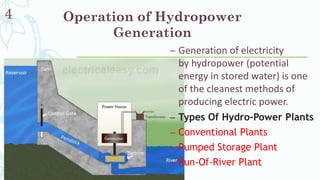
Operation of Hydropower
Generation
– Generation of electricity
by hydropower (potential
energy in stored water) is one
of the cleanest methods of
producing electric power.
– Types Of Hydro-Power Plants
– Conventional Plants
– Pumped Storage Plant
– Run-Of-River Plant
4
Objective of Power System
Management
– To manage the operation of the system, modern power
systems are equipped with Energy Management Systems
which coordinates various control functions in system
operation.
– The prime goal of Energy Management systems is the
secure and economic operation of power systems to ensure
uninterrupted, safe flow of power to customers at
minimum cost.
5
Cont.…
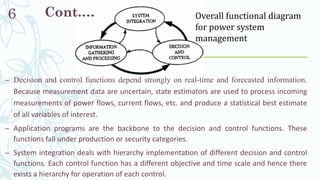
– Decision and control functions depend strongly on real-time and forecasted information.
Because measurement data are uncertain, state estimators are used to process incoming
measurements of power flows, current flows, etc. and produce a statistical best estimate
of all variables of interest.
– Application programs are the backbone to the decision and control functions. These
functions fall under production or security categories.
– System integration deals with hierarchy implementation of different decision and control
functions. Each control function has a different objective and time scale and hence there
exists a hierarchy for operation of each control.
6 Overall functional diagram
for power system
management
Energy Management Systems (EMS)
– Energy management system is the process of
monitoring, coordinating and controlling the
generation, transmission and distribution of electrical
energy.
– The physical plant to be managed includes generating
plants that produce energy fed through transformers to
the HV transmission network(grid), interconnecting
generating plants, and load centres.
7
Cont.…
– Since transmission systems provide negligible energy
storage, supply and demand must be balanced by either
generation or load.
– Production is controlled by turbine governors at
generating plants,
– Automatic generation control is performed by control
centre computers remote from generating plants
8
Cont.….
– Load management(Demand-side management): is the
process of balancing the supply of electricity on the
network with the electrical load by adjusting or controlling
the load rather than the power station output.
– AGC consists of two major and several minor functions that
operate on –line in real time to adjust the generation
against load at minimum cost. The major functions are load
frequency control and economic dispatch,
9
Cont.…
– The minor functions are reserve monitoring,
interchange scheduling, and other similar monitoring
and record functions /load forecast, fault allocation,
trouble analysis/.
– Generation control and ED minimize the current cost
of energy production and transmission within the
range of available controls.
1
0
Protection & Communication
Systems in Power System
– The electric power communication system shall
be designed for speech signals, telecontrol signals
and protection signals.
– Provisions for a remote control of a power plant,
switchyard, substation and Remote Control
Centre (e.g. LDC) via the tele control
communication channels shall be foreseen.
– A communication system based on Optical Fiber
in the Ground Wire (OPGW) is recommended.
11
Operating Frequency and Voltage (LF
and QV) Control
12
– Although there are many things to control in power system, majorly we
control voltage and frequency by controlling other parameters of the
generators, load and other devices in the system.
– For efficient and secured power system:- maintain reliability, security,
stability, operate in most economical way, better quality (frequency
with in the limit (2%), voltage (5% HV, 10% LV)).
– Frequency is global phenomena ( same in one node and other), voltage
is local phenomena (one point and another point is different). Eg.
Change of frequency and voltage affect normal operation of the
system.
Cont.…
– Frequency control can be achieved by controlling active power which
is possible at generation (injecting power) and load end (consuming
power).
– Total Generation < demand = frequency fall. -- generation increase,
or load decrease/ very expensive/not-recommended b/c it affect
power reliability.
– Total Generation > demand = frequency rise. – generation
decrease /load increase, not at hand/
– Reactive power control is responsible mainly for voltage control
which is a local problem.
13
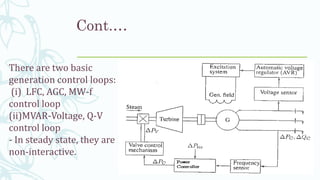
There are two basic
generation control loops:
(i) LFC, AGC, MW-f
control loop
(ii)MVAR-Voltage, Q-V
control loop
- In steady state, they are
non-interactive.
14 Cont.…
Cont’d
– Main ancillary services of Power system Control
– Load-frequency control
– Primary regulation
– Secondary reserves
– Tertiary reserves
– Voltage control
– System restoration
– Automatic generation control (AGC) is used to automatically change generation
to keep the ACE close to zero.
– Usually the utility control center or independent system operator calculates ACE
based upon tie-line flows and frequency; then the AGC module sends control
signals out to the generators every couple of seconds to adjust generation.
15
Cont’d
– In a power system the load demand is continuously changing. In
accordance with it the power input has also to vary. If the input -
output balance is not maintained a change in frequency will occur.
The control of frequency is achieved primarily through speed
governor mechanism aided by supplementary means for precise
control.
– Primary control
– – Makes use of the governor in the generator
– Time constant of about 1 second
– Objective: to prevent frequency deviations
– Each machine has a specific response to frequency deviations
– The primary control cannot completely recover the nominal frequency value
or eliminate errors in scheduled power exchanges
16
Cont’d
– Secondary & tertiary controls
– This is the Automatic Generation Control, AGC
– Time response ~ 1 minute
– Restores frequency & power exchanges to preset values
– It cancels the Area Control Error ACE, which combines both
objectives
– Tertiary control
– This is an economic generation dispatch that recomputes the
set points of generators & restores secondary reserves
– Time response ~15 minutes
17
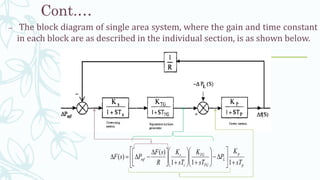
– The block diagram of single area system, where the gain and time constant
in each block are as described in the individual section, is as shown below.
18
Cont.…
p
p
L
TG
TG
s
s
ref
sT
K
P
sT
K
sT
K
R
sF
PsF
+






−





+





+


 
−=
111
)(
)(
18
Economic Operation of Power System
19
ECONOMIC OPERATION /ED-ECONOMIC DISPATCH/
– The economic dispatch problem consists in allocating the
total demand among generating units so that the production
cost is minimized.
– Generating units have different production costs depending
on the prime energy source used to produce electricity
(mainly coal, oil, natural gas, uranium, and water stored in
reservoirs).
20
– In addition to continuous decisions on how to allocate the
demand among generating units, the economics of
electricity generation also requires the calculation of an
optimum time schedule for the start-up and shutdown
costs of the generating units. (since the units’ start-up or
shutdown costs can be significant, on/off scheduling
decisions must be optimally coordinated with the ED of the
continuous generation outputs.
Cont.…
21
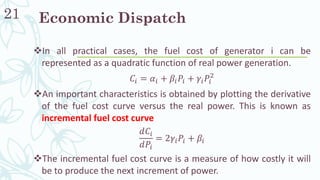
❖In all practical cases, the fuel cost of generator i can be
represented as a quadratic function of real power generation.
𝐶𝑖 = 𝛼𝑖 + 𝛽𝑖 𝑃𝑖 + 𝛾𝑖 𝑃𝑖
2
❖An important characteristics is obtained by plotting the derivative
of the fuel cost curve versus the real power. This is known as
incremental fuel cost curve
𝑑𝐶𝑖
𝑑𝑃𝑖
= 2𝛾𝑖 𝑃𝑖 + 𝛽𝑖
❖The incremental fuel cost curve is a measure of how costly it will
be to produce the next increment of power.
Economic Dispatch
Cont.….
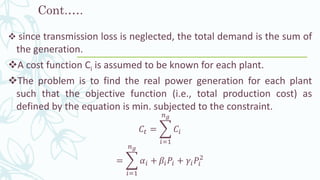
❖ since transmission loss is neglected, the total demand is the sum of
the generation.
❖A cost function Ci is assumed to be known for each plant.
❖The problem is to find the real power generation for each plant
such that the objective function (i.e., total production cost) as
defined by the equation is min. subjected to the constraint.
𝐶𝑡 = ෍
𝑖=1
𝑛 𝑔
𝐶𝑖
= ෍
𝑖=1
𝑛 𝑔
𝛼𝑖 + 𝛽𝑖 𝑃𝑖 + 𝛾𝑖 𝑃𝑖
2
Cont.….
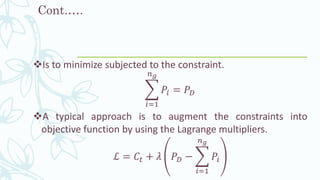
❖Is to minimize subjected to the constraint.
෍
𝑖=1
𝑛 𝑔
𝑃𝑖 = 𝑃 𝐷
❖A typical approach is to augment the constraints into
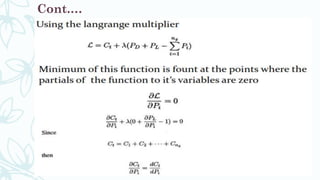
objective function by using the Lagrange multipliers.
ℒ = 𝐶𝑡 + 𝜆 𝑃 𝐷 − ෍
𝑖=1
𝑛 𝑔
𝑃𝑖
Cont.….
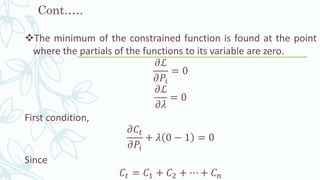
❖The minimum of the constrained function is found at the point
where the partials of the functions to its variable are zero.
𝜕ℒ
𝜕𝑃𝑖
= 0
𝜕ℒ
𝜕𝜆
= 0
First condition,
𝜕𝐶𝑡
𝜕𝑃𝑖
+ 𝜆 0 − 1 = 0
Since
𝐶𝑡 = 𝐶1 + 𝐶2 + ⋯ + 𝐶 𝑛
Cont.….
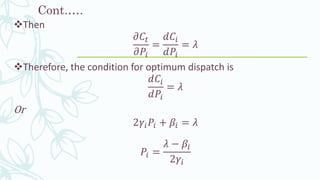
❖Then
𝜕𝐶𝑡
𝜕𝑃𝑖
=
𝑑𝐶𝑖
𝑑𝑃𝑖
= 𝜆
❖Therefore, the condition for optimum dispatch is
𝑑𝐶𝑖
𝑑𝑃𝑖
= 𝜆
Or
2𝛾𝑖 𝑃𝑖 + 𝛽𝑖 = 𝜆
𝑃𝑖 =
𝜆 − 𝛽𝑖
2𝛾𝑖
Cont.….
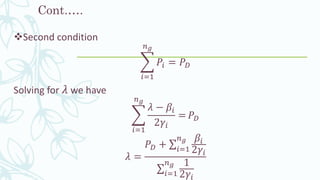
❖Second condition
෍
𝑖=1
𝑛 𝑔
𝑃𝑖 = 𝑃 𝐷
Solving for 𝜆 we have
෍
𝑖=1
𝑛 𝑔
𝜆 − 𝛽𝑖
2𝛾𝑖
= 𝑃 𝐷
𝜆 =
𝑃 𝐷 + σ𝑖=1
𝑛 𝑔 𝛽𝑖
2𝛾𝑖
σ𝑖=1
𝑛 𝑔 1
2𝛾𝑖
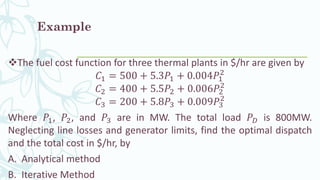
Example
❖The fuel cost function for three thermal plants in $/hr are given by
𝐶1 = 500 + 5.3𝑃1 + 0.004𝑃1
2
𝐶2 = 400 + 5.5𝑃2 + 0.006𝑃2
2
𝐶3 = 200 + 5.8𝑃3 + 0.009𝑃3
2
Where 𝑃1, 𝑃2, and 𝑃3 are in MW. The total load 𝑃 𝐷 is 800MW.
Neglecting line losses and generator limits, find the optimal dispatch
and the total cost in $/hr, by
A. Analytical method
B. Iterative Method
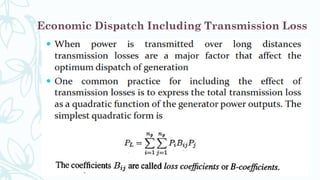
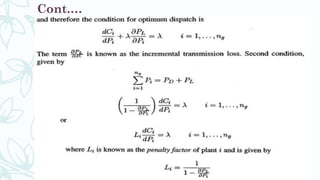
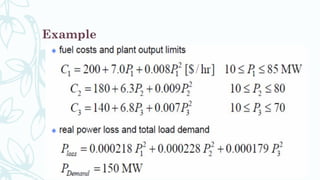
Economic Dispatch Including Transmission Loss
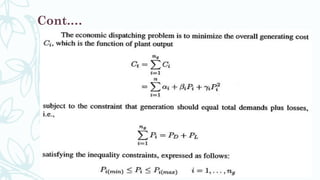
Cont.…
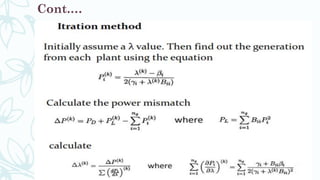
Cont.…
Cont.…
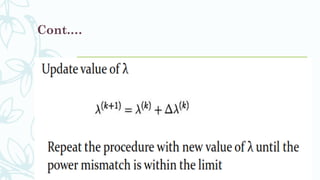
Cont.…
Cont.…
Example
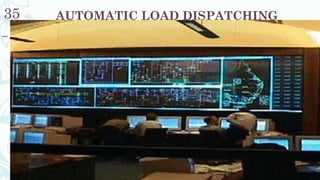
AUTOMATIC LOAD DISPATCHING35
– The Load Dispatch Department is the nerve center for the
operation, planning, monitoring and control of the power system.
Electricity cannot be stored and has to be produced when it is
needed. It is therefore essential that power system is planned and
operated optimally & economically. This is the main objective of
Load Dispatch Centre.
Interchange evaluation and Power Pool
Operation
36
– An extended power system can be divided into a number of
load frequency control areas interconnected by means of tie
lines in order
– to get commercial benefit from neighboring systems
– to meet sudden requirement of electric power and improve reliability
– Reduce in installed capacity.
– The major disadvantages are control system becomes
complex and any disturbance in one system is reflected in the
other area .
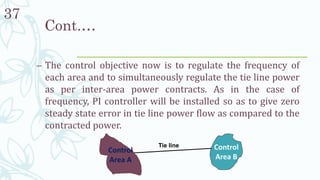
37
– The control objective now is to regulate the frequency of
each area and to simultaneously regulate the tie line power
as per inter-area power contracts. As in the case of
frequency, PI controller will be installed so as to give zero
steady state error in tie line power flow as compared to the
contracted power.
Cont.…
Control
Area A
Control
Area B
Tie line
End of Course

Power system planing and operation (pce5312) chapter five

  • 1.
    POWER SYSTEM PLANING AND OPERATION (PCE5312) CHAPTERFIVE: POWER SYSTEM OPERATION BY: MESFIN M.
  • 2.
    Outline ➢Operation of HydropowerGeneration ➢Energy Management System (EMS) ➢Protection & communication system in power system ➢Operating Voltage and Frequency Control ➢Optimal Power System Operation ➢Interchange evaluation and Power Pool Operation 2
  • 3.
    Introduction to PowerSystem Operation – Modern power system networks are highly interconnected systems. – Planning, Operation, Control and Protection strategies of power systems are strictly necessary studies to be involved. – It is essential to manage the power system in the most effective manner, which exhibits high availability and reliability with minimum cost. 3
  • 4.
    Operation of Hydropower Generation –Generation of electricity by hydropower (potential energy in stored water) is one of the cleanest methods of producing electric power. – Types Of Hydro-Power Plants – Conventional Plants – Pumped Storage Plant – Run-Of-River Plant 4
  • 5.
    Objective of PowerSystem Management – To manage the operation of the system, modern power systems are equipped with Energy Management Systems which coordinates various control functions in system operation. – The prime goal of Energy Management systems is the secure and economic operation of power systems to ensure uninterrupted, safe flow of power to customers at minimum cost. 5
  • 6.
    Cont.… – Decision andcontrol functions depend strongly on real-time and forecasted information. Because measurement data are uncertain, state estimators are used to process incoming measurements of power flows, current flows, etc. and produce a statistical best estimate of all variables of interest. – Application programs are the backbone to the decision and control functions. These functions fall under production or security categories. – System integration deals with hierarchy implementation of different decision and control functions. Each control function has a different objective and time scale and hence there exists a hierarchy for operation of each control. 6 Overall functional diagram for power system management
  • 7.
    Energy Management Systems(EMS) – Energy management system is the process of monitoring, coordinating and controlling the generation, transmission and distribution of electrical energy. – The physical plant to be managed includes generating plants that produce energy fed through transformers to the HV transmission network(grid), interconnecting generating plants, and load centres. 7
  • 8.
    Cont.… – Since transmissionsystems provide negligible energy storage, supply and demand must be balanced by either generation or load. – Production is controlled by turbine governors at generating plants, – Automatic generation control is performed by control centre computers remote from generating plants 8
  • 9.
    Cont.…. – Load management(Demand-sidemanagement): is the process of balancing the supply of electricity on the network with the electrical load by adjusting or controlling the load rather than the power station output. – AGC consists of two major and several minor functions that operate on –line in real time to adjust the generation against load at minimum cost. The major functions are load frequency control and economic dispatch, 9
  • 10.
    Cont.… – The minorfunctions are reserve monitoring, interchange scheduling, and other similar monitoring and record functions /load forecast, fault allocation, trouble analysis/. – Generation control and ED minimize the current cost of energy production and transmission within the range of available controls. 1 0
  • 11.
    Protection & Communication Systemsin Power System – The electric power communication system shall be designed for speech signals, telecontrol signals and protection signals. – Provisions for a remote control of a power plant, switchyard, substation and Remote Control Centre (e.g. LDC) via the tele control communication channels shall be foreseen. – A communication system based on Optical Fiber in the Ground Wire (OPGW) is recommended. 11
  • 12.
    Operating Frequency andVoltage (LF and QV) Control 12 – Although there are many things to control in power system, majorly we control voltage and frequency by controlling other parameters of the generators, load and other devices in the system. – For efficient and secured power system:- maintain reliability, security, stability, operate in most economical way, better quality (frequency with in the limit (2%), voltage (5% HV, 10% LV)). – Frequency is global phenomena ( same in one node and other), voltage is local phenomena (one point and another point is different). Eg. Change of frequency and voltage affect normal operation of the system.
  • 13.
    Cont.… – Frequency controlcan be achieved by controlling active power which is possible at generation (injecting power) and load end (consuming power). – Total Generation < demand = frequency fall. -- generation increase, or load decrease/ very expensive/not-recommended b/c it affect power reliability. – Total Generation > demand = frequency rise. – generation decrease /load increase, not at hand/ – Reactive power control is responsible mainly for voltage control which is a local problem. 13
  • 14.
    There are twobasic generation control loops: (i) LFC, AGC, MW-f control loop (ii)MVAR-Voltage, Q-V control loop - In steady state, they are non-interactive. 14 Cont.…
  • 15.
    Cont’d – Main ancillaryservices of Power system Control – Load-frequency control – Primary regulation – Secondary reserves – Tertiary reserves – Voltage control – System restoration – Automatic generation control (AGC) is used to automatically change generation to keep the ACE close to zero. – Usually the utility control center or independent system operator calculates ACE based upon tie-line flows and frequency; then the AGC module sends control signals out to the generators every couple of seconds to adjust generation. 15
  • 16.
    Cont’d – In apower system the load demand is continuously changing. In accordance with it the power input has also to vary. If the input - output balance is not maintained a change in frequency will occur. The control of frequency is achieved primarily through speed governor mechanism aided by supplementary means for precise control. – Primary control – – Makes use of the governor in the generator – Time constant of about 1 second – Objective: to prevent frequency deviations – Each machine has a specific response to frequency deviations – The primary control cannot completely recover the nominal frequency value or eliminate errors in scheduled power exchanges 16
  • 17.
    Cont’d – Secondary &tertiary controls – This is the Automatic Generation Control, AGC – Time response ~ 1 minute – Restores frequency & power exchanges to preset values – It cancels the Area Control Error ACE, which combines both objectives – Tertiary control – This is an economic generation dispatch that recomputes the set points of generators & restores secondary reserves – Time response ~15 minutes 17
  • 18.
    – The blockdiagram of single area system, where the gain and time constant in each block are as described in the individual section, is as shown below. 18 Cont.… p p L TG TG s s ref sT K P sT K sT K R sF PsF +       −      +      +     −= 111 )( )( 18
  • 19.
    Economic Operation ofPower System 19 ECONOMIC OPERATION /ED-ECONOMIC DISPATCH/ – The economic dispatch problem consists in allocating the total demand among generating units so that the production cost is minimized. – Generating units have different production costs depending on the prime energy source used to produce electricity (mainly coal, oil, natural gas, uranium, and water stored in reservoirs).
  • 20.
    20 – In additionto continuous decisions on how to allocate the demand among generating units, the economics of electricity generation also requires the calculation of an optimum time schedule for the start-up and shutdown costs of the generating units. (since the units’ start-up or shutdown costs can be significant, on/off scheduling decisions must be optimally coordinated with the ED of the continuous generation outputs. Cont.…
  • 21.
    21 ❖In all practicalcases, the fuel cost of generator i can be represented as a quadratic function of real power generation. 𝐶𝑖 = 𝛼𝑖 + 𝛽𝑖 𝑃𝑖 + 𝛾𝑖 𝑃𝑖 2 ❖An important characteristics is obtained by plotting the derivative of the fuel cost curve versus the real power. This is known as incremental fuel cost curve 𝑑𝐶𝑖 𝑑𝑃𝑖 = 2𝛾𝑖 𝑃𝑖 + 𝛽𝑖 ❖The incremental fuel cost curve is a measure of how costly it will be to produce the next increment of power. Economic Dispatch
  • 22.
    Cont.…. ❖ since transmissionloss is neglected, the total demand is the sum of the generation. ❖A cost function Ci is assumed to be known for each plant. ❖The problem is to find the real power generation for each plant such that the objective function (i.e., total production cost) as defined by the equation is min. subjected to the constraint. 𝐶𝑡 = ෍ 𝑖=1 𝑛 𝑔 𝐶𝑖 = ෍ 𝑖=1 𝑛 𝑔 𝛼𝑖 + 𝛽𝑖 𝑃𝑖 + 𝛾𝑖 𝑃𝑖 2
  • 23.
    Cont.…. ❖Is to minimizesubjected to the constraint. ෍ 𝑖=1 𝑛 𝑔 𝑃𝑖 = 𝑃 𝐷 ❖A typical approach is to augment the constraints into objective function by using the Lagrange multipliers. ℒ = 𝐶𝑡 + 𝜆 𝑃 𝐷 − ෍ 𝑖=1 𝑛 𝑔 𝑃𝑖
  • 24.
    Cont.…. ❖The minimum ofthe constrained function is found at the point where the partials of the functions to its variable are zero. 𝜕ℒ 𝜕𝑃𝑖 = 0 𝜕ℒ 𝜕𝜆 = 0 First condition, 𝜕𝐶𝑡 𝜕𝑃𝑖 + 𝜆 0 − 1 = 0 Since 𝐶𝑡 = 𝐶1 + 𝐶2 + ⋯ + 𝐶 𝑛
  • 25.
    Cont.…. ❖Then 𝜕𝐶𝑡 𝜕𝑃𝑖 = 𝑑𝐶𝑖 𝑑𝑃𝑖 = 𝜆 ❖Therefore, thecondition for optimum dispatch is 𝑑𝐶𝑖 𝑑𝑃𝑖 = 𝜆 Or 2𝛾𝑖 𝑃𝑖 + 𝛽𝑖 = 𝜆 𝑃𝑖 = 𝜆 − 𝛽𝑖 2𝛾𝑖
  • 26.
    Cont.…. ❖Second condition ෍ 𝑖=1 𝑛 𝑔 𝑃𝑖= 𝑃 𝐷 Solving for 𝜆 we have ෍ 𝑖=1 𝑛 𝑔 𝜆 − 𝛽𝑖 2𝛾𝑖 = 𝑃 𝐷 𝜆 = 𝑃 𝐷 + σ𝑖=1 𝑛 𝑔 𝛽𝑖 2𝛾𝑖 σ𝑖=1 𝑛 𝑔 1 2𝛾𝑖
  • 27.
    Example ❖The fuel costfunction for three thermal plants in $/hr are given by 𝐶1 = 500 + 5.3𝑃1 + 0.004𝑃1 2 𝐶2 = 400 + 5.5𝑃2 + 0.006𝑃2 2 𝐶3 = 200 + 5.8𝑃3 + 0.009𝑃3 2 Where 𝑃1, 𝑃2, and 𝑃3 are in MW. The total load 𝑃 𝐷 is 800MW. Neglecting line losses and generator limits, find the optimal dispatch and the total cost in $/hr, by A. Analytical method B. Iterative Method
  • 28.
    Economic Dispatch IncludingTransmission Loss
  • 29.
  • 30.
  • 31.
  • 32.
  • 33.
  • 34.
  • 35.
    AUTOMATIC LOAD DISPATCHING35 –The Load Dispatch Department is the nerve center for the operation, planning, monitoring and control of the power system. Electricity cannot be stored and has to be produced when it is needed. It is therefore essential that power system is planned and operated optimally & economically. This is the main objective of Load Dispatch Centre.
  • 36.
    Interchange evaluation andPower Pool Operation 36 – An extended power system can be divided into a number of load frequency control areas interconnected by means of tie lines in order – to get commercial benefit from neighboring systems – to meet sudden requirement of electric power and improve reliability – Reduce in installed capacity. – The major disadvantages are control system becomes complex and any disturbance in one system is reflected in the other area .
  • 37.
    37 – The controlobjective now is to regulate the frequency of each area and to simultaneously regulate the tie line power as per inter-area power contracts. As in the case of frequency, PI controller will be installed so as to give zero steady state error in tie line power flow as compared to the contracted power. Cont.… Control Area A Control Area B Tie line
  • 38.