PRESENTED BY:
OSAMA NASEEM
OPTICAL fIBRE AND ITS
ADVANTAGES
Tableofcontents
 What is OPTICAL FIBRE?
 Evolution of OPTICAL FIBRE
 Components of OPTICAL FIBRE
 Total Internal Reflection
 How OPTICAL FIBRE works?
 Types of OPTICAL FIBRE
 Advantages and Disadvantages of OPTICAL FIBRE
WhatisOPTICALFIBRE?
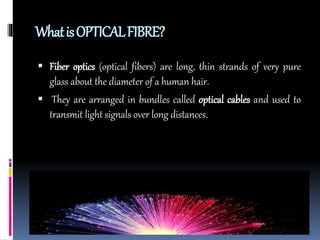
 Fiber optics (optical fibers) are long, thin strands of very pure
glass about the diameter of a human hair.
 They are arranged in bundles called optical cables and used to
transmit light signals over long distances.
EVOLUTIONOFOPTICALFIBRE
 1880 – Alexander Graham Bell
 1930 – Patents on tubing
 1950 – patents for two layer glass wave guide
 1960 – Laser first used as alight source
 1965 – High loss of light discovered
 1970 – Refining of manufacturing process
 1980 – OPTICAL FIBRE becomes backbone of long distance
telephone networks
COMPONENTSOFOPTICALFIBRE
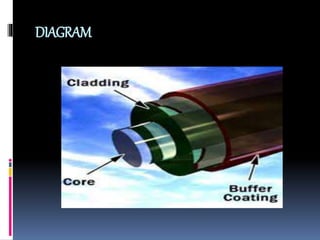
 CORE – thin glass centre where the light
travels.
 CLADDING – outer optical material that surrounds the core.
 BUFFER COATING – plastic coating that protects the fibre.
DIAGRAM
TOTALINTERNALREFLECTION(TIR)
 To understand ‘how optical fibre works’ we have to understand
the concept of TIR.
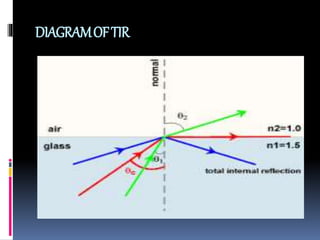
 When the angle of incidence becomes larger than the critical
angle, no refraction occur. The entire light is reflected back into
the denser medium. This is known as TOTAL INTERNAL
REFLECTION.
DIAGRAMOFTIR
HOWOPTICALFIBREWORKS?
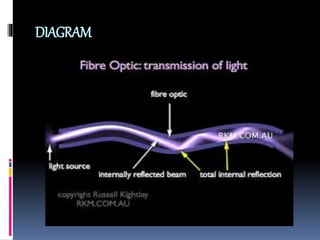
 Light that enters the core at one end of the optical fibre goes
straight and hits the inner wall(cladding) of fibre optics. The
angle of incidence with cladding is greater than the critical angle,
light is totally reflected into the fibre optics until it hits the inner
wall again, and so on.
 As explained above, this phenomena is TOTAL INTERNAL
REFLECTION.
DIAGRAM
TYPESOFOPTICALFIBRE
 There are two basic types of optical fibre.
 SINGLE MODE FIBRE
 MULTI-MODE FIBRE
SINGLEMODEFIBRE
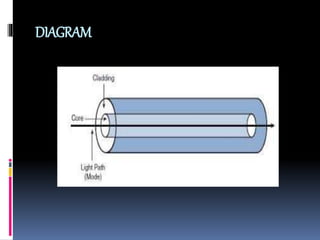
 Single mode fiber is optical fiber that is designed for the
transmission of a single ray or mode of light as a carrier .
 It is used for long-distance signal transmission.
 This fibre is used in telecom and CAT V networks.
DIAGRAM
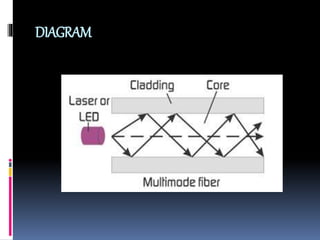
MULTI-MODEFIBRE
 Each optical fibre in a multi-mode cable is about 10 times thicker
than fibre optics used in a single mode cable. This means light
beams can travel through the core by following different
paths,hence the name multi-mode.
 Multi-mode cable can send information only over relatively short
distances and are used to link computer networks together.
DIAGRAM
ADVANTAGES
 Bandwidth - Fibre optic cables have a much greater
bandwidth than copper cables. The amount of information that
can be transmitted per unit time of fibre over other transmission
media is its most significant advantage.
 Low Power Loss - An optical fibre offers low power loss. In
comparison to copper; in a network, the longest recommended
copper distance is 100m while with fibre, it is 2000m.
 Interference- Fibre optic cables are immune to
electromagnetic interference. It can also be run in electrically
noisy environments without concern as electrical noise will not
affect fibre.
 Size- In comparison to copper, a fibre optic cable has nearly 4.5
times as much capacity as the wire cable has and a cross sectional
area that is 30 times less.
 Weight - Fibre optic cables are much thinner and lighter than
metal wires. They also occupy less space with cables of the same
information capacity. Lighter weight makes fibre easier to install.
 Safety- Since the fibre is a dielectric, it does not present a spark
hazard.
 Security - Optical fibers are difficult to tap. fibre is the most
secure medium available for carrying sensitive data.
 Flexibility - An optical fibre has greater tensile strength than
copper or steel fibers of the same diameter. It is flexible, bends
easily and resists most corrosive elements that attack copper
cable.
DISADVANTAGES
 COST- Cables are expensive to install but last longer than
copper cables.
 TRANSMISSION- Transmission on optical fiber requires
repeating at distance intervals.
 FRAGILE - Fibers can be broken or have transmission loses
when wrapped around curves of only a few centimeters
radius. However by encasing fibers in a plastic sheath, it is
difficult to bend the cable into a small enough radius to break the
fiber.
Thank You
Any Question?

Optical fibre Presentation

  • 1.
    PRESENTED BY: OSAMA NASEEM OPTICALfIBRE AND ITS ADVANTAGES
  • 2.
    Tableofcontents  What isOPTICAL FIBRE?  Evolution of OPTICAL FIBRE  Components of OPTICAL FIBRE  Total Internal Reflection  How OPTICAL FIBRE works?  Types of OPTICAL FIBRE  Advantages and Disadvantages of OPTICAL FIBRE
  • 3.
    WhatisOPTICALFIBRE?  Fiber optics(optical fibers) are long, thin strands of very pure glass about the diameter of a human hair.  They are arranged in bundles called optical cables and used to transmit light signals over long distances.
  • 4.
    EVOLUTIONOFOPTICALFIBRE  1880 –Alexander Graham Bell  1930 – Patents on tubing  1950 – patents for two layer glass wave guide  1960 – Laser first used as alight source  1965 – High loss of light discovered  1970 – Refining of manufacturing process  1980 – OPTICAL FIBRE becomes backbone of long distance telephone networks
  • 5.
    COMPONENTSOFOPTICALFIBRE  CORE –thin glass centre where the light travels.  CLADDING – outer optical material that surrounds the core.  BUFFER COATING – plastic coating that protects the fibre.
  • 6.
  • 7.
    TOTALINTERNALREFLECTION(TIR)  To understand‘how optical fibre works’ we have to understand the concept of TIR.  When the angle of incidence becomes larger than the critical angle, no refraction occur. The entire light is reflected back into the denser medium. This is known as TOTAL INTERNAL REFLECTION.
  • 8.
  • 9.
    HOWOPTICALFIBREWORKS?  Light thatenters the core at one end of the optical fibre goes straight and hits the inner wall(cladding) of fibre optics. The angle of incidence with cladding is greater than the critical angle, light is totally reflected into the fibre optics until it hits the inner wall again, and so on.  As explained above, this phenomena is TOTAL INTERNAL REFLECTION.
  • 10.
  • 11.
    TYPESOFOPTICALFIBRE  There aretwo basic types of optical fibre.  SINGLE MODE FIBRE  MULTI-MODE FIBRE
  • 12.
    SINGLEMODEFIBRE  Single modefiber is optical fiber that is designed for the transmission of a single ray or mode of light as a carrier .  It is used for long-distance signal transmission.  This fibre is used in telecom and CAT V networks.
  • 13.
  • 14.
    MULTI-MODEFIBRE  Each opticalfibre in a multi-mode cable is about 10 times thicker than fibre optics used in a single mode cable. This means light beams can travel through the core by following different paths,hence the name multi-mode.  Multi-mode cable can send information only over relatively short distances and are used to link computer networks together.
  • 15.
  • 16.
    ADVANTAGES  Bandwidth -Fibre optic cables have a much greater bandwidth than copper cables. The amount of information that can be transmitted per unit time of fibre over other transmission media is its most significant advantage.  Low Power Loss - An optical fibre offers low power loss. In comparison to copper; in a network, the longest recommended copper distance is 100m while with fibre, it is 2000m.
  • 17.
     Interference- Fibreoptic cables are immune to electromagnetic interference. It can also be run in electrically noisy environments without concern as electrical noise will not affect fibre.  Size- In comparison to copper, a fibre optic cable has nearly 4.5 times as much capacity as the wire cable has and a cross sectional area that is 30 times less.  Weight - Fibre optic cables are much thinner and lighter than metal wires. They also occupy less space with cables of the same information capacity. Lighter weight makes fibre easier to install.
  • 18.
     Safety- Sincethe fibre is a dielectric, it does not present a spark hazard.  Security - Optical fibers are difficult to tap. fibre is the most secure medium available for carrying sensitive data.  Flexibility - An optical fibre has greater tensile strength than copper or steel fibers of the same diameter. It is flexible, bends easily and resists most corrosive elements that attack copper cable.
  • 19.
    DISADVANTAGES  COST- Cablesare expensive to install but last longer than copper cables.  TRANSMISSION- Transmission on optical fiber requires repeating at distance intervals.
  • 20.
     FRAGILE -Fibers can be broken or have transmission loses when wrapped around curves of only a few centimeters radius. However by encasing fibers in a plastic sheath, it is difficult to bend the cable into a small enough radius to break the fiber.
  • 21.