Evolution of Optical Fibers to Current Technologies
By
Dr. Sourabh Roy
Dept. of Physics
NIT Warngal
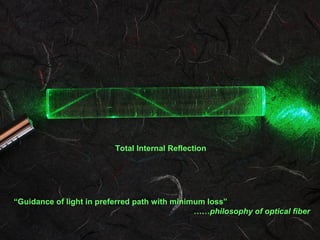
Total Internal Reflection
“Guidance of light in preferred path with minimum loss”
……philosophy of optical fiber
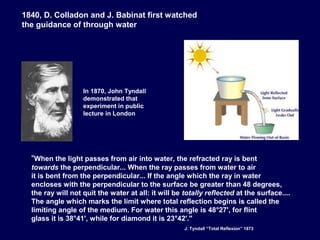
"When the light passes from air into water, the refracted ray is bent
towards the perpendicular... When the ray passes from water to air
it is bent from the perpendicular... If the angle which the ray in water
encloses with the perpendicular to the surface be greater than 48 degrees,
the ray will not quit the water at all: it will be totally reflected at the surface....
The angle which marks the limit where total reflection begins is called the
limiting angle of the medium. For water this angle is 48°27', for flint
glass it is 38°41', while for diamond it is 23°42'."
In 1870, John Tyndall
demonstrated that
experiment in public
lecture in London
1840, D. Colladon and J. Babinat first watched
the guidance of through water
J. Tyndall “Total Reflexion” 1873
First practical implementation of this total reflection property concentrated on
image transmission in early Nineteenth century
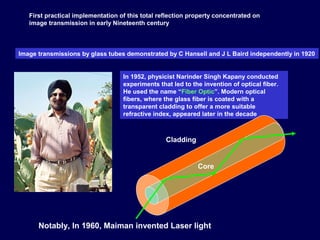
In 1952, physicist Narinder Singh Kapany conducted
experiments that led to the invention of optical fiber.
He used the name “Fiber Optic”. Modern optical
fibers, where the glass fiber is coated with a
transparent cladding to offer a more suitable
refractive index, appeared later in the decade
Gayetri DeviGayetri Devi
Core
Cladding
Image transmissions by glass tubes demonstrated by C Hansell and J L Baird independently in 1920
Notably, In 1960, Maiman invented Laser light
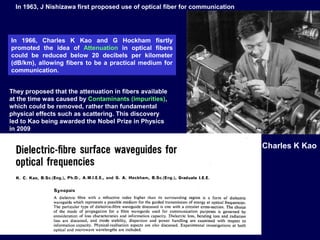
In 1963, J Nishizawa first proposed use of optical fiber for communication
In 1966, Charles K Kao and G Hockham fisrtly
promoted the idea of Attenuation in optical fibers
could be reduced below 20 decibels per kilometer
(dB/km), allowing fibers to be a practical medium for
communication.
They proposed that the attenuation in fibers available
at the time was caused by Contaminants (impurities),
which could be removed, rather than fundamental
physical effects such as scattering. This discovery
led to Kao being awarded the Nobel Prize in Physics
in 2009
Charles K Kao
This idea accelerated research and development of optical fiber toward application in
communication
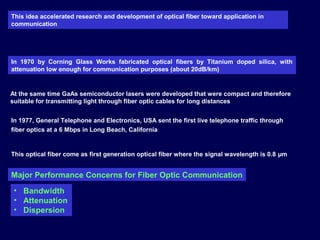
In 1970 by Corning Glass Works fabricated optical fibers by Titanium doped silica, with
attenuation low enough for communication purposes (about 20dB/km)
In 1977, General Telephone and Electronics, USA sent the first live telephone traffic through
fiber optics at a 6 Mbps in Long Beach, California
At the same time GaAs semiconductor lasers were developed that were compact and therefore
suitable for transmitting light through fiber optic cables for long distances
This optical fiber come as first generation optical fiber where the signal wavelength is 0.8 µm
Major Performance Concerns for Fiber Optic Communication
• Bandwidth
• Attenuation
• Dispersion
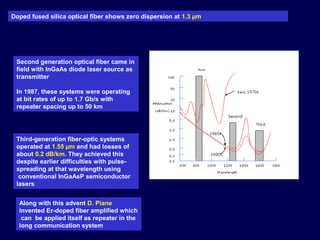
Doped fused silica optical fiber shows zero dispersion at 1.3 µm
Second generation optical fiber came in
field with InGaAs diode laser source as
transmitter
In 1987, these systems were operating
at bit rates of up to 1.7 Gb/s with
repeater spacing up to 50 km
Third-generation fiber-optic systems
operated at 1.55 µm and had losses of
about 0.2 dB/km. They achieved this
despite earlier difficulties with pulse-
spreading at that wavelength using
conventional InGaAsP semiconductor
lasers
Along with this advent D. Piane
invented Er-doped fiber amplified which
can be applied itself as repeater in the
long communication system
 Enormous Bandwidths
 Low transmission loss
 Immunity to cross talk
 Electrical Isolation
 Small size and weight
 Signal security
 Ruggedness and flexibility
 Low cost and availability
Advantage of optical fiber in communication
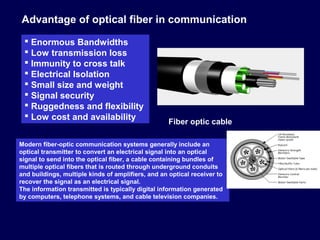
Modern fiber-optic communication systems generally include an
optical transmitter to convert an electrical signal into an optical
signal to send into the optical fiber, a cable containing bundles of
multiple optical fibers that is routed through underground conduits
and buildings, multiple kinds of amplifiers, and an optical receiver to
recover the signal as an electrical signal.
The information transmitted is typically digital information generated
by computers, telephone systems, and cable television companies.
Fiber optic cable
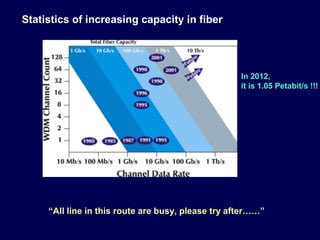
Statistics of increasing capacity in fiber
“All line in this route are busy, please try after……”
In 2012,
it is 1.05 Petabit/s !!!
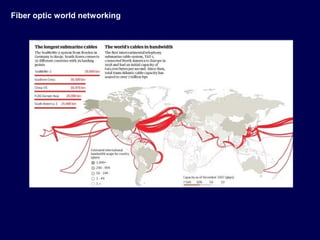
Fiber optic world networking
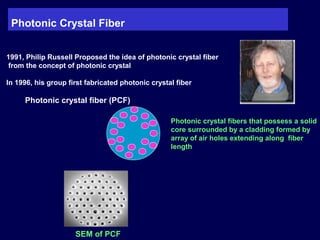
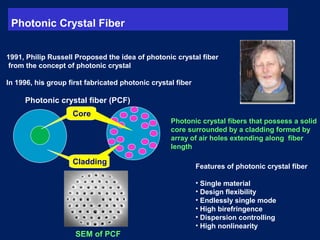
Photonic Crystal Fiber
1991, Philip Russell Proposed the idea of photonic crystal fiber
from the concept of photonic crystal
In 1996, his group first fabricated photonic crystal fiber
Photonic crystal fibers that possess a solid
core surrounded by a cladding formed by
array of air holes extending along fiber
length
Photonic crystal fiber (PCF)
SEM of PCF
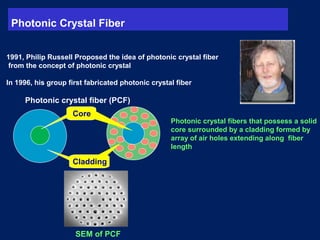
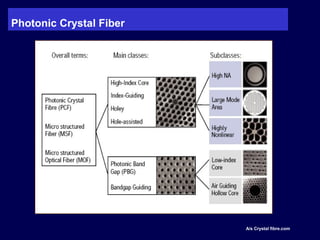
Photonic Crystal Fiber
1991, Philip Russell Proposed the idea of photonic crystal fiber
from the concept of photonic crystal
In 1996, his group first fabricated photonic crystal fiber
Photonic crystal fibers that possess a solid
core surrounded by a cladding formed by
array of air holes extending along fiber
length
Photonic crystal fiber (PCF)
SEM of PCF
Core
Cladding
Photonic Crystal Fiber
1991, Philip Russell Proposed the idea of photonic crystal fiber
from the concept of photonic crystal
In 1996, his group first fabricated photonic crystal fiber
Features of photonic crystal fiber
• Single material
• Design flexibility
• Endlessly single mode
• High birefringence
• Dispersion controlling
• High nonlinearity
Photonic crystal fibers that possess a solid
core surrounded by a cladding formed by
array of air holes extending along fiber
length
Photonic crystal fiber (PCF)
SEM of PCF
Core
Cladding
Photonic Crystal Fiber
A/s Crystal fibre.com
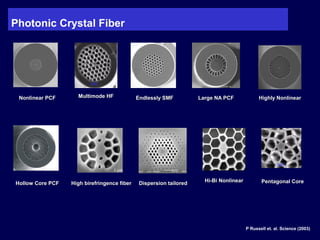
Photonic Crystal Fiber
Large NA PCFLarge NA PCF
Hollow Core PCFHollow Core PCF
Endlessly SMFEndlessly SMFNonlinear PCFNonlinear PCF Multimode HFMultimode HF Highly NonlinearHighly Nonlinear
High birefringence fiberHigh birefringence fiber Dispersion tailoredDispersion tailored Hi-Bi NonlinearHi-Bi Nonlinear
P Russell et. al. Science (2003)
Pentagonal CorePentagonal Core
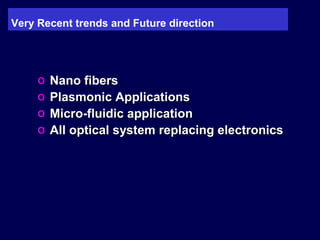
Very Recent trends and Future direction
o Nano fibersNano fibers
o Plasmonic ApplicationsPlasmonic Applications
o Micro-fluidic applicationMicro-fluidic application
o All optical system replacing electronicsAll optical system replacing electronics
Evolution of Optical Fibers

Evolution of Optical Fibers

  • 1.
    Evolution of OpticalFibers to Current Technologies By Dr. Sourabh Roy Dept. of Physics NIT Warngal
  • 2.
    Total Internal Reflection “Guidanceof light in preferred path with minimum loss” ……philosophy of optical fiber
  • 3.
    "When the lightpasses from air into water, the refracted ray is bent towards the perpendicular... When the ray passes from water to air it is bent from the perpendicular... If the angle which the ray in water encloses with the perpendicular to the surface be greater than 48 degrees, the ray will not quit the water at all: it will be totally reflected at the surface.... The angle which marks the limit where total reflection begins is called the limiting angle of the medium. For water this angle is 48°27', for flint glass it is 38°41', while for diamond it is 23°42'." In 1870, John Tyndall demonstrated that experiment in public lecture in London 1840, D. Colladon and J. Babinat first watched the guidance of through water J. Tyndall “Total Reflexion” 1873
  • 4.
    First practical implementationof this total reflection property concentrated on image transmission in early Nineteenth century In 1952, physicist Narinder Singh Kapany conducted experiments that led to the invention of optical fiber. He used the name “Fiber Optic”. Modern optical fibers, where the glass fiber is coated with a transparent cladding to offer a more suitable refractive index, appeared later in the decade Gayetri DeviGayetri Devi Core Cladding Image transmissions by glass tubes demonstrated by C Hansell and J L Baird independently in 1920 Notably, In 1960, Maiman invented Laser light
  • 5.
    In 1963, JNishizawa first proposed use of optical fiber for communication In 1966, Charles K Kao and G Hockham fisrtly promoted the idea of Attenuation in optical fibers could be reduced below 20 decibels per kilometer (dB/km), allowing fibers to be a practical medium for communication. They proposed that the attenuation in fibers available at the time was caused by Contaminants (impurities), which could be removed, rather than fundamental physical effects such as scattering. This discovery led to Kao being awarded the Nobel Prize in Physics in 2009 Charles K Kao
  • 6.
    This idea acceleratedresearch and development of optical fiber toward application in communication In 1970 by Corning Glass Works fabricated optical fibers by Titanium doped silica, with attenuation low enough for communication purposes (about 20dB/km) In 1977, General Telephone and Electronics, USA sent the first live telephone traffic through fiber optics at a 6 Mbps in Long Beach, California At the same time GaAs semiconductor lasers were developed that were compact and therefore suitable for transmitting light through fiber optic cables for long distances This optical fiber come as first generation optical fiber where the signal wavelength is 0.8 µm Major Performance Concerns for Fiber Optic Communication • Bandwidth • Attenuation • Dispersion
  • 7.
    Doped fused silicaoptical fiber shows zero dispersion at 1.3 µm Second generation optical fiber came in field with InGaAs diode laser source as transmitter In 1987, these systems were operating at bit rates of up to 1.7 Gb/s with repeater spacing up to 50 km Third-generation fiber-optic systems operated at 1.55 µm and had losses of about 0.2 dB/km. They achieved this despite earlier difficulties with pulse- spreading at that wavelength using conventional InGaAsP semiconductor lasers Along with this advent D. Piane invented Er-doped fiber amplified which can be applied itself as repeater in the long communication system
  • 8.
     Enormous Bandwidths Low transmission loss  Immunity to cross talk  Electrical Isolation  Small size and weight  Signal security  Ruggedness and flexibility  Low cost and availability Advantage of optical fiber in communication Modern fiber-optic communication systems generally include an optical transmitter to convert an electrical signal into an optical signal to send into the optical fiber, a cable containing bundles of multiple optical fibers that is routed through underground conduits and buildings, multiple kinds of amplifiers, and an optical receiver to recover the signal as an electrical signal. The information transmitted is typically digital information generated by computers, telephone systems, and cable television companies. Fiber optic cable
  • 9.
    Statistics of increasingcapacity in fiber “All line in this route are busy, please try after……” In 2012, it is 1.05 Petabit/s !!!
  • 10.
  • 11.
    Photonic Crystal Fiber 1991,Philip Russell Proposed the idea of photonic crystal fiber from the concept of photonic crystal In 1996, his group first fabricated photonic crystal fiber Photonic crystal fibers that possess a solid core surrounded by a cladding formed by array of air holes extending along fiber length Photonic crystal fiber (PCF) SEM of PCF
  • 12.
    Photonic Crystal Fiber 1991,Philip Russell Proposed the idea of photonic crystal fiber from the concept of photonic crystal In 1996, his group first fabricated photonic crystal fiber Photonic crystal fibers that possess a solid core surrounded by a cladding formed by array of air holes extending along fiber length Photonic crystal fiber (PCF) SEM of PCF Core Cladding
  • 13.
    Photonic Crystal Fiber 1991,Philip Russell Proposed the idea of photonic crystal fiber from the concept of photonic crystal In 1996, his group first fabricated photonic crystal fiber Features of photonic crystal fiber • Single material • Design flexibility • Endlessly single mode • High birefringence • Dispersion controlling • High nonlinearity Photonic crystal fibers that possess a solid core surrounded by a cladding formed by array of air holes extending along fiber length Photonic crystal fiber (PCF) SEM of PCF Core Cladding
  • 14.
    Photonic Crystal Fiber A/sCrystal fibre.com
  • 15.
    Photonic Crystal Fiber LargeNA PCFLarge NA PCF Hollow Core PCFHollow Core PCF Endlessly SMFEndlessly SMFNonlinear PCFNonlinear PCF Multimode HFMultimode HF Highly NonlinearHighly Nonlinear High birefringence fiberHigh birefringence fiber Dispersion tailoredDispersion tailored Hi-Bi NonlinearHi-Bi Nonlinear P Russell et. al. Science (2003) Pentagonal CorePentagonal Core
  • 16.
    Very Recent trendsand Future direction o Nano fibersNano fibers o Plasmonic ApplicationsPlasmonic Applications o Micro-fluidic applicationMicro-fluidic application o All optical system replacing electronicsAll optical system replacing electronics