Evolution of Telecommunication Rohan Sripad Prasanna Raghavan P
0G 1G technologies 2G technologies Circuit and Packet Switching. 3GPP & 3GPP2 Services offered by 3G Deployment Problems 3G in India & its delay 4G Transition 2.5G technologies 2.75G technologies 3G technologies An interim 3.5G
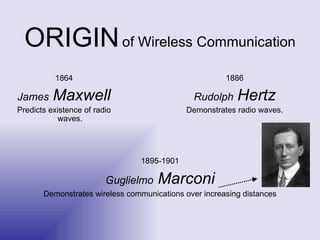
ORIGIN   of Wireless Communication 1895-1901 Guglielmo  Marconi Demonstrates wireless communications over increasing distances 1864 James   Maxwell Predicts existence of radio waves. 1886 Rudolph   Hertz Demonstrates radio waves.
0G 1924
1G AMPS TACS NMT 1980s Analog Voice Typical 2.4 Kbps
1G Advanced Mobile Phone Services (AMPS) Deployed in US , Japan : 1983 Nordic Mobile Telephony (NMT) Sweden, Denmark, Norway, Finland : 1981 Total Access Communication System (TACS) British System, similar to AMPS : 1985
2G GSM CDMA TDMA 1990s Digital Voice 9.6 - 14.4 Kbps (circuit data)
2G – GSM Global system for Mobile Based on TDMA ; Europe 900 Mhz, 1800 Mhz.  Later 850 Mhz and 1900 Mhz in Americas Quad Band ; World Phones
2G - CDMA Code Division Multiple Access cdmaOne or IS-95 All users use same freq band ; 800 Mhz Major success in Korea, Used by Verizon and Sprint Easy Migration to 3G
 
Circuit Switching A private road all for yourself Dedicated end to end connection
Packet Switching Divided packets can take different paths and times  A shared highway
3GPP GPRS EDGE LTE WCDMA HSPA 1.92 Mbps 14 Mbps 384 Kbps 114 Kbps 100 Mbps
3GPP2 1xRTT EV-DO UMB (abandoned 2008 Nov & favoring LTE) 114 Kbps 2.4 Mbps 288 Mbps
0G 1G technologies 2G technologies Circuit and Packet Switching. 3GPP & 3GPP2 Services offered by 3G Deployment Problems 3G in India & its delay 4G Transition 2.5G technologies 2.75G technologies 3G technologies An interim 3.5G
2.5G GPRS 2001 Packet Data
2.5G - GPRS General Packet Radio Service - An Overlay technology on top of  the existing GSM systems. Data rate = 56 – 114Kbps. 4 MCS (Modulation and coding schemes) used. Factors affecting downlink/uplink speed: TDMA slots Multi-slot class Channel Encoding used.
HSCSD High-Speed Circuit-Switched Data. An enhancement to CSD – Multiple timeslots used. Data rates up to 38.4 Kbps (4 times CSD). In reality supports 14.4Kbps . Expensive than CSD. Latency less that GPRS.
2.75G EDGE 2003 Packet Data CDMA 1xRTT
EDGE EDGE (Enhanced Data rate for GSM) Superset of GPRS. Data rate = 4 times GPRS. 9 MCS (Modulation and coding schemes) used – Gaussian min shift keying and 8PSK.
Evolved EDGE Data rate = 1Mbps Encoding technique – 32QAM and 16QAM. Requires simple network enhancements with software update.
CDMA 1xRTT 1x is an abbreviation of 1xRTT (1x Radio Transmission Technology).1x refers to the no. of duplex radio channels. Supports 33-35 simultaneous voice calls per 1.25MHz.(cdmaOne = 20 voice calls) Encoding technique: BPSK for forward and reverse link. Data Rate = 153 Kbps/153 Kbps. Software and minimum hardware update.
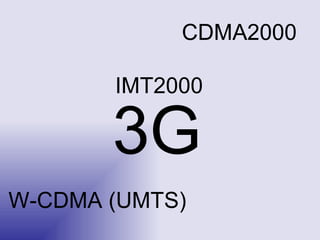
3G IMT2000 W-CDMA (UMTS) CDMA2000
UMTS UMTS - Universal Mobile Telecommunications System. Also known as W-CDMA. W-CDMA uses the DS-CDMA and TDD channel access method with a pair of 5 MHz channels. Requires new cell towers & frequency allocations.  Data rate = 1Mbps(theoritical) Frequency bands: Uplink 1885-2025 MHz (mobile-to-base ) Downlink 2110-2200 MHz (base-to-mobile).
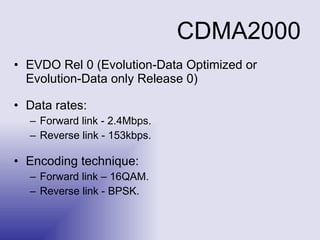
CDMA2000 EVDO Rel 0 (Evolution-Data Optimized or Evolution-Data only Release 0) Data rates: Forward link - 2.4Mbps. Reverse link - 153kbps. Encoding technique: Forward link – 16QAM. Reverse link - BPSK.
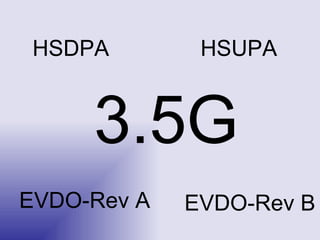
3.5G EVDO-Rev A HSDPA HSUPA EVDO-Rev B
HSPA High Speed Packet Access is a collection of two mobile telephony protocols HSDPA and HSUPA. High Speed Downlink Packet Access (HSDPA)  Data rates for Forward link - 14.4Mbps. Encoding technique – QPSK and 16QAM High Speed Uplink Packet Access (HSUPA) or EUL(Enhanced Uplink) Data rates for Reverse link - 5.76Mbps. Just a software update for most WCDMA networks.
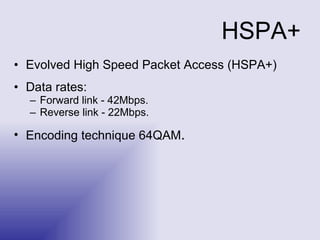
HSPA+ Evolved High Speed Packet Access (HSPA+) Data rates: Forward link - 42Mbps. Reverse link - 22Mbps. Encoding technique 64QAM .
EVDO Rev A EVDO Rev A (Revision A) Also called as EV-DV (Evolution Data/Voice) Data rates: Forward link - 3.1Mbps. Reverse link - 1.8Mbps. Encoding technique: Forward link – 16QAM. Reverse link - QPSK and 8PSK.
EVDO Rev B Combine up to fifteen 1.25MHz carriers (20MHz) in forward and/or reverse link. Carriers not physically combined and not adjacent to each other. Data rate: Forward link = 3.1Mbps*15channels = 47Mbps. Reverse link = 1.8Mbps*15channels = 27Mbps. Encoding technique 64QAM. Uplink data rate increases from 3.1Mbps to 4.9Mbps per channel. Thus, Data rate: Forward link = 4.9Mbps*15channels = 74Mbps. Only software updation required.
0G 1G technologies 2G technologies Circuit and Packet Switching. 3GPP & 3GPP2 Services offered by 3G Deployment Problems 3G in India & its delay 4G Transition 2.5G technologies 2.75G technologies 3G technologies An interim 3.5G of 4G
Multi Player Gaming Location Based Services Video Services Instant Messaging
 
 
PROBLEMS DEPLOYMENT
Argentina  Estonia  Kyrgyzstan  Slovenia  Australia  Finland  Malaysia  South Korea  Austria  France  Mauritius  South Africa  Azerbaijan  Georgia  Mexico  Spain  Bahrain  Germany  Moldova  Sri Lanka  Belarus  Greece  Netherlands  Sweden  Belgium  Guatemala  New Zealand  Taiwan  Bermuda  Hong Kong  Nicaragua  Tajikistan  Brazil  Hungary  Nigeria  Thailand  Canada  Iceland  Norway  Ukraine  Chile  India  Pakistan  U A E China  Indonesia  Panama  United Kingdom  Colombia  Ireland  Peru  United States  Cyprus  Israel  Poland  Uzbekistan  Czech Republic  Italy  Portugal  Venezuela  Denmark  Jamaica  Romania  Vietnam  Dominican  Japan  Russia  Venezuela  Ecuador  Kazakhstan  Singapore  Vietnam
3G  INDIA in
Where are we ? Out in Market…
4G
Summary G Technology Data Rates 1 Analog Typical 2.4 Kbps;  max 22 Kbps 2 Digital – TDMA, CDMA 9.6 - 14.4 Kbps (circuit data) 2.5 GPRS – mux packets in  voice timeslots 15 - 40 Kbps 3 Improved modulation,  using CDMA variants 50 – 144 Kbps (1xRTT);  200 – 384 Kbps (UMTS);  500 Kbps – 2.4 Mbps (EVDO) 3.5 More modulation tweaks 2–14 Mbps (HSPA) 4 New modulation (OFDMA); Multi-path (MIMO);  All IP LTE:  >10 Mbps;  eventual  potential >100 Mbps

Evolution Of Telecommunication

  • 1.
    Evolution of TelecommunicationRohan Sripad Prasanna Raghavan P
  • 2.
    0G 1G technologies2G technologies Circuit and Packet Switching. 3GPP & 3GPP2 Services offered by 3G Deployment Problems 3G in India & its delay 4G Transition 2.5G technologies 2.75G technologies 3G technologies An interim 3.5G
  • 3.
    0G 1G technologies2G technologies Circuit and Packet Switching. 3GPP & 3GPP2 Services offered by 3G Deployment Problems 3G in India & its delay 4G Transition 2.5G technologies 2.75G technologies 3G technologies An interim 3.5G
  • 4.
    0G 1G technologies2G technologies Circuit and Packet Switching. 3GPP & 3GPP2 Services offered by 3G Deployment Problems 3G in India & its delay 4G Transition 2.5G technologies 2.75G technologies 3G technologies An interim 3.5G
  • 5.
    ORIGIN of Wireless Communication 1895-1901 Guglielmo Marconi Demonstrates wireless communications over increasing distances 1864 James Maxwell Predicts existence of radio waves. 1886 Rudolph Hertz Demonstrates radio waves.
  • 6.
  • 7.
    1G AMPS TACSNMT 1980s Analog Voice Typical 2.4 Kbps
  • 8.
    1G Advanced MobilePhone Services (AMPS) Deployed in US , Japan : 1983 Nordic Mobile Telephony (NMT) Sweden, Denmark, Norway, Finland : 1981 Total Access Communication System (TACS) British System, similar to AMPS : 1985
  • 9.
    2G GSM CDMATDMA 1990s Digital Voice 9.6 - 14.4 Kbps (circuit data)
  • 10.
    2G – GSMGlobal system for Mobile Based on TDMA ; Europe 900 Mhz, 1800 Mhz. Later 850 Mhz and 1900 Mhz in Americas Quad Band ; World Phones
  • 11.
    2G - CDMACode Division Multiple Access cdmaOne or IS-95 All users use same freq band ; 800 Mhz Major success in Korea, Used by Verizon and Sprint Easy Migration to 3G
  • 12.
  • 13.
    Circuit Switching Aprivate road all for yourself Dedicated end to end connection
  • 14.
    Packet Switching Dividedpackets can take different paths and times A shared highway
  • 15.
    3GPP GPRS EDGELTE WCDMA HSPA 1.92 Mbps 14 Mbps 384 Kbps 114 Kbps 100 Mbps
  • 16.
    3GPP2 1xRTT EV-DOUMB (abandoned 2008 Nov & favoring LTE) 114 Kbps 2.4 Mbps 288 Mbps
  • 17.
    0G 1G technologies2G technologies Circuit and Packet Switching. 3GPP & 3GPP2 Services offered by 3G Deployment Problems 3G in India & its delay 4G Transition 2.5G technologies 2.75G technologies 3G technologies An interim 3.5G
  • 18.
    2.5G GPRS 2001Packet Data
  • 19.
    2.5G - GPRSGeneral Packet Radio Service - An Overlay technology on top of the existing GSM systems. Data rate = 56 – 114Kbps. 4 MCS (Modulation and coding schemes) used. Factors affecting downlink/uplink speed: TDMA slots Multi-slot class Channel Encoding used.
  • 20.
    HSCSD High-Speed Circuit-SwitchedData. An enhancement to CSD – Multiple timeslots used. Data rates up to 38.4 Kbps (4 times CSD). In reality supports 14.4Kbps . Expensive than CSD. Latency less that GPRS.
  • 21.
    2.75G EDGE 2003Packet Data CDMA 1xRTT
  • 22.
    EDGE EDGE (EnhancedData rate for GSM) Superset of GPRS. Data rate = 4 times GPRS. 9 MCS (Modulation and coding schemes) used – Gaussian min shift keying and 8PSK.
  • 23.
    Evolved EDGE Datarate = 1Mbps Encoding technique – 32QAM and 16QAM. Requires simple network enhancements with software update.
  • 24.
    CDMA 1xRTT 1xis an abbreviation of 1xRTT (1x Radio Transmission Technology).1x refers to the no. of duplex radio channels. Supports 33-35 simultaneous voice calls per 1.25MHz.(cdmaOne = 20 voice calls) Encoding technique: BPSK for forward and reverse link. Data Rate = 153 Kbps/153 Kbps. Software and minimum hardware update.
  • 25.
    3G IMT2000 W-CDMA(UMTS) CDMA2000
  • 26.
    UMTS UMTS -Universal Mobile Telecommunications System. Also known as W-CDMA. W-CDMA uses the DS-CDMA and TDD channel access method with a pair of 5 MHz channels. Requires new cell towers & frequency allocations. Data rate = 1Mbps(theoritical) Frequency bands: Uplink 1885-2025 MHz (mobile-to-base ) Downlink 2110-2200 MHz (base-to-mobile).
  • 27.
    CDMA2000 EVDO Rel0 (Evolution-Data Optimized or Evolution-Data only Release 0) Data rates: Forward link - 2.4Mbps. Reverse link - 153kbps. Encoding technique: Forward link – 16QAM. Reverse link - BPSK.
  • 28.
    3.5G EVDO-Rev AHSDPA HSUPA EVDO-Rev B
  • 29.
    HSPA High SpeedPacket Access is a collection of two mobile telephony protocols HSDPA and HSUPA. High Speed Downlink Packet Access (HSDPA) Data rates for Forward link - 14.4Mbps. Encoding technique – QPSK and 16QAM High Speed Uplink Packet Access (HSUPA) or EUL(Enhanced Uplink) Data rates for Reverse link - 5.76Mbps. Just a software update for most WCDMA networks.
  • 30.
    HSPA+ Evolved HighSpeed Packet Access (HSPA+) Data rates: Forward link - 42Mbps. Reverse link - 22Mbps. Encoding technique 64QAM .
  • 31.
    EVDO Rev AEVDO Rev A (Revision A) Also called as EV-DV (Evolution Data/Voice) Data rates: Forward link - 3.1Mbps. Reverse link - 1.8Mbps. Encoding technique: Forward link – 16QAM. Reverse link - QPSK and 8PSK.
  • 32.
    EVDO Rev BCombine up to fifteen 1.25MHz carriers (20MHz) in forward and/or reverse link. Carriers not physically combined and not adjacent to each other. Data rate: Forward link = 3.1Mbps*15channels = 47Mbps. Reverse link = 1.8Mbps*15channels = 27Mbps. Encoding technique 64QAM. Uplink data rate increases from 3.1Mbps to 4.9Mbps per channel. Thus, Data rate: Forward link = 4.9Mbps*15channels = 74Mbps. Only software updation required.
  • 33.
    0G 1G technologies2G technologies Circuit and Packet Switching. 3GPP & 3GPP2 Services offered by 3G Deployment Problems 3G in India & its delay 4G Transition 2.5G technologies 2.75G technologies 3G technologies An interim 3.5G of 4G
  • 34.
    Multi Player GamingLocation Based Services Video Services Instant Messaging
  • 35.
  • 36.
  • 37.
  • 38.
    Argentina Estonia Kyrgyzstan Slovenia Australia Finland Malaysia South Korea Austria France Mauritius South Africa Azerbaijan Georgia Mexico Spain Bahrain Germany Moldova Sri Lanka Belarus Greece Netherlands Sweden Belgium Guatemala New Zealand Taiwan Bermuda Hong Kong Nicaragua Tajikistan Brazil Hungary Nigeria Thailand Canada Iceland Norway Ukraine Chile India Pakistan U A E China Indonesia Panama United Kingdom Colombia Ireland Peru United States Cyprus Israel Poland Uzbekistan Czech Republic Italy Portugal Venezuela Denmark Jamaica Romania Vietnam Dominican Japan Russia Venezuela Ecuador Kazakhstan Singapore Vietnam
  • 39.
  • 40.
    Where are we? Out in Market…
  • 41.
  • 42.
    Summary G TechnologyData Rates 1 Analog Typical 2.4 Kbps; max 22 Kbps 2 Digital – TDMA, CDMA 9.6 - 14.4 Kbps (circuit data) 2.5 GPRS – mux packets in voice timeslots 15 - 40 Kbps 3 Improved modulation, using CDMA variants 50 – 144 Kbps (1xRTT); 200 – 384 Kbps (UMTS); 500 Kbps – 2.4 Mbps (EVDO) 3.5 More modulation tweaks 2–14 Mbps (HSPA) 4 New modulation (OFDMA); Multi-path (MIMO); All IP LTE: >10 Mbps; eventual potential >100 Mbps