Optical Computing Technology
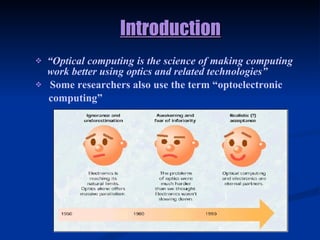
Introduction “ Optical computing is the science of making computing work better using optics and related technologies” Some researchers also use the term “optoelectronic  computing”
Why Do We Need Optical Computers  ? Rapid growth of the Internet Network speeds currently limited by electronic circuits Terabit speeds are required Traditional silicon circuits have a physical limit
Types of Optical Computer   Optical Analog These include 2-D Fourier transform or  optical  correlators, and optical  matrix-vector  processors.  Optoelectronics   This type of computing device would be to shorten  the pulse delay in chips and other logic elements by using optical  interconnections.
Optical parallel digital computers These would use the inherent parallelism of  optical devices along with digital electronics for  flexibility.  Optical neural computer Neural computers compute in the sense that they  have streams of input and output bits. They do  not require anything resembling ordinary  programming, if programming is done at all it is  by dynamically changing the degree to which the  individual nodes are connected.
How Does Optical Computer Work ? Photonic circuits Organic compounds No short-circuiting possible No heat dissipation Speed of light in photonic circuits will  be close to speed of light  in vacuum Light beams can travel in parallel
Devices used for optical computing Logic gates : Logic gates are implemented optically by controlling the population inversion that occurs to produce lasing. A controlling laser is used to control the population inversion thus causing switching to occur. Holographic truth table: Destructive interference with light to be emitted or not is based on phase relationship. Logic based on gratings: 1 is represented by vertical grating causing light 0 is represented by horizontal grating causing darkness.
Devices used for optical computing Holographic  storage : Holographic data storage has 4 components: Holographic material:   thin film on which data is to be stored Spatial Light Modulator (SLM) :  2D array of pixels, each of which is a simple switch to either block or pass light Detector array:   2D array of detector pixels, either as Charge-coupled device (CCD) camera or CMOS detector pixels to detect existence of light Reference arm:   arm carrying the laser source to produce the reference beam
Interconnections in Optical Computing Optical interconnection technologies are relatively  mature Fiber optic cables and optical transceivers are widely used Applications of optical communications like fiber channel and computer  networking are already being used. Chip to Chip and On-Chip interconnection possibilities  are still being examined.
Application of Optical Computing   Optical Computing In Communication Wavelength division multiplexing  Optical Amplifiers Storage area  network Fiber Channel Topologies Basic topologies: F C-AL (Fiber Channel Arbitration Loop): Cost effective, low performance solution  Switched:   Better performance, more expensive Hybrid topologies: Uses loops and switches as building blocks Any interconnection network scheme can be realized
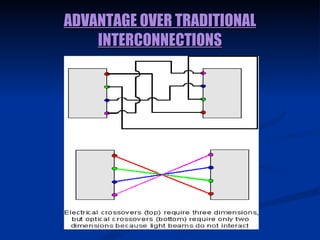
Application of Optical Computing Optical Computing In VLSI Technology   Many researchers have been investigating suitable optical logic devices, interconnection schemes, and architectures. Furthermore,  optics may provide drastically new architectures to overcome some architectural problems of conventional electrical computers. Optical computing as expanders   The optical expander described utilizes high-speed and high-space-bandwidth product connections that are provided by optical beams in three dimensions.
ADVANTAGE OVER TRADITIONAL INTERCONNECTIONS
ADVANTAGES small size high density high speed low heating of junctions dynamically reconfigurable and scalable into larger or smaller topologies and network massively parallel computing capability applications in artificial intelligence applications
Although there is a basic speed limitation in  optoelectronic conversion delays ,WDM is used to get  around this limitation. Promising but there are problems regarding dense  organization of optical processing units but DWDM  techniques can be used to overcome these limitations too. LIMITATIONS
CONCLUSION   Optics has been used in computing for a number of years but the main emphasis has been and continues to be to link portions of computers, for communications, or more intrinsically in devices that have some optical application or component.  Optical digital computers are still some years away, however a number of devices that can ultimately lead to real optical computers have already been manufactured, including optical logic gates, optical switches, optical interconnections, and optical memory.  The most likely near-term optical computer will really be a hybrid composed of traditional architectural design along with some portions that can perform some functional operations in optical mode.
THANK YOU

Optical Computing Technology

  • 1.
    OpticalComputing Technology
  • 2.
    Introduction “ Opticalcomputing is the science of making computing work better using optics and related technologies” Some researchers also use the term “optoelectronic computing”
  • 3.
    Why Do WeNeed Optical Computers ? Rapid growth of the Internet Network speeds currently limited by electronic circuits Terabit speeds are required Traditional silicon circuits have a physical limit
  • 4.
    Types of OpticalComputer Optical Analog These include 2-D Fourier transform or optical correlators, and optical matrix-vector processors. Optoelectronics This type of computing device would be to shorten the pulse delay in chips and other logic elements by using optical interconnections.
  • 5.
    Optical parallel digitalcomputers These would use the inherent parallelism of optical devices along with digital electronics for flexibility. Optical neural computer Neural computers compute in the sense that they have streams of input and output bits. They do not require anything resembling ordinary programming, if programming is done at all it is by dynamically changing the degree to which the individual nodes are connected.
  • 6.
    How Does OpticalComputer Work ? Photonic circuits Organic compounds No short-circuiting possible No heat dissipation Speed of light in photonic circuits will be close to speed of light in vacuum Light beams can travel in parallel
  • 7.
    Devices used foroptical computing Logic gates : Logic gates are implemented optically by controlling the population inversion that occurs to produce lasing. A controlling laser is used to control the population inversion thus causing switching to occur. Holographic truth table: Destructive interference with light to be emitted or not is based on phase relationship. Logic based on gratings: 1 is represented by vertical grating causing light 0 is represented by horizontal grating causing darkness.
  • 8.
    Devices used foroptical computing Holographic storage : Holographic data storage has 4 components: Holographic material: thin film on which data is to be stored Spatial Light Modulator (SLM) : 2D array of pixels, each of which is a simple switch to either block or pass light Detector array: 2D array of detector pixels, either as Charge-coupled device (CCD) camera or CMOS detector pixels to detect existence of light Reference arm: arm carrying the laser source to produce the reference beam
  • 9.
    Interconnections in OpticalComputing Optical interconnection technologies are relatively mature Fiber optic cables and optical transceivers are widely used Applications of optical communications like fiber channel and computer networking are already being used. Chip to Chip and On-Chip interconnection possibilities are still being examined.
  • 10.
    Application of OpticalComputing Optical Computing In Communication Wavelength division multiplexing Optical Amplifiers Storage area network Fiber Channel Topologies Basic topologies: F C-AL (Fiber Channel Arbitration Loop): Cost effective, low performance solution Switched: Better performance, more expensive Hybrid topologies: Uses loops and switches as building blocks Any interconnection network scheme can be realized
  • 11.
    Application of OpticalComputing Optical Computing In VLSI Technology Many researchers have been investigating suitable optical logic devices, interconnection schemes, and architectures. Furthermore, optics may provide drastically new architectures to overcome some architectural problems of conventional electrical computers. Optical computing as expanders The optical expander described utilizes high-speed and high-space-bandwidth product connections that are provided by optical beams in three dimensions.
  • 12.
  • 13.
    ADVANTAGES small sizehigh density high speed low heating of junctions dynamically reconfigurable and scalable into larger or smaller topologies and network massively parallel computing capability applications in artificial intelligence applications
  • 14.
    Although there isa basic speed limitation in optoelectronic conversion delays ,WDM is used to get around this limitation. Promising but there are problems regarding dense organization of optical processing units but DWDM techniques can be used to overcome these limitations too. LIMITATIONS
  • 15.
    CONCLUSION Optics has been used in computing for a number of years but the main emphasis has been and continues to be to link portions of computers, for communications, or more intrinsically in devices that have some optical application or component. Optical digital computers are still some years away, however a number of devices that can ultimately lead to real optical computers have already been manufactured, including optical logic gates, optical switches, optical interconnections, and optical memory. The most likely near-term optical computer will really be a hybrid composed of traditional architectural design along with some portions that can perform some functional operations in optical mode.
  • 16.