Autonomous Drone Project
Abin Varghese
Roll No – 01
VAES
RSET
Guided by:
Mr Ajai V Babu
Asst. Professor
Dept. ECE
RSET
Objective
 Autonomes drone - indoor navigation
 Light weight frame design
 Indoor Wi-Fi repeater with maximum coverage
 GPS integration
 Direction detection by compass
 Calibration by Gyroscope
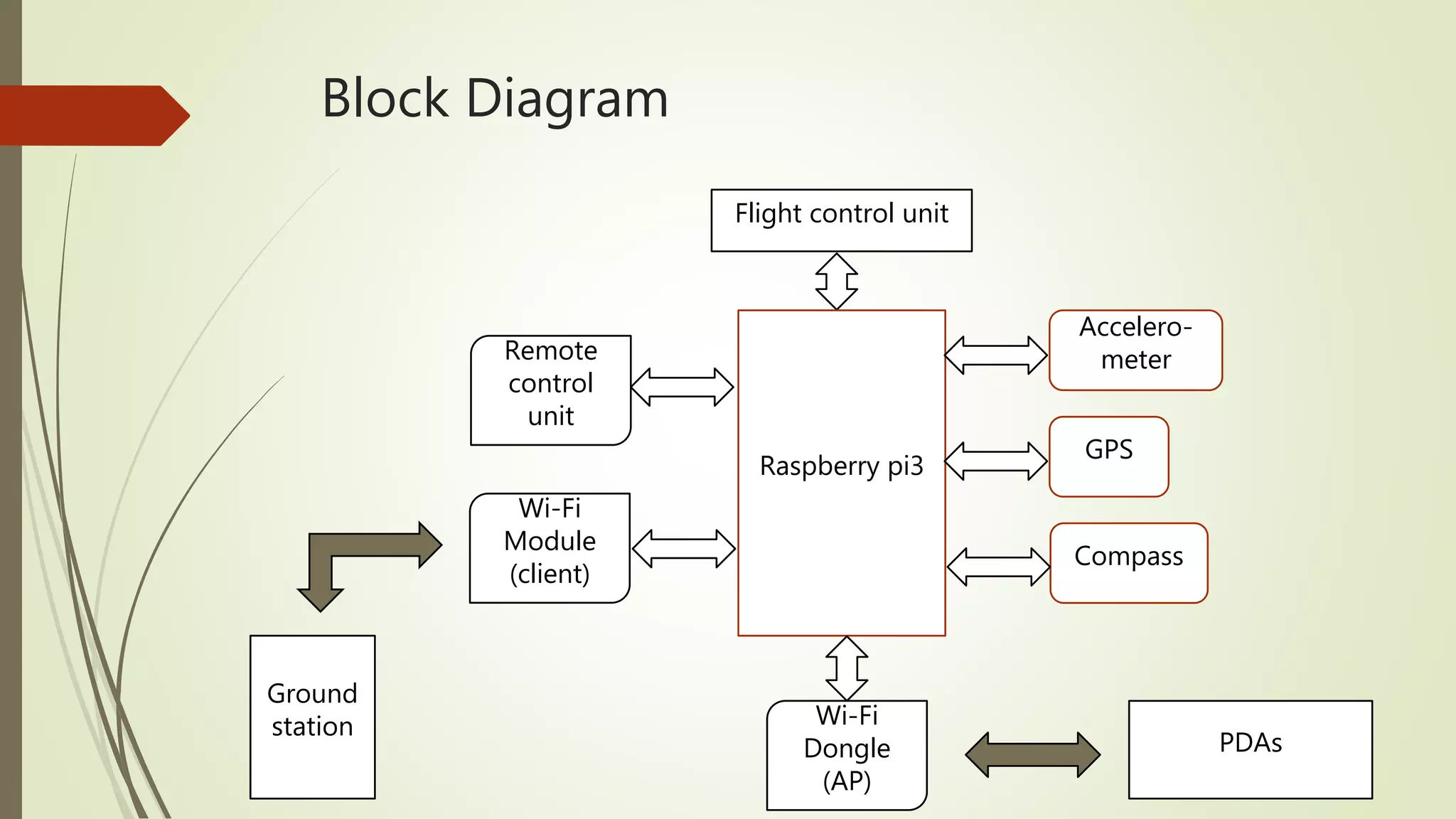
Block Diagram
Raspberry pi3
Accelero-
meter
GPS
Compass
Flight control unit
Remote
control
unit
Wi-Fi
Dongle
(AP)
Wi-Fi
Module
(client)
Ground
station
PDAs
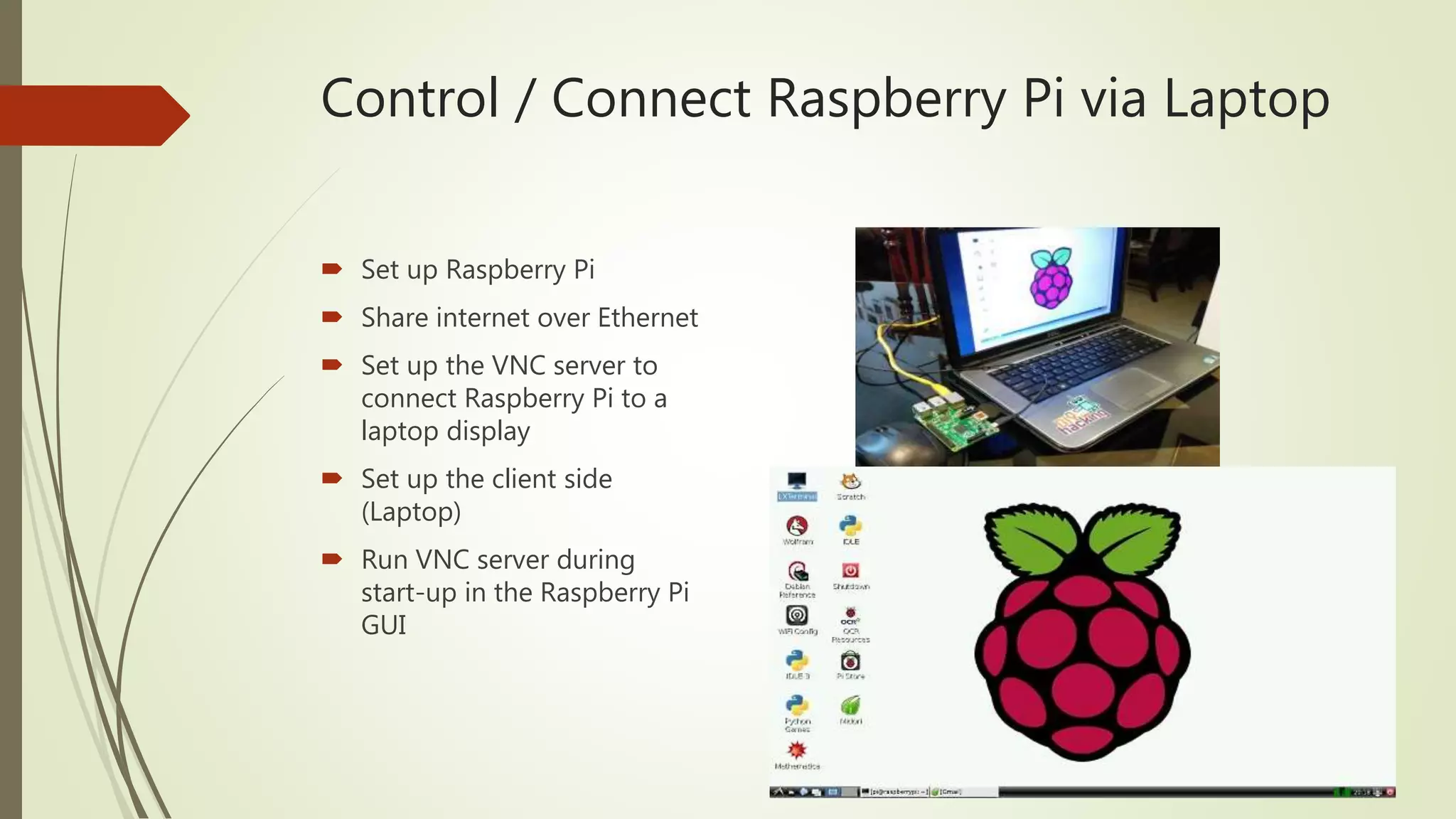
Control / Connect Raspberry Pi via Laptop
 Set up Raspberry Pi
 Share internet over Ethernet
 Set up the VNC server to
connect Raspberry Pi to a
laptop display
 Set up the client side
(Laptop)
 Run VNC server during
start-up in the Raspberry Pi
GUI
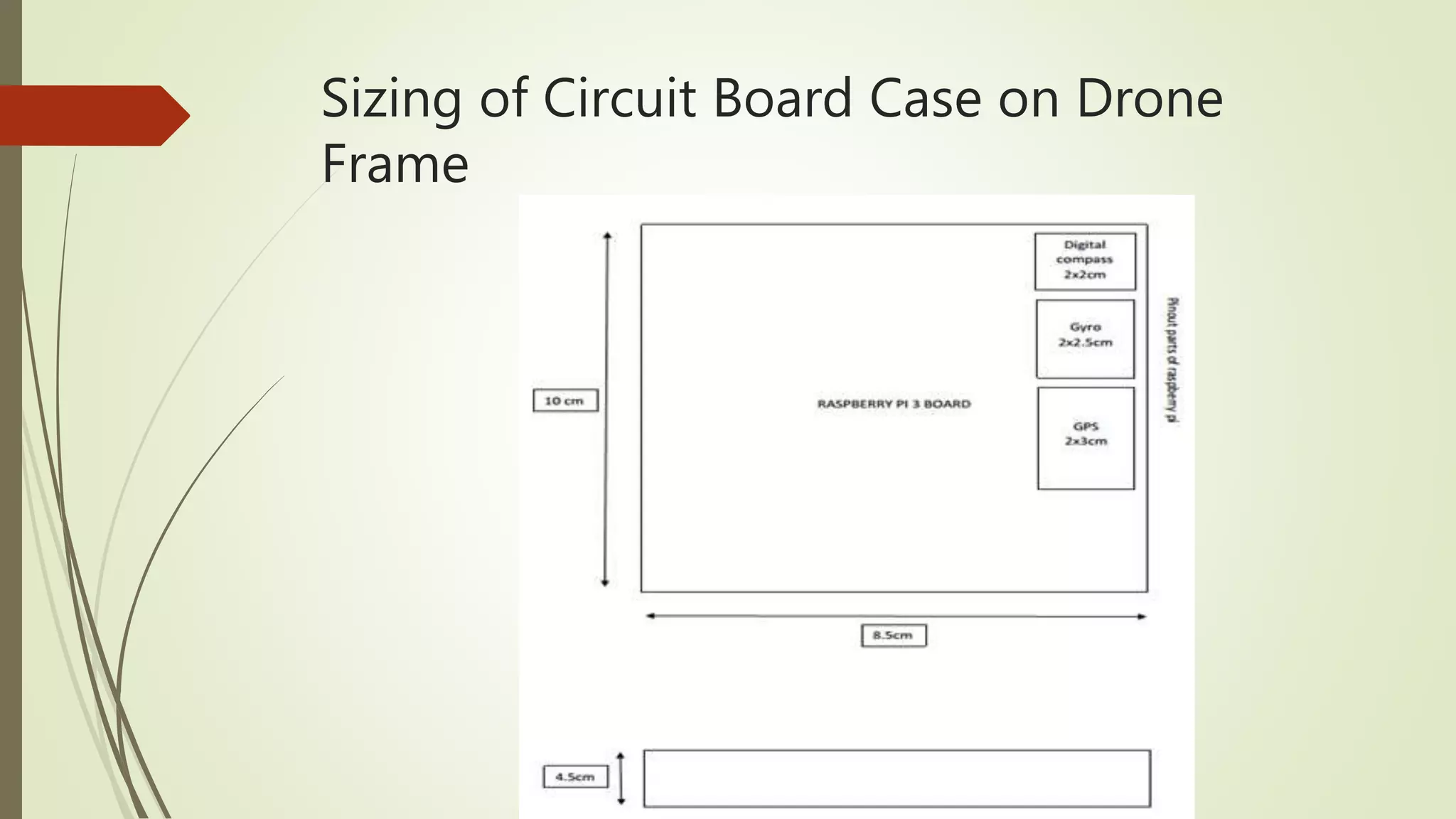
Sizing of Circuit Board Case on Drone
Frame
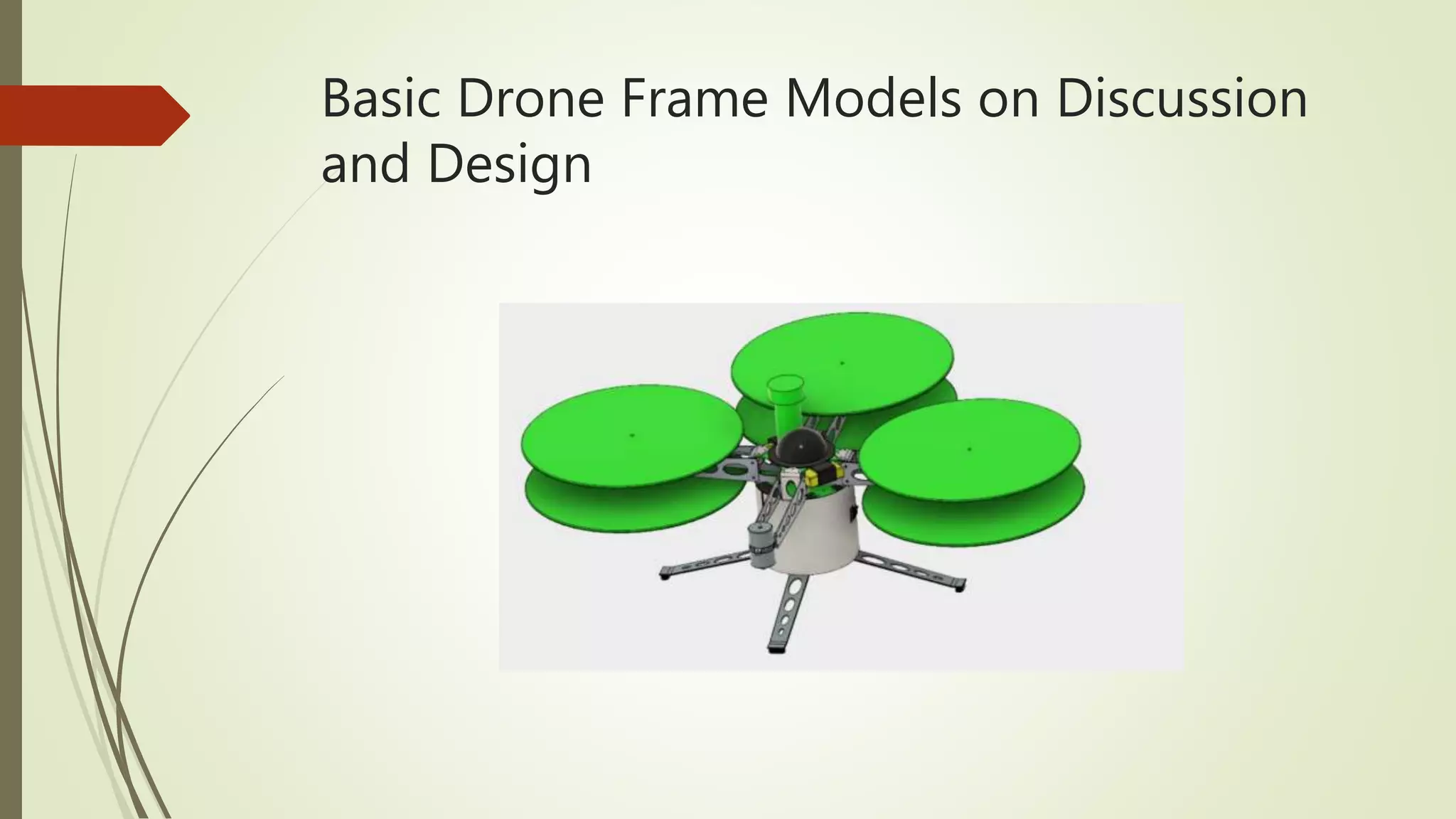
Basic Drone Frame Models on Discussion
and Design
Motors and Propellers
 The lighter the propeller, the easier it is for a broader set of motors
to be used.
 Motor requires several wires to control which set of coils are
powered. There are typically 3 wires, and the power is switched
between pairs of the 3 to move the motors. Motor control boards
are used to handle these three phases at the high currents required
and control their speed.
ESCs
 ESC stands for electronic speed controller. It takes a single signal
from the Flight Controller, and converts that to high power pulses
to the motors. There's a microcontroller at its core.
Batteries
 Quadcopters are generally powered by LiPo (lithium polymer)
batteries. These have a huge power to weight ratio - for the
amount of power they can deliver, they weigh very little.
 A single LiPo cell puts out a nominal 3.7 volts. Quadcopters are
usually driven by several of these cells strung together in series to
produce a battery (of cells) providing higher output voltages.
Sensors
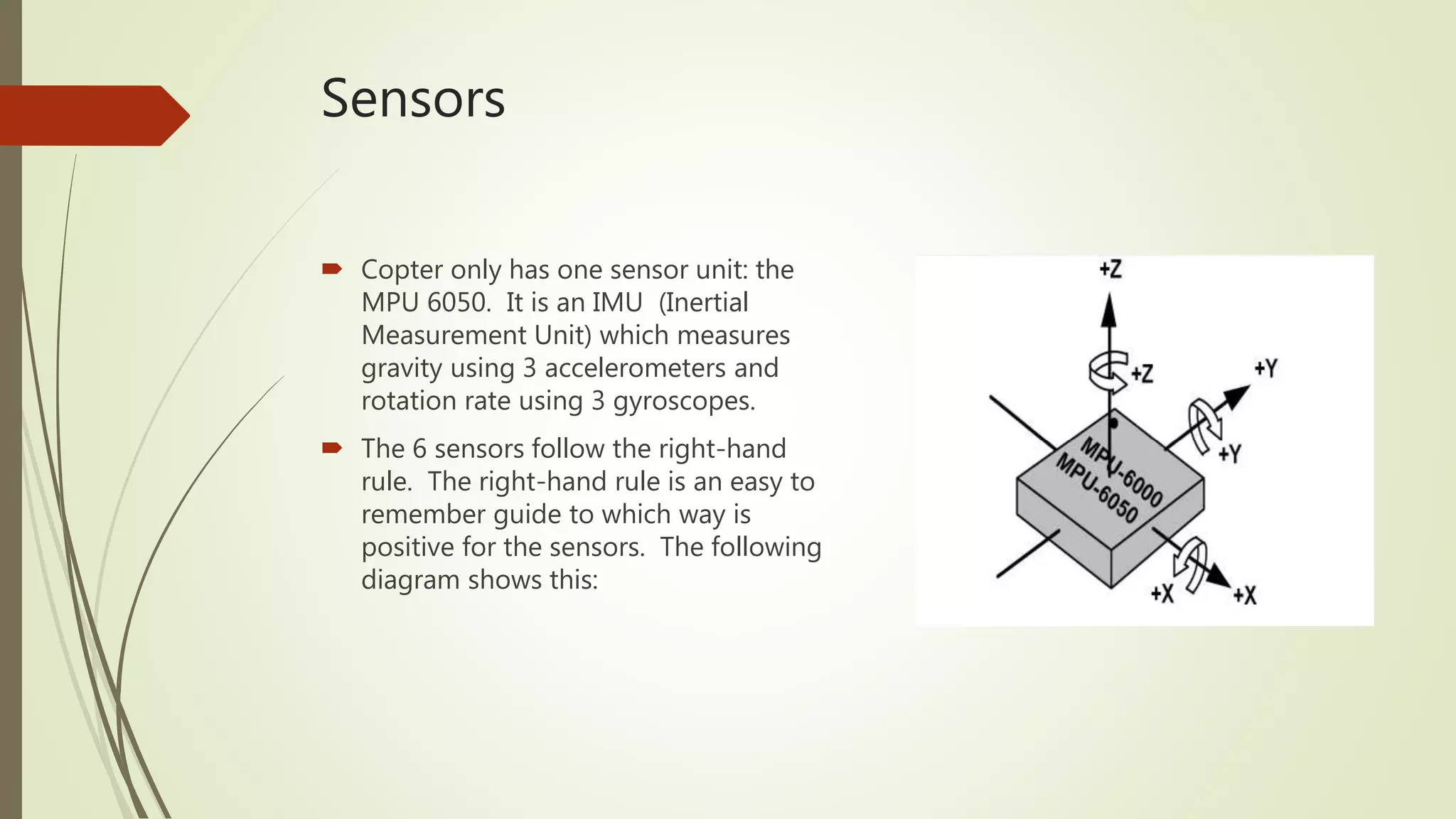
 Copter only has one sensor unit: the
MPU 6050. It is an IMU (Inertial
Measurement Unit) which measures
gravity using 3 accelerometers and
rotation rate using 3 gyroscopes.
 The 6 sensors follow the right-hand
rule. The right-hand rule is an easy to
remember guide to which way is
positive for the sensors. The following
diagram shows this:
Flight Controller
 UAV flight control is based on a Raspberry Pi, running software
written in Python. It reads the sensors using the results to check
what's happening compared to the flight plan, and changes how
fast each of the propellers is spinning to fix any differences.
PWM
 Pulse Width Modulation takes several forms; in the context of
driving a servo or brushless motors, it's normally a positive pulse
between 1 and 2ms long. This pulse is sent to the ESC anywhere
from 45 to several hundred times a second.
 To achieve the necessary accuracy, normally microcontrollers are
used. Luckily the Raspberry Pi provides the necessary PWM
hardware, and is able to produce these pulses at up to 300Hz at a
resolution of 1us - perfect.
PIDs (Proportional–Integral–Derivative
Controller)
 PIDs are the software glue that connects commands and sensors inputs together to
control the power to the motors.
 The algorithm is called a PID because it produces 3 outputs
 Proportional to the error
 Integral of the error
 Differential of the error
Sensor Calibration
 Because Copter is autonomous, the data read from the sensors
must be as accurate as possible. For the gyro, this is easy, and the
code performs the calibration automatically prior to every flight.
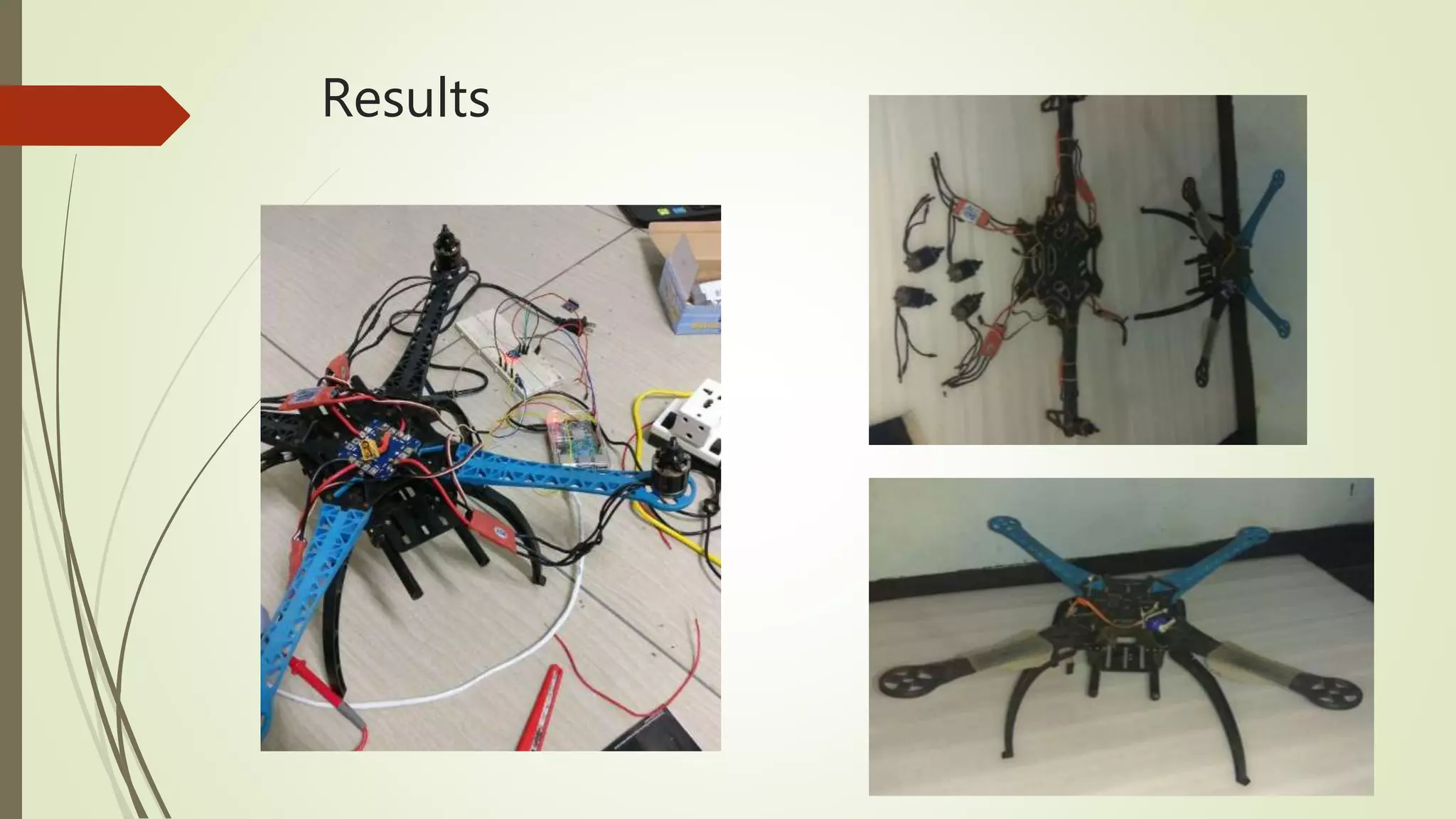
Results
Reference
 [Online].Available: https://learn.adafruit.com/setting-up-a-raspberry-pi-as-a-wifi-
accesspoint
 [Online].Available: https://blog.bitify.co.uk/2013/11/reading-data-from-mpu-6050-
on-raspberry.html
 [Online].Available: https://www.raspberrypi.org/documentation
 [Online].Available: https://github.com/vjaunet/QUADCOPTER_V2
 [Online].Available: https://github.com/vjaunet/QUADCOPTER
 [Online].Available: https://www.dropbox.com/sh/yu5a21jszu9l56i/auMp69raLM
 [Online].Available: https://en.m.Wikipedia.org/

Autonomous drone project part 1

  • 1.
    Autonomous Drone Project AbinVarghese Roll No – 01 VAES RSET Guided by: Mr Ajai V Babu Asst. Professor Dept. ECE RSET
  • 2.
    Objective  Autonomes drone- indoor navigation  Light weight frame design  Indoor Wi-Fi repeater with maximum coverage  GPS integration  Direction detection by compass  Calibration by Gyroscope
  • 3.
    Block Diagram Raspberry pi3 Accelero- meter GPS Compass Flightcontrol unit Remote control unit Wi-Fi Dongle (AP) Wi-Fi Module (client) Ground station PDAs
  • 4.
    Control / ConnectRaspberry Pi via Laptop  Set up Raspberry Pi  Share internet over Ethernet  Set up the VNC server to connect Raspberry Pi to a laptop display  Set up the client side (Laptop)  Run VNC server during start-up in the Raspberry Pi GUI
  • 5.
    Sizing of CircuitBoard Case on Drone Frame
  • 6.
    Basic Drone FrameModels on Discussion and Design
  • 7.
    Motors and Propellers The lighter the propeller, the easier it is for a broader set of motors to be used.  Motor requires several wires to control which set of coils are powered. There are typically 3 wires, and the power is switched between pairs of the 3 to move the motors. Motor control boards are used to handle these three phases at the high currents required and control their speed.
  • 8.
    ESCs  ESC standsfor electronic speed controller. It takes a single signal from the Flight Controller, and converts that to high power pulses to the motors. There's a microcontroller at its core.
  • 9.
    Batteries  Quadcopters aregenerally powered by LiPo (lithium polymer) batteries. These have a huge power to weight ratio - for the amount of power they can deliver, they weigh very little.  A single LiPo cell puts out a nominal 3.7 volts. Quadcopters are usually driven by several of these cells strung together in series to produce a battery (of cells) providing higher output voltages.
  • 10.
    Sensors  Copter onlyhas one sensor unit: the MPU 6050. It is an IMU (Inertial Measurement Unit) which measures gravity using 3 accelerometers and rotation rate using 3 gyroscopes.  The 6 sensors follow the right-hand rule. The right-hand rule is an easy to remember guide to which way is positive for the sensors. The following diagram shows this:
  • 11.
    Flight Controller  UAVflight control is based on a Raspberry Pi, running software written in Python. It reads the sensors using the results to check what's happening compared to the flight plan, and changes how fast each of the propellers is spinning to fix any differences.
  • 12.
    PWM  Pulse WidthModulation takes several forms; in the context of driving a servo or brushless motors, it's normally a positive pulse between 1 and 2ms long. This pulse is sent to the ESC anywhere from 45 to several hundred times a second.  To achieve the necessary accuracy, normally microcontrollers are used. Luckily the Raspberry Pi provides the necessary PWM hardware, and is able to produce these pulses at up to 300Hz at a resolution of 1us - perfect.
  • 13.
    PIDs (Proportional–Integral–Derivative Controller)  PIDsare the software glue that connects commands and sensors inputs together to control the power to the motors.  The algorithm is called a PID because it produces 3 outputs  Proportional to the error  Integral of the error  Differential of the error
  • 14.
    Sensor Calibration  BecauseCopter is autonomous, the data read from the sensors must be as accurate as possible. For the gyro, this is easy, and the code performs the calibration automatically prior to every flight.
  • 15.
  • 16.
    Reference  [Online].Available: https://learn.adafruit.com/setting-up-a-raspberry-pi-as-a-wifi- accesspoint [Online].Available: https://blog.bitify.co.uk/2013/11/reading-data-from-mpu-6050- on-raspberry.html  [Online].Available: https://www.raspberrypi.org/documentation  [Online].Available: https://github.com/vjaunet/QUADCOPTER_V2  [Online].Available: https://github.com/vjaunet/QUADCOPTER  [Online].Available: https://www.dropbox.com/sh/yu5a21jszu9l56i/auMp69raLM  [Online].Available: https://en.m.Wikipedia.org/