A
SEMINAR ON


 OPTICAL
COMPUTING
              Submitted by:
             HITESH KUMAWAT
                 EIC
                 4th year
CONTENT


          2
INTRODUCTION

With the growth of computing technology the
need of high performance computers (HPC)
has significantly increased. Optics has been
used in computing for a number of years but
the main emphasis has been and continues to
be to link portions of computers, for
communications, or more intrinsically in
devices that have some optical application or
component (optical pattern recognition etc.)


                                                3
WHY WE NEED OPTICAL
COMPUTERS?

• Rapid growth of the Internet
• Network speeds currently limited by
  electronic circuits
• Terabit speeds are required
• Traditional silicon circuits have a physical
  limit


                                                 4
WHAT IS THE OPTICAL
           COMPUTING?
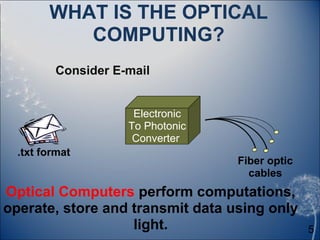
         Consider E-mail


                     Electronic
                    To Photonic
                     Converter
  .txt format
                                  Fiber optic
                                    cables
Optical Computers perform computations,
operate, store and transmit data using only
                   light.                       5
COMPONENTS FOR
           COMPUTING
• VCSEL (Vertical Cavity Surface Emitting
  Laser)

• SPT (Smart Pixel Technology)

• WDM (Wavelength Division Multiplexing)


                                            6
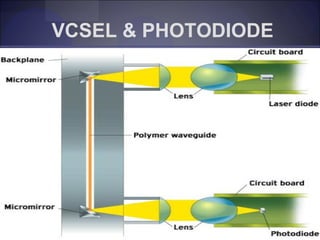
VCSEL & PHOTODIODE
SMART PIXEL
              TECHNOLOGY
Smart pixel technology is a relatively new
approach to integrating electronic circuitry and
optoelectronic devices in a common framework.
The purpose is to leverage the advantages of
each individual technology and provide improved
performance for specific applications.

Here, the electronic circuitry provides complex
functionality and programmability while the
optoelectronic devices provide high-speed
switching and compatibility with existing optical
media.
                                                    8
DEVICES FOR OPTICAL
        COMPUTING
• Logic gates :
   Logic gates are implemented optically by
   controlling the population inversion that occurs
   to produce lasing. A controlling laser is used to
   control the population inversion thus causing
   switching to occur.

• Holographic truth table:
   Destructive interference with light to be emitted
   or not is based on phase relationship.

• Logic based on gratings:
     1 is represented vertical grating causing light
     0 is represented by horizontal grating causing
      darkness.                                         9
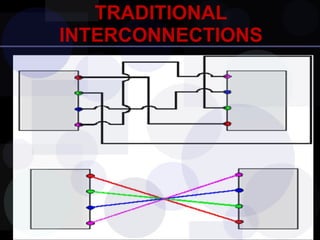
TRADITIONAL
INTERCONNECTIONS
INTERCONNECTIONS IN OPTICAL
           COMPUTING

• Fiber optic cables and optical transceivers are
  widely used.

• Applications of optical communications like
  fiber channel and computer networking are
  already being used.

• Chip to Chip and On-Chip interconnection
  possibilities are still being examined.

                                                    11
APPLICATION

•   High speed communications
•   Process satellite data.
•   Storage area Network
•   Optical crossbar interconnects are
    used in a synchronous transfer modes
    and shared memory multiprocessor
    systems.


                                      12
CONT….

• Optical Computing In VLSI Technology
Many researchers have been investigating suitable
optical logic devices, interconnection schemes, and
architectures. Furthermore, optics may provide
drastically new architectures to overcome some
architectural problems of conventional electrical
computers.
• Optical computing as expanders
The optical expander described utilizes high-speed
and high-space-bandwidth product connections that
are provided by optical beams in three dimensions.


                                                      13
ADVANTAGES
• Small size
• High density
• High speed
• Low heating of junctions
• Dynamically reconfigurable and scalable
  into larger or smaller topologies and
  network
• Massively parallel computing capability
• Applications in artificial intelligence
  applications
                                            14
LIMITATION

• Although there is a basic speed limitation in
  optoelectronic conversion delays ,WDM is used
  to get around this limitation.


• Promising but there are problems regarding
  dense organization of optical processing units
  but DWDM techniques can be used to overcome
  these limitations too.


                                               15
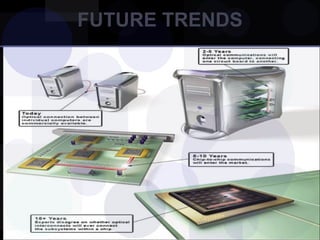
FUTURE TRENDS
CONCLUSION

Research in optical computing has opened up
new possibilities in several fields related to high
performance computing, high-speed
communications. To design algorithms that
execute applications faster , software
development will have a major impact in the
future and the ground rules for the computing
may have to be rewritten.


                                                      17
THANK YOU
QUERIES

Optical computing1

  • 1.
    A SEMINAR ON OPTICAL COMPUTING Submitted by: HITESH KUMAWAT EIC 4th year
  • 2.
  • 3.
    INTRODUCTION With the growthof computing technology the need of high performance computers (HPC) has significantly increased. Optics has been used in computing for a number of years but the main emphasis has been and continues to be to link portions of computers, for communications, or more intrinsically in devices that have some optical application or component (optical pattern recognition etc.) 3
  • 4.
    WHY WE NEEDOPTICAL COMPUTERS? • Rapid growth of the Internet • Network speeds currently limited by electronic circuits • Terabit speeds are required • Traditional silicon circuits have a physical limit 4
  • 5.
    WHAT IS THEOPTICAL COMPUTING? Consider E-mail Electronic To Photonic Converter .txt format Fiber optic cables Optical Computers perform computations, operate, store and transmit data using only light. 5
  • 6.
    COMPONENTS FOR COMPUTING • VCSEL (Vertical Cavity Surface Emitting Laser) • SPT (Smart Pixel Technology) • WDM (Wavelength Division Multiplexing) 6
  • 7.
  • 8.
    SMART PIXEL TECHNOLOGY Smart pixel technology is a relatively new approach to integrating electronic circuitry and optoelectronic devices in a common framework. The purpose is to leverage the advantages of each individual technology and provide improved performance for specific applications. Here, the electronic circuitry provides complex functionality and programmability while the optoelectronic devices provide high-speed switching and compatibility with existing optical media. 8
  • 9.
    DEVICES FOR OPTICAL COMPUTING • Logic gates : Logic gates are implemented optically by controlling the population inversion that occurs to produce lasing. A controlling laser is used to control the population inversion thus causing switching to occur. • Holographic truth table: Destructive interference with light to be emitted or not is based on phase relationship. • Logic based on gratings:  1 is represented vertical grating causing light  0 is represented by horizontal grating causing darkness. 9
  • 10.
  • 11.
    INTERCONNECTIONS IN OPTICAL COMPUTING • Fiber optic cables and optical transceivers are widely used. • Applications of optical communications like fiber channel and computer networking are already being used. • Chip to Chip and On-Chip interconnection possibilities are still being examined. 11
  • 12.
    APPLICATION • High speed communications • Process satellite data. • Storage area Network • Optical crossbar interconnects are used in a synchronous transfer modes and shared memory multiprocessor systems. 12
  • 13.
    CONT…. • Optical ComputingIn VLSI Technology Many researchers have been investigating suitable optical logic devices, interconnection schemes, and architectures. Furthermore, optics may provide drastically new architectures to overcome some architectural problems of conventional electrical computers. • Optical computing as expanders The optical expander described utilizes high-speed and high-space-bandwidth product connections that are provided by optical beams in three dimensions. 13
  • 14.
    ADVANTAGES • Small size •High density • High speed • Low heating of junctions • Dynamically reconfigurable and scalable into larger or smaller topologies and network • Massively parallel computing capability • Applications in artificial intelligence applications 14
  • 15.
    LIMITATION • Although thereis a basic speed limitation in optoelectronic conversion delays ,WDM is used to get around this limitation. • Promising but there are problems regarding dense organization of optical processing units but DWDM techniques can be used to overcome these limitations too. 15
  • 16.
  • 17.
    CONCLUSION Research in opticalcomputing has opened up new possibilities in several fields related to high performance computing, high-speed communications. To design algorithms that execute applications faster , software development will have a major impact in the future and the ground rules for the computing may have to be rewritten. 17
  • 18.
  • 19.