Record-breaking Petascale CycleCloud
HPC Production Run
156,000-core Cluster (1.21PetaFLOPS) Accelerates
Schrödinger Materials Science and Green Energy
November 2013
Cycle Computing
Cycle Computing believes
utility high performance computing
accelerates invention
Records broken, Science done
On November 3rd, ran a “MegaRun” cluster that had:
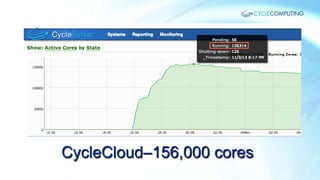
• 156,314 cores and 1.21 PetaFLOPS of theoretical peak compute power
• Ran 2.3 Million hours, totaling 264 years of computing, in 18 hours
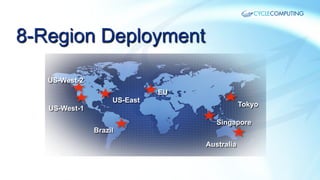
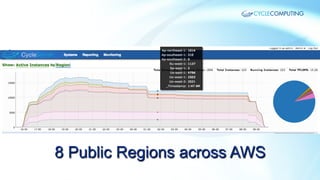
• Executed world-wide, across all 8 public AWS Regions (5 continents)
• Compared to $68Million to purchase – done on CycleCloud with Spot Instances for just $33K
THE SCIENCE
• Finding Organic Photovoltaic Compounds that are more efficient, easier to manufacture to help remove
the US’s reliance on fossil fuels.
• Designing, synthesizing, and experimenting with a new material can take 1 year of a scientists time
requiring hundreds of thousands of dollars in equipment, chemicals, etc. or
With Schrödinger Materials Science’s tools, on Cycle and AWS Spot Instances, it cost $0.16 per molecule
• The run analyzed 205,000 compounds in total
• This is the exact kind of science being outlined in the Materials Genome initiative from the White House
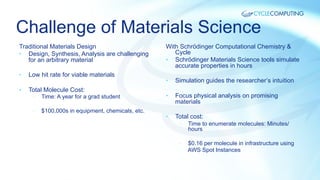
Challenge of Materials Science
Traditional Materials Design
•  Design, Synthesis, Analysis are challenging
for an arbitrary material
• 

Low hit rate for viable materials

• 

Total Molecule Cost:
• 

Time: A year for a grad student

• 

$100,000s in equipment, chemicals, etc.

With Schrödinger Computational Chemistry &
Cycle
•  Schrödinger Materials Science tools simulate
accurate properties in hours
• 

Simulation guides the researcher’s intuition

• 

Focus physical analysis on promising
materials

• 

Total cost:
• 

Time to enumerate molecules: Minutes/
hours

• 

$0.16 per molecule in infrastructure using
AWS Spot Instances
Designing Solar Materials
The Challenge is efficiency
•  Need to efficiently turn photons from the sun to Electricity
The number of possible materials is limitless
•  Need to separate the right compounds from the useless ones
•  If the 20th century was the century of silicon, the 21st will be all
organic
How do we find the right material,
without spending the entire 21st century looking for it?
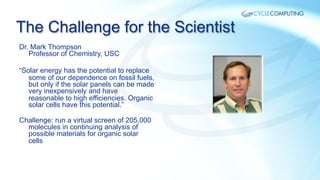
The Challenge for the Scientist
Dr. Mark Thompson
Professor of Chemistry, USC
“Solar energy has the potential to replace
some of our dependence on fossil fuels,
but only if the solar panels can be made
very inexpensively and have
reasonable to high efficiencies. Organic
solar cells have this potential.”
Challenge: run a virtual screen of 205,000
molecules in continuing analysis of
possible materials for organic solar
cells
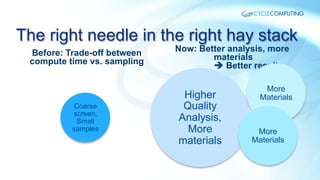
The right needle in the right hay stack
Before: Trade-off between
compute time vs. sampling

Coarse
screen,
Small
samples

Now: Better analysis, more
materials
è Better results

Higher
Quality
Analysis,
More
materials

More
Materials

More
Materials
Solution: Utility HPC
On-demand compute power is transformative for users, but hard to make production
—  Big Opportunity to help Manufacturing, Life Science, Energy, Financial

companies:

—  Rise of BigData, compute, Monte Carlo problems that power modern business and

science

—  Applications, like Schrödinger Materials Science tools, offer a compelling alternative

to physically testing products

—  Amazon Web Services makes infrastructure easily accessible
—  AWS Spot instances decrease the cost of compute
—  Science & engineering face faster time-to-market, increased agility requirements
—  Capital efficiency (OpEx replacing CapEx) are organizational goals
Why isn’t everyone doing this?
Because it is really complicated, and really hard to orchestrate
technical applications, securely, at scale
We’re the first and only ones doing this including the wellpublicized:
2000, 4000, 10000, 30000, and 50000 core clusters in
2010-2013
Clients including: Johnson & Johnson, Schrödinger, Pfizer,
Novartis, Genentech, HGST, Pacific Life Insurance, Hartford
Insurance Group …
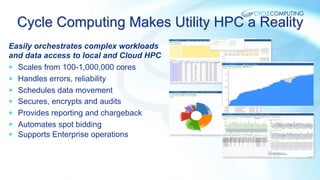
Cycle Computing Makes Utility HPC a Reality
Easily orchestrates complex workloads
and data access to local and Cloud HPC
—  Scales from 100-1,000,000 cores
—  Handles errors, reliability
—  Schedules data movement
—  Secures, encrypts and audits
—  Provides reporting and chargeback
—  Automates spot bidding
—  Supports Enterprise operations
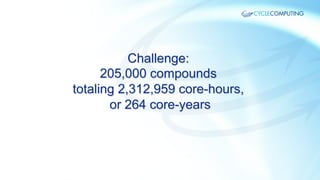
Challenge:
205,000 compounds
totaling 2,312,959 core-hours,
or 264 core-years
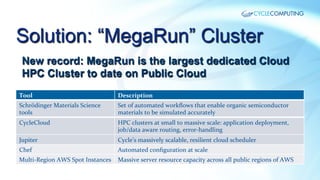
Solution: “MegaRun” Cluster
New record: MegaRun is the largest dedicated Cloud
HPC Cluster to date on Public Cloud
Tool	
  

Description	
  

Schrödinger	
  Materials	
  Science	
  
tools	
  

Set	
  of	
  automated	
  workflows	
  that	
  enable	
  organic	
  semiconductor	
  
materials	
  to	
  be	
  simulated	
  accurately	
  

CycleCloud	
  

HPC	
  clusters	
  at	
  small	
  to	
  massive	
  scale:	
  application	
  deployment,	
  
job/data	
  aware	
  routing,	
  error-­‐handling	
  

Jupiter	
  

Cycle’s	
  massively	
  scalable,	
  resilient	
  cloud	
  scheduler	


Chef	
  

Automated	
  configuration	
  at	
  scale	
  

Multi-­‐Region	
  AWS	
  Spot	
  Instances	
   Massive	
  server	
  resource	
  capacity	
  across	
  all	
  public	
  regions	
  of	
  AWS	
  
205,000 molecules
264 years of computing

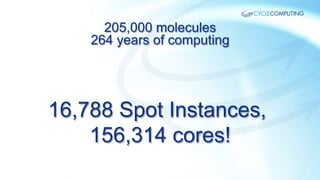
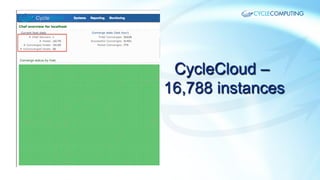
16,788 Spot Instances,
156,314 cores!
205,000 molecules
264 years of computing

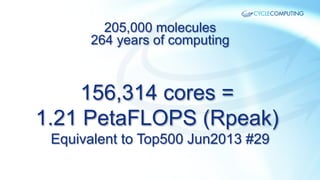
156,314 cores =
1.21 PetaFLOPS (Rpeak)
Equivalent to Top500 Jun2013 #29
205,000 molecules
264 years of computing

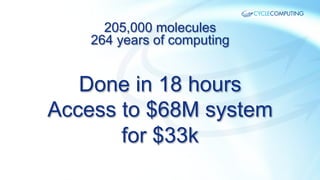
Done in 18 hours
Access to $68M system
for $33k
8-Region Deployment
US-West-2
US-East

EU
Tokyo

US-West-1
Brazil

Singapore
Australia
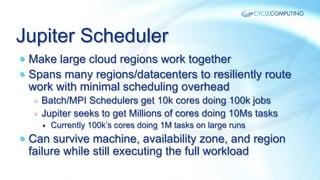
Jupiter Scheduler
—  Make large cloud regions work together
—  Spans many regions/datacenters to resiliently route

work with minimal scheduling overhead

—  Batch/MPI Schedulers get 10k cores doing 100k jobs
—  Jupiter seeks to get Millions of cores doing 10Ms tasks
—  Currently 100k’s cores doing 1M tasks on large runs

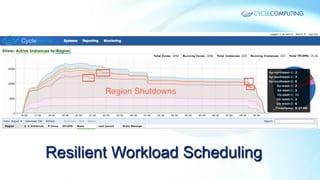
—  Can survive machine, availability zone, and region

failure while still executing the full workload
Resilient Workload Scheduling
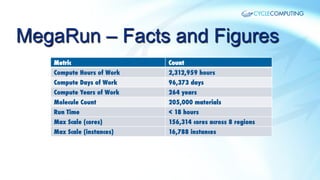
MegaRun – Facts and Figures
Metric

Count

Compute Hours of Work

2,312,959 hours

Compute Days of Work

96,373 days

Compute Years of Work

264 years

Molecule Count

205,000 materials

Run Time

< 18 hours

Max Scale (cores)

156,314 cores across 8 regions

Max Scale (instances)

16,788 instances
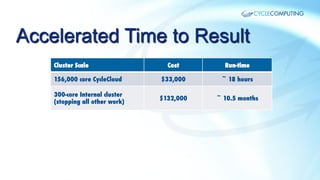
Accelerated Time to Result
Cluster Scale

Cost

Run-time

156,000 core CycleCloud

$33,000

~ 18 hours

300-core Internal cluster
(stopping all other work)

$132,000

~ 10.5 months
CycleCloud–156,000 cores
CycleCloud –
16,788 instances
8 Public Regions across AWS
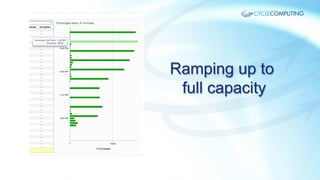
Ramping up to
full capacity
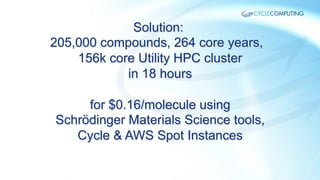
Solution:
205,000 compounds, 264 core years,
156k core Utility HPC cluster
in 18 hours
for $0.16/molecule using
Schrödinger Materials Science tools,
Cycle & AWS Spot Instances

Cycle Computing Record-breaking Petascale HPC Run

  • 1.
    Record-breaking Petascale CycleCloud HPCProduction Run 156,000-core Cluster (1.21PetaFLOPS) Accelerates Schrödinger Materials Science and Green Energy November 2013 Cycle Computing
  • 2.
    Cycle Computing believes utilityhigh performance computing accelerates invention
  • 3.
    Records broken, Sciencedone On November 3rd, ran a “MegaRun” cluster that had: • 156,314 cores and 1.21 PetaFLOPS of theoretical peak compute power • Ran 2.3 Million hours, totaling 264 years of computing, in 18 hours • Executed world-wide, across all 8 public AWS Regions (5 continents) • Compared to $68Million to purchase – done on CycleCloud with Spot Instances for just $33K THE SCIENCE • Finding Organic Photovoltaic Compounds that are more efficient, easier to manufacture to help remove the US’s reliance on fossil fuels. • Designing, synthesizing, and experimenting with a new material can take 1 year of a scientists time requiring hundreds of thousands of dollars in equipment, chemicals, etc. or With Schrödinger Materials Science’s tools, on Cycle and AWS Spot Instances, it cost $0.16 per molecule • The run analyzed 205,000 compounds in total • This is the exact kind of science being outlined in the Materials Genome initiative from the White House
  • 4.
    Challenge of MaterialsScience Traditional Materials Design •  Design, Synthesis, Analysis are challenging for an arbitrary material •  Low hit rate for viable materials •  Total Molecule Cost: •  Time: A year for a grad student •  $100,000s in equipment, chemicals, etc. With Schrödinger Computational Chemistry & Cycle •  Schrödinger Materials Science tools simulate accurate properties in hours •  Simulation guides the researcher’s intuition •  Focus physical analysis on promising materials •  Total cost: •  Time to enumerate molecules: Minutes/ hours •  $0.16 per molecule in infrastructure using AWS Spot Instances
  • 5.
    Designing Solar Materials TheChallenge is efficiency •  Need to efficiently turn photons from the sun to Electricity The number of possible materials is limitless •  Need to separate the right compounds from the useless ones •  If the 20th century was the century of silicon, the 21st will be all organic How do we find the right material, without spending the entire 21st century looking for it?
  • 6.
    The Challenge forthe Scientist Dr. Mark Thompson Professor of Chemistry, USC “Solar energy has the potential to replace some of our dependence on fossil fuels, but only if the solar panels can be made very inexpensively and have reasonable to high efficiencies. Organic solar cells have this potential.” Challenge: run a virtual screen of 205,000 molecules in continuing analysis of possible materials for organic solar cells
  • 7.
    The right needlein the right hay stack Before: Trade-off between compute time vs. sampling Coarse screen, Small samples Now: Better analysis, more materials è Better results Higher Quality Analysis, More materials More Materials More Materials
  • 8.
    Solution: Utility HPC On-demandcompute power is transformative for users, but hard to make production —  Big Opportunity to help Manufacturing, Life Science, Energy, Financial companies: —  Rise of BigData, compute, Monte Carlo problems that power modern business and science —  Applications, like Schrödinger Materials Science tools, offer a compelling alternative to physically testing products —  Amazon Web Services makes infrastructure easily accessible —  AWS Spot instances decrease the cost of compute —  Science & engineering face faster time-to-market, increased agility requirements —  Capital efficiency (OpEx replacing CapEx) are organizational goals
  • 9.
    Why isn’t everyonedoing this? Because it is really complicated, and really hard to orchestrate technical applications, securely, at scale We’re the first and only ones doing this including the wellpublicized: 2000, 4000, 10000, 30000, and 50000 core clusters in 2010-2013 Clients including: Johnson & Johnson, Schrödinger, Pfizer, Novartis, Genentech, HGST, Pacific Life Insurance, Hartford Insurance Group …
  • 10.
    Cycle Computing MakesUtility HPC a Reality Easily orchestrates complex workloads and data access to local and Cloud HPC —  Scales from 100-1,000,000 cores —  Handles errors, reliability —  Schedules data movement —  Secures, encrypts and audits —  Provides reporting and chargeback —  Automates spot bidding —  Supports Enterprise operations
  • 11.
  • 12.
    Solution: “MegaRun” Cluster Newrecord: MegaRun is the largest dedicated Cloud HPC Cluster to date on Public Cloud Tool   Description   Schrödinger  Materials  Science   tools   Set  of  automated  workflows  that  enable  organic  semiconductor   materials  to  be  simulated  accurately   CycleCloud   HPC  clusters  at  small  to  massive  scale:  application  deployment,   job/data  aware  routing,  error-­‐handling   Jupiter   Cycle’s  massively  scalable,  resilient  cloud  scheduler     Chef   Automated  configuration  at  scale   Multi-­‐Region  AWS  Spot  Instances   Massive  server  resource  capacity  across  all  public  regions  of  AWS  
  • 13.
    205,000 molecules 264 yearsof computing 16,788 Spot Instances, 156,314 cores!
  • 14.
    205,000 molecules 264 yearsof computing 156,314 cores = 1.21 PetaFLOPS (Rpeak) Equivalent to Top500 Jun2013 #29
  • 15.
    205,000 molecules 264 yearsof computing Done in 18 hours Access to $68M system for $33k
  • 16.
  • 17.
    Jupiter Scheduler —  Makelarge cloud regions work together —  Spans many regions/datacenters to resiliently route work with minimal scheduling overhead —  Batch/MPI Schedulers get 10k cores doing 100k jobs —  Jupiter seeks to get Millions of cores doing 10Ms tasks —  Currently 100k’s cores doing 1M tasks on large runs —  Can survive machine, availability zone, and region failure while still executing the full workload
  • 18.
  • 19.
    MegaRun – Factsand Figures Metric Count Compute Hours of Work 2,312,959 hours Compute Days of Work 96,373 days Compute Years of Work 264 years Molecule Count 205,000 materials Run Time < 18 hours Max Scale (cores) 156,314 cores across 8 regions Max Scale (instances) 16,788 instances
  • 20.
    Accelerated Time toResult Cluster Scale Cost Run-time 156,000 core CycleCloud $33,000 ~ 18 hours 300-core Internal cluster (stopping all other work) $132,000 ~ 10.5 months
  • 21.
  • 22.
  • 23.
    8 Public Regionsacross AWS
  • 24.
  • 25.
    Solution: 205,000 compounds, 264core years, 156k core Utility HPC cluster in 18 hours for $0.16/molecule using Schrödinger Materials Science tools, Cycle & AWS Spot Instances