ISRC Future Technology
       Briefing:
  Optical Computing
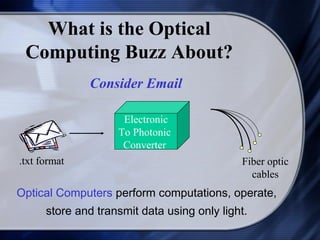
What is the Optical
 Computing Buzz About?
              Consider Email

                     Electronic
                    To Photonic
                     Converter
.txt format                                  Fiber optic
                                               cables
Optical Computers perform computations, operate,
      store and transmit data using only light.
Why Do We Need Optical
       Computers?
• Rapid growth of the Internet
• Network speeds currently limited by
  electronic circuits
• Terabit speeds are required
• Traditional silicon circuits have a physical
  limit
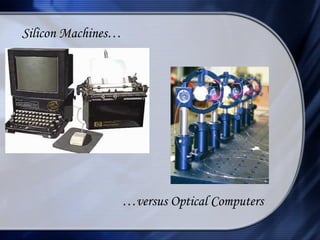
Silicon Machines…


                    …versus Optical Computers
How Does It Work?
• Photonic circuits
• Organic compounds
• No short-circuiting possible
• No heat dissipation
• Speed of light in photonic circuits will be
  close to speed of light in vacuum
• Light beams can travel in parallel
    – They can transfer data in parallel.
Future                Current
                     vs.
    Benefits             Limitations
• No conversion of data   • Photonic circuit
• Faster that today’s       accuracy
  machines                • Requirement of power
• Increased
  computational power
• Optimized storage
• Increased bandwidth
• Super-fast database
  searches
What Is the Projected
          Timeline?
• Still some time in the future
  – On our desktops in 15 years
• Now researchers have made progress
  – Light can be trapped for long enough to
    store data
  – Advanced optical CD-ROMs
    (Write/Read/Erase)
• In the near term, optical computers will
  most likely be hybrid optical/electronic
  systems.
What’s Beyond the Optical
          Limit?
• Quantum computing
  – Allows particles to be in more than one state
    at a time
  – Each particle in a quantum computer to hold
    more than one bit of information.
• A quantum computer is, thus far, only a
  hypothetical machine
  – Expected between 2030 and 2050
What Should Your
        Organization Do?
1. Participate in research activities (like ISRC
   seminars  )
2. Review the status of optical computing research
   about every two years
3. Compare those advances with advances in the
   micro-miniaturization of traditional processors
4. Try to identify those segments of the economy
   that will benefit the soonest from advances in
   optical computing

Optical comp

  • 1.
    ISRC Future Technology Briefing: Optical Computing
  • 2.
    What is theOptical Computing Buzz About? Consider Email Electronic To Photonic Converter .txt format Fiber optic cables Optical Computers perform computations, operate, store and transmit data using only light.
  • 3.
    Why Do WeNeed Optical Computers? • Rapid growth of the Internet • Network speeds currently limited by electronic circuits • Terabit speeds are required • Traditional silicon circuits have a physical limit
  • 4.
    Silicon Machines… …versus Optical Computers
  • 5.
    How Does ItWork? • Photonic circuits • Organic compounds • No short-circuiting possible • No heat dissipation • Speed of light in photonic circuits will be close to speed of light in vacuum • Light beams can travel in parallel – They can transfer data in parallel.
  • 6.
    Future Current vs. Benefits Limitations • No conversion of data • Photonic circuit • Faster that today’s accuracy machines • Requirement of power • Increased computational power • Optimized storage • Increased bandwidth • Super-fast database searches
  • 7.
    What Is theProjected Timeline? • Still some time in the future – On our desktops in 15 years • Now researchers have made progress – Light can be trapped for long enough to store data – Advanced optical CD-ROMs (Write/Read/Erase) • In the near term, optical computers will most likely be hybrid optical/electronic systems.
  • 8.
    What’s Beyond theOptical Limit? • Quantum computing – Allows particles to be in more than one state at a time – Each particle in a quantum computer to hold more than one bit of information. • A quantum computer is, thus far, only a hypothetical machine – Expected between 2030 and 2050
  • 9.
    What Should Your Organization Do? 1. Participate in research activities (like ISRC seminars  ) 2. Review the status of optical computing research about every two years 3. Compare those advances with advances in the micro-miniaturization of traditional processors 4. Try to identify those segments of the economy that will benefit the soonest from advances in optical computing