WELCOME
Powerpoint Presentation On
Optical Computing
By
• Soumen Chowdhury
• ECE (6th Semester)
• Roll No.:15
OPTICAL COMPUTING
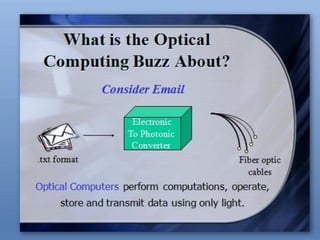
An optical computer (also
called a photonic computer) is
a device that uses the
PHOTONS in visible light or
infrared ( IR ) beams,rather
than electric current, to
perform digital computations.
Introduction
• Growth of computing technology increased the need of
high performance computers (HPC) significantly .
• The choice is motivated by several features that light
has:
• • Actually the fastest thing that we know, and
speed is exactly what we need for our computers.
• It can be easily manipulated (divided, transported,
• delayed,split etc.)
• It is very well suited for parallelization.
Optical computing technology is, in general,
developing in two directions.
Electro optical hybrids: One approach is to
build computers that have the same
architecture as present day computers but
using optics.
Optical mode: Another approach is to generate
a completely new kind of computer, which can
perform all functional operations in optical
mode.
Why we Use Optics for Computing?
• VLSI Technology: To make computers faster, their
components must be smaller and there by decrease the
distance between them.
• But they are limited not only by the speed of electrons in
matter but also by the increasing density of
interconnections necessary to link the electronic gates on
microchips.
• Einstein’s principle: One of the theoretical limits on how
fast a computer can function is given by Einstein’s
principle that signal cannot propagate faster than speed
of light.
• The optical computing comes as a solution of
miniaturization problem.
Features of optical computing
• Optical interconnections and optical integrated
circuits have several advantages over their
electronic counterparts(short circuit).
• Optical data processing can perform several
operations in parallel much faster and easier than
electrons.
• They are compact , faster and light in weight.
• Optics has a higher bandwidth capacity over
electronics, which enables more information to be
carried
OPTICAL COMPUTER
 An optical computer, besides being much faster than
an electronic one, might also be smaller.
 Bright flashes of laser light can be sent hundreds of
miles along fine strands of specially made glass or
plastic called OPTICAL FIBERS.
 Instead of transistors, such a computer will have
TRANSPHASORS
 These are switches that are activated by beams of
light rather than by pulses of electricity.
 Unlike transistors, transphasors can be built to handle
several incoming signals at once.
Beams of light can crisscross and
overlap without becoming mixed up,
whereas crossed electric currents
would get hopelessly confused.
Also, the arrangement of connections
and switches would not have to be flat,
as in an electronic computer. It could
be placed in any direction in space,
allowing totally new designs in
information processing
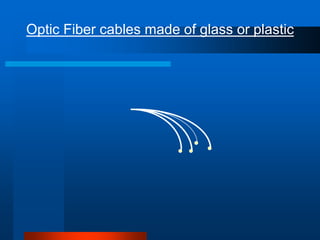
Optic Fiber cables made of glass or plastic
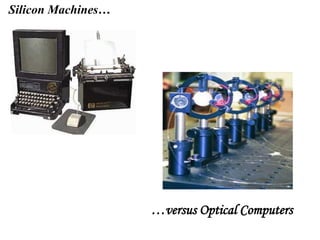
…versus Optical Computers
Silicon Machines…
SOME KEY OPTICAL COMPONENTS FOR
COMPUTING
 The major components are:
1. VCSEL (VERTICAL CAVITY SURFACE EMITTING LASER)
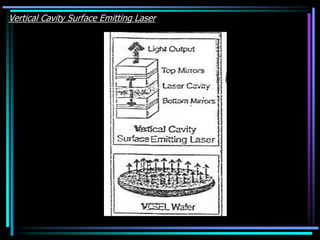
 VCSEL (pronounced ‘vixel’) is a semiconductor vertical cavity surface
that emits light in a cylindrical beam vertically from the surface of a
fabricated wafer.
 But rather than reflective ends, in a VCSEL there are several layers of
partially reflective mirrors above and below the active layer. Layers of
semiconductors with differing compositions create these mirrors, and
each mirror reflects a narrow range of wavelengths back in to the
cavity in order to cause light emission at just one wavelength.
Vertical Cavity Surface Emitting Laser
2. SMART PIXEL TECHNOLOGY
• Smart pixel technology is a relatively new
approach to integrating electronic circuitry
and optoelectronic devices in a common
framework.
• Here, the electronic circuitry provides
complex functionality and programmability.
• While the optoelectronic devices provide
high-speed switching and compatibility with
existing optical media.
3. WDM (WAVELENGTH DIVISION MULTIPLEXING)
• Wavelength division multiplexing is a method of sending
many different wavelengths down the same optical fiber.
Using this technology, modern networks in which individual
lasers can transmit at 10 gigabits per second through the
same fiber at the same time.
• WDM can transmit up to 32 wavelengths through a single
fiber, but cannot meet the bandwidth requirements of the
present day communication systems. So nowadays DWDM
(Dense wavelength division multiplexing) is used. This can
transmit up to 1000 wavelengths through a single fiber.
That is by using this we can improve the bandwidth
efficiency.
4. ADVANCES IN PHOTONIC SWITCHES
Logic gates are the building blocks of any digital
system. An optical logic gate is a switch that
controls one light beam by another; it is ON when
the device transmits light and it is OFF when it
blocks the light.
MERITS
• Optical computing is at least 1000 to 100000 times faster
than today’s silicon machines.
• Optical storage will provide an extremely optimized way
to store data, with space requirements far lesser than
today’s silicon chips.
• Super fast searches through databases.
• No short circuits, light beam can cross each other
without interfering with each other’s data.
• Higher performance
• Higher parallelism
• Less heat is released
• Less noise
• More Flexible in layout
• Less loss in communication
DRAWBACKS
• Today’s materials require much high power to work in
consumer products, coming up with the right materials
may take five years or more.
• Optical computing using a coherent source is simple to
compute and understand, but it has many drawbacks
like any imperfections or dust on the optical
components will create unwanted interference pattern
due to scattering effects.
• Optical components and their production is still
expensive
• New expensive high-tech factories have to be built
FUTURE TRENDS
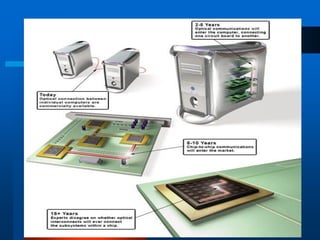
• The Ministry of Information Technology has
initiated a photonic development program. Under
this program some funded projects are continuing
in fiber optic high-speed network systems.
Research is going on for developing new laser
diodes, photo detectors and nonlinear material
studies for faster switches.
CONCLUSION
 Research in optical computing has opened up new
possibilities in several fields related to high
performance computing and high-speed
communications.
 To design algorithms that execute applications
faster, the specific properties of optics must be
considered, such as their ability to exploit massive
parallelism and global interconnections.
 As optoelectronic and smart pixel devices mature,
software development will have a major impact in the
future and the ground rules for the computing may
have to be rewritten.
THANK YOU........
References:
www.google.com
www.wikipedia.com
www.slideshare.com

Kamna

  • 1.
  • 2.
    Powerpoint Presentation On OpticalComputing By • Soumen Chowdhury • ECE (6th Semester) • Roll No.:15
  • 3.
  • 4.
    An optical computer(also called a photonic computer) is a device that uses the PHOTONS in visible light or infrared ( IR ) beams,rather than electric current, to perform digital computations.
  • 5.
    Introduction • Growth ofcomputing technology increased the need of high performance computers (HPC) significantly . • The choice is motivated by several features that light has: • • Actually the fastest thing that we know, and speed is exactly what we need for our computers. • It can be easily manipulated (divided, transported, • delayed,split etc.) • It is very well suited for parallelization.
  • 6.
    Optical computing technologyis, in general, developing in two directions. Electro optical hybrids: One approach is to build computers that have the same architecture as present day computers but using optics. Optical mode: Another approach is to generate a completely new kind of computer, which can perform all functional operations in optical mode.
  • 7.
    Why we UseOptics for Computing? • VLSI Technology: To make computers faster, their components must be smaller and there by decrease the distance between them. • But they are limited not only by the speed of electrons in matter but also by the increasing density of interconnections necessary to link the electronic gates on microchips. • Einstein’s principle: One of the theoretical limits on how fast a computer can function is given by Einstein’s principle that signal cannot propagate faster than speed of light. • The optical computing comes as a solution of miniaturization problem.
  • 8.
    Features of opticalcomputing • Optical interconnections and optical integrated circuits have several advantages over their electronic counterparts(short circuit). • Optical data processing can perform several operations in parallel much faster and easier than electrons. • They are compact , faster and light in weight. • Optics has a higher bandwidth capacity over electronics, which enables more information to be carried
  • 9.
    OPTICAL COMPUTER  Anoptical computer, besides being much faster than an electronic one, might also be smaller.  Bright flashes of laser light can be sent hundreds of miles along fine strands of specially made glass or plastic called OPTICAL FIBERS.  Instead of transistors, such a computer will have TRANSPHASORS  These are switches that are activated by beams of light rather than by pulses of electricity.  Unlike transistors, transphasors can be built to handle several incoming signals at once.
  • 10.
    Beams of lightcan crisscross and overlap without becoming mixed up, whereas crossed electric currents would get hopelessly confused. Also, the arrangement of connections and switches would not have to be flat, as in an electronic computer. It could be placed in any direction in space, allowing totally new designs in information processing
  • 11.
    Optic Fiber cablesmade of glass or plastic
  • 13.
  • 14.
    SOME KEY OPTICALCOMPONENTS FOR COMPUTING  The major components are: 1. VCSEL (VERTICAL CAVITY SURFACE EMITTING LASER)  VCSEL (pronounced ‘vixel’) is a semiconductor vertical cavity surface that emits light in a cylindrical beam vertically from the surface of a fabricated wafer.  But rather than reflective ends, in a VCSEL there are several layers of partially reflective mirrors above and below the active layer. Layers of semiconductors with differing compositions create these mirrors, and each mirror reflects a narrow range of wavelengths back in to the cavity in order to cause light emission at just one wavelength.
  • 15.
  • 16.
    2. SMART PIXELTECHNOLOGY • Smart pixel technology is a relatively new approach to integrating electronic circuitry and optoelectronic devices in a common framework. • Here, the electronic circuitry provides complex functionality and programmability. • While the optoelectronic devices provide high-speed switching and compatibility with existing optical media.
  • 17.
    3. WDM (WAVELENGTHDIVISION MULTIPLEXING) • Wavelength division multiplexing is a method of sending many different wavelengths down the same optical fiber. Using this technology, modern networks in which individual lasers can transmit at 10 gigabits per second through the same fiber at the same time. • WDM can transmit up to 32 wavelengths through a single fiber, but cannot meet the bandwidth requirements of the present day communication systems. So nowadays DWDM (Dense wavelength division multiplexing) is used. This can transmit up to 1000 wavelengths through a single fiber. That is by using this we can improve the bandwidth efficiency.
  • 18.
    4. ADVANCES INPHOTONIC SWITCHES Logic gates are the building blocks of any digital system. An optical logic gate is a switch that controls one light beam by another; it is ON when the device transmits light and it is OFF when it blocks the light.
  • 19.
    MERITS • Optical computingis at least 1000 to 100000 times faster than today’s silicon machines. • Optical storage will provide an extremely optimized way to store data, with space requirements far lesser than today’s silicon chips. • Super fast searches through databases. • No short circuits, light beam can cross each other without interfering with each other’s data. • Higher performance • Higher parallelism • Less heat is released • Less noise • More Flexible in layout • Less loss in communication
  • 20.
    DRAWBACKS • Today’s materialsrequire much high power to work in consumer products, coming up with the right materials may take five years or more. • Optical computing using a coherent source is simple to compute and understand, but it has many drawbacks like any imperfections or dust on the optical components will create unwanted interference pattern due to scattering effects. • Optical components and their production is still expensive • New expensive high-tech factories have to be built
  • 21.
    FUTURE TRENDS • TheMinistry of Information Technology has initiated a photonic development program. Under this program some funded projects are continuing in fiber optic high-speed network systems. Research is going on for developing new laser diodes, photo detectors and nonlinear material studies for faster switches.
  • 23.
    CONCLUSION  Research inoptical computing has opened up new possibilities in several fields related to high performance computing and high-speed communications.  To design algorithms that execute applications faster, the specific properties of optics must be considered, such as their ability to exploit massive parallelism and global interconnections.  As optoelectronic and smart pixel devices mature, software development will have a major impact in the future and the ground rules for the computing may have to be rewritten.
  • 24.
  • 25.