A G M Rural College of Engineering and Technology
Navagrah Teerth, Varur.
OPTICAL COMPUTER TECHNOLOGY
Under the Guidance of
Mrs.SNEHA B.E, M.Tech.
Asst. Professor
Submitted by
Preeti.K.S
CONTENTS
 Why we need them?
 What is optical computer?
 Block diagram
 Optical transistors
 Key components of optical computing
 Merits
 Applications
Why We Need Them ?
 Moore’s Law states that the number of transistors on a
computer chip doubles every eighteen months.
Traditional transistors can no longer keep up.
 „Too many transistors will slow down processor
speeds. „Transistors have physical size limits.
 Metallic wires limit the speed of transmission.
 Resistance per unit length in the chip is being increased,
causing more power usage and excess
What Is an Optical Computer?
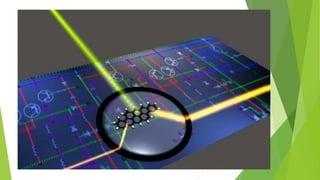
 An optical computer is a computer that performs its
computation with photons as opposed to the more
traditional electron-based computation.
 There are two different types of optical computers
1. Electro optical hybrid computers
2. pure optical computers
Electro-Optical Hybrid computers
 Use optical fibers and electric parts to read and direct
data from the processor
 Light pulses send information instead of voltage
packets.
 Processors change from binary code to light pulses
using lasers.
 Information is then detected and decoded electronically
back into binary.
Pure Optical Computers
 Use multiple frequencies
 Information is sent throughout computer as light waves
and packets.
 No electron based systems
 No converstion from binary to optical necessary, greatly
increasing the speed.
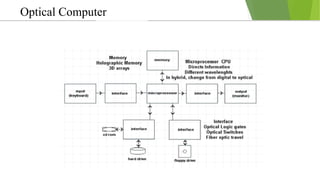
Optical Computer
Information flow in optical computers
 Information gets sent in from keyboard, mouse, or other
external sources and goes to the processor.
 Processor then sends the information through logic gates
and switches to be programmed.
 The information is then sent through different fiber optic
cables depending on it’s final location.
 Some information will be sent to the holographic
memory, where it will then be saved.
 After information is saved and the program would like
to use it,the program sends a command to the processor,
which then sends a command to receive the information.
 The program receives the information and sends a signal
back to the processor to tell it that the task is complete.
Optical Transistors
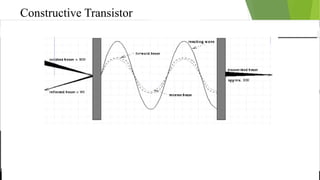
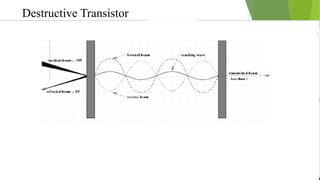
 Transistors based off of the Fabry-Perot Interferometer. „
1. Constructive interference yields a high intensity (a 1 in
binary) „
2. Destructive interference yields an intensity close to
zero (a 0 in binary)
Constructive Transistor
Destructive Transistor
SOME KEY OPTICAL COMPONENTS FOR
COMPUTING
 VCSEL (VERTICAL CAVITY SURFACE EMITTING
LASER)
 SLM (SPATIAL LIGHT MODULATORS)
 SMART PIXEL TECHNOLOGY
 WDM (WAVELENGTH DIVISION MULTIPLEXING)
VCSEL (VERTICAL CAVITY SURFACE
EMITTING LASER)
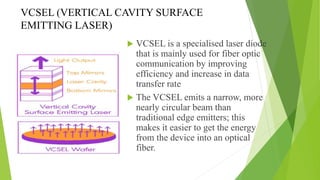
 VCSEL is a specialised laser diode
that is mainly used for fiber optic
communication by improving
efficiency and increase in data
transfer rate
 The VCSEL emits a narrow, more
nearly circular beam than
traditional edge emitters; this
makes it easier to get the energy
from the device into an optical
fiber.
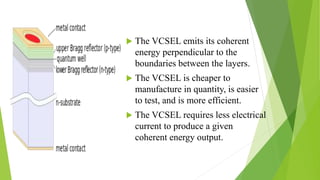
 The VCSEL emits its coherent
energy perpendicular to the
boundaries between the layers.
 The VCSEL is cheaper to
manufacture in quantity, is easier
to test, and is more efficient.
 The VCSEL requires less electrical
current to produce a given
coherent energy output.
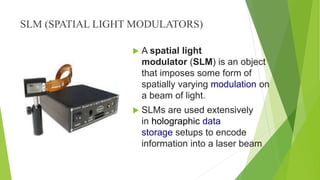
SLM (SPATIAL LIGHT MODULATORS)
 A spatial light
modulator (SLM) is an object
that imposes some form of
spatially varying modulation on
a beam of light.
 SLMs are used extensively
in holographic data
storage setups to encode
information into a laser beam
SMART PIXEL TECHNOLOGY
 Smart pixel technology is a relatively new approach to
integrating electronic circuitry and optoelectronic devices in a
common framework.
 Here, the electronic circuitry provides complex functionality
and programmability while the optoelectronic devices provide
high-speed switching and compatibility with existing optical
media.
 Application of one specific smart pixel technology to a 2D
application of analog-to-digital conversion called digital image
halftoning.
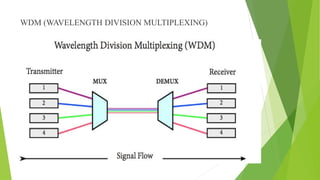
WDM (WAVELENGTH DIVISION MULTIPLEXING)
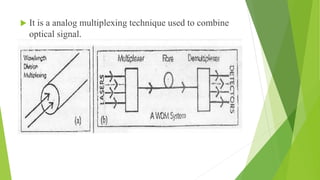
 It is a analog multiplexing technique used to combine
optical signal.
 Wavelength division multiplexing is a method of
sending many different wavelengths down the same
optical fiber.
 . Using this technology, modern networks in which
individual lasers can transmit at 10 gigabits per second
through the same fiber at the same time.
 WDM can transmit up to 32 wavelengths through a
single fiber, but cannot meet the bandwidth
requirements of the present day communication
systems.
DWDM(Dense wavelength division multiplexing)
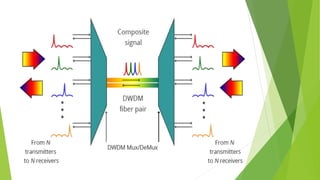
 Dense Wavelength Division Multiplexing (DWDM) is an
optical multiplexing technology used to increase bandwidth
over existing fiber networks.
 This can transmit up to 1000 wavelengths through a single
fiber.
That is by using this we can improve the bandwidth
efficiency.
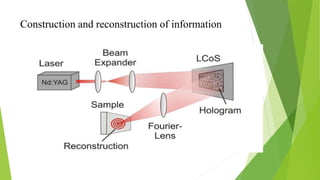
Construction and reconstruction of information
HOLOGRAPHIC MEMORY
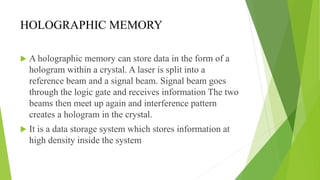
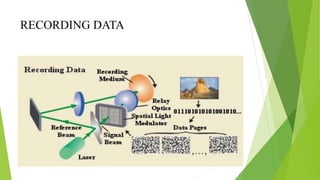
 A holographic memory can store data in the form of a
hologram within a crystal. A laser is split into a
reference beam and a signal beam. Signal beam goes
through the logic gate and receives information The two
beams then meet up again and interference pattern
creates a hologram in the crystal.
 It is a data storage system which stores information at
high density inside the system
RECORDING DATA
MERITS
1.Optical computing is at least 1000 to 100000 times faster
than today’s silicon machines.
2. No short circuits, light beam can cross each other without
interfering with each other’s data
3. Light beams can travel in parallel and no limit to number of
packets that can travel in the photonic circuits.
4. Optical computer removes the bottleneck in the present day
communication system
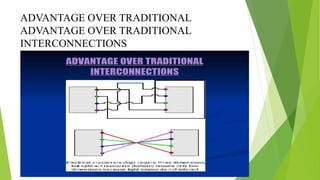
ADVANTAGE OVER TRADITIONAL
INTERCONNECTIONS
APPLICATIONS
 High speed communications :The rapid growth of
internet,expanding at almost15% per month, demands faster
speeds and larger bandwidth than electronic circuits can
provide.
 Super fast searches through databases.
 Optical Computing In VLSI Technology :optics may provide
drastically new architectures to overcome some conventional
electrical architectural problems of conventional electrical
computers.
optical computer technology

optical computer technology

  • 1.
    A G MRural College of Engineering and Technology Navagrah Teerth, Varur. OPTICAL COMPUTER TECHNOLOGY Under the Guidance of Mrs.SNEHA B.E, M.Tech. Asst. Professor Submitted by Preeti.K.S
  • 2.
    CONTENTS  Why weneed them?  What is optical computer?  Block diagram  Optical transistors  Key components of optical computing  Merits  Applications
  • 3.
    Why We NeedThem ?  Moore’s Law states that the number of transistors on a computer chip doubles every eighteen months. Traditional transistors can no longer keep up.  „Too many transistors will slow down processor speeds. „Transistors have physical size limits.  Metallic wires limit the speed of transmission.  Resistance per unit length in the chip is being increased, causing more power usage and excess
  • 4.
    What Is anOptical Computer?  An optical computer is a computer that performs its computation with photons as opposed to the more traditional electron-based computation.  There are two different types of optical computers 1. Electro optical hybrid computers 2. pure optical computers
  • 5.
    Electro-Optical Hybrid computers Use optical fibers and electric parts to read and direct data from the processor  Light pulses send information instead of voltage packets.  Processors change from binary code to light pulses using lasers.  Information is then detected and decoded electronically back into binary.
  • 6.
    Pure Optical Computers Use multiple frequencies  Information is sent throughout computer as light waves and packets.  No electron based systems  No converstion from binary to optical necessary, greatly increasing the speed.
  • 7.
  • 8.
    Information flow inoptical computers  Information gets sent in from keyboard, mouse, or other external sources and goes to the processor.  Processor then sends the information through logic gates and switches to be programmed.  The information is then sent through different fiber optic cables depending on it’s final location.
  • 9.
     Some informationwill be sent to the holographic memory, where it will then be saved.  After information is saved and the program would like to use it,the program sends a command to the processor, which then sends a command to receive the information.  The program receives the information and sends a signal back to the processor to tell it that the task is complete.
  • 10.
    Optical Transistors  Transistorsbased off of the Fabry-Perot Interferometer. „ 1. Constructive interference yields a high intensity (a 1 in binary) „ 2. Destructive interference yields an intensity close to zero (a 0 in binary)
  • 11.
  • 12.
  • 13.
    SOME KEY OPTICALCOMPONENTS FOR COMPUTING  VCSEL (VERTICAL CAVITY SURFACE EMITTING LASER)  SLM (SPATIAL LIGHT MODULATORS)  SMART PIXEL TECHNOLOGY  WDM (WAVELENGTH DIVISION MULTIPLEXING)
  • 14.
    VCSEL (VERTICAL CAVITYSURFACE EMITTING LASER)  VCSEL is a specialised laser diode that is mainly used for fiber optic communication by improving efficiency and increase in data transfer rate  The VCSEL emits a narrow, more nearly circular beam than traditional edge emitters; this makes it easier to get the energy from the device into an optical fiber.
  • 15.
     The VCSELemits its coherent energy perpendicular to the boundaries between the layers.  The VCSEL is cheaper to manufacture in quantity, is easier to test, and is more efficient.  The VCSEL requires less electrical current to produce a given coherent energy output.
  • 16.
    SLM (SPATIAL LIGHTMODULATORS)  A spatial light modulator (SLM) is an object that imposes some form of spatially varying modulation on a beam of light.  SLMs are used extensively in holographic data storage setups to encode information into a laser beam
  • 17.
    SMART PIXEL TECHNOLOGY Smart pixel technology is a relatively new approach to integrating electronic circuitry and optoelectronic devices in a common framework.  Here, the electronic circuitry provides complex functionality and programmability while the optoelectronic devices provide high-speed switching and compatibility with existing optical media.  Application of one specific smart pixel technology to a 2D application of analog-to-digital conversion called digital image halftoning.
  • 18.
  • 19.
     It isa analog multiplexing technique used to combine optical signal.
  • 20.
     Wavelength divisionmultiplexing is a method of sending many different wavelengths down the same optical fiber.  . Using this technology, modern networks in which individual lasers can transmit at 10 gigabits per second through the same fiber at the same time.  WDM can transmit up to 32 wavelengths through a single fiber, but cannot meet the bandwidth requirements of the present day communication systems.
  • 21.
    DWDM(Dense wavelength divisionmultiplexing)  Dense Wavelength Division Multiplexing (DWDM) is an optical multiplexing technology used to increase bandwidth over existing fiber networks.  This can transmit up to 1000 wavelengths through a single fiber. That is by using this we can improve the bandwidth efficiency.
  • 23.
  • 24.
    HOLOGRAPHIC MEMORY  Aholographic memory can store data in the form of a hologram within a crystal. A laser is split into a reference beam and a signal beam. Signal beam goes through the logic gate and receives information The two beams then meet up again and interference pattern creates a hologram in the crystal.  It is a data storage system which stores information at high density inside the system
  • 25.
  • 27.
    MERITS 1.Optical computing isat least 1000 to 100000 times faster than today’s silicon machines. 2. No short circuits, light beam can cross each other without interfering with each other’s data 3. Light beams can travel in parallel and no limit to number of packets that can travel in the photonic circuits. 4. Optical computer removes the bottleneck in the present day communication system
  • 28.
    ADVANTAGE OVER TRADITIONAL ADVANTAGEOVER TRADITIONAL INTERCONNECTIONS
  • 29.
    APPLICATIONS  High speedcommunications :The rapid growth of internet,expanding at almost15% per month, demands faster speeds and larger bandwidth than electronic circuits can provide.  Super fast searches through databases.  Optical Computing In VLSI Technology :optics may provide drastically new architectures to overcome some conventional electrical architectural problems of conventional electrical computers.