BUDHIST
EDUCATION:
A COMPREHENSIVE
PRESENTATION
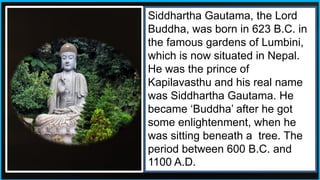
Siddhartha Gautama, the Lord
Buddha, was born in 623 B.C. in
the famous gardens of Lumbini,
which is now situated in Nepal.
He was the prince of
Kapilavasthu and his real name
was Siddhartha Gautama. He
became ‘Buddha’ after he got
some enlightenment, when he
was sitting beneath a tree. The
period between 600 B.C. and
1100 A.D.
Four Noble Truths in
Buddhism
Life is Full of Sufferings
The Cause of
Sufferings is desire
The end of the Suffering is
Possible
This End is Possible by Following
Eight Fold Paths
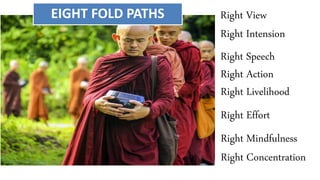
EIGHT FOLD PATHS Right View
Right Intension
Right Speech
Right Action
Right Livelihood
Right Effort
Right Mindfulness
Right Concentration
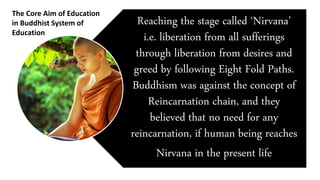
Reaching the stage called ‘Nirvana’
i.e. liberation from all sufferings
through liberation from desires and
greed by following Eight Fold Paths.
Buddhism was against the concept of
Reincarnation chain, and they
believed that no need for any
reincarnation, if human being reaches
Nirvana in the present life
The Core Aim of Education
in Buddhist System of
Education
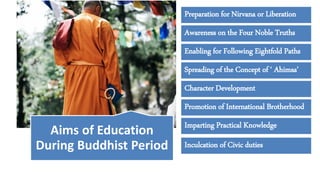
Aims of Education
During Buddhist Period
Preparation for Nirvana or Liberation
Awareness on the Four Noble Truths
Enabling for Following Eightfold Paths
Spreading of the Concept of ‘ Ahimsa’
Character Development
Promotion of International Brotherhood
Imparting Practical Knowledge
Inculcation of Civic duties
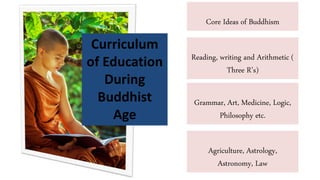
Curriculum
of Education
During
Buddhist
Age
Core Ideas of Buddhism
Reading, writing and Arithmetic (
Three R’s)
Grammar, Art, Medicine, Logic,
Philosophy etc.
Agriculture, Astrology,
Astronomy, Law
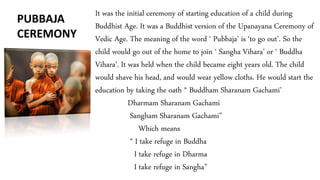
It was the initial ceremony of starting education of a child during
Buddhist Age. It was a Buddhist version of the Upanayana Ceremony of
Vedic Age. The meaning of the word ‘ Pubbaja’ is ‘to go out’. So the
child would go out of the home to join ‘ Sangha Vihara’ or ‘ Buddha
Vihara’. It was held when the child became eight years old. The child
would shave his head, and would wear yellow cloths. He would start the
education by taking the oath “ Buddham Sharanam Gachami’
Dharmam Sharanam Gachami
Sangham Sharanam Gachami”
Which means
“ I take refuge in Buddha
I take refuge in Dharma
I take refuge in Sangha”
PUBBAJA
CEREMONY
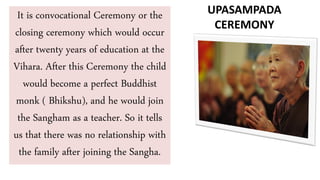
It is convocational Ceremony or the
closing ceremony which would occur
after twenty years of education at the
Vihara. After this Ceremony the child
would become a perfect Buddhist
monk ( Bhikshu), and he would join
the Sangham as a teacher. So it tells
us that there was no relationship with
the family after joining the Sangha.
UPASAMPADA
CEREMONY
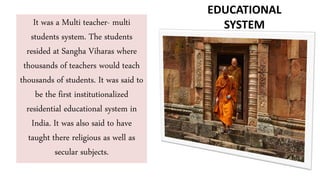
It was a Multi teacher- multi
students system. The students
resided at Sangha Viharas where
thousands of teachers would teach
thousands of students. It was said to
be the first institutionalized
residential educational system in
India. It was also said to have
taught there religious as well as
secular subjects.
EDUCATIONAL
SYSTEM
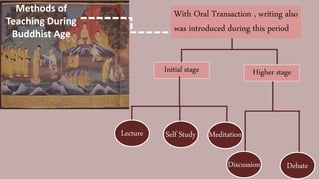
Methods of
Teaching During
Buddhist Age
Initial stage Higher stage
Lecture Self Study Meditation
Discussion Debate
With Oral Transaction , writing also
was introduced during this period
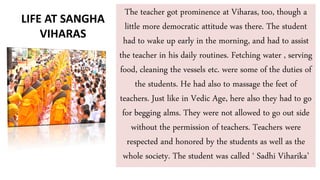
The teacher got prominence at Viharas, too, though a
little more democratic attitude was there. The student
had to wake up early in the morning, and had to assist
the teacher in his daily routines. Fetching water , serving
food, cleaning the vessels etc. were some of the duties of
the students. He had also to massage the feet of
teachers. Just like in Vedic Age, here also they had to go
for begging alms. They were not allowed to go out side
without the permission of teachers. Teachers were
respected and honored by the students as well as the
whole society. The student was called ‘ Sadhi Viharika’
LIFE AT SANGHA
VIHARAS
VISIT- themastereducator.com
THANK YOU

Buddhist Education: Salient Features

  • 1.
  • 2.
    Siddhartha Gautama, theLord Buddha, was born in 623 B.C. in the famous gardens of Lumbini, which is now situated in Nepal. He was the prince of Kapilavasthu and his real name was Siddhartha Gautama. He became ‘Buddha’ after he got some enlightenment, when he was sitting beneath a tree. The period between 600 B.C. and 1100 A.D.
  • 3.
    Four Noble Truthsin Buddhism Life is Full of Sufferings The Cause of Sufferings is desire The end of the Suffering is Possible This End is Possible by Following Eight Fold Paths
  • 4.
    EIGHT FOLD PATHSRight View Right Intension Right Speech Right Action Right Livelihood Right Effort Right Mindfulness Right Concentration
  • 5.
    Reaching the stagecalled ‘Nirvana’ i.e. liberation from all sufferings through liberation from desires and greed by following Eight Fold Paths. Buddhism was against the concept of Reincarnation chain, and they believed that no need for any reincarnation, if human being reaches Nirvana in the present life The Core Aim of Education in Buddhist System of Education
  • 6.
    Aims of Education DuringBuddhist Period Preparation for Nirvana or Liberation Awareness on the Four Noble Truths Enabling for Following Eightfold Paths Spreading of the Concept of ‘ Ahimsa’ Character Development Promotion of International Brotherhood Imparting Practical Knowledge Inculcation of Civic duties
  • 7.
    Curriculum of Education During Buddhist Age Core Ideasof Buddhism Reading, writing and Arithmetic ( Three R’s) Grammar, Art, Medicine, Logic, Philosophy etc. Agriculture, Astrology, Astronomy, Law
  • 8.
    It was theinitial ceremony of starting education of a child during Buddhist Age. It was a Buddhist version of the Upanayana Ceremony of Vedic Age. The meaning of the word ‘ Pubbaja’ is ‘to go out’. So the child would go out of the home to join ‘ Sangha Vihara’ or ‘ Buddha Vihara’. It was held when the child became eight years old. The child would shave his head, and would wear yellow cloths. He would start the education by taking the oath “ Buddham Sharanam Gachami’ Dharmam Sharanam Gachami Sangham Sharanam Gachami” Which means “ I take refuge in Buddha I take refuge in Dharma I take refuge in Sangha” PUBBAJA CEREMONY
  • 9.
    It is convocationalCeremony or the closing ceremony which would occur after twenty years of education at the Vihara. After this Ceremony the child would become a perfect Buddhist monk ( Bhikshu), and he would join the Sangham as a teacher. So it tells us that there was no relationship with the family after joining the Sangha. UPASAMPADA CEREMONY
  • 10.
    It was aMulti teacher- multi students system. The students resided at Sangha Viharas where thousands of teachers would teach thousands of students. It was said to be the first institutionalized residential educational system in India. It was also said to have taught there religious as well as secular subjects. EDUCATIONAL SYSTEM
  • 11.
    Methods of Teaching During BuddhistAge Initial stage Higher stage Lecture Self Study Meditation Discussion Debate With Oral Transaction , writing also was introduced during this period
  • 12.
    The teacher gotprominence at Viharas, too, though a little more democratic attitude was there. The student had to wake up early in the morning, and had to assist the teacher in his daily routines. Fetching water , serving food, cleaning the vessels etc. were some of the duties of the students. He had also to massage the feet of teachers. Just like in Vedic Age, here also they had to go for begging alms. They were not allowed to go out side without the permission of teachers. Teachers were respected and honored by the students as well as the whole society. The student was called ‘ Sadhi Viharika’ LIFE AT SANGHA VIHARAS
  • 13.