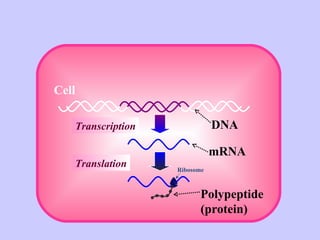
Cell DNA mRNA Transcription Polypeptide (protein) Translation Ribosome
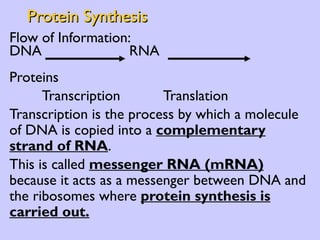
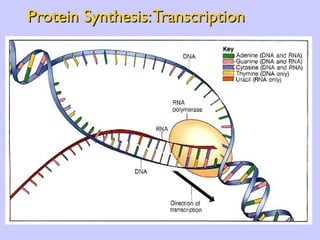
Protein Synthesis Flow of Information: DNA   RNA   Proteins Transcription  Translation Transcription is the process by which a molecule of DNA is copied into a  complementary strand of RNA .  This is called  messenger RNA (mRNA)  because it acts as a messenger between DNA and the ribosomes where  protein synthesis is carried out.
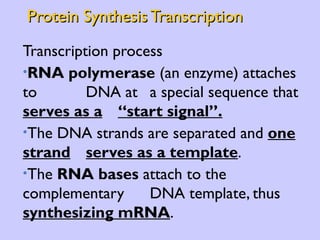
Protein Synthesis Transcription Transcription process RNA polymerase  (an enzyme) attaches to  DNA at  a special sequence that  serves as a   “start signal”. The DNA strands are separated and  one strand   serves as a template . The  RNA bases  attach to the complementary  DNA template, thus  synthesizing mRNA .
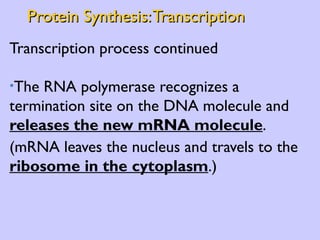
Protein Synthesis: Transcription Transcription process continued The RNA polymerase recognizes a termination site on the DNA molecule and  releases the new mRNA molecule . (mRNA leaves the nucleus and travels to the  ribosome in the cytoplasm .)
Protein Synthesis: Transcription
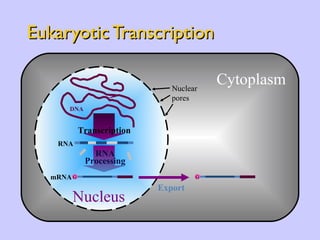
Eukaryotic Transcription DNA Cytoplasm Nucleus Export G AAAAAA RNA Transcription Nuclear  pores G AAAAAA RNA Processing mRNA
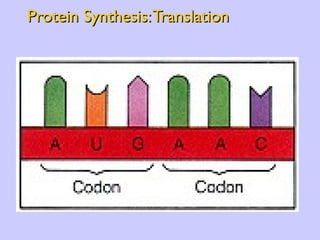
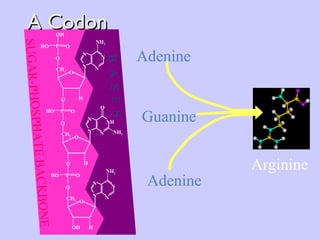
Protein Synthesis: Translation Translation   is the process of decoding a mRNA molecule into a  polypeptide chain or   protein. Each combination of  3 nucleotides on mRNA is called a  codon or three-letter code word.   Each codon specifies a  particular  amino acid  that is to be placed in the polypeptide chain (protein).
Protein Synthesis: Translation
A Codon SUGAR-PHOSPHATE BACKBONE B  A  S  E  S H P O O HO O O CH 2 NH 2 N NH N N H OH P O O HO O O CH 2 NH 2 N N N N H P O OH HO O O CH 2 NH 2 N N N N O Guanine Adenine Adenine Arginine
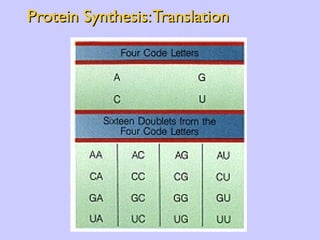
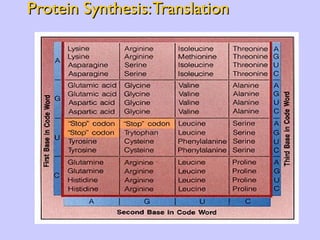
Protein Synthesis: Translation A three-letter code is used because there are  20  different amino acids  that are used to make proteins. If a  two-letter code  were used there would not be enough codons to select all 20 amino acids.  That is, there are 4 bases in RNA, so 4 2  (4x 4)=16;  where as 4 3  (4x4x4)=64 .
Protein Synthesis: Translation
Protein Synthesis: Translation Therefore, there is a total of 64 codons with mRNA,  61specify a particular amino acid . This means there are  more than one codon  for each of the 20 amino acids.  The remaining three codons (UAA, UAG, & UGA) are  stop codons , which signify the end of a polypeptide chain (protein).  Besides selecting the amino acid methionine, the codon  AUG  also serves as the “ initiator ”  codon , which starts the synthesis of a protein
Protein Synthesis: Translation
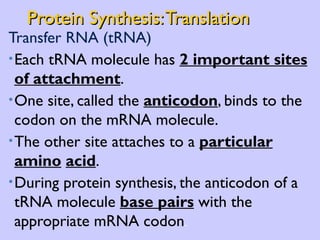
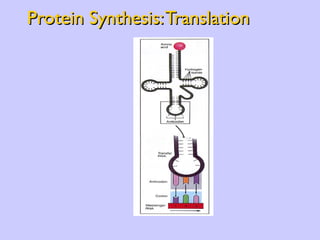
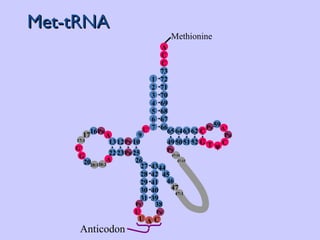
Protein Synthesis: Translation Transfer RNA (tRNA) Each tRNA molecule has  2 important sites of attachment .  One site, called the  anticodon , binds to the codon on the mRNA molecule.  The other site attaches to a  particular amino   acid . During protein synthesis, the anticodon of a tRNA molecule  base pairs  with the appropriate mRNA codon .
Protein Synthesis: Translation
Met-tRNA Methionine U * 9 26 22 23 Pu 16 12 Py 10 25 20:1 G * 17:1 Pu A 20:2 17 13 20 G A 50 51 65 64 63 G 62 52 C Pu 59  A * C Py T 49 39 41 42 31 29 28 Pu * 43 1 27 U 35 38 36 Py * 34 40 30 47:1 47:15 46 Py 47:16 45 44 47 73 C C A 70 71 72 66 67 68 69 3 2 1 7 6 5 4 A C U Anticodon
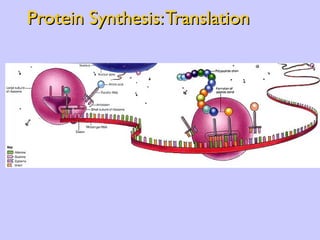
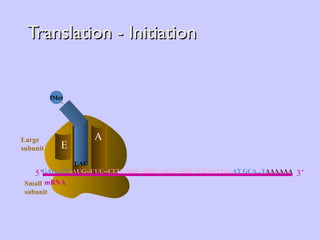
Protein Synthesis: Translation Ribosome: Are made up of  2 subunits, a large one and a smaller one, each subunit contains  ribosomal   RNA (rRNA) & proteins . Protein synthesis starts when the  two subunits   bind to mRNA . The initiator codon AUG binds to the first anticodon of tRNA,  signaling the start of a   protein.
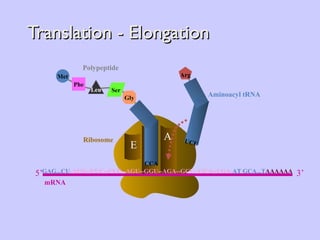
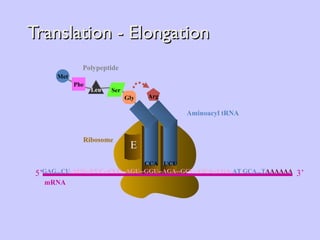
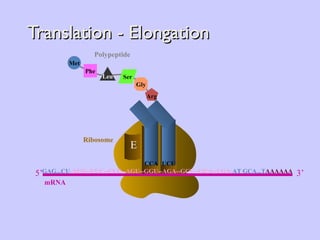
Protein Synthesis: Translation Ribosome: The anticodon of another tRNA binds to the next mRNA codon, bringing the  2nd amino   acid  to be placed in the protein. As each anticodon & codon bind together a  peptide bond forms between the two amino   acids.
Protein Synthesis: Translation Ribosome: The protein chain continues to grow until a  stop codon  reaches the ribosome, which results in the release of the new protein and mRNA,  completing the process of translation .
Protein Synthesis: Translation
Translation - Initiation A E Large subunit P Small subunit fMet UAC GAG...CU -AUG--UUC--CUU--AGU--GGU--AGA--GCU--GUA--UGA- AT GCA...T AAAAAA 5’ mRNA 3’
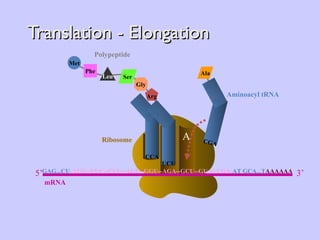
Translation - Elongation A E Ribosome P UCU Arg Aminoacyl tRNA Phe Leu Met Ser Gly Polypeptide CCA GAG...CU -AUG--UUC--CUU--AGU--GGU--AGA--GCU--GUA--UGA- AT GCA...T AAAAAA 5’ mRNA 3’
Translation - Elongation Aminoacyl tRNA A E Ribosome P Phe Leu Met Ser Gly Polypeptide Arg UCU CCA GAG...CU -AUG--UUC--CUU--AGU--GGU--AGA--GCU--GUA--UGA- AT GCA...T AAAAAA 5’ mRNA 3’
Translation - Elongation A E Ribosome P CCA Arg UCU Phe Leu Met Ser Gly Polypeptide GAG...CU -AUG--UUC--CUU--AGU--GGU--AGA--GCU--GUA--UGA- AT GCA...T AAAAAA 5’ mRNA 3’
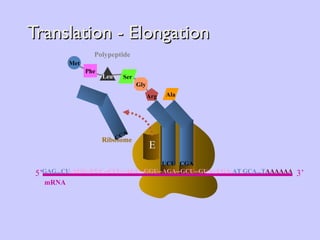
Translation - Elongation A E Ribosome P Aminoacyl tRNA CGA Ala CCA Arg UCU Phe Leu Met Ser Gly Polypeptide GAG...CU -AUG--UUC--CUU--AGU--GGU--AGA--GCU--GUA--UGA- AT GCA...T AAAAAA 5’ mRNA 3’
Translation - Elongation A E Ribosome P CCA Arg UCU Phe Leu Met Ser Gly Polypeptide CGA Ala GAG...CU -AUG--UUC--CUU--AGU--GGU--AGA--GCU--GUA--UGA- AT GCA...T AAAAAA 5’ mRNA 3’
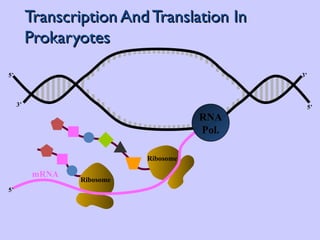
Transcription And Translation In Prokaryotes 3’ 5’ 5’ 3’ Ribosome Ribosome 5’ mRNA RNA Pol.
THANK YOU FOR VIEWING OUR PRESENTATION

Central dogma

  • 1.
  • 2.
    Cell DNA mRNATranscription Polypeptide (protein) Translation Ribosome
  • 3.
    Protein Synthesis Flowof Information: DNA RNA Proteins Transcription Translation Transcription is the process by which a molecule of DNA is copied into a complementary strand of RNA . This is called messenger RNA (mRNA) because it acts as a messenger between DNA and the ribosomes where protein synthesis is carried out.
  • 4.
    Protein Synthesis TranscriptionTranscription process RNA polymerase (an enzyme) attaches to DNA at a special sequence that serves as a “start signal”. The DNA strands are separated and one strand serves as a template . The RNA bases attach to the complementary DNA template, thus synthesizing mRNA .
  • 5.
    Protein Synthesis: TranscriptionTranscription process continued The RNA polymerase recognizes a termination site on the DNA molecule and releases the new mRNA molecule . (mRNA leaves the nucleus and travels to the ribosome in the cytoplasm .)
  • 6.
  • 7.
    Eukaryotic Transcription DNACytoplasm Nucleus Export G AAAAAA RNA Transcription Nuclear pores G AAAAAA RNA Processing mRNA
  • 8.
    Protein Synthesis: TranslationTranslation is the process of decoding a mRNA molecule into a polypeptide chain or protein. Each combination of 3 nucleotides on mRNA is called a codon or three-letter code word. Each codon specifies a particular amino acid that is to be placed in the polypeptide chain (protein).
  • 9.
  • 10.
    A Codon SUGAR-PHOSPHATEBACKBONE B A S E S H P O O HO O O CH 2 NH 2 N NH N N H OH P O O HO O O CH 2 NH 2 N N N N H P O OH HO O O CH 2 NH 2 N N N N O Guanine Adenine Adenine Arginine
  • 11.
    Protein Synthesis: TranslationA three-letter code is used because there are 20 different amino acids that are used to make proteins. If a two-letter code were used there would not be enough codons to select all 20 amino acids. That is, there are 4 bases in RNA, so 4 2 (4x 4)=16; where as 4 3 (4x4x4)=64 .
  • 12.
  • 13.
    Protein Synthesis: TranslationTherefore, there is a total of 64 codons with mRNA, 61specify a particular amino acid . This means there are more than one codon for each of the 20 amino acids. The remaining three codons (UAA, UAG, & UGA) are stop codons , which signify the end of a polypeptide chain (protein). Besides selecting the amino acid methionine, the codon AUG also serves as the “ initiator ” codon , which starts the synthesis of a protein
  • 14.
  • 15.
    Protein Synthesis: TranslationTransfer RNA (tRNA) Each tRNA molecule has 2 important sites of attachment . One site, called the anticodon , binds to the codon on the mRNA molecule. The other site attaches to a particular amino acid . During protein synthesis, the anticodon of a tRNA molecule base pairs with the appropriate mRNA codon .
  • 16.
  • 17.
    Met-tRNA Methionine U* 9 26 22 23 Pu 16 12 Py 10 25 20:1 G * 17:1 Pu A 20:2 17 13 20 G A 50 51 65 64 63 G 62 52 C Pu 59  A * C Py T 49 39 41 42 31 29 28 Pu * 43 1 27 U 35 38 36 Py * 34 40 30 47:1 47:15 46 Py 47:16 45 44 47 73 C C A 70 71 72 66 67 68 69 3 2 1 7 6 5 4 A C U Anticodon
  • 18.
    Protein Synthesis: TranslationRibosome: Are made up of 2 subunits, a large one and a smaller one, each subunit contains ribosomal RNA (rRNA) & proteins . Protein synthesis starts when the two subunits bind to mRNA . The initiator codon AUG binds to the first anticodon of tRNA, signaling the start of a protein.
  • 19.
    Protein Synthesis: TranslationRibosome: The anticodon of another tRNA binds to the next mRNA codon, bringing the 2nd amino acid to be placed in the protein. As each anticodon & codon bind together a peptide bond forms between the two amino acids.
  • 20.
    Protein Synthesis: TranslationRibosome: The protein chain continues to grow until a stop codon reaches the ribosome, which results in the release of the new protein and mRNA, completing the process of translation .
  • 21.
  • 22.
    Translation - InitiationA E Large subunit P Small subunit fMet UAC GAG...CU -AUG--UUC--CUU--AGU--GGU--AGA--GCU--GUA--UGA- AT GCA...T AAAAAA 5’ mRNA 3’
  • 23.
    Translation - ElongationA E Ribosome P UCU Arg Aminoacyl tRNA Phe Leu Met Ser Gly Polypeptide CCA GAG...CU -AUG--UUC--CUU--AGU--GGU--AGA--GCU--GUA--UGA- AT GCA...T AAAAAA 5’ mRNA 3’
  • 24.
    Translation - ElongationAminoacyl tRNA A E Ribosome P Phe Leu Met Ser Gly Polypeptide Arg UCU CCA GAG...CU -AUG--UUC--CUU--AGU--GGU--AGA--GCU--GUA--UGA- AT GCA...T AAAAAA 5’ mRNA 3’
  • 25.
    Translation - ElongationA E Ribosome P CCA Arg UCU Phe Leu Met Ser Gly Polypeptide GAG...CU -AUG--UUC--CUU--AGU--GGU--AGA--GCU--GUA--UGA- AT GCA...T AAAAAA 5’ mRNA 3’
  • 26.
    Translation - ElongationA E Ribosome P Aminoacyl tRNA CGA Ala CCA Arg UCU Phe Leu Met Ser Gly Polypeptide GAG...CU -AUG--UUC--CUU--AGU--GGU--AGA--GCU--GUA--UGA- AT GCA...T AAAAAA 5’ mRNA 3’
  • 27.
    Translation - ElongationA E Ribosome P CCA Arg UCU Phe Leu Met Ser Gly Polypeptide CGA Ala GAG...CU -AUG--UUC--CUU--AGU--GGU--AGA--GCU--GUA--UGA- AT GCA...T AAAAAA 5’ mRNA 3’
  • 28.
    Transcription And TranslationIn Prokaryotes 3’ 5’ 5’ 3’ Ribosome Ribosome 5’ mRNA RNA Pol.
  • 29.
    THANK YOU FORVIEWING OUR PRESENTATION