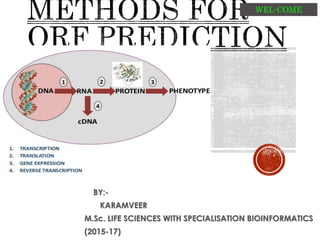
BY:-
BY:-
KARAMVEER
M.Sc. LIFE SCIENCES WITH SPECIALISATION BIOINFORMATICS
(2015-17)
WEL-COME
 From a genomic DNA sequence we want to predict the regions that
will encode for a protein: the genes.
• Gene finding is about detecting these coding regions and infer the
gene structure starting from genomic DNA sequences.
 an open reading frame (ORF) is the part of a reading frame that has
the potential to code for a protein or peptide. An ORF is a continuous
stretch of codons that do not contain a stop codon
• We need to distinguish coding from non-coding regions using
properties specific to each type of DNA region.
• Gene finding is not an easy task!
• DNA sequence signals have low information content.
• It is difficult to discriminate real signals from noise (degenerated and
highly unspecific signals);
 Simple 1st step in gene findings.
 Translate genomic sequence in six frames.
 Identify stop codon in each frame.
 Regions without stop codons are called “open reading frames”
or ORFs.
 Locate and tag all of the likely ORFs in a sequence.
 The longest ORF from a methionine codon is a good prediction
of a protein encoding sequence.
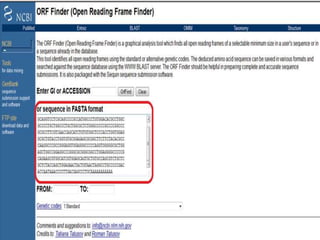
 The ORF finder is a graphical analysis tool which finds all
open reading of a selectable minimum size in a user’s sequence
or in a sequence already in the database.
 This tool identifies all open reading frames using the standard
genetic codes.
 The deduced amino acid sequence can be saved in various
format and searched against the sequence database using the
blast server.
 The orf finder should be helpful in preparing complete and
accurate sequence.
 Based on sequence similarity of query sequence with
annotated genes present in databases.
 Given a database of sequences of other organism.
 Search for query sequence in this database .
 Identify database sequence (known genes) that resemble the
query sequence.
 If the identified sequences are genes , the query sequence is
probably (putatively) a gene.
 Basic local alignment search tool.
 Well known search tool in this category.
Strengths:-
 able to identify biologically relevant genes.
 Accuracy
weakness:-
 Could not identify genes that code for protein , not present in
database.
 Only 50% genes can be found by homology to other known
genes or proteins.
 Uses HMMs to compare DNA sequences to protein
sequences at the level of its conceptual translation,
regardless of sequencing errors and introns.
• Principle:
• The exon model used in genewise is a HMM with 3
base states (match, insert, delete) with the addition of
more transitions between states to consider frame-
shifts.
• Intron states have been added to the base model.
• Genewise directly compare HMM-profiles of proteins
or domains to the gene structure HMM model.
• Genewise is a powerful tool, but time consuming.
• Requires strong similarities (>70% identity) to produce
good predictions.
• Genewise is part of the Wise2 package:
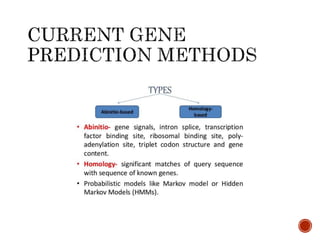
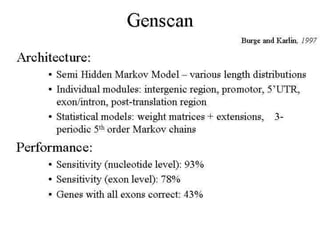
 Computational prediction that use most elementary
information.
 Can predict both eukaryotic and prokaryotic genes.
 Predict genes based on the given sequence alone.
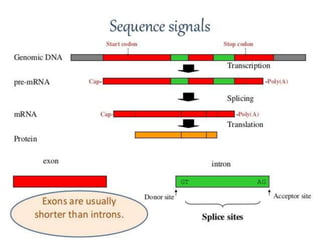
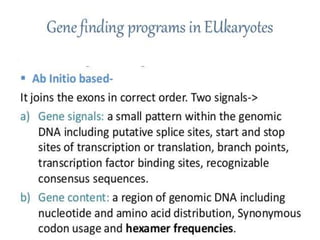
 It works on two major features associated with genes:-
1. Gene signals
2. Gene content
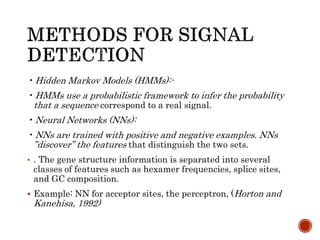
• Hidden Markov Models (HMMs):-
• HMMs use a probabilistic framework to infer the probability
that a sequence correspond to a real signal.
• Neural Networks (NNs):
• NNs are trained with positive and negative examples. NNs
”discover” the features that distinguish the two sets.
• . The gene structure information is separated into several
classes of features such as hexamer frequencies, splice sites,
and GC composition.
 Example: NN for acceptor sites, the perceptron, (Horton and
Kanehisa, 1992)
 Neural network recognizing coding potential
• Incorporates genomic context information (splice junctions,
start and stop codons , poly-A signals)
• Not appropriate for sequences without genomic context
• http://compbio.ornl.gov
• Human, Mouse, Drosophila, Arabidopsis, and E. coli
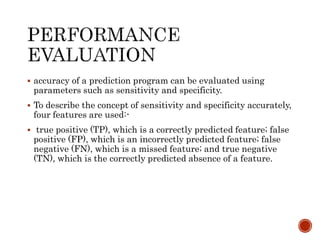
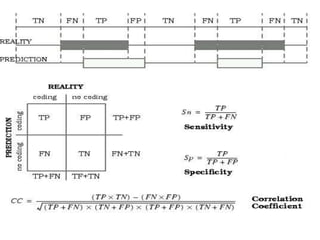
 accuracy of a prediction program can be evaluated using
parameters such as sensitivity and specificity.
 To describe the concept of sensitivity and specificity accurately,
four features are used:-
 true positive (TP), which is a correctly predicted feature; false
positive (FP), which is an incorrectly predicted feature; false
negative (FN), which is a missed feature; and true negative
(TN), which is the correctly predicted absence of a feature.
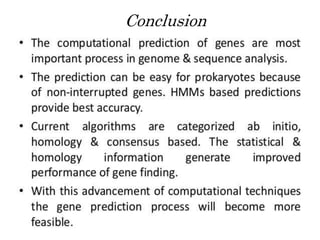
Conclusion
 https://www.google.co.in/search?q=gene+components&biw=1366&bih=623
&source=lnms&tbm=isch&sa=X&sqi=2&ved=0CAYQ_AUoAWoVChMIld-
fy7_4yAIVwh-
UCh1dfwEb#tbm=isch&q=rbs+in+prokaryotic+gene&imgrc=p4VQkhXIIG
_DsM%3A.
 http://www.aun.edu.eg/molecular_biology/Procedure%20Bioinformatics22.
23-4-2015/Xiong%20-
%20Essential%20Bioinformatics%20send%20by%20Amira.pdf.
prediction methods for ORF