Oil Properties 
EG314 Reservoir Rocks & Fluid 
Properties
Specific Gravity of Oil 
• Crude oils are classified according to their physical 
properties, such as oil specific gravity, viscosity, surface 
tension, density, boiling point, and freezing point, etc. 
• The most commonly used properties for classification 
are viscosity and oil gravity. 
• The crude oil gravity is represented in degrees API 
(oAPI), ranging from 8 oAPI to 58 oAPI. The higher the 
API gravity, the lighter the crude, and vice versa. 
• The API gravity and crude oil specific gravity (water = 
1) are related by: 
횼o = 141.5 
131.5 + oAPI 
and 
oAPI = 141.5 – 131.5 
Ύo
Bubble Point Pressure 
• Bubble point as defined by Standing is the state at which an 
infinitesimal quantity of gas is in equilibrium with a large quantity 
of fluid. 
• Bubble point pressure, symbol pb, is the fluid pressure in a system 
at its bubble point (saturation pressure?) 
• When the pressure is above the bubblepoint pressure 
(undersaturated), the fluid is capable of holding additional gases 
or liquid at the existing pressure and temperature. 
• When oil & gas are produced and the reservoir pressure drops 
below the bubble point pressure, gas is liberated from oil. 
• The following equation is used to estimate the bubble point 
pressure: 
pb = 18.2 {[Rs/Ύg]0.83 x 10 [0.00091(TR) – 0.0125(oAPI)] - 1.4} 
Where Rs is the produced gas/oil ratio in SCF/STB and TR is the 
reservoir temperature in oF.
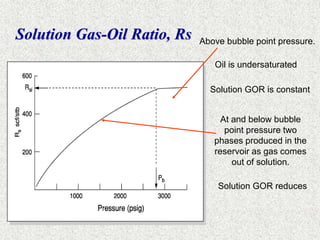
Above bubble point pressure. 
Oil is undersaturated 
Solution GOR is constant 
At and below bubble 
point pressure two 
phases produced in the 
reservoir as gas comes 
out of solution. 
Solution GOR reduces 
Solution Gas-Oil Ratio, Rs
Reservoir Fluid Study 
• Below bubble point gas released and mobility 
effected by relative permeability 
considerations. 
• Gas separation in the production tubing is 
different and considered to remain with 
associated oil. 
• Two basic liberation mechanisms. 
Flash liberation 
Differential liberation
Reservoir Fluid Study 
• Flash Liberation (vaporization) 
The gas is evolved during a definite reduction in 
pressure and the gas is kept in contact with the liquid 
until equilibrium has been established. 
• Differential Liberation (vaporization) 
The gas being evolved is being continuously 
removed from contact with the liquid and the liquid is 
in equilibrium with the gas being evolved over a finite 
pressure range.
Solution Gas-Oil Ratio, Rs 
Above bubble point 
All gas in solution 
At bubble point 
All gas in solution 
Below bubble point 
Free gas and solution gas 
At surface conditions 
No gas in solution
Oil Formation Volume Factor 
• Oil formation volume factor (Bo), is defined as the 
ratio of the liquid volume at reservoir conditions to 
the liquid volume at stock-tank (standard) conditions. 
• This factor is used to convert reservoir barrels to 
stock-tank barrels. 
• The oil formation volume factor can be expressed 
mathematically as: 
Bo = (Vo)p,T /(Vo)sc 
Where Bo = oil formation vol. factor, bbl/STB 
(vo) p,T = vol. of oil under reservoir conditions, bbl 
(Vo)sc = vol. of oil is measured under standard conditions, STB
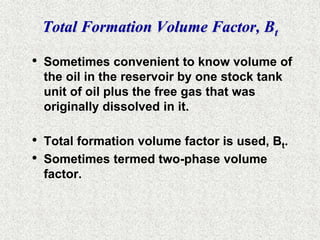
Total Formation Volume Factor, Bt 
• Sometimes convenient to know volume of 
the oil in the reservoir by one stock tank 
unit of oil plus the free gas that was 
originally dissolved in it. 
• Total formation volume factor is used, Bt. 
• Sometimes termed two-phase volume 
factor.
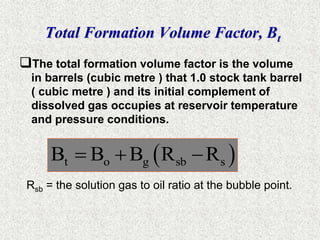
Total Formation Volume Factor, Bt 
The total formation volume factor is the volume 
in barrels (cubic metre ) that 1.0 stock tank barrel 
( cubic metre ) and its initial complement of 
dissolved gas occupies at reservoir temperature 
and pressure conditions. 
Bt  Bo Bg Rsb Rs  
Rsb = the solution gas to oil ratio at the bubble point.
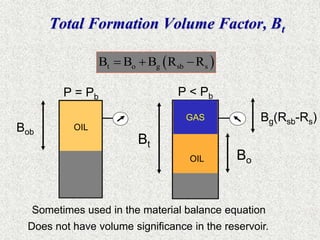
Total Formation Volume Factor, Bt 
Bt  Bo Bg Rsb Rs  
P = Pb 
OIL 
Hg 
Bob 
P < Pb 
GAS 
OIL 
Hg 
Bo 
Bg(Rsb-Rs) 
Bt 
Sometimes used in the material balance equation 
Does not have volume significance in the reservoir.
Total Formation Volume Factor, Bt 
Bt  Bo Bg Rsb Rs  
Above Pb, Bt = Bo
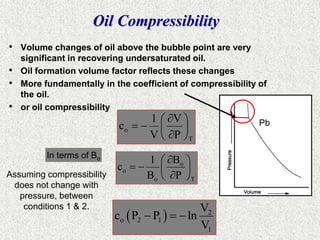
Oil Compressibility 
• Volume changes of oil above the bubble point are very 
significant in recovering undersaturated oil. 
• Oil formation volume factor reflects these changes 
• More fundamentally in the coefficient of compressibility of 
the oil. 
• or oil compressibility 
Pb 
o 
1 V 
   
    
T 
c 
V P 
   
   
o 
o 
1 B 
    
o T 
c 
B P 
   
In terms of Bo 
Assuming compressibility 
does not change with 
pressure, between 
conditions 1 & 2. 
V 
  2 
o 2 1 
1 
c P P ln 
V 
  

Oil Properties

  • 1.
    Oil Properties EG314Reservoir Rocks & Fluid Properties
  • 2.
    Specific Gravity ofOil • Crude oils are classified according to their physical properties, such as oil specific gravity, viscosity, surface tension, density, boiling point, and freezing point, etc. • The most commonly used properties for classification are viscosity and oil gravity. • The crude oil gravity is represented in degrees API (oAPI), ranging from 8 oAPI to 58 oAPI. The higher the API gravity, the lighter the crude, and vice versa. • The API gravity and crude oil specific gravity (water = 1) are related by: 횼o = 141.5 131.5 + oAPI and oAPI = 141.5 – 131.5 Ύo
  • 3.
    Bubble Point Pressure • Bubble point as defined by Standing is the state at which an infinitesimal quantity of gas is in equilibrium with a large quantity of fluid. • Bubble point pressure, symbol pb, is the fluid pressure in a system at its bubble point (saturation pressure?) • When the pressure is above the bubblepoint pressure (undersaturated), the fluid is capable of holding additional gases or liquid at the existing pressure and temperature. • When oil & gas are produced and the reservoir pressure drops below the bubble point pressure, gas is liberated from oil. • The following equation is used to estimate the bubble point pressure: pb = 18.2 {[Rs/Ύg]0.83 x 10 [0.00091(TR) – 0.0125(oAPI)] - 1.4} Where Rs is the produced gas/oil ratio in SCF/STB and TR is the reservoir temperature in oF.
  • 4.
    Above bubble pointpressure. Oil is undersaturated Solution GOR is constant At and below bubble point pressure two phases produced in the reservoir as gas comes out of solution. Solution GOR reduces Solution Gas-Oil Ratio, Rs
  • 5.
    Reservoir Fluid Study • Below bubble point gas released and mobility effected by relative permeability considerations. • Gas separation in the production tubing is different and considered to remain with associated oil. • Two basic liberation mechanisms. Flash liberation Differential liberation
  • 6.
    Reservoir Fluid Study • Flash Liberation (vaporization) The gas is evolved during a definite reduction in pressure and the gas is kept in contact with the liquid until equilibrium has been established. • Differential Liberation (vaporization) The gas being evolved is being continuously removed from contact with the liquid and the liquid is in equilibrium with the gas being evolved over a finite pressure range.
  • 7.
    Solution Gas-Oil Ratio,Rs Above bubble point All gas in solution At bubble point All gas in solution Below bubble point Free gas and solution gas At surface conditions No gas in solution
  • 8.
    Oil Formation VolumeFactor • Oil formation volume factor (Bo), is defined as the ratio of the liquid volume at reservoir conditions to the liquid volume at stock-tank (standard) conditions. • This factor is used to convert reservoir barrels to stock-tank barrels. • The oil formation volume factor can be expressed mathematically as: Bo = (Vo)p,T /(Vo)sc Where Bo = oil formation vol. factor, bbl/STB (vo) p,T = vol. of oil under reservoir conditions, bbl (Vo)sc = vol. of oil is measured under standard conditions, STB
  • 9.
    Total Formation VolumeFactor, Bt • Sometimes convenient to know volume of the oil in the reservoir by one stock tank unit of oil plus the free gas that was originally dissolved in it. • Total formation volume factor is used, Bt. • Sometimes termed two-phase volume factor.
  • 10.
    Total Formation VolumeFactor, Bt The total formation volume factor is the volume in barrels (cubic metre ) that 1.0 stock tank barrel ( cubic metre ) and its initial complement of dissolved gas occupies at reservoir temperature and pressure conditions. Bt  Bo Bg Rsb Rs  Rsb = the solution gas to oil ratio at the bubble point.
  • 11.
    Total Formation VolumeFactor, Bt Bt  Bo Bg Rsb Rs  P = Pb OIL Hg Bob P < Pb GAS OIL Hg Bo Bg(Rsb-Rs) Bt Sometimes used in the material balance equation Does not have volume significance in the reservoir.
  • 12.
    Total Formation VolumeFactor, Bt Bt  Bo Bg Rsb Rs  Above Pb, Bt = Bo
  • 13.
    Oil Compressibility •Volume changes of oil above the bubble point are very significant in recovering undersaturated oil. • Oil formation volume factor reflects these changes • More fundamentally in the coefficient of compressibility of the oil. • or oil compressibility Pb o 1 V        T c V P       o o 1 B     o T c B P    In terms of Bo Assuming compressibility does not change with pressure, between conditions 1 & 2. V   2 o 2 1 1 c P P ln V   