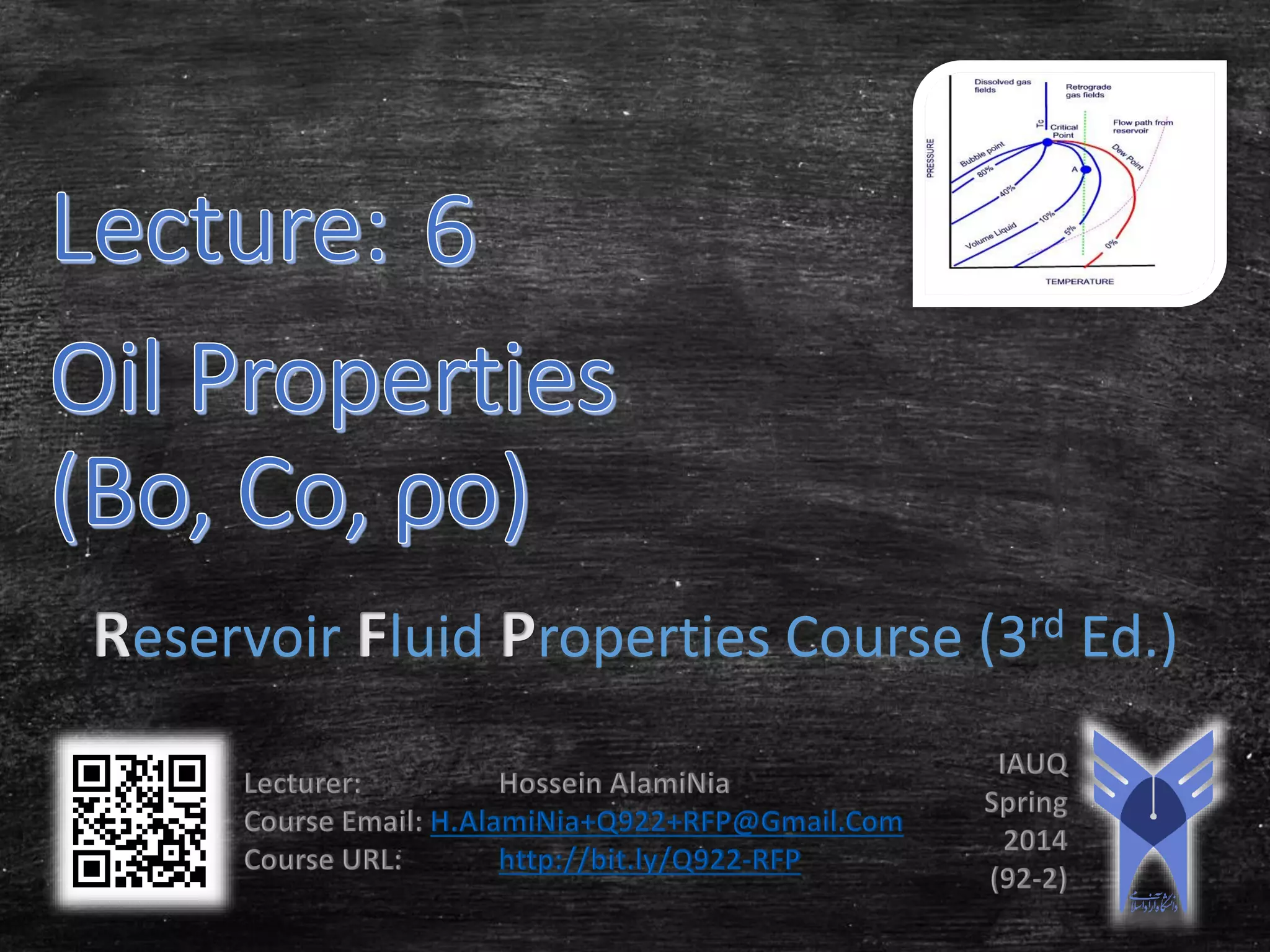
Reservoir Fluid Properties Course (3rd Ed.)
1. Crude Oil Properties:
A. Density (ρo), Gravity (γo, API)
B. Gas Solubility (Solution gas) (Rs)
C. Bubble-point pressure (Pb)
1. Crude Oil Properties:
A. Formation volume factor for P=<Pb (Bo)
B. Isothermal compressibility coefficient (Co)
C. Formation volume factor for P>Pb (Bo)
D. Density
The oil formation volume factor, Bo
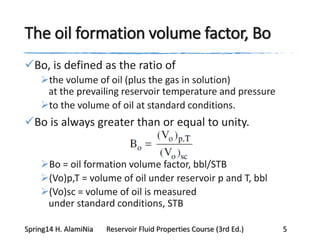
Bo, is defined as the ratio of
the volume of oil (plus the gas in solution)
at the prevailing reservoir temperature and pressure
to the volume of oil at standard conditions.
Bo is always greater than or equal to unity.
Bo = oil formation volume factor, bbl/STB
(Vo)p,T = volume of oil under reservoir p and T, bbl
(Vo)sc = volume of oil is measured
under standard conditions, STB
Spring14 H. AlamiNia Reservoir Fluid Properties Course (3rd Ed.) 5
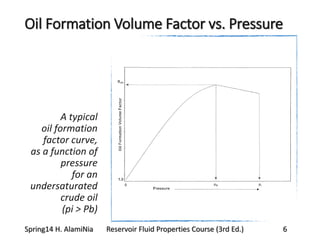
Oil Formation Volume Factor vs. Pressure
A typical
oil formation
factor curve,
as a function of
pressure
for an
undersaturated
crude oil
(pi > Pb)
Spring14 H. AlamiNia Reservoir Fluid Properties Course (3rd Ed.) 6
Bo Behavior with pressure
As the pressure is reduced
below the initial reservoir pressure pi,
the oil volume increases due to the oil expansion and
results in an increase in the oil formation volume factor and
will continue until the bubble-point pressure is reached.
At Pb,
the oil reaches its maximum expansion and
consequently attains a maximum value of Bob
for the oil formation volume factor.
As the pressure is reduced below Pb,
volume of oil and Bo are decreased as solution gas liberates
When the pressure is reduced to atmospheric pressure
and the temperature to 60°F,
the value of Bo is equal to one.
Spring14 H. AlamiNia Reservoir Fluid Properties Course (3rd Ed.) 7
Bo Correlations
Most of the empirical Bo correlations utilize the
generalized relationship of: Bo = f (Rs, γg, γo, T)
Standing’s correlation
The Vasquez-Beggs correlation
Glaso’s correlation
Marhoun’s correlation
The Petrosky-Farshad correlation
Other correlations
All the correlations could be used for any pressure
equal to or below the bubble-point pressure.
Spring14 H. AlamiNia Reservoir Fluid Properties Course (3rd Ed.) 8
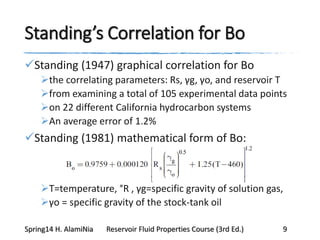
Standing’s Correlation for Bo
Standing (1947) graphical correlation for Bo
the correlating parameters: Rs, γg, γo, and reservoir T
from examining a total of 105 experimental data points
on 22 different California hydrocarbon systems
An average error of 1.2%
Standing (1981) mathematical form of Bo:
T=temperature, °R , γg=specific gravity of solution gas,
γo = specific gravity of the stock-tank oil
Spring14 H. AlamiNia Reservoir Fluid Properties Course (3rd Ed.) 9
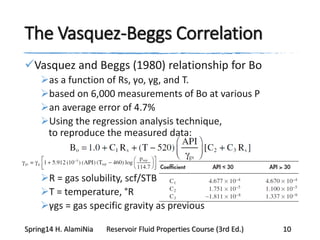
The Vasquez-Beggs Correlation
Vasquez and Beggs (1980) relationship for Bo
as a function of Rs, γo, γg, and T.
based on 6,000 measurements of Bo at various P
an average error of 4.7%
Using the regression analysis technique,
to reproduce the measured data:
R = gas solubility, scf/STB
T = temperature, °R
γgs = gas specific gravity as previous
Spring14 H. AlamiNia Reservoir Fluid Properties Course (3rd Ed.) 10
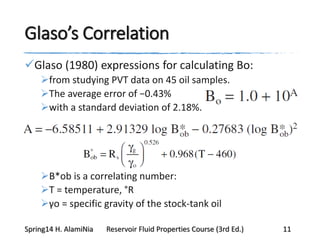
Glaso’s Correlation
Glaso (1980) expressions for calculating Bo:
from studying PVT data on 45 oil samples.
The average error of −0.43%
with a standard deviation of 2.18%.
B*ob is a correlating number:
T = temperature, °R
γo = specific gravity of the stock-tank oil
Spring14 H. AlamiNia Reservoir Fluid Properties Course (3rd Ed.) 11
oil formation volume factor
correlations comparison
Sutton and Farshad (1984) concluded that
Glaso’s correlation offers the best accuracy
when compared with
the Standing and Vasquez-Beggs correlations.
In general,
Glaso’s correlation underpredicts Bo
Standing’s expression tends to overpredict Bo
oil formation volume factors greater than 1.2 bbl/STB
The Vasquez-Beggs correlation typically overpredicts Bo
Spring14 H. AlamiNia Reservoir Fluid Properties Course (3rd Ed.) 12
Marhoun’s Correlation
Marhoun (1988) correlation for determining Bo
a function of the Rs, stock-tank oil gravity, γg, and T
by use of the nonlinear multiple regression analysis
on 160 experimental data points.
experimental data from 69 Middle Eastern oil reserves.
with the correlating parameter F
a = 0.742390, b = 0.323294, c = −1.202040
T is the system temperature in °R.
Spring14 H. AlamiNia Reservoir Fluid Properties Course (3rd Ed.) 13
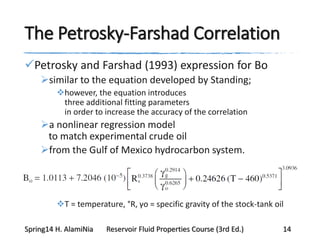
The Petrosky-Farshad Correlation
Petrosky and Farshad (1993) expression for Bo
similar to the equation developed by Standing;
however, the equation introduces
three additional fitting parameters
in order to increase the accuracy of the correlation
a nonlinear regression model
to match experimental crude oil
from the Gulf of Mexico hydrocarbon system.
T = temperature, °R, γo = specific gravity of the stock-tank oil
Spring14 H. AlamiNia Reservoir Fluid Properties Course (3rd Ed.) 14
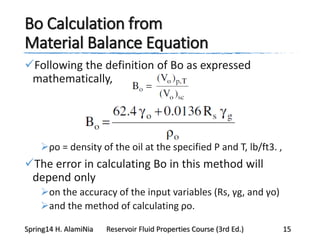
Bo Calculation from
Material Balance Equation
Following the definition of Bo as expressed
mathematically,
ρo = density of the oil at the specified P and T, lb/ft3. ,
The error in calculating Bo in this method will
depend only
on the accuracy of the input variables (Rs, γg, and γo)
and the method of calculating ρo.
Spring14 H. AlamiNia Reservoir Fluid Properties Course (3rd Ed.) 15
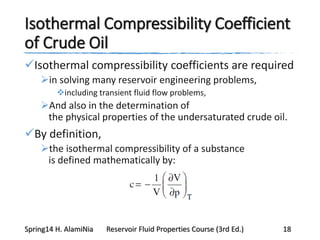
Isothermal Compressibility Coefficient
of Crude Oil
Isothermal compressibility coefficients are required
in solving many reservoir engineering problems,
including transient fluid flow problems,
And also in the determination of
the physical properties of the undersaturated crude oil.
By definition,
the isothermal compressibility of a substance
is defined mathematically by:
Spring14 H. AlamiNia Reservoir Fluid Properties Course (3rd Ed.) 18
Isothermal Compressibility Coefficient
of the Oil
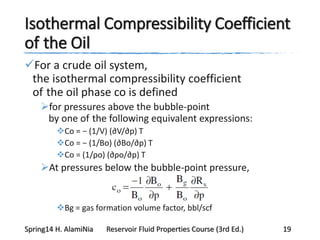
For a crude oil system,
the isothermal compressibility coefficient
of the oil phase co is defined
for pressures above the bubble-point
by one of the following equivalent expressions:
Co = − (1/V) (∂V/∂p) T
Co = − (1/Bo) (∂Bo/∂p) T
Co = (1/ρo) (∂ρo/∂p) T
At pressures below the bubble-point pressure,
Bg = gas formation volume factor, bbl/scf
Spring14 H. AlamiNia Reservoir Fluid Properties Course (3rd Ed.) 19
Co Correlations
There are several correlations that are developed
to estimate the oil compressibility at pressures
above the bubble-point pressure, i.e.,
undersaturated crude oil system.
The Vasquez-Beggs correlation
The Petrosky-Farshad correlation
McCain’s correlation
Spring14 H. AlamiNia Reservoir Fluid Properties Course (3rd Ed.) 20
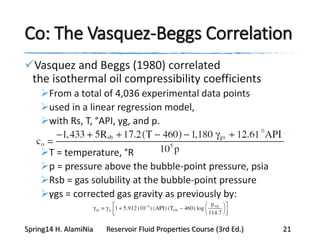
Co: The Vasquez-Beggs Correlation
Vasquez and Beggs (1980) correlated
the isothermal oil compressibility coefficients
From a total of 4,036 experimental data points
used in a linear regression model,
with Rs, T, °API, γg, and p.
T = temperature, °R
p = pressure above the bubble-point pressure, psia
Rsb = gas solubility at the bubble-point pressure
γgs = corrected gas gravity as previously by:
Spring14 H. AlamiNia Reservoir Fluid Properties Course (3rd Ed.) 21
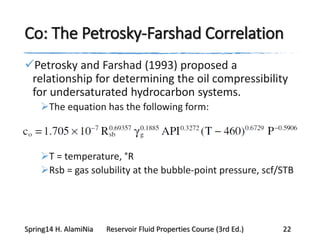
Co: The Petrosky-Farshad Correlation
Petrosky and Farshad (1993) proposed a
relationship for determining the oil compressibility
for undersaturated hydrocarbon systems.
The equation has the following form:
T = temperature, °R
Rsb = gas solubility at the bubble-point pressure, scf/STB
Spring14 H. AlamiNia Reservoir Fluid Properties Course (3rd Ed.) 22
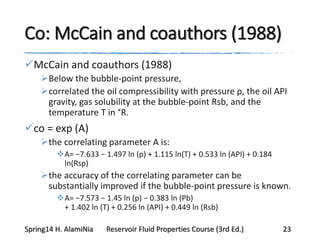
Co: McCain and coauthors (1988)
McCain and coauthors (1988)
Below the bubble-point pressure,
correlated the oil compressibility with pressure ρ, the oil API
gravity, gas solubility at the bubble-point Rsb, and the
temperature T in °R.
co = exp (A)
the correlating parameter A is:
A= −7.633 − 1.497 ln (p) + 1.115 ln(T) + 0.533 ln (API) + 0.184
ln(Rsp)
the accuracy of the correlating parameter can be
substantially improved if the bubble-point pressure is known.
A= −7.573 − 1.45 ln (p) − 0.383 ln (Pb)
+ 1.402 ln (T) + 0.256 ln (API) + 0.449 ln (Rsb)
Spring14 H. AlamiNia Reservoir Fluid Properties Course (3rd Ed.) 23
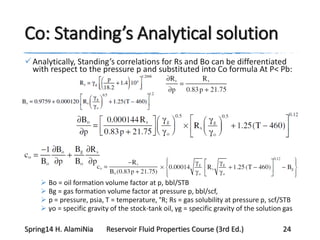
Co: Standing’s Analytical solution
Analytically, Standing’s correlations for Rs and Bo can be differentiated
with respect to the pressure p and substituted into Co formula At P< Pb:
 Bo = oil formation volume factor at p, bbl/STB
 Bg = gas formation volume factor at pressure p, bbl/scf,
 p = pressure, psia, T = temperature, °R; Rs = gas solubility at pressure p, scf/STB
 γo = specific gravity of the stock-tank oil, γg = specific gravity of the solution gas
Spring14 H. AlamiNia Reservoir Fluid Properties Course (3rd Ed.) 24
The PVT consistency
when it is necessary to establish PVT relationships
for the hydrocarbon system
through correlations or by extrapolation,
care should be exercised
to see that the PVT functions are consistent.
This consistency is assured if the increase in oil volume with
increasing pressure is less than the decrease in volume
associated with the gas going into solution.
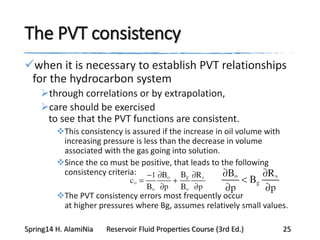
Since the co must be positive, that leads to the following
consistency criteria:
The PVT consistency errors most frequently occur
at higher pressures where Bg, assumes relatively small values.
Spring14 H. AlamiNia Reservoir Fluid Properties Course (3rd Ed.) 25
Oil Formation Volume Factor for
Undersaturated Oils
With increasing pressures
above the bubble-point pressure,
the oil formation volume factor
decreases due to the compression of the oil.
To account for the effects of oil compression on Bo,
the oil formation volume factor at the bubble-point
is first calculated
by using any of the methods previously described.
The calculated Bo is then adjusted
to account for the effect
if increasing the pressure above
the bubble-point pressure.
Spring14 H. AlamiNia Reservoir Fluid Properties Course (3rd Ed.) 27
Bo Adjustment for
Undersaturated Oils
This adjustment step is accomplished
by using the isothermal compressibility coefficient
The above relationship can be rearranged and integrated
to produce
Evaluating co
at the arithmetic average pressure [pavg=(p1+p2)/2] and
concluding the integration procedure to give:
Spring14 H. AlamiNia Reservoir Fluid Properties Course (3rd Ed.) 28
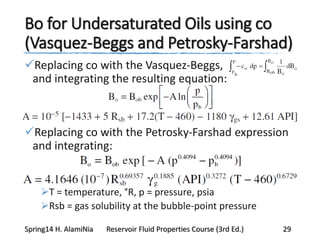
Bo for Undersaturated Oils using co
(Vasquez-Beggs and Petrosky-Farshad)
Replacing co with the Vasquez-Beggs,
and integrating the resulting equation:
Replacing co with the Petrosky-Farshad expression
and integrating:
T = temperature, °R, p = pressure, psia
Rsb = gas solubility at the bubble-point pressure
Spring14 H. AlamiNia Reservoir Fluid Properties Course (3rd Ed.) 29
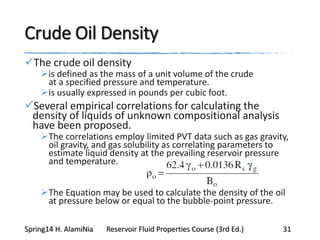
Crude Oil Density
The crude oil density
is defined as the mass of a unit volume of the crude
at a specified pressure and temperature.
is usually expressed in pounds per cubic foot.
Several empirical correlations for calculating the
density of liquids of unknown compositional analysis
have been proposed.
The correlations employ limited PVT data such as gas gravity,
oil gravity, and gas solubility as correlating parameters to
estimate liquid density at the prevailing reservoir pressure
and temperature.
The Equation may be used to calculate the density of the oil
at pressure below or equal to the bubble-point pressure.
Spring14 H. AlamiNia Reservoir Fluid Properties Course (3rd Ed.) 31
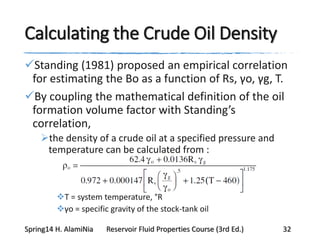
Calculating the Crude Oil Density
Standing (1981) proposed an empirical correlation
for estimating the Bo as a function of Rs, γo, γg, T.
By coupling the mathematical definition of the oil
formation volume factor with Standing’s
correlation,
the density of a crude oil at a specified pressure and
temperature can be calculated from :
T = system temperature, °R
γo = specific gravity of the stock-tank oil
Spring14 H. AlamiNia Reservoir Fluid Properties Course (3rd Ed.) 32
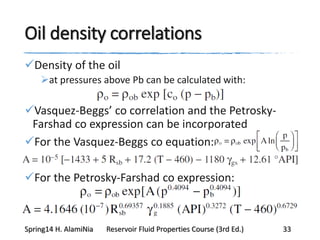
Oil density correlations
Density of the oil
at pressures above Pb can be calculated with:
Vasquez-Beggs’ co correlation and the Petrosky-
Farshad co expression can be incorporated
For the Vasquez-Beggs co equation:
For the Petrosky-Farshad co expression:
Spring14 H. AlamiNia Reservoir Fluid Properties Course (3rd Ed.) 33
1. Ahmed, T. (2010). Reservoir engineering
handbook (Gulf Professional Publishing).
Chapter 2
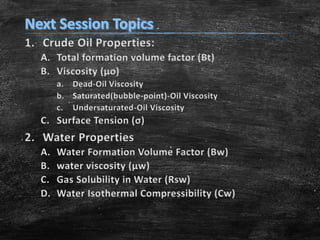
1. Crude Oil Properties:
A. Total formation volume factor (Bt)
B. Viscosity (μo)
a. Dead-Oil Viscosity
b. Saturated(bubble-point)-Oil Viscosity
c. Undersaturated-Oil Viscosity
C. Surface Tension (σ)
2. Water Properties
A. Water Formation Volume Factor (Bw)
B. water viscosity (μw)
C. Gas Solubility in Water (Rsw)
D. Water Isothermal Compressibility (Cw)
Q922+rfp+l06 v1

Q922+rfp+l06 v1

  • 1.
  • 2.
    1. Crude OilProperties: A. Density (ρo), Gravity (γo, API) B. Gas Solubility (Solution gas) (Rs) C. Bubble-point pressure (Pb)
  • 3.
    1. Crude OilProperties: A. Formation volume factor for P=<Pb (Bo) B. Isothermal compressibility coefficient (Co) C. Formation volume factor for P>Pb (Bo) D. Density
  • 5.
    The oil formationvolume factor, Bo Bo, is defined as the ratio of the volume of oil (plus the gas in solution) at the prevailing reservoir temperature and pressure to the volume of oil at standard conditions. Bo is always greater than or equal to unity. Bo = oil formation volume factor, bbl/STB (Vo)p,T = volume of oil under reservoir p and T, bbl (Vo)sc = volume of oil is measured under standard conditions, STB Spring14 H. AlamiNia Reservoir Fluid Properties Course (3rd Ed.) 5
  • 6.
    Oil Formation VolumeFactor vs. Pressure A typical oil formation factor curve, as a function of pressure for an undersaturated crude oil (pi > Pb) Spring14 H. AlamiNia Reservoir Fluid Properties Course (3rd Ed.) 6
  • 7.
    Bo Behavior withpressure As the pressure is reduced below the initial reservoir pressure pi, the oil volume increases due to the oil expansion and results in an increase in the oil formation volume factor and will continue until the bubble-point pressure is reached. At Pb, the oil reaches its maximum expansion and consequently attains a maximum value of Bob for the oil formation volume factor. As the pressure is reduced below Pb, volume of oil and Bo are decreased as solution gas liberates When the pressure is reduced to atmospheric pressure and the temperature to 60°F, the value of Bo is equal to one. Spring14 H. AlamiNia Reservoir Fluid Properties Course (3rd Ed.) 7
  • 8.
    Bo Correlations Most ofthe empirical Bo correlations utilize the generalized relationship of: Bo = f (Rs, γg, γo, T) Standing’s correlation The Vasquez-Beggs correlation Glaso’s correlation Marhoun’s correlation The Petrosky-Farshad correlation Other correlations All the correlations could be used for any pressure equal to or below the bubble-point pressure. Spring14 H. AlamiNia Reservoir Fluid Properties Course (3rd Ed.) 8
  • 9.
    Standing’s Correlation forBo Standing (1947) graphical correlation for Bo the correlating parameters: Rs, γg, γo, and reservoir T from examining a total of 105 experimental data points on 22 different California hydrocarbon systems An average error of 1.2% Standing (1981) mathematical form of Bo: T=temperature, °R , γg=specific gravity of solution gas, γo = specific gravity of the stock-tank oil Spring14 H. AlamiNia Reservoir Fluid Properties Course (3rd Ed.) 9
  • 10.
    The Vasquez-Beggs Correlation Vasquezand Beggs (1980) relationship for Bo as a function of Rs, γo, γg, and T. based on 6,000 measurements of Bo at various P an average error of 4.7% Using the regression analysis technique, to reproduce the measured data: R = gas solubility, scf/STB T = temperature, °R γgs = gas specific gravity as previous Spring14 H. AlamiNia Reservoir Fluid Properties Course (3rd Ed.) 10
  • 11.
    Glaso’s Correlation Glaso (1980)expressions for calculating Bo: from studying PVT data on 45 oil samples. The average error of −0.43% with a standard deviation of 2.18%. B*ob is a correlating number: T = temperature, °R γo = specific gravity of the stock-tank oil Spring14 H. AlamiNia Reservoir Fluid Properties Course (3rd Ed.) 11
  • 12.
    oil formation volumefactor correlations comparison Sutton and Farshad (1984) concluded that Glaso’s correlation offers the best accuracy when compared with the Standing and Vasquez-Beggs correlations. In general, Glaso’s correlation underpredicts Bo Standing’s expression tends to overpredict Bo oil formation volume factors greater than 1.2 bbl/STB The Vasquez-Beggs correlation typically overpredicts Bo Spring14 H. AlamiNia Reservoir Fluid Properties Course (3rd Ed.) 12
  • 13.
    Marhoun’s Correlation Marhoun (1988)correlation for determining Bo a function of the Rs, stock-tank oil gravity, γg, and T by use of the nonlinear multiple regression analysis on 160 experimental data points. experimental data from 69 Middle Eastern oil reserves. with the correlating parameter F a = 0.742390, b = 0.323294, c = −1.202040 T is the system temperature in °R. Spring14 H. AlamiNia Reservoir Fluid Properties Course (3rd Ed.) 13
  • 14.
    The Petrosky-Farshad Correlation Petroskyand Farshad (1993) expression for Bo similar to the equation developed by Standing; however, the equation introduces three additional fitting parameters in order to increase the accuracy of the correlation a nonlinear regression model to match experimental crude oil from the Gulf of Mexico hydrocarbon system. T = temperature, °R, γo = specific gravity of the stock-tank oil Spring14 H. AlamiNia Reservoir Fluid Properties Course (3rd Ed.) 14
  • 15.
    Bo Calculation from MaterialBalance Equation Following the definition of Bo as expressed mathematically, ρo = density of the oil at the specified P and T, lb/ft3. , The error in calculating Bo in this method will depend only on the accuracy of the input variables (Rs, γg, and γo) and the method of calculating ρo. Spring14 H. AlamiNia Reservoir Fluid Properties Course (3rd Ed.) 15
  • 18.
    Isothermal Compressibility Coefficient ofCrude Oil Isothermal compressibility coefficients are required in solving many reservoir engineering problems, including transient fluid flow problems, And also in the determination of the physical properties of the undersaturated crude oil. By definition, the isothermal compressibility of a substance is defined mathematically by: Spring14 H. AlamiNia Reservoir Fluid Properties Course (3rd Ed.) 18
  • 19.
    Isothermal Compressibility Coefficient ofthe Oil For a crude oil system, the isothermal compressibility coefficient of the oil phase co is defined for pressures above the bubble-point by one of the following equivalent expressions: Co = − (1/V) (∂V/∂p) T Co = − (1/Bo) (∂Bo/∂p) T Co = (1/ρo) (∂ρo/∂p) T At pressures below the bubble-point pressure, Bg = gas formation volume factor, bbl/scf Spring14 H. AlamiNia Reservoir Fluid Properties Course (3rd Ed.) 19
  • 20.
    Co Correlations There areseveral correlations that are developed to estimate the oil compressibility at pressures above the bubble-point pressure, i.e., undersaturated crude oil system. The Vasquez-Beggs correlation The Petrosky-Farshad correlation McCain’s correlation Spring14 H. AlamiNia Reservoir Fluid Properties Course (3rd Ed.) 20
  • 21.
    Co: The Vasquez-BeggsCorrelation Vasquez and Beggs (1980) correlated the isothermal oil compressibility coefficients From a total of 4,036 experimental data points used in a linear regression model, with Rs, T, °API, γg, and p. T = temperature, °R p = pressure above the bubble-point pressure, psia Rsb = gas solubility at the bubble-point pressure γgs = corrected gas gravity as previously by: Spring14 H. AlamiNia Reservoir Fluid Properties Course (3rd Ed.) 21
  • 22.
    Co: The Petrosky-FarshadCorrelation Petrosky and Farshad (1993) proposed a relationship for determining the oil compressibility for undersaturated hydrocarbon systems. The equation has the following form: T = temperature, °R Rsb = gas solubility at the bubble-point pressure, scf/STB Spring14 H. AlamiNia Reservoir Fluid Properties Course (3rd Ed.) 22
  • 23.
    Co: McCain andcoauthors (1988) McCain and coauthors (1988) Below the bubble-point pressure, correlated the oil compressibility with pressure ρ, the oil API gravity, gas solubility at the bubble-point Rsb, and the temperature T in °R. co = exp (A) the correlating parameter A is: A= −7.633 − 1.497 ln (p) + 1.115 ln(T) + 0.533 ln (API) + 0.184 ln(Rsp) the accuracy of the correlating parameter can be substantially improved if the bubble-point pressure is known. A= −7.573 − 1.45 ln (p) − 0.383 ln (Pb) + 1.402 ln (T) + 0.256 ln (API) + 0.449 ln (Rsb) Spring14 H. AlamiNia Reservoir Fluid Properties Course (3rd Ed.) 23
  • 24.
    Co: Standing’s Analyticalsolution Analytically, Standing’s correlations for Rs and Bo can be differentiated with respect to the pressure p and substituted into Co formula At P< Pb:  Bo = oil formation volume factor at p, bbl/STB  Bg = gas formation volume factor at pressure p, bbl/scf,  p = pressure, psia, T = temperature, °R; Rs = gas solubility at pressure p, scf/STB  γo = specific gravity of the stock-tank oil, γg = specific gravity of the solution gas Spring14 H. AlamiNia Reservoir Fluid Properties Course (3rd Ed.) 24
  • 25.
    The PVT consistency whenit is necessary to establish PVT relationships for the hydrocarbon system through correlations or by extrapolation, care should be exercised to see that the PVT functions are consistent. This consistency is assured if the increase in oil volume with increasing pressure is less than the decrease in volume associated with the gas going into solution. Since the co must be positive, that leads to the following consistency criteria: The PVT consistency errors most frequently occur at higher pressures where Bg, assumes relatively small values. Spring14 H. AlamiNia Reservoir Fluid Properties Course (3rd Ed.) 25
  • 27.
    Oil Formation VolumeFactor for Undersaturated Oils With increasing pressures above the bubble-point pressure, the oil formation volume factor decreases due to the compression of the oil. To account for the effects of oil compression on Bo, the oil formation volume factor at the bubble-point is first calculated by using any of the methods previously described. The calculated Bo is then adjusted to account for the effect if increasing the pressure above the bubble-point pressure. Spring14 H. AlamiNia Reservoir Fluid Properties Course (3rd Ed.) 27
  • 28.
    Bo Adjustment for UndersaturatedOils This adjustment step is accomplished by using the isothermal compressibility coefficient The above relationship can be rearranged and integrated to produce Evaluating co at the arithmetic average pressure [pavg=(p1+p2)/2] and concluding the integration procedure to give: Spring14 H. AlamiNia Reservoir Fluid Properties Course (3rd Ed.) 28
  • 29.
    Bo for UndersaturatedOils using co (Vasquez-Beggs and Petrosky-Farshad) Replacing co with the Vasquez-Beggs, and integrating the resulting equation: Replacing co with the Petrosky-Farshad expression and integrating: T = temperature, °R, p = pressure, psia Rsb = gas solubility at the bubble-point pressure Spring14 H. AlamiNia Reservoir Fluid Properties Course (3rd Ed.) 29
  • 31.
    Crude Oil Density Thecrude oil density is defined as the mass of a unit volume of the crude at a specified pressure and temperature. is usually expressed in pounds per cubic foot. Several empirical correlations for calculating the density of liquids of unknown compositional analysis have been proposed. The correlations employ limited PVT data such as gas gravity, oil gravity, and gas solubility as correlating parameters to estimate liquid density at the prevailing reservoir pressure and temperature. The Equation may be used to calculate the density of the oil at pressure below or equal to the bubble-point pressure. Spring14 H. AlamiNia Reservoir Fluid Properties Course (3rd Ed.) 31
  • 32.
    Calculating the CrudeOil Density Standing (1981) proposed an empirical correlation for estimating the Bo as a function of Rs, γo, γg, T. By coupling the mathematical definition of the oil formation volume factor with Standing’s correlation, the density of a crude oil at a specified pressure and temperature can be calculated from : T = system temperature, °R γo = specific gravity of the stock-tank oil Spring14 H. AlamiNia Reservoir Fluid Properties Course (3rd Ed.) 32
  • 33.
    Oil density correlations Densityof the oil at pressures above Pb can be calculated with: Vasquez-Beggs’ co correlation and the Petrosky- Farshad co expression can be incorporated For the Vasquez-Beggs co equation: For the Petrosky-Farshad co expression: Spring14 H. AlamiNia Reservoir Fluid Properties Course (3rd Ed.) 33
  • 34.
    1. Ahmed, T.(2010). Reservoir engineering handbook (Gulf Professional Publishing). Chapter 2
  • 35.
    1. Crude OilProperties: A. Total formation volume factor (Bt) B. Viscosity (μo) a. Dead-Oil Viscosity b. Saturated(bubble-point)-Oil Viscosity c. Undersaturated-Oil Viscosity C. Surface Tension (σ) 2. Water Properties A. Water Formation Volume Factor (Bw) B. water viscosity (μw) C. Gas Solubility in Water (Rsw) D. Water Isothermal Compressibility (Cw)