Reservoir Fluid Properties Course (2nd Ed.)
1. Reservoir Fluids
2. Phase Behavior of Hydrocarbons
3. Phase Envelopes
1. Reservoir Fluid Behaviors
2. Petroleum Reservoirs
A. Oil
B. Gas
Multiphase Behavior
Naturally occurring hydrocarbon systems found in
petroleum reservoirs are mixtures of organic
compounds that exhibit multiphase behavior over
wide ranges of pressures and temperatures.
These hydrocarbon accumulations may occur in the
gaseous state, the liquid state, the solid state, or in
various combinations of gas, liquid, and solid.

Fall 13 H. AlamiNia

Reservoir Fluid Properties Course:

5
Petroleum Engineers Task
These differences in phase behavior, coupled with
the physical properties of reservoir rock that
determine the relative ease with which gas and
liquid are transmitted or retained, result in many
diverse types of hydrocarbon reservoirs with
complex behaviors.
Frequently, petroleum engineers have the task to
study the behavior and characteristics of a
petroleum reservoir and to determine the course of
future development and production that would
maximize the profit.
Fall 13 H. AlamiNia

Reservoir Fluid Properties Course:

6
Classification of Reservoirs and
Reservoir Fluids
Petroleum reservoirs are broadly classified as oil or gas
reservoirs. These broad classifications are further
subdivided depending on:
The composition of the reservoir hydrocarbon mixture
Initial reservoir pressure and temperature
Pressure and temperature of the surface production

The conditions under which these phases exist are a
matter of considerable practical importance.
The experimental or the mathematical determinations
of these conditions are conveniently expressed in
different types of diagrams commonly called phase
diagrams. One such diagram is called the pressuretemperature diagram.
Fall 13 H. AlamiNia

Reservoir Fluid Properties Course:

7
Pressure-Temperature Diagram
Although a different hydrocarbon system would
have a different phase diagram, the general
configuration is similar.
These multicomponent pressure-temperature
diagrams are essentially used to:
Classify reservoirs
Classify the naturally occurring hydrocarbon systems
Describe the phase behavior of the reservoir fluid

Fall 13 H. AlamiNia

Reservoir Fluid Properties Course:

8
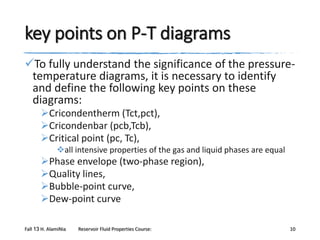
Typical P-T Diagram
for a Multicomponent System

Fall 13 H. AlamiNia

Reservoir Fluid Properties Course:

9
key points on P-T diagrams
To fully understand the significance of the pressuretemperature diagrams, it is necessary to identify
and define the following key points on these
diagrams:
Cricondentherm (Tct,pct),
Cricondenbar (pcb,Tcb),
Critical point (pc, Tc),
all intensive properties of the gas and liquid phases are equal

Phase envelope (two-phase region),
Quality lines,
Bubble-point curve,
Dew-point curve
Fall 13 H. AlamiNia

Reservoir Fluid Properties Course:

10
Oil vs. Gas Reservoirs
In general, reservoirs are conveniently classified on
the basis of the location of the point representing
the initial reservoir pressure pi and temperature T
with respect to the pressure-temperature diagram
of the reservoir fluid. Accordingly, reservoirs can be
classified into basically two types. These are:
Oil reservoirs
If the Tr is less than the Tc of the reservoir fluid

Gas reservoirs
If the Tr is greater than the Tc of the hydrocarbon fluid
Fall 13 H. AlamiNia

Reservoir Fluid Properties Course:

12
Oil Reservoirs
Depending upon initial reservoir pressure pi, oil
reservoirs can be subclassified into the following
categories:
Undersaturated oil reservoir. If the initial reservoir
pressure pi, is greater than the bubble-point pressure Pb
of the reservoir fluid
Saturated oil reservoir. When pi is equal to the bubblepoint pressure of the reservoir fluid
Gas-cap reservoir or two-phase reservoir. If pi is below
the bubble point pressure of the reservoir fluid
The appropriate quality line gives the ratio of the gas-cap
volume to reservoir oil volume.
Fall 13 H. AlamiNia

Reservoir Fluid Properties Course:

13
Crude Oils
Crude oils cover a wide range in physical properties and
chemical compositions, and it is often important to be
able to group them into broad categories of related oils.
In general, crude oils are commonly classified into the
following types:
Ordinary black oil
Low-shrinkage crude oil
High-shrinkage (volatile) crude oil
Near-critical crude oil

The above classifications are essentially based upon the
properties exhibited by the crude oil, including physical
properties, composition, gas-oil ratio, appearance, and
pressure-temperature phase diagrams.
Fall 13 H. AlamiNia

Reservoir Fluid Properties Course:

14
Ordinary black oil
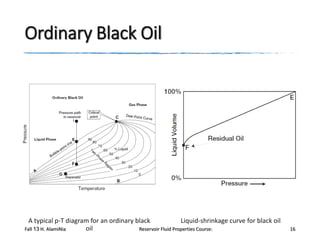
quality lines, which are approximately equally spaced,
characterize this black oil phase diagram.
Following the pressure reduction path as indicated by
the vertical line EF on next figure, the liquid shrinkage
curve, is prepared by plotting the liquid volume percent
as a function of pressure.
The liquid shrinkage curve approximates a straight line except
at very low pressures.

When produced, ordinary black oils usually yield gas-oil
ratios between 200 and 700 scf/STB and
oil gravities of 15° to 40° API
The stock tank oil is usually brown to dark green
Fall 13 H. AlamiNia

Reservoir Fluid Properties Course:

15
Ordinary Black Oil

A typical p-T diagram for an ordinary black
Liquid-shrinkage curve for black oil
oil
Fall 13 H. AlamiNia
Reservoir Fluid Properties Course:

16
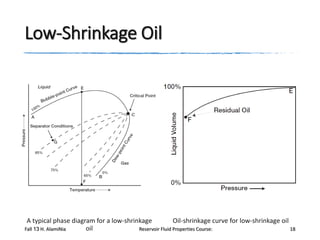
Low-shrinkage oil
The diagram is characterized by quality lines that
are closely spaced near the dew-point curve.
The other associated properties of this type of
crude oil are:
Oil formation volume factor less than 1.2 bbl/STB
Gas-oil ratio less than 200 scf/STB
Oil gravity less than 35° API
Black or deeply colored
Substantial liquid recovery at separator conditions as
indicated by point G on the 85% quality line of next slide

Fall 13 H. AlamiNia

Reservoir Fluid Properties Course:

17
Low-Shrinkage Oil

A typical phase diagram for a low-shrinkage
Oil-shrinkage curve for low-shrinkage oil
oil
Fall 13 H. AlamiNia
Reservoir Fluid Properties Course:
18
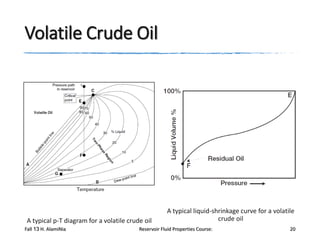
Volatile (high-shrinkage) crude oil
Note that the quality lines are close together near the
bubble-point and are more widely spaced at lower
pressures.
This type of crude oil is commonly characterized by a
high liquid shrinkage immediately below the bubblepoint as shown in next Figure.
The other characteristic properties of this oil include:

Oil formation volume factor less than 2 bbl/STB
Gas-oil ratios between 2,000 and 3,200 scf/STB
Oil gravities between 45° and 55° API
Lower liquid recovery of separator conditions (10% next slide)
Greenish to orange in color
the API gravity of the stock-tank liquid will increase in the
later life of the reservoirs

Fall 13 H. AlamiNia

Reservoir Fluid Properties Course:

19
Volatile Crude Oil

A typical p-T diagram for a volatile crude oil
Fall 13 H. AlamiNia

A typical liquid-shrinkage curve for a volatile
crude oil

Reservoir Fluid Properties Course:

20
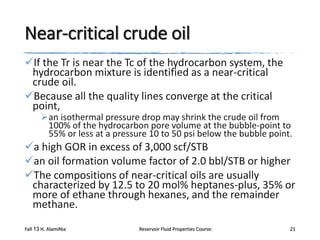
Near-critical crude oil
If the Tr is near the Tc of the hydrocarbon system, the
hydrocarbon mixture is identified as a near-critical
crude oil.
Because all the quality lines converge at the critical
point,

an isothermal pressure drop may shrink the crude oil from
100% of the hydrocarbon pore volume at the bubble-point to
55% or less at a pressure 10 to 50 psi below the bubble point.

a high GOR in excess of 3,000 scf/STB
an oil formation volume factor of 2.0 bbl/STB or higher
The compositions of near-critical oils are usually
characterized by 12.5 to 20 mol% heptanes-plus, 35% or
more of ethane through hexanes, and the remainder
methane.
Fall 13 H. AlamiNia

Reservoir Fluid Properties Course:

21
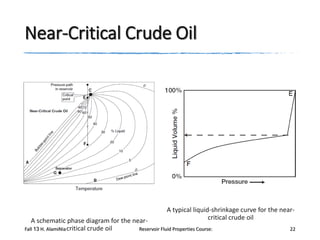
Near-Critical Crude Oil

A typical liquid-shrinkage curve for the nearcritical crude oil

A schematic phase diagram for the nearFall 13 H. AlamiNia critical crude oil
Reservoir Fluid Properties Course:

22
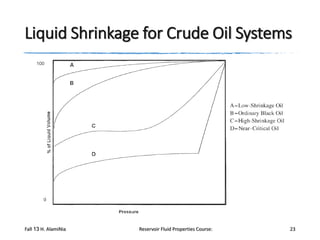
Liquid Shrinkage for Crude Oil Systems

Fall 13 H. AlamiNia

Reservoir Fluid Properties Course:

23
Gas Reservoirs
In general, if the reservoir temperature is above the
critical temperature of the hydrocarbon system, the
reservoir is classified as a natural gas reservoir.
On the basis of their phase diagrams and the
prevailing reservoir conditions, natural gases can be
classified into four categories:
Retrograde gas-condensate
Near-critical gas-condensate
Wet gas
Dry gas

Fall 13 H. AlamiNia

Reservoir Fluid Properties Course:

26
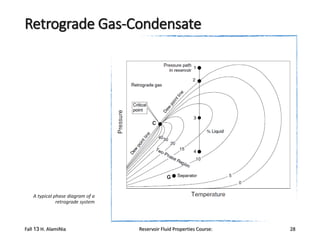
Retrograde gas-condensate reservoir
If the Tr lies between the Tc and Tct of the reservoir
fluid, the reservoir is classified as a retrograde gas
condensate reservoir.
This category of gas reservoir is a unique type of
hydrocarbon accumulation in that the special
thermodynamic behavior of the reservoir fluid is the
controlling factor in the development and the depletion
process of the reservoir.

When the pressure is decreased on these mixtures,
instead of expanding (if a gas) or vaporizing (if a
liquid) as might be expected, they vaporize instead
of condensing.
Fall 13 H. AlamiNia

Reservoir Fluid Properties Course:

27
Retrograde Gas-Condensate

A typical phase diagram of a
retrograde system

Fall 13 H. AlamiNia

Reservoir Fluid Properties Course:

28
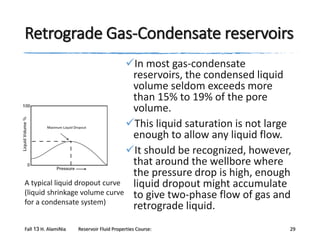
Retrograde Gas-Condensate reservoirs
In most gas-condensate
reservoirs, the condensed liquid
volume seldom exceeds more
than 15% to 19% of the pore
volume.
This liquid saturation is not large
enough to allow any liquid flow.
It should be recognized, however,
that around the wellbore where
the pressure drop is high, enough
A typical liquid dropout curve
liquid dropout might accumulate
(liquid shrinkage volume curve to give two-phase flow of gas and
for a condensate system)
retrograde liquid.
Fall 13 H. AlamiNia

Reservoir Fluid Properties Course:

29
Retrograde Gas-Condensate
The associated physical characteristics of this category
are:
Gas-oil ratios between 8,000 and 70,000 scf/STB.
Generally, the GOR for a condensate system increases with time
due to the liquid dropout and the loss of heavy components in the
liquid.

Condensate gravity above 50° API
• Stock-tank liquid is usually water-white or slightly colored

There is a fairly sharp dividing line between oils and
condensates from a compositional standpoint.
Reservoir fluids that contain heptanes and are heavier
in concentrations of more than 12.5 mol% are almost
always in the liquid phase in the reservoir.
Fall 13 H. AlamiNia

Reservoir Fluid Properties Course:

30
Near-critical gas-condensate reservoir
If the Tr is near the Tc, the hydrocarbon mixture is
classified as a near-critical gas-condensate.
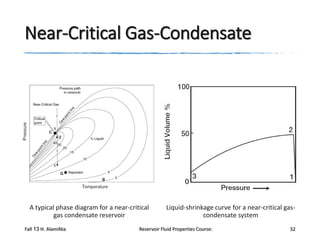
Because all the quality lines converge at the critical
point, a rapid liquid buildup will immediately occur
below the dew point.
This behavior can be justified by the fact that several
quality lines are crossed very rapidly by the isothermal
reduction in pressure.
At the point where the liquid ceases to build up and
begins to shrink again, the reservoir goes from the
retrograde region to a normal vaporization region.
Fall 13 H. AlamiNia

Reservoir Fluid Properties Course:

31
Near-Critical Gas-Condensate

A typical phase diagram for a near-critical
gas condensate reservoir
Fall 13 H. AlamiNia

Liquid-shrinkage curve for a near-critical gascondensate system

Reservoir Fluid Properties Course:

32
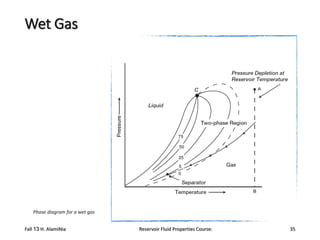
Wet-gas reservoir
In a wet gas reservoir temperature is above the
cricondentherm of the hydrocarbon mixture.

Because the reservoir temperature exceeds the
cricondentherm of the hydrocarbon system, the reservoir
fluid will always remain in the vapor phase region as the
reservoir is depleted isothermally, along the vertical line A-B.

As the produced gas flows to the surface, however, the
pressure and temperature of the gas will decline.

If the gas enters the two-phase region, a liquid phase will
condense out of the gas and be produced from the surface
separators.
This is caused by a sufficient decrease in the kinetic energy of
heavy molecules with temperature drop and their subsequent
change to liquid through the attractive forces between
molecules.

Fall 13 H. AlamiNia

Reservoir Fluid Properties Course:

33
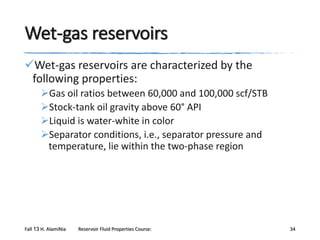
Wet-gas reservoirs
Wet-gas reservoirs are characterized by the
following properties:
Gas oil ratios between 60,000 and 100,000 scf/STB
Stock-tank oil gravity above 60° API
Liquid is water-white in color
Separator conditions, i.e., separator pressure and
temperature, lie within the two-phase region

Fall 13 H. AlamiNia

Reservoir Fluid Properties Course:

34
Wet Gas

Phase diagram for a wet gas

Fall 13 H. AlamiNia

Reservoir Fluid Properties Course:

35
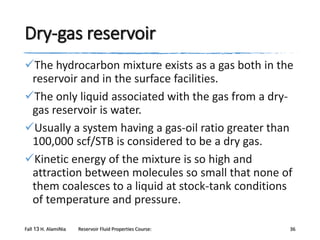
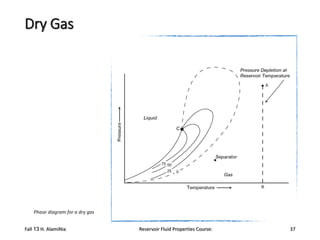
Dry-gas reservoir
The hydrocarbon mixture exists as a gas both in the
reservoir and in the surface facilities.
The only liquid associated with the gas from a drygas reservoir is water.
Usually a system having a gas-oil ratio greater than
100,000 scf/STB is considered to be a dry gas.
Kinetic energy of the mixture is so high and
attraction between molecules so small that none of
them coalesces to a liquid at stock-tank conditions
of temperature and pressure.
Fall 13 H. AlamiNia

Reservoir Fluid Properties Course:

36
Dry Gas

Phase diagram for a dry gas

Fall 13 H. AlamiNia

Reservoir Fluid Properties Course:

37
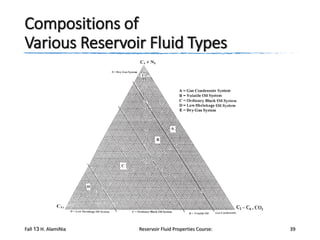
Other hydrocarbon classifications
The classification of hydrocarbon fluids might also
be characterized by the initial composition of the
system.
McCain (1994) suggested that the heavy components in
the hydrocarbon mixtures have the strongest effect on
fluid characteristics.
The ternary diagram, with equilateral triangles can be
conveniently used to roughly define the compositional
boundaries that separate different types of hydrocarbon
systems.

Fall 13 H. AlamiNia

Reservoir Fluid Properties Course:

38
Compositions of
Various Reservoir Fluid Types

Fall 13 H. AlamiNia

Reservoir Fluid Properties Course:

39
Empirical equations of state
Empirical equations of state are commonly used as
a quantitative tool in describing and classifying the
hydrocarbon system.
These equations of state require:
Detailed compositional analyses of the hydrocarbon
system
Complete descriptions of the physical and critical
properties of the mixture individual components
Many characteristic properties of these individual components
(in other words, pure substances) have been measured and
compiled over the years.

Fall 13 H. AlamiNia

Reservoir Fluid Properties Course:

40
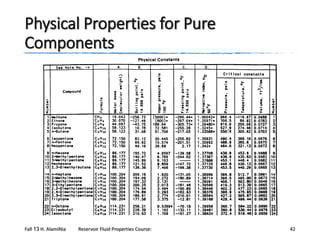
Characteristic properties
Characteristic properties provide vital information for
calculating the thermodynamic properties of pure
components, as well as their mixtures.
The most important of these properties are:
Critical pressure, pc
Critical temperature, Tc
Critical volume, Vc
Critical compressibility factor, zc
Acentric factor, T
Molecular weight, M

Next slide documents some of the above-listed
properties for a number of hydrocarbon and
nonhydrocarbon components.
Fall 13 H. AlamiNia

Reservoir Fluid Properties Course:

41
Physical Properties for Pure
Components

Fall 13 H. AlamiNia

Reservoir Fluid Properties Course:

42
physical property prediction
Riazi and Daubert (1987) developed a simple twoparameter equation for predicting the physical
properties of pure compounds and undefined
hydrocarbon mixtures.
θ = a (M)b γc EXP [d (M) + e γ + f (M) γ]

based on the use of the M and γ of the undefined petroleum
fraction as the correlating parameters.

Where

θ = any physical property
•
•
•
•

Tc = critical temperature, °R
Pc = critical pressure, psia
Tb = boiling point temperature, °R
Vc = critical volume, ft3/lb

a–f = constants for each property
γ = specific gravity of the fraction
M = molecular weight
Fall 13 H. AlamiNia

Reservoir Fluid Properties Course:

43
1. Ahmed, T. (2010). Reservoir engineering
handbook (Gulf Professional Publishing).
Chapter 1
Q921 rfp lec3
Q921 rfp lec3

Q921 rfp lec3

  • 1.
  • 2.
    1. Reservoir Fluids 2.Phase Behavior of Hydrocarbons 3. Phase Envelopes
  • 3.
    1. Reservoir FluidBehaviors 2. Petroleum Reservoirs A. Oil B. Gas
  • 5.
    Multiphase Behavior Naturally occurringhydrocarbon systems found in petroleum reservoirs are mixtures of organic compounds that exhibit multiphase behavior over wide ranges of pressures and temperatures. These hydrocarbon accumulations may occur in the gaseous state, the liquid state, the solid state, or in various combinations of gas, liquid, and solid. Fall 13 H. AlamiNia Reservoir Fluid Properties Course: 5
  • 6.
    Petroleum Engineers Task Thesedifferences in phase behavior, coupled with the physical properties of reservoir rock that determine the relative ease with which gas and liquid are transmitted or retained, result in many diverse types of hydrocarbon reservoirs with complex behaviors. Frequently, petroleum engineers have the task to study the behavior and characteristics of a petroleum reservoir and to determine the course of future development and production that would maximize the profit. Fall 13 H. AlamiNia Reservoir Fluid Properties Course: 6
  • 7.
    Classification of Reservoirsand Reservoir Fluids Petroleum reservoirs are broadly classified as oil or gas reservoirs. These broad classifications are further subdivided depending on: The composition of the reservoir hydrocarbon mixture Initial reservoir pressure and temperature Pressure and temperature of the surface production The conditions under which these phases exist are a matter of considerable practical importance. The experimental or the mathematical determinations of these conditions are conveniently expressed in different types of diagrams commonly called phase diagrams. One such diagram is called the pressuretemperature diagram. Fall 13 H. AlamiNia Reservoir Fluid Properties Course: 7
  • 8.
    Pressure-Temperature Diagram Although adifferent hydrocarbon system would have a different phase diagram, the general configuration is similar. These multicomponent pressure-temperature diagrams are essentially used to: Classify reservoirs Classify the naturally occurring hydrocarbon systems Describe the phase behavior of the reservoir fluid Fall 13 H. AlamiNia Reservoir Fluid Properties Course: 8
  • 9.
    Typical P-T Diagram fora Multicomponent System Fall 13 H. AlamiNia Reservoir Fluid Properties Course: 9
  • 10.
    key points onP-T diagrams To fully understand the significance of the pressuretemperature diagrams, it is necessary to identify and define the following key points on these diagrams: Cricondentherm (Tct,pct), Cricondenbar (pcb,Tcb), Critical point (pc, Tc), all intensive properties of the gas and liquid phases are equal Phase envelope (two-phase region), Quality lines, Bubble-point curve, Dew-point curve Fall 13 H. AlamiNia Reservoir Fluid Properties Course: 10
  • 12.
    Oil vs. GasReservoirs In general, reservoirs are conveniently classified on the basis of the location of the point representing the initial reservoir pressure pi and temperature T with respect to the pressure-temperature diagram of the reservoir fluid. Accordingly, reservoirs can be classified into basically two types. These are: Oil reservoirs If the Tr is less than the Tc of the reservoir fluid Gas reservoirs If the Tr is greater than the Tc of the hydrocarbon fluid Fall 13 H. AlamiNia Reservoir Fluid Properties Course: 12
  • 13.
    Oil Reservoirs Depending uponinitial reservoir pressure pi, oil reservoirs can be subclassified into the following categories: Undersaturated oil reservoir. If the initial reservoir pressure pi, is greater than the bubble-point pressure Pb of the reservoir fluid Saturated oil reservoir. When pi is equal to the bubblepoint pressure of the reservoir fluid Gas-cap reservoir or two-phase reservoir. If pi is below the bubble point pressure of the reservoir fluid The appropriate quality line gives the ratio of the gas-cap volume to reservoir oil volume. Fall 13 H. AlamiNia Reservoir Fluid Properties Course: 13
  • 14.
    Crude Oils Crude oilscover a wide range in physical properties and chemical compositions, and it is often important to be able to group them into broad categories of related oils. In general, crude oils are commonly classified into the following types: Ordinary black oil Low-shrinkage crude oil High-shrinkage (volatile) crude oil Near-critical crude oil The above classifications are essentially based upon the properties exhibited by the crude oil, including physical properties, composition, gas-oil ratio, appearance, and pressure-temperature phase diagrams. Fall 13 H. AlamiNia Reservoir Fluid Properties Course: 14
  • 15.
    Ordinary black oil qualitylines, which are approximately equally spaced, characterize this black oil phase diagram. Following the pressure reduction path as indicated by the vertical line EF on next figure, the liquid shrinkage curve, is prepared by plotting the liquid volume percent as a function of pressure. The liquid shrinkage curve approximates a straight line except at very low pressures. When produced, ordinary black oils usually yield gas-oil ratios between 200 and 700 scf/STB and oil gravities of 15° to 40° API The stock tank oil is usually brown to dark green Fall 13 H. AlamiNia Reservoir Fluid Properties Course: 15
  • 16.
    Ordinary Black Oil Atypical p-T diagram for an ordinary black Liquid-shrinkage curve for black oil oil Fall 13 H. AlamiNia Reservoir Fluid Properties Course: 16
  • 17.
    Low-shrinkage oil The diagramis characterized by quality lines that are closely spaced near the dew-point curve. The other associated properties of this type of crude oil are: Oil formation volume factor less than 1.2 bbl/STB Gas-oil ratio less than 200 scf/STB Oil gravity less than 35° API Black or deeply colored Substantial liquid recovery at separator conditions as indicated by point G on the 85% quality line of next slide Fall 13 H. AlamiNia Reservoir Fluid Properties Course: 17
  • 18.
    Low-Shrinkage Oil A typicalphase diagram for a low-shrinkage Oil-shrinkage curve for low-shrinkage oil oil Fall 13 H. AlamiNia Reservoir Fluid Properties Course: 18
  • 19.
    Volatile (high-shrinkage) crudeoil Note that the quality lines are close together near the bubble-point and are more widely spaced at lower pressures. This type of crude oil is commonly characterized by a high liquid shrinkage immediately below the bubblepoint as shown in next Figure. The other characteristic properties of this oil include: Oil formation volume factor less than 2 bbl/STB Gas-oil ratios between 2,000 and 3,200 scf/STB Oil gravities between 45° and 55° API Lower liquid recovery of separator conditions (10% next slide) Greenish to orange in color the API gravity of the stock-tank liquid will increase in the later life of the reservoirs Fall 13 H. AlamiNia Reservoir Fluid Properties Course: 19
  • 20.
    Volatile Crude Oil Atypical p-T diagram for a volatile crude oil Fall 13 H. AlamiNia A typical liquid-shrinkage curve for a volatile crude oil Reservoir Fluid Properties Course: 20
  • 21.
    Near-critical crude oil Ifthe Tr is near the Tc of the hydrocarbon system, the hydrocarbon mixture is identified as a near-critical crude oil. Because all the quality lines converge at the critical point, an isothermal pressure drop may shrink the crude oil from 100% of the hydrocarbon pore volume at the bubble-point to 55% or less at a pressure 10 to 50 psi below the bubble point. a high GOR in excess of 3,000 scf/STB an oil formation volume factor of 2.0 bbl/STB or higher The compositions of near-critical oils are usually characterized by 12.5 to 20 mol% heptanes-plus, 35% or more of ethane through hexanes, and the remainder methane. Fall 13 H. AlamiNia Reservoir Fluid Properties Course: 21
  • 22.
    Near-Critical Crude Oil Atypical liquid-shrinkage curve for the nearcritical crude oil A schematic phase diagram for the nearFall 13 H. AlamiNia critical crude oil Reservoir Fluid Properties Course: 22
  • 23.
    Liquid Shrinkage forCrude Oil Systems Fall 13 H. AlamiNia Reservoir Fluid Properties Course: 23
  • 26.
    Gas Reservoirs In general,if the reservoir temperature is above the critical temperature of the hydrocarbon system, the reservoir is classified as a natural gas reservoir. On the basis of their phase diagrams and the prevailing reservoir conditions, natural gases can be classified into four categories: Retrograde gas-condensate Near-critical gas-condensate Wet gas Dry gas Fall 13 H. AlamiNia Reservoir Fluid Properties Course: 26
  • 27.
    Retrograde gas-condensate reservoir Ifthe Tr lies between the Tc and Tct of the reservoir fluid, the reservoir is classified as a retrograde gas condensate reservoir. This category of gas reservoir is a unique type of hydrocarbon accumulation in that the special thermodynamic behavior of the reservoir fluid is the controlling factor in the development and the depletion process of the reservoir. When the pressure is decreased on these mixtures, instead of expanding (if a gas) or vaporizing (if a liquid) as might be expected, they vaporize instead of condensing. Fall 13 H. AlamiNia Reservoir Fluid Properties Course: 27
  • 28.
    Retrograde Gas-Condensate A typicalphase diagram of a retrograde system Fall 13 H. AlamiNia Reservoir Fluid Properties Course: 28
  • 29.
    Retrograde Gas-Condensate reservoirs Inmost gas-condensate reservoirs, the condensed liquid volume seldom exceeds more than 15% to 19% of the pore volume. This liquid saturation is not large enough to allow any liquid flow. It should be recognized, however, that around the wellbore where the pressure drop is high, enough A typical liquid dropout curve liquid dropout might accumulate (liquid shrinkage volume curve to give two-phase flow of gas and for a condensate system) retrograde liquid. Fall 13 H. AlamiNia Reservoir Fluid Properties Course: 29
  • 30.
    Retrograde Gas-Condensate The associatedphysical characteristics of this category are: Gas-oil ratios between 8,000 and 70,000 scf/STB. Generally, the GOR for a condensate system increases with time due to the liquid dropout and the loss of heavy components in the liquid. Condensate gravity above 50° API • Stock-tank liquid is usually water-white or slightly colored There is a fairly sharp dividing line between oils and condensates from a compositional standpoint. Reservoir fluids that contain heptanes and are heavier in concentrations of more than 12.5 mol% are almost always in the liquid phase in the reservoir. Fall 13 H. AlamiNia Reservoir Fluid Properties Course: 30
  • 31.
    Near-critical gas-condensate reservoir Ifthe Tr is near the Tc, the hydrocarbon mixture is classified as a near-critical gas-condensate. Because all the quality lines converge at the critical point, a rapid liquid buildup will immediately occur below the dew point. This behavior can be justified by the fact that several quality lines are crossed very rapidly by the isothermal reduction in pressure. At the point where the liquid ceases to build up and begins to shrink again, the reservoir goes from the retrograde region to a normal vaporization region. Fall 13 H. AlamiNia Reservoir Fluid Properties Course: 31
  • 32.
    Near-Critical Gas-Condensate A typicalphase diagram for a near-critical gas condensate reservoir Fall 13 H. AlamiNia Liquid-shrinkage curve for a near-critical gascondensate system Reservoir Fluid Properties Course: 32
  • 33.
    Wet-gas reservoir In awet gas reservoir temperature is above the cricondentherm of the hydrocarbon mixture. Because the reservoir temperature exceeds the cricondentherm of the hydrocarbon system, the reservoir fluid will always remain in the vapor phase region as the reservoir is depleted isothermally, along the vertical line A-B. As the produced gas flows to the surface, however, the pressure and temperature of the gas will decline. If the gas enters the two-phase region, a liquid phase will condense out of the gas and be produced from the surface separators. This is caused by a sufficient decrease in the kinetic energy of heavy molecules with temperature drop and their subsequent change to liquid through the attractive forces between molecules. Fall 13 H. AlamiNia Reservoir Fluid Properties Course: 33
  • 34.
    Wet-gas reservoirs Wet-gas reservoirsare characterized by the following properties: Gas oil ratios between 60,000 and 100,000 scf/STB Stock-tank oil gravity above 60° API Liquid is water-white in color Separator conditions, i.e., separator pressure and temperature, lie within the two-phase region Fall 13 H. AlamiNia Reservoir Fluid Properties Course: 34
  • 35.
    Wet Gas Phase diagramfor a wet gas Fall 13 H. AlamiNia Reservoir Fluid Properties Course: 35
  • 36.
    Dry-gas reservoir The hydrocarbonmixture exists as a gas both in the reservoir and in the surface facilities. The only liquid associated with the gas from a drygas reservoir is water. Usually a system having a gas-oil ratio greater than 100,000 scf/STB is considered to be a dry gas. Kinetic energy of the mixture is so high and attraction between molecules so small that none of them coalesces to a liquid at stock-tank conditions of temperature and pressure. Fall 13 H. AlamiNia Reservoir Fluid Properties Course: 36
  • 37.
    Dry Gas Phase diagramfor a dry gas Fall 13 H. AlamiNia Reservoir Fluid Properties Course: 37
  • 38.
    Other hydrocarbon classifications Theclassification of hydrocarbon fluids might also be characterized by the initial composition of the system. McCain (1994) suggested that the heavy components in the hydrocarbon mixtures have the strongest effect on fluid characteristics. The ternary diagram, with equilateral triangles can be conveniently used to roughly define the compositional boundaries that separate different types of hydrocarbon systems. Fall 13 H. AlamiNia Reservoir Fluid Properties Course: 38
  • 39.
    Compositions of Various ReservoirFluid Types Fall 13 H. AlamiNia Reservoir Fluid Properties Course: 39
  • 40.
    Empirical equations ofstate Empirical equations of state are commonly used as a quantitative tool in describing and classifying the hydrocarbon system. These equations of state require: Detailed compositional analyses of the hydrocarbon system Complete descriptions of the physical and critical properties of the mixture individual components Many characteristic properties of these individual components (in other words, pure substances) have been measured and compiled over the years. Fall 13 H. AlamiNia Reservoir Fluid Properties Course: 40
  • 41.
    Characteristic properties Characteristic propertiesprovide vital information for calculating the thermodynamic properties of pure components, as well as their mixtures. The most important of these properties are: Critical pressure, pc Critical temperature, Tc Critical volume, Vc Critical compressibility factor, zc Acentric factor, T Molecular weight, M Next slide documents some of the above-listed properties for a number of hydrocarbon and nonhydrocarbon components. Fall 13 H. AlamiNia Reservoir Fluid Properties Course: 41
  • 42.
    Physical Properties forPure Components Fall 13 H. AlamiNia Reservoir Fluid Properties Course: 42
  • 43.
    physical property prediction Riaziand Daubert (1987) developed a simple twoparameter equation for predicting the physical properties of pure compounds and undefined hydrocarbon mixtures. θ = a (M)b γc EXP [d (M) + e γ + f (M) γ] based on the use of the M and γ of the undefined petroleum fraction as the correlating parameters. Where θ = any physical property • • • • Tc = critical temperature, °R Pc = critical pressure, psia Tb = boiling point temperature, °R Vc = critical volume, ft3/lb a–f = constants for each property γ = specific gravity of the fraction M = molecular weight Fall 13 H. AlamiNia Reservoir Fluid Properties Course: 43
  • 44.
    1. Ahmed, T.(2010). Reservoir engineering handbook (Gulf Professional Publishing). Chapter 1