RFT & MDT APLICATION FOR
FIELD DEVELOPMENT
PRESENTATION OUTLINE
2
▰ INTRODUCTION
▰ BASIC DATA ACQUISITION & APPLICATION
▰ CASE STUDY
▰ SUMMARY
INTRODUCTION
3
1
Brief Summary of RFT & MDT
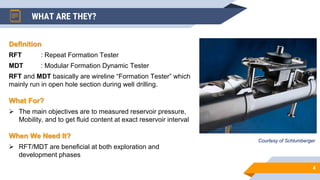
WHAT ARE THEY?
4
Courtesy of Schlumberger
Definition
RFT : Repeat Formation Tester
MDT : Modular Formation Dynamic Tester
RFT and MDT basically are wireline “Formation Tester” which
mainly run in open hole section during well drilling.
What For?
➢ The main objectives are to measured reservoir pressure,
Mobility, and to get fluid content at exact reservoir interval
When We Need It?
➢ RFT/MDT are beneficial at both exploration and
development phases
5
WHEN WE NEED IT?
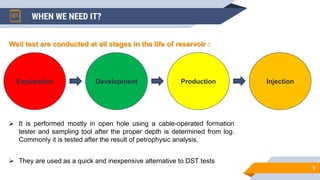
Well test are conducted at all stages in the life of reservoir :
Exploration Development Production Injection
➢ It is performed mostly in open hole using a cable-operated formation
tester and sampling tool after the proper depth is determined from log.
Commonly it is tested after the result of petrophysic analysis,
➢ They are used as a quick and inexpensive alternative to DST tests
WHAT FOR?
These pressure measurements are useful in determining:
➢ Variation in pressure among various formation
➢ Gradient of fluid pressure within a formation that can indicate fluid contact
➢ Gas-oil or oil-water contact
➢ Formation permeability
➢ Conduct controlled local production and vertical interference
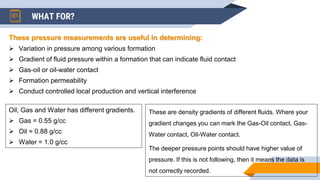
Oil, Gas and Water has different gradients.
➢ Gas = 0.55 g/cc
➢ Oil = 0.88 g/cc
➢ Water = 1.0 g/cc
These are density gradients of different fluids. Where your
gradient changes you can mark the Gas-Oil contact, Gas-
Water contact, Oil-Water contact.
The deeper pressure points should have higher value of
pressure. If this is not following, then it means the data is
not correctly recorded.
GENERAL TOOL EVOLUTION
7
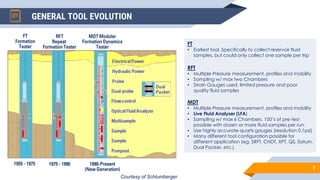
FT
Formation
Tester
RFT
Repeat
Formation Tester
MDT Modular
Formation Dynamics
Tester
1955 - 1975 1990-Present
(New Generation)
1975 - 1990
Courtesy of Schlumberger
FT
• Earliest tool, Specifically to collect reservoir fluid
samples, but could only collect one sample per trip
RFT
• Multiple Pressure measurement, profiles and mobility
• Sampling w/ max two Chambers
• Strain Gauges used, limited pressure and poor
quality fluid samples
MDT
• Multiple Pressure measurement, profiles and mobility
• Live Fluid Analyser (LFA)
• Sampling w/ max 6 Chambers. 100’s of pre-test
possible with dozen or more fluid samples per run.
• Use highly accurate quartz gauges (resolution 0.1psi)
• Many different tool configuration possible for
different application (eg. SRFT, CHDT, XPT, QS, Saturn,
Dual Packer, etc.)
BASIC TOOL CONFIGURATION
8
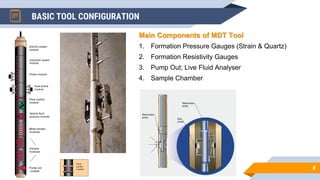
Main Components of MDT Tool
1. Formation Pressure Gauges (Strain & Quartz)
2. Formation Resistivity Gauges
3. Pump Out; Live Fluid Analyser
4. Sample Chamber
COMPARISON
BASIC DATA ACQUISITION
10
2
How Do They Work
OPERATIONAL MDT
11
a. Retracted Tool
b. Tool Set
Formation
Time
Pressure
Packer Pretest Piston
Gauge
After Tool is Set Flowline is at Mud Hydrostatic Pressure
PRESSURE TEST : How Do Wireline Tools Measure Pressure
1
12
Formation
Time
Pressure
Packer Pretest Piston
Gauge
PRESSURE TEST : How Do Wireline Tools Measure Pressure
2
13
Formation
Time
Pressure
Packer Pretest Piston
Gauge
PRESSURE TEST : How Do Wireline Tools Measure Pressure
3
14
Formation
Time
Pressure
Packer Pretest Piston
Gauge
PRESSURE TEST : How Do Wireline Tools Measure Pressure
4
15
Formation
Time
Pressure
Packer Pretest Piston
Gauge
PRESSURE TEST : How Do Wireline Tools Measure Pressure
5
16
Formation
Time
Pressure
Packer Pretest Piston
Gauge
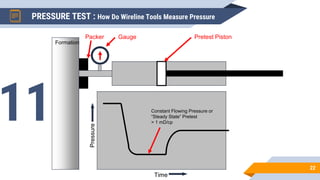
Formation delivers fluid at the same rate the pretest
piston expands the flowline volume
PRESSURE TEST : How Do Wireline Tools Measure Pressure
6
17
Formation
Time
Pressure
Packer Pretest Piston
Gauge
PRESSURE TEST : How Do Wireline Tools Measure Pressure
7
18
Formation
Time
Pressure
Packer Pretest Piston
Gauge
PRESSURE TEST : How Do Wireline Tools Measure Pressure
8
19
Formation
Time
Pressure
Packer Pretest Piston
Gauge
Piston Stops
PRESSURE TEST : How Do Wireline Tools Measure Pressure
9
20
Formation
Time
Pressure
Packer Pretest Piston
Gauge
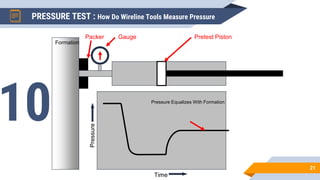
Pressure Equalizes With Formation
PRESSURE TEST : How Do Wireline Tools Measure Pressure
10
21
Formation
Time
Pressure
Packer Pretest Piston
Gauge
Constant Flowing Pressure or
“Steady State” Pretest
> 1 mD/cp
PRESSURE TEST : How Do Wireline Tools Measure Pressure
11
22
PRESSURE TEST
23
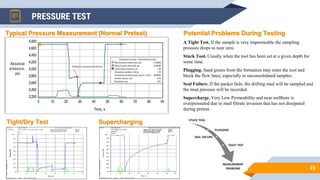
Typical Pressure Measurement (Normal Pretest)
Tight/Dry Test Supercharging
A Tight Test. If the sample is very impermeable the sampling
pressure drops to near zero.
Stuck Tool. Usually when the tool has been set at a given depth for
some time.
Plugging. Sand grains from the formation may enter the tool and
block the flow lines, especially in unconsolidated samples.
Seal Failure. If the packer fails, the drilling mud will be sampled and
the mud pressure will be recorded.
Supercharge. Very Low Permeability and near wellbore is
overpressured due to mud filtrate invasion that has not dissipated
during pretest.
Potential Problems During Testing
LIVE FLUID ANALYSIS
24
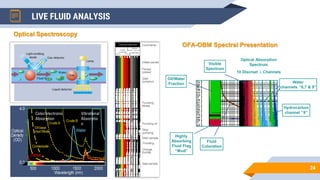
Optical Spectroscopy
OFA-OBM Spectral Presentation
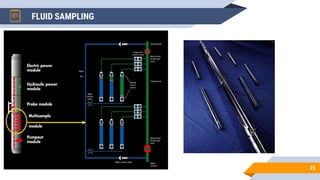
FLUID SAMPLING
25
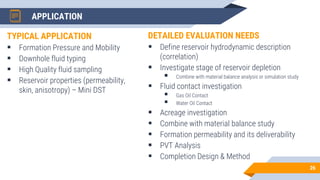
APPLICATION
26
TYPICAL APPLICATION
▪ Formation Pressure and Mobility
▪ Downhole fluid typing
▪ High Quality fluid sampling
▪ Reservoir properties (permeability,
skin, anisotropy) – Mini DST
DETAILED EVALUATION NEEDS
▪ Define reservoir hydrodynamic description
(correlation)
▪ Investigate stage of reservoir depletion
▪ Combine with material balance analysis or simulation study
▪ Fluid contact investigation
▪ Gas Oil Contact
▪ Water Oil Contact
▪ Acreage investigation
▪ Combine with material balance study
▪ Formation permeability and its deliverability
▪ PVT Analysis
▪ Completion Design & Method
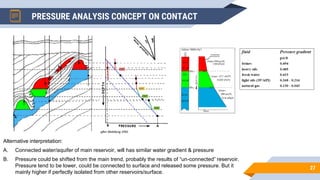
PRESSURE ANALYSIS CONCEPT ON CONTACT
27
Alternative interpretation:
A. Connected water/aquifer of main reservoir, will has similar water gradient & pressure
B. Pressure could be shifted from the main trend, probably the results of “un-connected” reservoir.
Pressure tend to be lower, could be connected to surface and released some pressure. But it
mainly higher if perfectly isolated from other reservoirs/surface.
STUDY CASE
28
3
Case in Oil and Gas Development
SUMMARY
29
4
SUMMARY
30
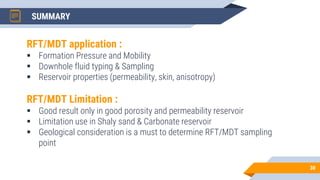
RFT/MDT application :
▪ Formation Pressure and Mobility
▪ Downhole fluid typing & Sampling
▪ Reservoir properties (permeability, skin, anisotropy)
RFT/MDT Limitation :
▪ Good result only in good porosity and permeability reservoir
▪ Limitation use in Shaly sand & Carbonate reservoir
▪ Geological consideration is a must to determine RFT/MDT sampling
point
THANK YOU!
Let’s Discuss
31

RFT & MDT.pdf

  • 1.
    RFT & MDTAPLICATION FOR FIELD DEVELOPMENT
  • 2.
    PRESENTATION OUTLINE 2 ▰ INTRODUCTION ▰BASIC DATA ACQUISITION & APPLICATION ▰ CASE STUDY ▰ SUMMARY
  • 3.
  • 4.
    WHAT ARE THEY? 4 Courtesyof Schlumberger Definition RFT : Repeat Formation Tester MDT : Modular Formation Dynamic Tester RFT and MDT basically are wireline “Formation Tester” which mainly run in open hole section during well drilling. What For? ➢ The main objectives are to measured reservoir pressure, Mobility, and to get fluid content at exact reservoir interval When We Need It? ➢ RFT/MDT are beneficial at both exploration and development phases
  • 5.
    5 WHEN WE NEEDIT? Well test are conducted at all stages in the life of reservoir : Exploration Development Production Injection ➢ It is performed mostly in open hole using a cable-operated formation tester and sampling tool after the proper depth is determined from log. Commonly it is tested after the result of petrophysic analysis, ➢ They are used as a quick and inexpensive alternative to DST tests
  • 6.
    WHAT FOR? These pressuremeasurements are useful in determining: ➢ Variation in pressure among various formation ➢ Gradient of fluid pressure within a formation that can indicate fluid contact ➢ Gas-oil or oil-water contact ➢ Formation permeability ➢ Conduct controlled local production and vertical interference Oil, Gas and Water has different gradients. ➢ Gas = 0.55 g/cc ➢ Oil = 0.88 g/cc ➢ Water = 1.0 g/cc These are density gradients of different fluids. Where your gradient changes you can mark the Gas-Oil contact, Gas- Water contact, Oil-Water contact. The deeper pressure points should have higher value of pressure. If this is not following, then it means the data is not correctly recorded.
  • 7.
    GENERAL TOOL EVOLUTION 7 FT Formation Tester RFT Repeat FormationTester MDT Modular Formation Dynamics Tester 1955 - 1975 1990-Present (New Generation) 1975 - 1990 Courtesy of Schlumberger FT • Earliest tool, Specifically to collect reservoir fluid samples, but could only collect one sample per trip RFT • Multiple Pressure measurement, profiles and mobility • Sampling w/ max two Chambers • Strain Gauges used, limited pressure and poor quality fluid samples MDT • Multiple Pressure measurement, profiles and mobility • Live Fluid Analyser (LFA) • Sampling w/ max 6 Chambers. 100’s of pre-test possible with dozen or more fluid samples per run. • Use highly accurate quartz gauges (resolution 0.1psi) • Many different tool configuration possible for different application (eg. SRFT, CHDT, XPT, QS, Saturn, Dual Packer, etc.)
  • 8.
    BASIC TOOL CONFIGURATION 8 MainComponents of MDT Tool 1. Formation Pressure Gauges (Strain & Quartz) 2. Formation Resistivity Gauges 3. Pump Out; Live Fluid Analyser 4. Sample Chamber
  • 9.
  • 10.
  • 11.
  • 12.
    Formation Time Pressure Packer Pretest Piston Gauge AfterTool is Set Flowline is at Mud Hydrostatic Pressure PRESSURE TEST : How Do Wireline Tools Measure Pressure 1 12
  • 13.
    Formation Time Pressure Packer Pretest Piston Gauge PRESSURETEST : How Do Wireline Tools Measure Pressure 2 13
  • 14.
    Formation Time Pressure Packer Pretest Piston Gauge PRESSURETEST : How Do Wireline Tools Measure Pressure 3 14
  • 15.
    Formation Time Pressure Packer Pretest Piston Gauge PRESSURETEST : How Do Wireline Tools Measure Pressure 4 15
  • 16.
    Formation Time Pressure Packer Pretest Piston Gauge PRESSURETEST : How Do Wireline Tools Measure Pressure 5 16
  • 17.
    Formation Time Pressure Packer Pretest Piston Gauge Formationdelivers fluid at the same rate the pretest piston expands the flowline volume PRESSURE TEST : How Do Wireline Tools Measure Pressure 6 17
  • 18.
    Formation Time Pressure Packer Pretest Piston Gauge PRESSURETEST : How Do Wireline Tools Measure Pressure 7 18
  • 19.
    Formation Time Pressure Packer Pretest Piston Gauge PRESSURETEST : How Do Wireline Tools Measure Pressure 8 19
  • 20.
    Formation Time Pressure Packer Pretest Piston Gauge PistonStops PRESSURE TEST : How Do Wireline Tools Measure Pressure 9 20
  • 21.
    Formation Time Pressure Packer Pretest Piston Gauge PressureEqualizes With Formation PRESSURE TEST : How Do Wireline Tools Measure Pressure 10 21
  • 22.
    Formation Time Pressure Packer Pretest Piston Gauge ConstantFlowing Pressure or “Steady State” Pretest > 1 mD/cp PRESSURE TEST : How Do Wireline Tools Measure Pressure 11 22
  • 23.
    PRESSURE TEST 23 Typical PressureMeasurement (Normal Pretest) Tight/Dry Test Supercharging A Tight Test. If the sample is very impermeable the sampling pressure drops to near zero. Stuck Tool. Usually when the tool has been set at a given depth for some time. Plugging. Sand grains from the formation may enter the tool and block the flow lines, especially in unconsolidated samples. Seal Failure. If the packer fails, the drilling mud will be sampled and the mud pressure will be recorded. Supercharge. Very Low Permeability and near wellbore is overpressured due to mud filtrate invasion that has not dissipated during pretest. Potential Problems During Testing
  • 24.
    LIVE FLUID ANALYSIS 24 OpticalSpectroscopy OFA-OBM Spectral Presentation
  • 25.
  • 26.
    APPLICATION 26 TYPICAL APPLICATION ▪ FormationPressure and Mobility ▪ Downhole fluid typing ▪ High Quality fluid sampling ▪ Reservoir properties (permeability, skin, anisotropy) – Mini DST DETAILED EVALUATION NEEDS ▪ Define reservoir hydrodynamic description (correlation) ▪ Investigate stage of reservoir depletion ▪ Combine with material balance analysis or simulation study ▪ Fluid contact investigation ▪ Gas Oil Contact ▪ Water Oil Contact ▪ Acreage investigation ▪ Combine with material balance study ▪ Formation permeability and its deliverability ▪ PVT Analysis ▪ Completion Design & Method
  • 27.
    PRESSURE ANALYSIS CONCEPTON CONTACT 27 Alternative interpretation: A. Connected water/aquifer of main reservoir, will has similar water gradient & pressure B. Pressure could be shifted from the main trend, probably the results of “un-connected” reservoir. Pressure tend to be lower, could be connected to surface and released some pressure. But it mainly higher if perfectly isolated from other reservoirs/surface.
  • 28.
    STUDY CASE 28 3 Case inOil and Gas Development
  • 29.
  • 30.
    SUMMARY 30 RFT/MDT application : ▪Formation Pressure and Mobility ▪ Downhole fluid typing & Sampling ▪ Reservoir properties (permeability, skin, anisotropy) RFT/MDT Limitation : ▪ Good result only in good porosity and permeability reservoir ▪ Limitation use in Shaly sand & Carbonate reservoir ▪ Geological consideration is a must to determine RFT/MDT sampling point
  • 31.