Prepared by Nouh Almandhari
Concept of Skin Factor
What is Skin/Formation Damage
Concept of Effective Wellbore Radius r’w
Causes of Skin
Hawking’s Formula for Skin Factor
Skin Effect on Production
Some quantitative methods for Skin Determination
Concept of Skin Factor
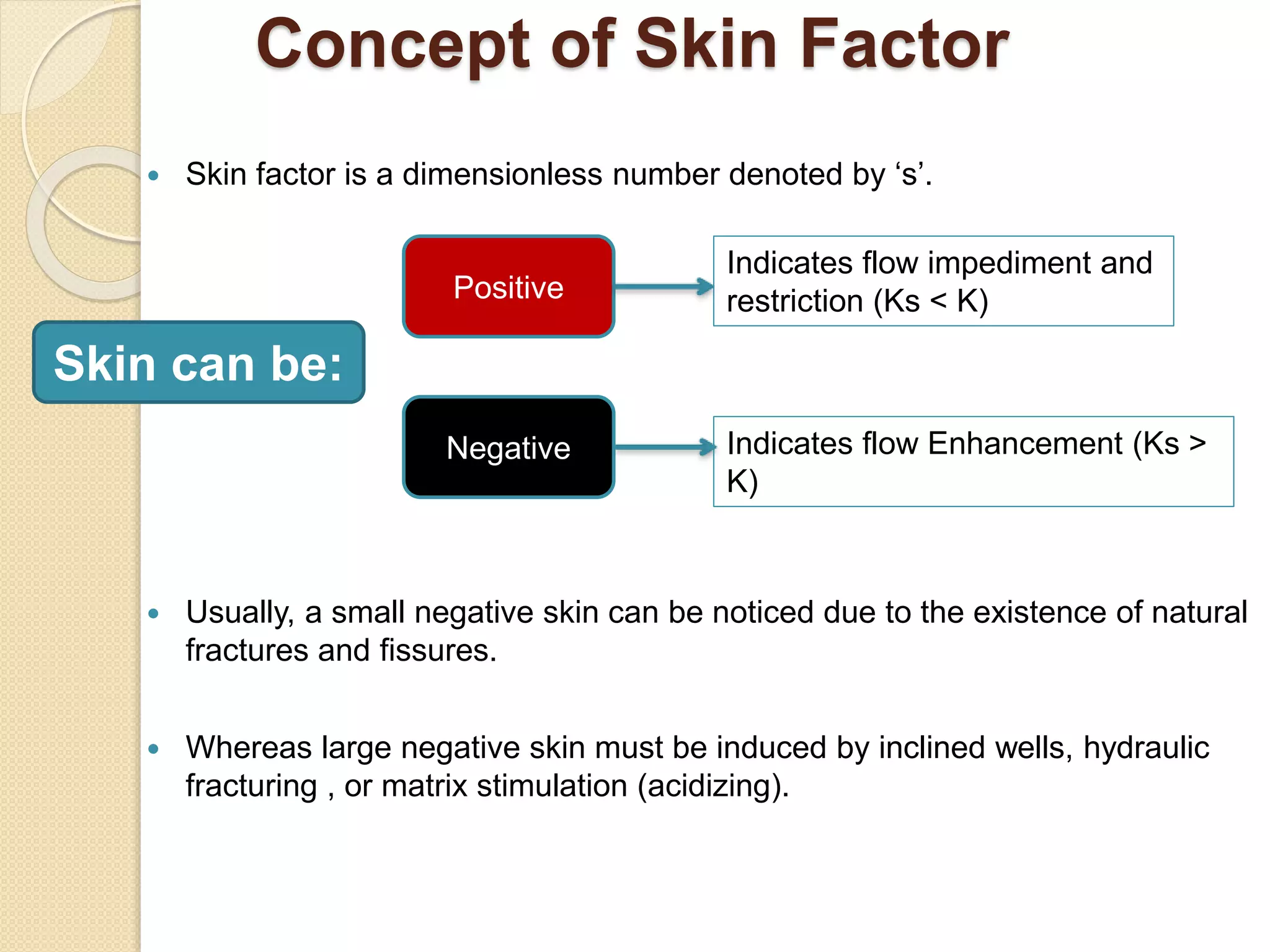
 Skin factor is a dimensionless number denoted by ‘s’.
 Usually, a small negative skin can be noticed due to the existence of natural
fractures and fissures.
 Whereas large negative skin must be induced by inclined wells, hydraulic
fracturing , or matrix stimulation (acidizing).
Skin can be:
Positive
Negative
Indicates flow impediment and
restriction (Ks < K)
Indicates flow Enhancement (Ks >
K)
What is Formation Damage
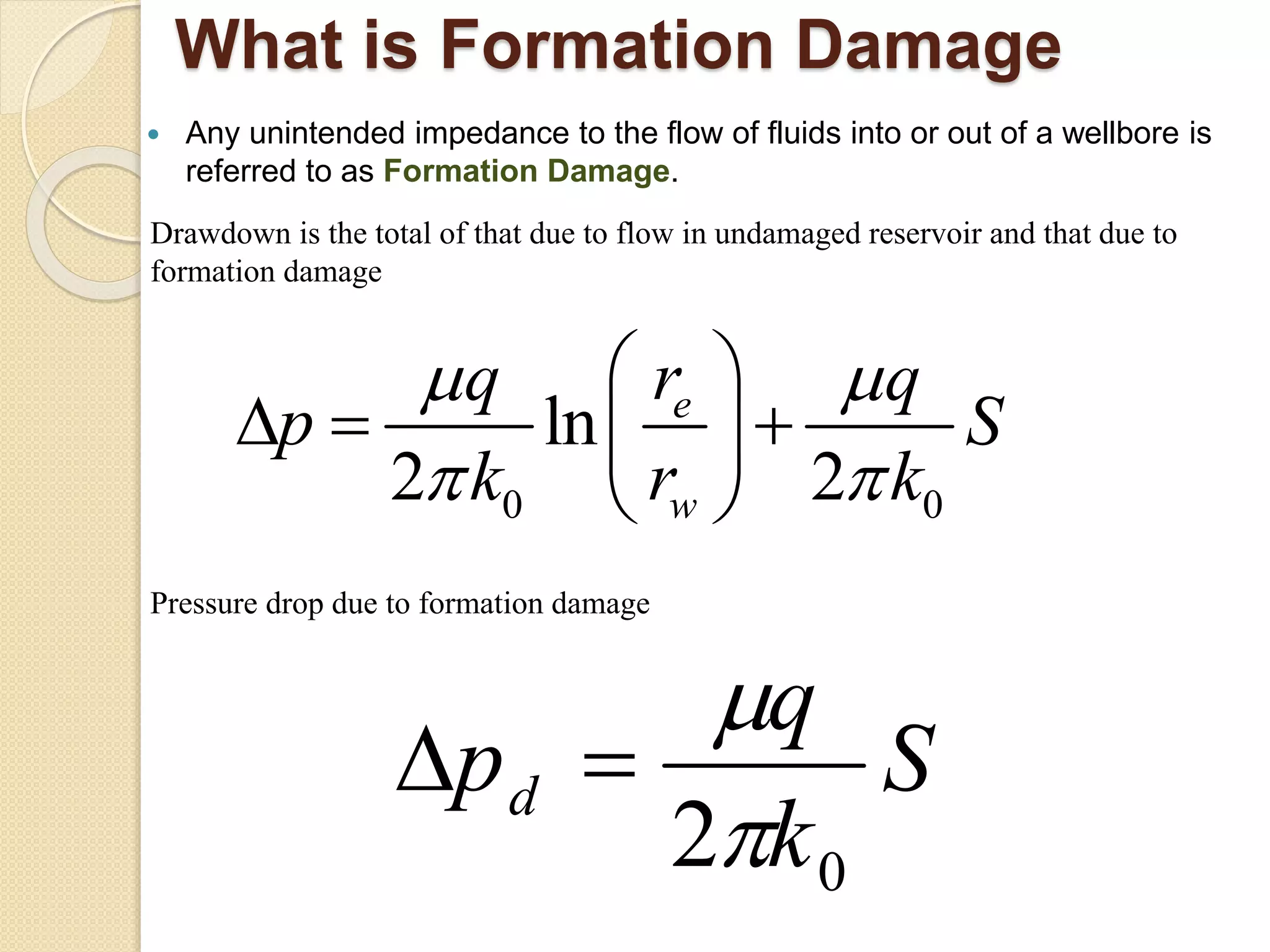
 Any unintended impedance to the flow of fluids into or out of a wellbore is
referred to as Formation Damage.
0 0
ln
2 2
e
w
rq q
p S
k r k
 
 
 
   
 
S
k
q
pd
02


Drawdown is the total of that due to flow in undamaged reservoir and that due to
formation damage
Pressure drop due to formation damage
Good to Know
 Positive skin causes additional pressure drop
which indeed reduces the well productivity thus
reducing revenue
With Skin:
Additional ΔP
With no Skin
Concept of Effective Wellbore
Radius
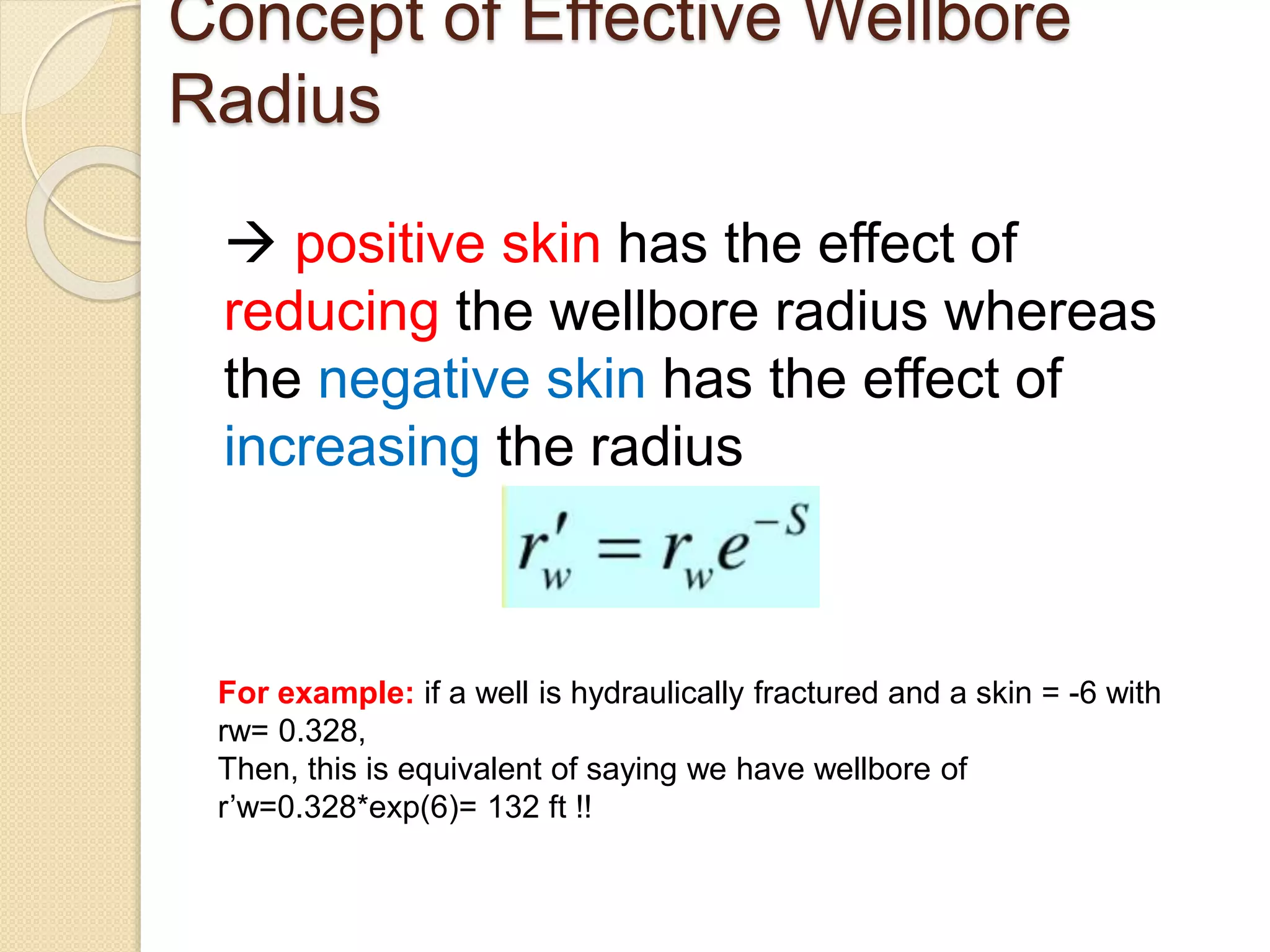
 positive skin has the effect of
reducing the wellbore radius whereas
the negative skin has the effect of
increasing the radius
For example: if a well is hydraulically fractured and a skin = -6 with
rw= 0.328,
Then, this is equivalent of saying we have wellbore of
r’w=0.328*exp(6)= 132 ft !!
Causes of Skin:
 Solid Plugging.
 Clay-particle swelling or dispersion.
 Saturation changes.
 Wettability Reversal.
 Fines migration.
 Deposition of paraffins or asphaltenes
… and others
Causes of Skin
 Solid Plugging:
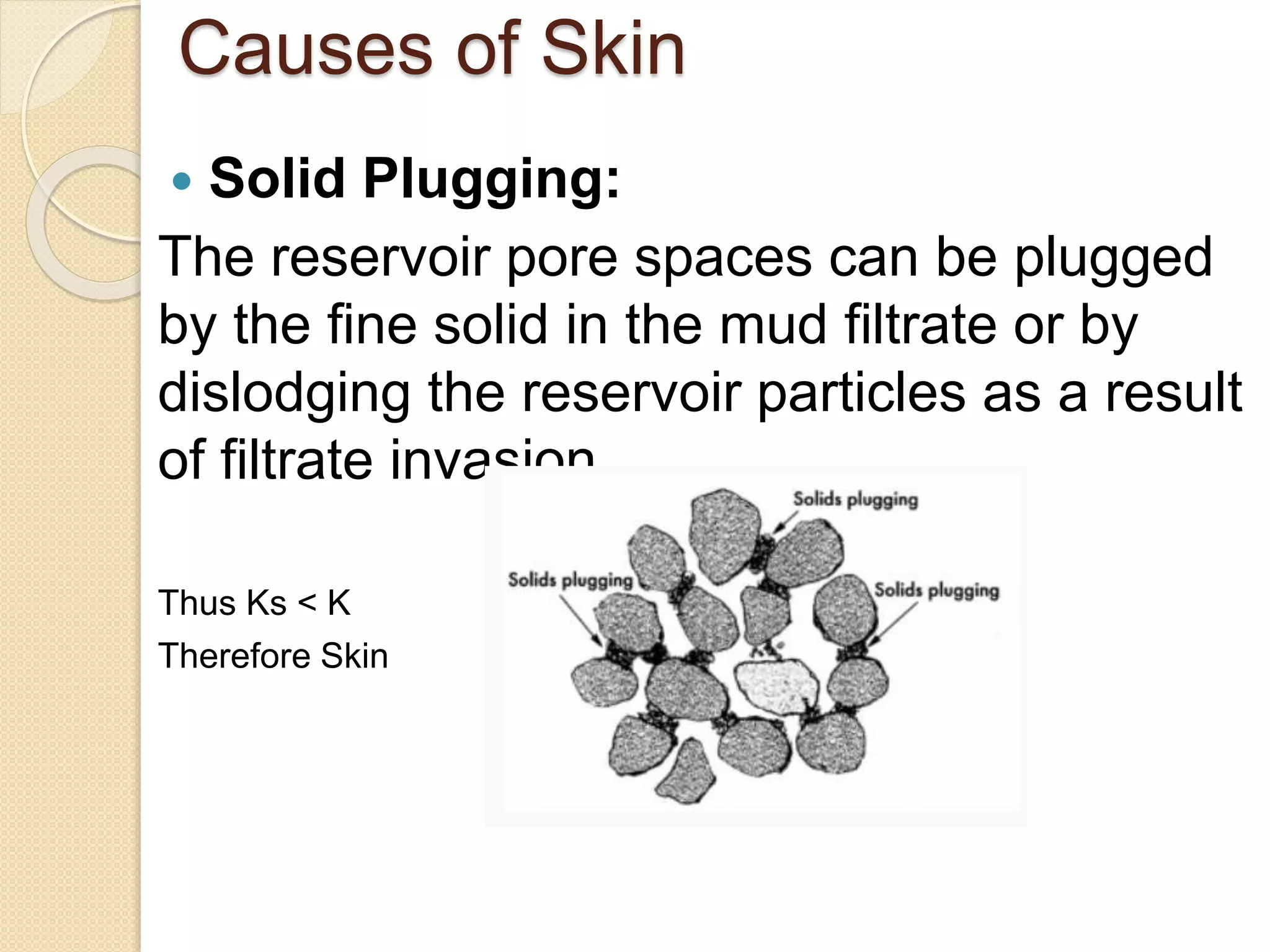
The reservoir pore spaces can be plugged
by the fine solid in the mud filtrate or by
dislodging the reservoir particles as a result
of filtrate invasion.
Thus Ks < K
Therefore Skin
Causes of Skin
 Clay-particle swelling or dispersion: This
is an inherent problem in sandstone that contains water-
sensitive clays in which they absorb water and become
bigger thus blocking the highways.
 Clays example: Smectites and mixed-layer illites, and
can expand in volume up to 20 times their original
volume through adsorption of layers of water between
their unit cells.
 Preventing the clay Swelling: by the addition of
polymers containing quaternary ammonium salts,
hydrolyzable metal ions.
Causes of Skin
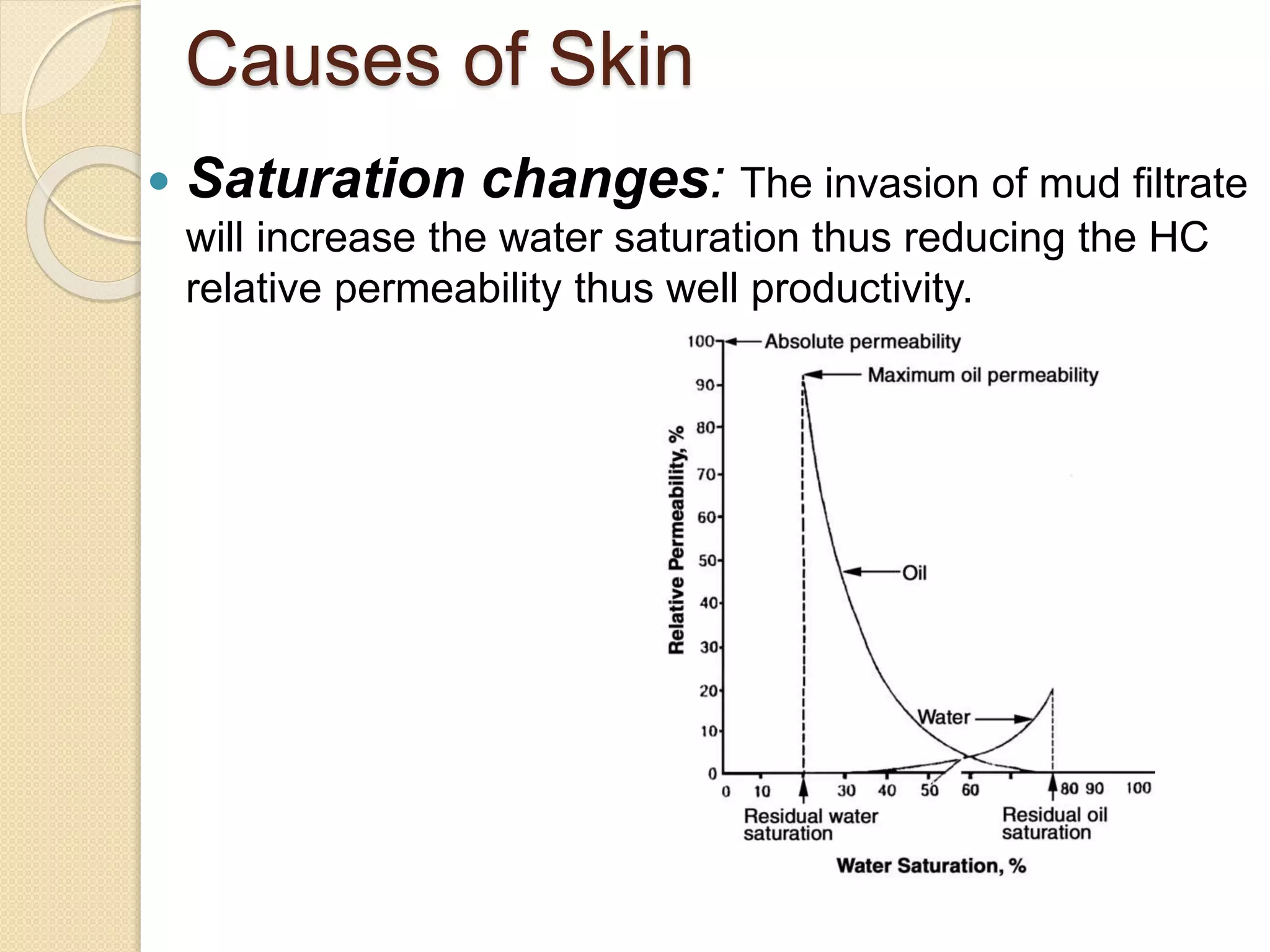
 Saturation changes: The invasion of mud filtrate
will increase the water saturation thus reducing the HC
relative permeability thus well productivity.
Causes of Skin
 Wettability Reversal: Reservoir rocks are water-
wet in nature. If the well to be drilled with oil-based mud
systems, excess surfactants in the mud filtrate that enter
the rock can cause wettability reversal. This causes the
HC to be the wetting phase thus hindering its freedom of
movement thus lower HC productivity and excessive
water production and treatment cost.
Causes of Skin
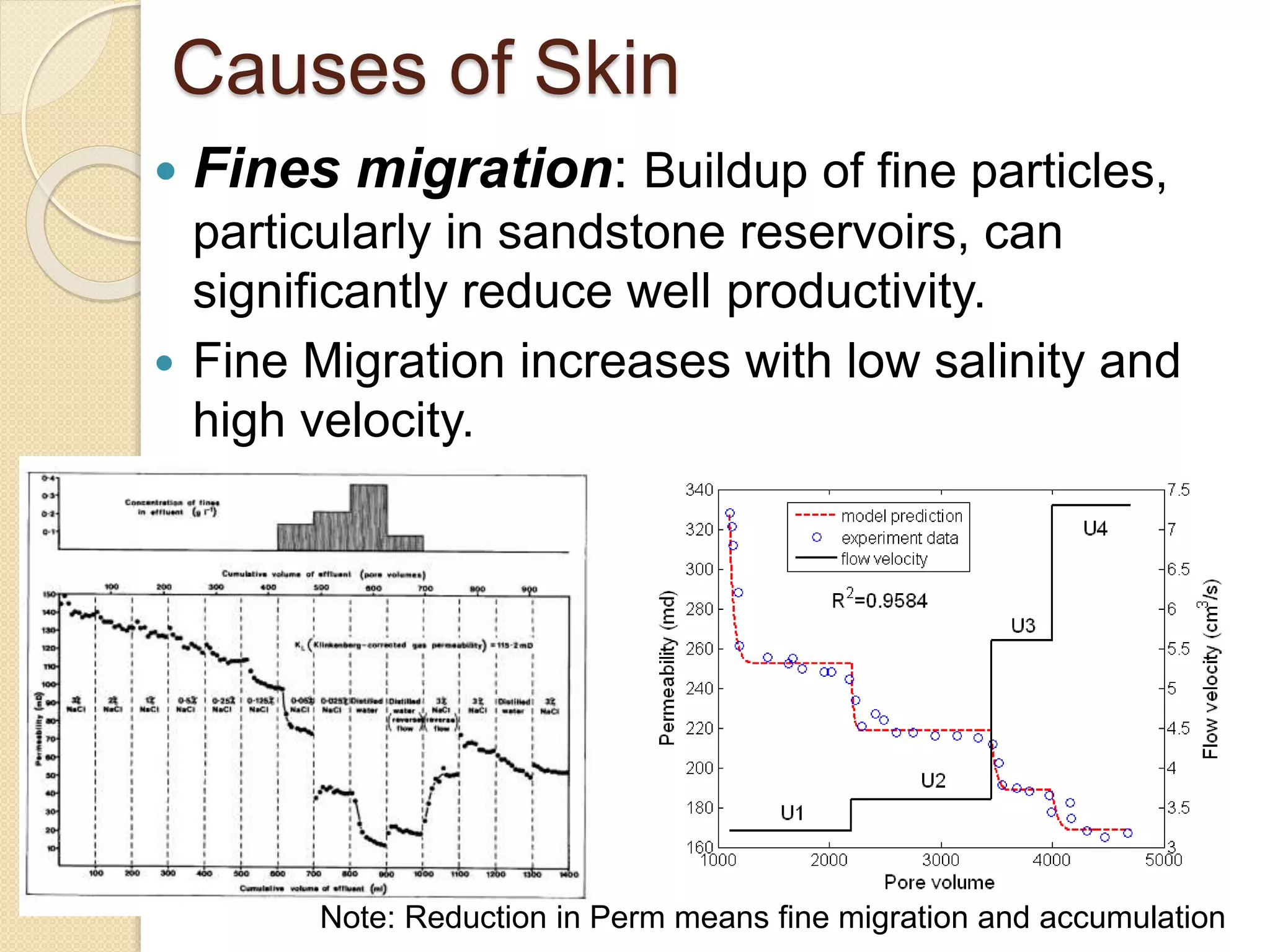
 Fines migration: Buildup of fine particles,
particularly in sandstone reservoirs, can
significantly reduce well productivity.
 Fine Migration increases with low salinity and
high velocity.
Note: Reduction in Perm means fine migration and accumulation
13
ln
ld
Fe
Fg
Fl
Fd
 d d l n e g nF l Fl F F l  
Equilibrium condition: total of torques equals zero
Fd – drag force
Fe – electrostatic force
(attraction or repulsion)
Fl – lifting force
Fg - gravity
Revision: Physics of particle attachment
No particles are captured under the mechanical equilibrium
Fe – maximum value of electrostatic DLVO force Fe(h)
Causes of Skin
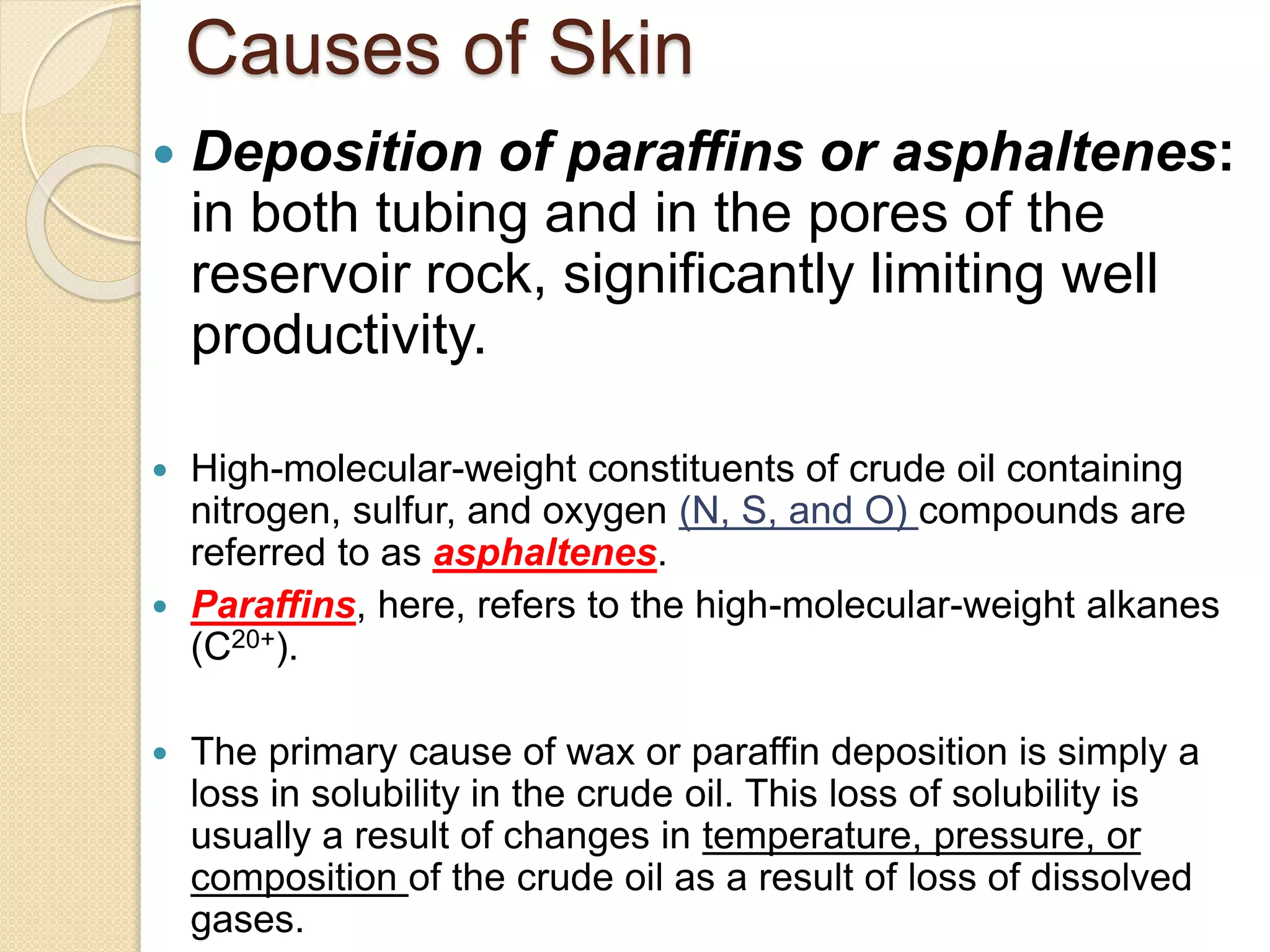
 Deposition of paraffins or asphaltenes:
in both tubing and in the pores of the
reservoir rock, significantly limiting well
productivity.
 High-molecular-weight constituents of crude oil containing
nitrogen, sulfur, and oxygen (N, S, and O) compounds are
referred to as asphaltenes.
 Paraffins, here, refers to the high-molecular-weight alkanes
(C20+).
 The primary cause of wax or paraffin deposition is simply a
loss in solubility in the crude oil. This loss of solubility is
usually a result of changes in temperature, pressure, or
composition of the crude oil as a result of loss of dissolved
gases.
Revision
Hawking’s formula for skin factor
 Reduced permeability kd in damaged zone rw<r<rd:
𝑺 =
𝒌
𝒌𝒅
− 𝟏 𝐥𝐧(
𝒓𝒅
𝒓𝒘
)
That is:
ln , ln ,
2 2
ln ln ln ln ln ln ln
2 2 2 2
ln , ln ln 1 ln
2
e d
ed dw
d d w
e d e d e d d
ed dw
d d w d d w w w d w
e d d d
w w d w d w
r rq q
p p
k r k r
r r r r r r rq q q k q k
p p p
k r k r k r k r k r r k r
r r r rq k k
p S S
k r r k r k r
 
 
   
   


   
   
              
   
   
          
   
Reservoir
Wellbore
rwrd
Kd
K
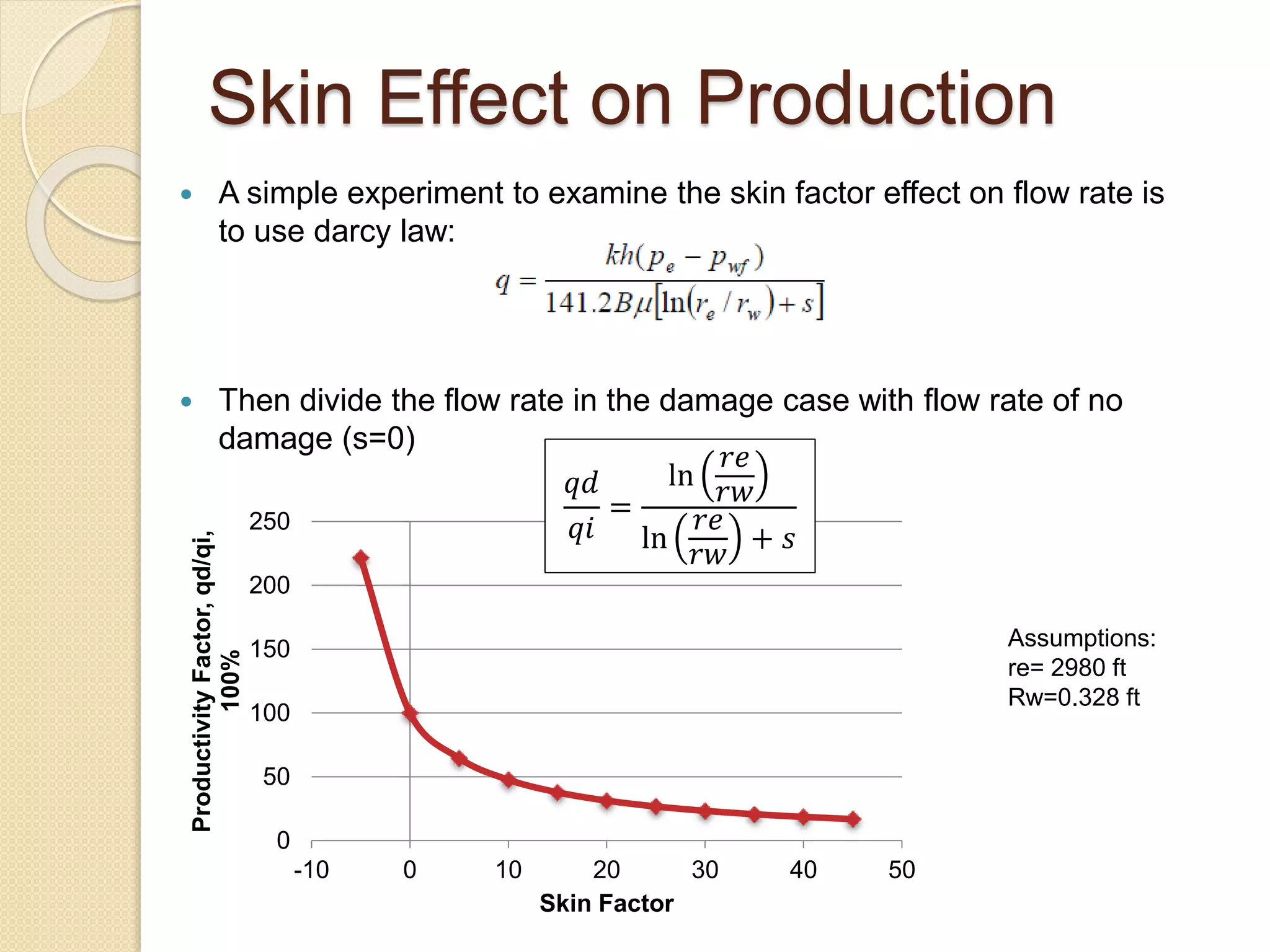
Skin Effect on Production
 A simple experiment to examine the skin factor effect on flow rate is
to use darcy law:
 Then divide the flow rate in the damage case with flow rate of no
damage (s=0)
0
50
100
150
200
250
-10 0 10 20 30 40 50
ProductivityFactor,qd/qi,
100%
Skin Factor
𝑞𝑑
𝑞𝑖
=
ln
𝑟𝑒
𝑟𝑤
ln
𝑟𝑒
𝑟𝑤
+ 𝑠
Assumptions:
re= 2980 ft
Rw=0.328 ft
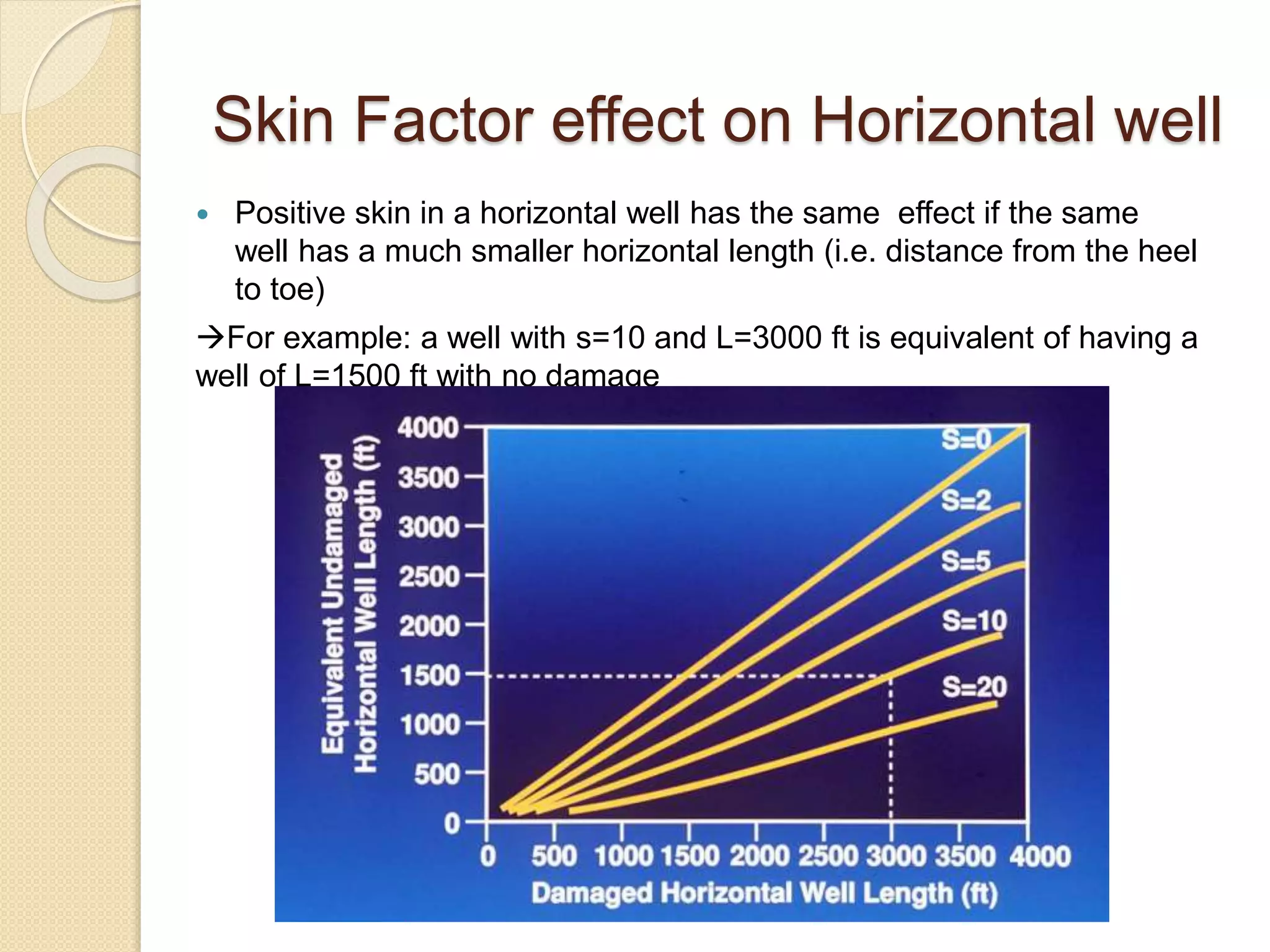
Skin Factor effect on Horizontal well
 Positive skin in a horizontal well has the same effect if the same
well has a much smaller horizontal length (i.e. distance from the heel
to toe)
For example: a well with s=10 and L=3000 ft is equivalent of having a
well of L=1500 ft with no damage
Some quantitative methods for Skin
Determination
 Well Testing (Drawdown test, Build-up
test, Type Curve, )
 Drill stem test (which is essentially a
small PBU test analysis)
Thank you

Skin Factor and Formation Damage

  • 1.
    Prepared by NouhAlmandhari
  • 2.
    Concept of SkinFactor What is Skin/Formation Damage Concept of Effective Wellbore Radius r’w Causes of Skin Hawking’s Formula for Skin Factor Skin Effect on Production Some quantitative methods for Skin Determination
  • 3.
    Concept of SkinFactor  Skin factor is a dimensionless number denoted by ‘s’.  Usually, a small negative skin can be noticed due to the existence of natural fractures and fissures.  Whereas large negative skin must be induced by inclined wells, hydraulic fracturing , or matrix stimulation (acidizing). Skin can be: Positive Negative Indicates flow impediment and restriction (Ks < K) Indicates flow Enhancement (Ks > K)
  • 4.
    What is FormationDamage  Any unintended impedance to the flow of fluids into or out of a wellbore is referred to as Formation Damage. 0 0 ln 2 2 e w rq q p S k r k             S k q pd 02   Drawdown is the total of that due to flow in undamaged reservoir and that due to formation damage Pressure drop due to formation damage
  • 5.
    Good to Know Positive skin causes additional pressure drop which indeed reduces the well productivity thus reducing revenue With Skin: Additional ΔP With no Skin
  • 6.
    Concept of EffectiveWellbore Radius  positive skin has the effect of reducing the wellbore radius whereas the negative skin has the effect of increasing the radius For example: if a well is hydraulically fractured and a skin = -6 with rw= 0.328, Then, this is equivalent of saying we have wellbore of r’w=0.328*exp(6)= 132 ft !!
  • 7.
    Causes of Skin: Solid Plugging.  Clay-particle swelling or dispersion.  Saturation changes.  Wettability Reversal.  Fines migration.  Deposition of paraffins or asphaltenes … and others
  • 8.
    Causes of Skin Solid Plugging: The reservoir pore spaces can be plugged by the fine solid in the mud filtrate or by dislodging the reservoir particles as a result of filtrate invasion. Thus Ks < K Therefore Skin
  • 9.
    Causes of Skin Clay-particle swelling or dispersion: This is an inherent problem in sandstone that contains water- sensitive clays in which they absorb water and become bigger thus blocking the highways.  Clays example: Smectites and mixed-layer illites, and can expand in volume up to 20 times their original volume through adsorption of layers of water between their unit cells.  Preventing the clay Swelling: by the addition of polymers containing quaternary ammonium salts, hydrolyzable metal ions.
  • 10.
    Causes of Skin Saturation changes: The invasion of mud filtrate will increase the water saturation thus reducing the HC relative permeability thus well productivity.
  • 11.
    Causes of Skin Wettability Reversal: Reservoir rocks are water- wet in nature. If the well to be drilled with oil-based mud systems, excess surfactants in the mud filtrate that enter the rock can cause wettability reversal. This causes the HC to be the wetting phase thus hindering its freedom of movement thus lower HC productivity and excessive water production and treatment cost.
  • 12.
    Causes of Skin Fines migration: Buildup of fine particles, particularly in sandstone reservoirs, can significantly reduce well productivity.  Fine Migration increases with low salinity and high velocity. Note: Reduction in Perm means fine migration and accumulation
  • 13.
    13 ln ld Fe Fg Fl Fd  d dl n e g nF l Fl F F l   Equilibrium condition: total of torques equals zero Fd – drag force Fe – electrostatic force (attraction or repulsion) Fl – lifting force Fg - gravity Revision: Physics of particle attachment No particles are captured under the mechanical equilibrium Fe – maximum value of electrostatic DLVO force Fe(h)
  • 14.
    Causes of Skin Deposition of paraffins or asphaltenes: in both tubing and in the pores of the reservoir rock, significantly limiting well productivity.  High-molecular-weight constituents of crude oil containing nitrogen, sulfur, and oxygen (N, S, and O) compounds are referred to as asphaltenes.  Paraffins, here, refers to the high-molecular-weight alkanes (C20+).  The primary cause of wax or paraffin deposition is simply a loss in solubility in the crude oil. This loss of solubility is usually a result of changes in temperature, pressure, or composition of the crude oil as a result of loss of dissolved gases.
  • 15.
  • 16.
    Hawking’s formula forskin factor  Reduced permeability kd in damaged zone rw<r<rd: 𝑺 = 𝒌 𝒌𝒅 − 𝟏 𝐥𝐧( 𝒓𝒅 𝒓𝒘 ) That is: ln , ln , 2 2 ln ln ln ln ln ln ln 2 2 2 2 ln , ln ln 1 ln 2 e d ed dw d d w e d e d e d d ed dw d d w d d w w w d w e d d d w w d w d w r rq q p p k r k r r r r r r r rq q q k q k p p p k r k r k r k r k r r k r r r r rq k k p S S k r r k r k r                                                             Reservoir Wellbore rwrd Kd K
  • 17.
    Skin Effect onProduction  A simple experiment to examine the skin factor effect on flow rate is to use darcy law:  Then divide the flow rate in the damage case with flow rate of no damage (s=0) 0 50 100 150 200 250 -10 0 10 20 30 40 50 ProductivityFactor,qd/qi, 100% Skin Factor 𝑞𝑑 𝑞𝑖 = ln 𝑟𝑒 𝑟𝑤 ln 𝑟𝑒 𝑟𝑤 + 𝑠 Assumptions: re= 2980 ft Rw=0.328 ft
  • 18.
    Skin Factor effecton Horizontal well  Positive skin in a horizontal well has the same effect if the same well has a much smaller horizontal length (i.e. distance from the heel to toe) For example: a well with s=10 and L=3000 ft is equivalent of having a well of L=1500 ft with no damage
  • 19.
    Some quantitative methodsfor Skin Determination  Well Testing (Drawdown test, Build-up test, Type Curve, )  Drill stem test (which is essentially a small PBU test analysis)
  • 20.