RESERVES ESTIMATION
(VOLUMETRIC METHOD)
Presenter Shivshambhu Kumar
Date 29 April 2017
4/29/2017 By Shivshambhu Kumar 1
1. INTRODUCTION
 Reserves are those quantities of petroleum which are anticipated to be
commercially recovered from known accumulations from a given date forward.
 All reserve estimates involve some degree of uncertainty.
 The uncertainty depends mainly on the amount of reliable geologic and engineering
data available at the time of the estimate and the interpretation of these data.
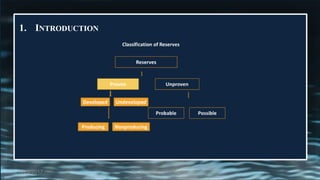
 The relative degree of uncertainty may be conveyed by placing reserves into one of
two principal classifications, either proved or unproved .
 Unproved reserves are less certain to be recovered than proved reserves and may be
further sub-classified as probable (2P) and possible (P10) reserves to denote
progressively increasing uncertainty in their recoverability.
4/29/2017 By Shivshambhu Kumar 3
1. INTRODUCTION
4/29/2017 By Shivshambhu Kumar 4
1. INTRODUCTION
Estimating hydrocarbon reserves is a complex process that involves integrating geological and
engineering data. Depending on the amount and quality of data available, one or more of the following
methods may be used to estimate reserves:
• Volumetric
• Material balance
• Production history
• Analogy
Volumetric estimates of OOIP and OGIP are based on a geological model that geometrically describes the
volume of hydrocarbons in the reservoir. However, due mainly to gas evolving from the oil as pressure and
temperature are decreased, oil at the surface occupies less space than it does in the subsurface. Conversely, gas
at the surface occupies more space than it does In the subsurface because of expansion. This necessitates
correcting subsurface volumes to standard units of volume measured at surface conditions.
4/29/2017 By Shivshambhu Kumar 5
2. RECOVERABLE HYDROCARBON
1. Porosity
2. Water Saturation
3. Net Pay
4. Area
5. Pressure
6. Formation Volume Factor
7. Original Hydrocarbon in Place
8. Recovery Factor
4/29/2017 By Shivshambhu Kumar 6
ORIGINAL HYDROCARBON IN PLACE
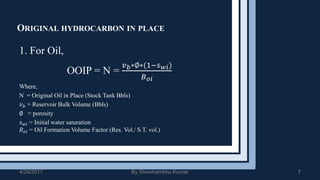
1. For Oil,
OOIP = N =
𝑣 𝑏∗∅∗(1−𝑠 𝑤𝑖)
𝐵 𝑜𝑖
Where,
N = Original Oil in Place (Stock Tank Bbls)
𝑣 𝑏 = Reservoir Bulk Volume (Bbls)
∅ = porosity
𝑠 𝑤𝑖 = Initial water saturation
𝐵 𝑜𝑖 = Oil Formation Volume Factor (Res. Vol./ S.T. vol.)
4/29/2017 By Shivshambhu Kumar 7
ORIGINAL HYDROCARBON IN PLACE
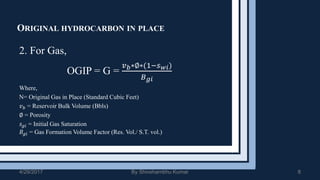
2. For Gas,
OGIP = G =
𝑣 𝑏∗∅∗(1−𝑠 𝑤𝑖)
𝐵 𝑔𝑖
Where,
N= Original Gas in Place (Standard Cubic Feet)
𝑣 𝑏 = Reservoir Bulk Volume (Bbls)
∅ = Porosity
𝑠 𝑔𝑖 = Initial Gas Saturation
𝐵 𝑔𝑖 = Gas Formation Volume Factor (Res. Vol./ S.T. vol.)
4/29/2017 By Shivshambhu Kumar 8
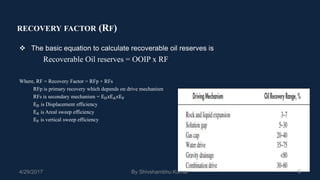
RECOVERY FACTOR (RF)
 The basic equation to calculate recoverable oil reserves is
Recoverable Oil reserves = OOIP x RF
Where, RF = Recovery Factor = RFp + RFs
RFp is primary recovery which depends on drive mechanism
RFs is secondary mechanism = EDxEAxEV
ED is Displacement efficiency
EA is Areal sweep efficiency
EV is vertical sweep efficiency
4/29/2017 By Shivshambhu Kumar 9
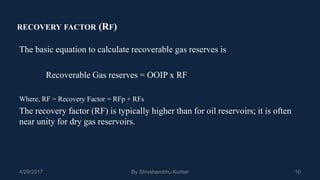
RECOVERY FACTOR (RF)
The basic equation to calculate recoverable gas reserves is
Recoverable Gas reserves = OOIP x RF
Where, RF = Recovery Factor = RFp + RFs
The recovery factor (RF) is typically higher than for oil reservoirs; it is often
near unity for dry gas reservoirs.
4/29/2017 By Shivshambhu Kumar 10
3. PRODUCTION RATES AND FORECASTING
1. Permeability
2. Relative Permeability
3. Viscosity
4. Pressure Drop
5. Drainage Area
6. Radial Flow Equation
4/29/2017 By Shivshambhu Kumar 11
RADIAL FLOW EQUATION
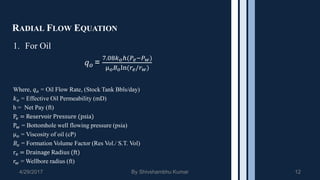
1. For Oil
𝑞 𝑜 =
7.08𝑘 𝑜ℎ(𝑃𝑒−𝑃 𝑤)
µ 𝑜 𝐵 𝑜ln(𝑟𝑒/𝑟 𝑤)
Where, 𝑞 𝑜 = Oil Flow Rate, (Stock Tank Bbls/day)
𝑘 𝑜 = Effective Oil Permeability (mD)
h = Net Pay (ft)
Pe = Reservoir Pressure (psia)
Pw = Bottomhole well flowing pressure (psia)
µ 𝑜 = Viscosity of oil (cP)
𝐵𝑜 = Formation Volume Factor (Res Vol./ S.T. Vol)
re = Drainage Radius (ft)
𝑟𝑤 = Wellbore radius (ft)
4/29/2017 By Shivshambhu Kumar 12
RADIAL FLOW EQUATION
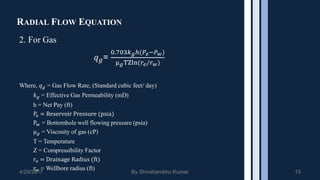
2. For Gas
𝑞 𝑔=
0.703𝑘 𝑔ℎ(𝑃𝑒−𝑃 𝑤)
µ 𝑔TZln(𝑟𝑒/𝑟 𝑤)
Where, 𝑞 𝑔 = Gas Flow Rate, (Standard cubic feet/ day)
𝑘 𝑔 = Effective Gas Permeability (mD)
h = Net Pay (ft)
Pe = Reservoir Pressure (psia)
Pw = Bottomhole well flowing pressure (psia)
µ 𝑔 = Viscosity of gas (cP)
T = Temperature
Z = Compressibility Factor
re = Drainage Radius (ft)
𝑟𝑤 = Wellbore radius (ft)
4/29/2017 By Shivshambhu Kumar 13
4. SOURCE OF DATA
1. Offset and Regional Data
2. Mud Logs
3. Electrical logs
4. Drill Stem Test
5. Production Test
4/29/2017 By Shivshambhu Kumar 14
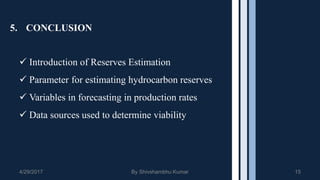
5. CONCLUSION
 Introduction of Reserves Estimation
 Parameter for estimating hydrocarbon reserves
 Variables in forecasting in production rates
 Data sources used to determine viability
4/29/2017 By Shivshambhu Kumar 15
T H A N K Y O U
4/29/2017 By Shivshambhu Kumar 16

Reserves estimation (Volumetric Method)

  • 1.
    RESERVES ESTIMATION (VOLUMETRIC METHOD) PresenterShivshambhu Kumar Date 29 April 2017 4/29/2017 By Shivshambhu Kumar 1
  • 2.
    1. INTRODUCTION  Reservesare those quantities of petroleum which are anticipated to be commercially recovered from known accumulations from a given date forward.  All reserve estimates involve some degree of uncertainty.  The uncertainty depends mainly on the amount of reliable geologic and engineering data available at the time of the estimate and the interpretation of these data.  The relative degree of uncertainty may be conveyed by placing reserves into one of two principal classifications, either proved or unproved .  Unproved reserves are less certain to be recovered than proved reserves and may be further sub-classified as probable (2P) and possible (P10) reserves to denote progressively increasing uncertainty in their recoverability. 4/29/2017 By Shivshambhu Kumar 3
  • 3.
    1. INTRODUCTION 4/29/2017 ByShivshambhu Kumar 4
  • 4.
    1. INTRODUCTION Estimating hydrocarbonreserves is a complex process that involves integrating geological and engineering data. Depending on the amount and quality of data available, one or more of the following methods may be used to estimate reserves: • Volumetric • Material balance • Production history • Analogy Volumetric estimates of OOIP and OGIP are based on a geological model that geometrically describes the volume of hydrocarbons in the reservoir. However, due mainly to gas evolving from the oil as pressure and temperature are decreased, oil at the surface occupies less space than it does in the subsurface. Conversely, gas at the surface occupies more space than it does In the subsurface because of expansion. This necessitates correcting subsurface volumes to standard units of volume measured at surface conditions. 4/29/2017 By Shivshambhu Kumar 5
  • 5.
    2. RECOVERABLE HYDROCARBON 1.Porosity 2. Water Saturation 3. Net Pay 4. Area 5. Pressure 6. Formation Volume Factor 7. Original Hydrocarbon in Place 8. Recovery Factor 4/29/2017 By Shivshambhu Kumar 6
  • 6.
    ORIGINAL HYDROCARBON INPLACE 1. For Oil, OOIP = N = 𝑣 𝑏∗∅∗(1−𝑠 𝑤𝑖) 𝐵 𝑜𝑖 Where, N = Original Oil in Place (Stock Tank Bbls) 𝑣 𝑏 = Reservoir Bulk Volume (Bbls) ∅ = porosity 𝑠 𝑤𝑖 = Initial water saturation 𝐵 𝑜𝑖 = Oil Formation Volume Factor (Res. Vol./ S.T. vol.) 4/29/2017 By Shivshambhu Kumar 7
  • 7.
    ORIGINAL HYDROCARBON INPLACE 2. For Gas, OGIP = G = 𝑣 𝑏∗∅∗(1−𝑠 𝑤𝑖) 𝐵 𝑔𝑖 Where, N= Original Gas in Place (Standard Cubic Feet) 𝑣 𝑏 = Reservoir Bulk Volume (Bbls) ∅ = Porosity 𝑠 𝑔𝑖 = Initial Gas Saturation 𝐵 𝑔𝑖 = Gas Formation Volume Factor (Res. Vol./ S.T. vol.) 4/29/2017 By Shivshambhu Kumar 8
  • 8.
    RECOVERY FACTOR (RF) The basic equation to calculate recoverable oil reserves is Recoverable Oil reserves = OOIP x RF Where, RF = Recovery Factor = RFp + RFs RFp is primary recovery which depends on drive mechanism RFs is secondary mechanism = EDxEAxEV ED is Displacement efficiency EA is Areal sweep efficiency EV is vertical sweep efficiency 4/29/2017 By Shivshambhu Kumar 9
  • 9.
    RECOVERY FACTOR (RF) Thebasic equation to calculate recoverable gas reserves is Recoverable Gas reserves = OOIP x RF Where, RF = Recovery Factor = RFp + RFs The recovery factor (RF) is typically higher than for oil reservoirs; it is often near unity for dry gas reservoirs. 4/29/2017 By Shivshambhu Kumar 10
  • 10.
    3. PRODUCTION RATESAND FORECASTING 1. Permeability 2. Relative Permeability 3. Viscosity 4. Pressure Drop 5. Drainage Area 6. Radial Flow Equation 4/29/2017 By Shivshambhu Kumar 11
  • 11.
    RADIAL FLOW EQUATION 1.For Oil 𝑞 𝑜 = 7.08𝑘 𝑜ℎ(𝑃𝑒−𝑃 𝑤) µ 𝑜 𝐵 𝑜ln(𝑟𝑒/𝑟 𝑤) Where, 𝑞 𝑜 = Oil Flow Rate, (Stock Tank Bbls/day) 𝑘 𝑜 = Effective Oil Permeability (mD) h = Net Pay (ft) Pe = Reservoir Pressure (psia) Pw = Bottomhole well flowing pressure (psia) µ 𝑜 = Viscosity of oil (cP) 𝐵𝑜 = Formation Volume Factor (Res Vol./ S.T. Vol) re = Drainage Radius (ft) 𝑟𝑤 = Wellbore radius (ft) 4/29/2017 By Shivshambhu Kumar 12
  • 12.
    RADIAL FLOW EQUATION 2.For Gas 𝑞 𝑔= 0.703𝑘 𝑔ℎ(𝑃𝑒−𝑃 𝑤) µ 𝑔TZln(𝑟𝑒/𝑟 𝑤) Where, 𝑞 𝑔 = Gas Flow Rate, (Standard cubic feet/ day) 𝑘 𝑔 = Effective Gas Permeability (mD) h = Net Pay (ft) Pe = Reservoir Pressure (psia) Pw = Bottomhole well flowing pressure (psia) µ 𝑔 = Viscosity of gas (cP) T = Temperature Z = Compressibility Factor re = Drainage Radius (ft) 𝑟𝑤 = Wellbore radius (ft) 4/29/2017 By Shivshambhu Kumar 13
  • 13.
    4. SOURCE OFDATA 1. Offset and Regional Data 2. Mud Logs 3. Electrical logs 4. Drill Stem Test 5. Production Test 4/29/2017 By Shivshambhu Kumar 14
  • 14.
    5. CONCLUSION  Introductionof Reserves Estimation  Parameter for estimating hydrocarbon reserves  Variables in forecasting in production rates  Data sources used to determine viability 4/29/2017 By Shivshambhu Kumar 15
  • 15.
    T H AN K Y O U 4/29/2017 By Shivshambhu Kumar 16

Editor's Notes

  • #2 This template is in wide-screen format and demonstrates how transitions, animations, and multimedia choreography can be used to enrich a presentation.
  • #3 This slide can be used as a background before the presentation begins.