SARWAR ALAM ANSARI
MS-Petroleum Engineering ( Student)
SARWAR ALAM ANSARI
MS-Petroleum Engineering
Khazar University, Baku, Azerbaijan
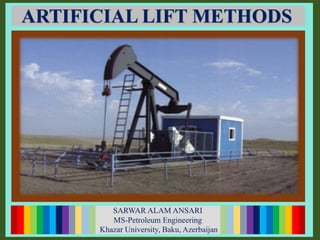
ARTIFICIAL LIFT METHODS
INTRODUCTION
Artificial lift
Increase Reservoir Pressure
To recover more production
Natural flow decrease over time
50% of wells need artificial lift world wide
96% of US wells need artificial lift in starting
2
TYPES OF ARTIFICIAL LIFT METHODS
Sucker Rod Pump
Gas Lift
Electric Submersible Pumping ( ESP )
Hydraulic Piston Pumping
Hydraulic Jet Pumping
Plunger Lift
Progressive Cavity Pumping
3
SELECTION PARAMETERS
Well completion & profile
Geophysical & Environmental conditions
Reservoir Characteristics
Reservoir Pressure & well productivity
Characteristics of fluid
Surface constraints
Service available
Economic consideration
Operation ease
4
SUCKER ROD PUMP
Introduction:
• Referred as Beam Pumping
• Provides mechanical energy
• Efficient, Simple and Easy to operate
5
SUCKER ROD PUMP
6
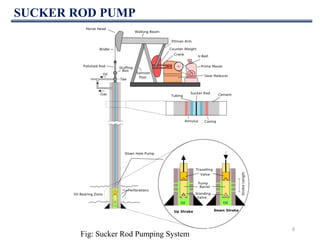
Fig: Sucker Rod Pumping System
SUCKER ROD PUMP
Advantages of Sucker Rod Pump:
High System Efficiency
Optimization Controls Available
Economical to Repair and Service
Positive Displacement/Strong Drawdown
Upgraded Materials Reduce Corrosion Concerns
Flexibility - Adjust Production Through Stroke Length and Speed
High Salvage Value for Surface & Downhole Equipment
7
SUCKER ROD PUMP
8
Limitations of Sucker Rod Pump:
Potential for Tubing and Rod Wear
Gas-Oil Ratios
Most Systems Limited to Ability of Rods to Handle Loads (Volume
Decreases As Depth Increases)
Environmental and Aesthetic Concerns
SUCKER ROD PUMP
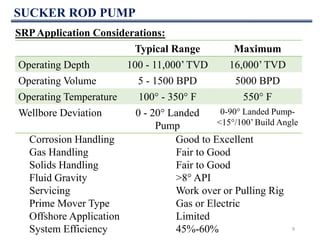
SRPApplication Considerations:
9
Typical Range Maximum
Operating Depth 100 - 11,000’ TVD 16,000’ TVD
Operating Volume 5 - 1500 BPD 5000 BPD
Operating Temperature 100° - 350° F 550° F
Wellbore Deviation 0 - 20° Landed
Pump
0-90° Landed Pump-
<15°/100’Build Angle
Corrosion Handling Good to Excellent
Gas Handling Fair to Good
Solids Handling Fair to Good
Fluid Gravity >8° API
Servicing Work over or Pulling Rig
Prime Mover Type Gas or Electric
Offshore Application Limited
System Efficiency 45%-60%
GAS LIFT
Introduction:
• Initial injections of pressurized gas need to be injected in steps or
stages starting near the top of the string and then going deeper.
• Compressed gas affects liquid in two ways
i) the energy of expansion propels the oil to the surface
ii) the gas aerates the oil so that the effective density of the
fluid is less and, thus easier to get to the surface .
• Four categories of wells
High PI, High BHP wells (>0.5 low PI)
High PI, Low BHP wells (<0.5 High PI)
Low PI, High BHP wells
Low PI, Low BHP wells
10
GAS LIFT
11
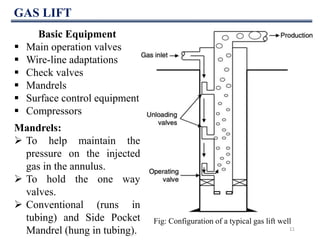
Fig: Configuration of a typical gas lift well
Basic Equipment
 Main operation valves
 Wire-line adaptations
 Check valves
 Mandrels
 Surface control equipment
 Compressors
Mandrels:
 To help maintain the
pressure on the injected
gas in the annulus.
 To hold the one way
valves.
 Conventional (runs in
tubing) and Side Pocket
Mandrel (hung in tubing).
GAS LIFT
12
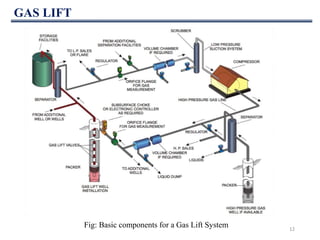
Fig: Basic components for a Gas Lift System
GAS LIFT
13
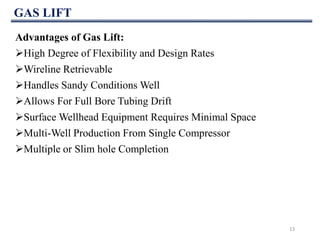
Advantages of Gas Lift:
High Degree of Flexibility and Design Rates
Wireline Retrievable
Handles Sandy Conditions Well
Allows For Full Bore Tubing Drift
Surface Wellhead Equipment Requires Minimal Space
Multi-Well Production From Single Compressor
Multiple or Slim hole Completion
GAS LIFT
14
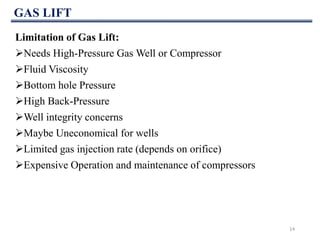
Limitation of Gas Lift:
Needs High-Pressure Gas Well or Compressor
Fluid Viscosity
Bottom hole Pressure
High Back-Pressure
Well integrity concerns
Maybe Uneconomical for wells
Limited gas injection rate (depends on orifice)
Expensive Operation and maintenance of compressors
GAS LIFT
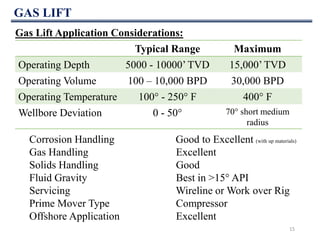
Gas Lift Application Considerations:
15
Typical Range Maximum
Operating Depth 5000 - 10000’ TVD 15,000’ TVD
Operating Volume 100 – 10,000 BPD 30,000 BPD
Operating Temperature 100° - 250° F 400° F
Wellbore Deviation 0 - 50° 70° short medium
radius
Corrosion Handling Good to Excellent (with up materials)
Gas Handling Excellent
Solids Handling Good
Fluid Gravity Best in >15° API
Servicing Wireline or Work over Rig
Prime Mover Type Compressor
Offshore Application Excellent
ELECTRICAL SUBMERSIBLE PUMP
16
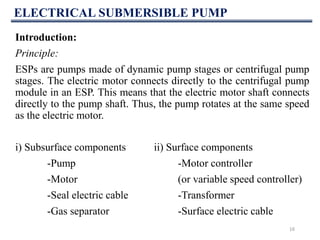
Introduction:
Principle:
ESPs are pumps made of dynamic pump stages or centrifugal pump
stages. The electric motor connects directly to the centrifugal pump
module in an ESP. This means that the electric motor shaft connects
directly to the pump shaft. Thus, the pump rotates at the same speed
as the electric motor.
i) Subsurface components ii) Surface components
-Pump -Motor controller
-Motor (or variable speed controller)
-Seal electric cable -Transformer
-Gas separator -Surface electric cable
ELECTRICAL SUBMERSIBLE PUMP
17Fig: A sketch of an ESP installation
ELECTRICAL SUBMERSIBLE PUMP
18
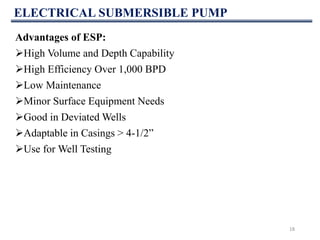
Advantages of ESP:
High Volume and Depth Capability
High Efficiency Over 1,000 BPD
Low Maintenance
Minor Surface Equipment Needs
Good in Deviated Wells
Adaptable in Casings > 4-1/2”
Use for Well Testing
ELECTRICAL SUBMERSIBLE PUMP
19
Limitations of ESP:
Available Electric Power
Limited Adaptability to Major Changes in Reservoir
Difficult to Repair In the Field
Free Gas and/or Abrasives
High Viscosity
Higher Pulling Costs
ELECTRICAL SUBMERSIBLE PUMP
20
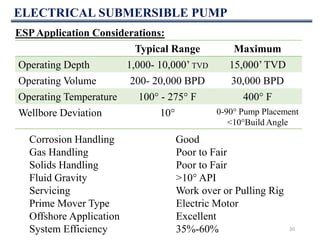
ESPApplication Considerations:
Corrosion Handling Good
Gas Handling Poor to Fair
Solids Handling Poor to Fair
Fluid Gravity >10° API
Servicing Work over or Pulling Rig
Prime Mover Type Electric Motor
Offshore Application Excellent
System Efficiency 35%-60%
Typical Range Maximum
Operating Depth 1,000- 10,000’ TVD 15,000’ TVD
Operating Volume 200- 20,000 BPD 30,000 BPD
Operating Temperature 100° - 275° F 400° F
Wellbore Deviation 10° 0-90° Pump Placement
<10°Build Angle
HYDRAULIC JET PUMPING
21
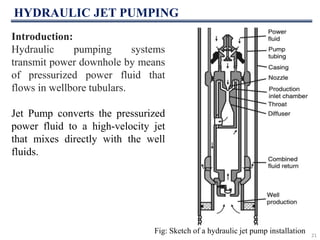
Fig: Sketch of a hydraulic jet pump installation
Introduction:
Hydraulic pumping systems
transmit power downhole by means
of pressurized power fluid that
flows in wellbore tubulars.
Jet Pump converts the pressurized
power fluid to a high-velocity jet
that mixes directly with the well
fluids.
HYDRAULIC JET PUMPING
22
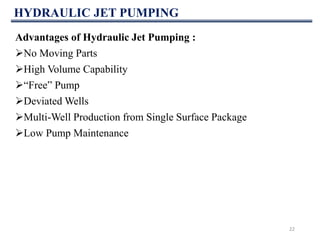
Advantages of Hydraulic Jet Pumping :
No Moving Parts
High Volume Capability
“Free” Pump
Deviated Wells
Multi-Well Production from Single Surface Package
Low Pump Maintenance
HYDRAULIC JET PUMPING
23
Limitation of Hydraulic Jet Pumping :
Producing Rate Relative to Bottomhole Pressure
Some Require Specific Bottomhole Assemblies
Lower Horsepower Efficiency
High-Pressure Surface Line Requirements
HYDRAULIC JET PUMPING
24
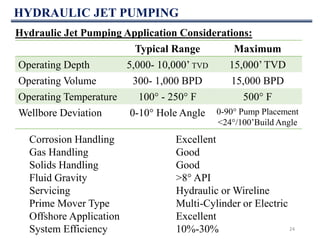
Hydraulic Jet Pumping Application Considerations:
Corrosion Handling Excellent
Gas Handling Good
Solids Handling Good
Fluid Gravity >8° API
Servicing Hydraulic or Wireline
Prime Mover Type Multi-Cylinder or Electric
Offshore Application Excellent
System Efficiency 10%-30%
Typical Range Maximum
Operating Depth 5,000- 10,000’ TVD 15,000’ TVD
Operating Volume 300- 1,000 BPD 15,000 BPD
Operating Temperature 100° - 250° F 500° F
Wellbore Deviation 0-10° Hole Angle 0-90° Pump Placement
<24°/100’Build Angle
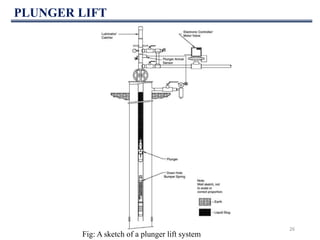
PLUNGER LIFT
25
Principle:
It uses a free piston that travels up and down in the well’s tubing
string.
It minimize liquid fall back and uses the well’s energy more
efficiently than in slug or bubble flow.
It remove liquids from the wellbore so that the well can be produced
at the lowest bottom-hole pressures.
Mechanics of a plunger lift system is same in oil/gas well, or gas lift.
A length of steel, is dropped down the tubing to the bottom of the
well and allowed to travel back to the surface. It provides a piston-
like interface between liquids and gas in the wellbore and prevents
liquid fall back.
PLUNGER LIFT
26
Fig: A sketch of a plunger lift system
PLUNGER LIFT
27
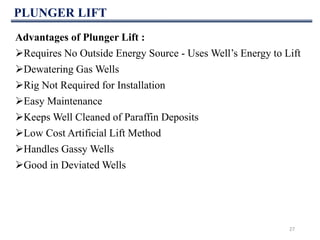
Advantages of Plunger Lift :
Requires No Outside Energy Source - Uses Well’s Energy to Lift
Dewatering Gas Wells
Rig Not Required for Installation
Easy Maintenance
Keeps Well Cleaned of Paraffin Deposits
Low Cost Artificial Lift Method
Handles Gassy Wells
Good in Deviated Wells
PLUNGER LIFT
28
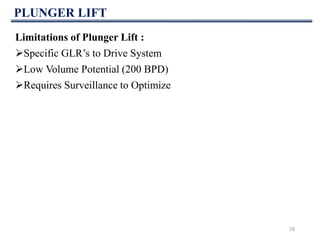
Limitations of Plunger Lift :
Specific GLR’s to Drive System
Low Volume Potential (200 BPD)
Requires Surveillance to Optimize
PLUNGER LIFT
29
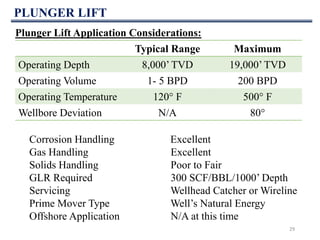
Plunger Lift Application Considerations:
Corrosion Handling Excellent
Gas Handling Excellent
Solids Handling Poor to Fair
GLR Required 300 SCF/BBL/1000’ Depth
Servicing Wellhead Catcher or Wireline
Prime Mover Type Well’s Natural Energy
Offshore Application N/A at this time
Typical Range Maximum
Operating Depth 8,000’ TVD 19,000’ TVD
Operating Volume 1- 5 BPD 200 BPD
Operating Temperature 120° F 500° F
Wellbore Deviation N/A 80°
PROGRESSIVE CAVITY PUMPING
30
Introduction:
It is a positive displacement pump.
It uses an eccentrically rotating single helical rotor, turning inside a
stator.
It can be used for lifting heavy oils at a variable flow rate.
PROGRESSIVE CAVITY PUMPING
31
Fig: A sketch of a PCP system
PROGRESSIVE CAVITY PUMPING
32
Advantages of Progressive Cavity Pumping:
Low Capital Cost
Low Surface Profile for Visual & Height Sensitive Areas
High System Efficiency
Simple Installation, Quiet Operation
Pumps Oils and Waters with Solids
Low Power Consumption
Portable Surface Equipment
Low Maintenance Costs
Use In Horizontal/Directional Wells
PROGRESSIVE CAVITY PUMPING
33
Limitations of Progressive Cavity Pumping:
Limited Depth Capability
Temperature
Sensitivity to Produced Fluids
Low Volumetric Efficiencies in High-Gas Environments
Requires Constant Fluid Level above Pump
PROGRESSIVE CAVITY PUMPING
34
Progressive Cavity Pumping Application Considerations:
Corrosion Handling Fair
Gas Handling Good
Solids Handling Excellent
Fluid Gravity <35° API
Servicing Workover or Pulling Rig
Prime Mover Type Gas or Electric
Offshore Application Good(ES/PCP)
System Efficiency 40% - 70%
Typical Range Maximum
Operating Depth 2,000-4,500’ TVD 6,000’ TVD
Operating Volume 5- 2,200 BPD 4,500 BPD
Operating Temperature 75-150° F 250° F
Wellbore Deviation 0-90° 0-90° Landed Pump
<15°/100’ Build Angle
35

Artificial Lift Methods

  • 1.
    SARWAR ALAM ANSARI MS-PetroleumEngineering ( Student) SARWAR ALAM ANSARI MS-Petroleum Engineering Khazar University, Baku, Azerbaijan ARTIFICIAL LIFT METHODS
  • 2.
    INTRODUCTION Artificial lift Increase ReservoirPressure To recover more production Natural flow decrease over time 50% of wells need artificial lift world wide 96% of US wells need artificial lift in starting 2
  • 3.
    TYPES OF ARTIFICIALLIFT METHODS Sucker Rod Pump Gas Lift Electric Submersible Pumping ( ESP ) Hydraulic Piston Pumping Hydraulic Jet Pumping Plunger Lift Progressive Cavity Pumping 3
  • 4.
    SELECTION PARAMETERS Well completion& profile Geophysical & Environmental conditions Reservoir Characteristics Reservoir Pressure & well productivity Characteristics of fluid Surface constraints Service available Economic consideration Operation ease 4
  • 5.
    SUCKER ROD PUMP Introduction: •Referred as Beam Pumping • Provides mechanical energy • Efficient, Simple and Easy to operate 5
  • 6.
    SUCKER ROD PUMP 6 Fig:Sucker Rod Pumping System
  • 7.
    SUCKER ROD PUMP Advantagesof Sucker Rod Pump: High System Efficiency Optimization Controls Available Economical to Repair and Service Positive Displacement/Strong Drawdown Upgraded Materials Reduce Corrosion Concerns Flexibility - Adjust Production Through Stroke Length and Speed High Salvage Value for Surface & Downhole Equipment 7
  • 8.
    SUCKER ROD PUMP 8 Limitationsof Sucker Rod Pump: Potential for Tubing and Rod Wear Gas-Oil Ratios Most Systems Limited to Ability of Rods to Handle Loads (Volume Decreases As Depth Increases) Environmental and Aesthetic Concerns
  • 9.
    SUCKER ROD PUMP SRPApplicationConsiderations: 9 Typical Range Maximum Operating Depth 100 - 11,000’ TVD 16,000’ TVD Operating Volume 5 - 1500 BPD 5000 BPD Operating Temperature 100° - 350° F 550° F Wellbore Deviation 0 - 20° Landed Pump 0-90° Landed Pump- <15°/100’Build Angle Corrosion Handling Good to Excellent Gas Handling Fair to Good Solids Handling Fair to Good Fluid Gravity >8° API Servicing Work over or Pulling Rig Prime Mover Type Gas or Electric Offshore Application Limited System Efficiency 45%-60%
  • 10.
    GAS LIFT Introduction: • Initialinjections of pressurized gas need to be injected in steps or stages starting near the top of the string and then going deeper. • Compressed gas affects liquid in two ways i) the energy of expansion propels the oil to the surface ii) the gas aerates the oil so that the effective density of the fluid is less and, thus easier to get to the surface . • Four categories of wells High PI, High BHP wells (>0.5 low PI) High PI, Low BHP wells (<0.5 High PI) Low PI, High BHP wells Low PI, Low BHP wells 10
  • 11.
    GAS LIFT 11 Fig: Configurationof a typical gas lift well Basic Equipment  Main operation valves  Wire-line adaptations  Check valves  Mandrels  Surface control equipment  Compressors Mandrels:  To help maintain the pressure on the injected gas in the annulus.  To hold the one way valves.  Conventional (runs in tubing) and Side Pocket Mandrel (hung in tubing).
  • 12.
    GAS LIFT 12 Fig: Basiccomponents for a Gas Lift System
  • 13.
    GAS LIFT 13 Advantages ofGas Lift: High Degree of Flexibility and Design Rates Wireline Retrievable Handles Sandy Conditions Well Allows For Full Bore Tubing Drift Surface Wellhead Equipment Requires Minimal Space Multi-Well Production From Single Compressor Multiple or Slim hole Completion
  • 14.
    GAS LIFT 14 Limitation ofGas Lift: Needs High-Pressure Gas Well or Compressor Fluid Viscosity Bottom hole Pressure High Back-Pressure Well integrity concerns Maybe Uneconomical for wells Limited gas injection rate (depends on orifice) Expensive Operation and maintenance of compressors
  • 15.
    GAS LIFT Gas LiftApplication Considerations: 15 Typical Range Maximum Operating Depth 5000 - 10000’ TVD 15,000’ TVD Operating Volume 100 – 10,000 BPD 30,000 BPD Operating Temperature 100° - 250° F 400° F Wellbore Deviation 0 - 50° 70° short medium radius Corrosion Handling Good to Excellent (with up materials) Gas Handling Excellent Solids Handling Good Fluid Gravity Best in >15° API Servicing Wireline or Work over Rig Prime Mover Type Compressor Offshore Application Excellent
  • 16.
    ELECTRICAL SUBMERSIBLE PUMP 16 Introduction: Principle: ESPsare pumps made of dynamic pump stages or centrifugal pump stages. The electric motor connects directly to the centrifugal pump module in an ESP. This means that the electric motor shaft connects directly to the pump shaft. Thus, the pump rotates at the same speed as the electric motor. i) Subsurface components ii) Surface components -Pump -Motor controller -Motor (or variable speed controller) -Seal electric cable -Transformer -Gas separator -Surface electric cable
  • 17.
    ELECTRICAL SUBMERSIBLE PUMP 17Fig:A sketch of an ESP installation
  • 18.
    ELECTRICAL SUBMERSIBLE PUMP 18 Advantagesof ESP: High Volume and Depth Capability High Efficiency Over 1,000 BPD Low Maintenance Minor Surface Equipment Needs Good in Deviated Wells Adaptable in Casings > 4-1/2” Use for Well Testing
  • 19.
    ELECTRICAL SUBMERSIBLE PUMP 19 Limitationsof ESP: Available Electric Power Limited Adaptability to Major Changes in Reservoir Difficult to Repair In the Field Free Gas and/or Abrasives High Viscosity Higher Pulling Costs
  • 20.
    ELECTRICAL SUBMERSIBLE PUMP 20 ESPApplicationConsiderations: Corrosion Handling Good Gas Handling Poor to Fair Solids Handling Poor to Fair Fluid Gravity >10° API Servicing Work over or Pulling Rig Prime Mover Type Electric Motor Offshore Application Excellent System Efficiency 35%-60% Typical Range Maximum Operating Depth 1,000- 10,000’ TVD 15,000’ TVD Operating Volume 200- 20,000 BPD 30,000 BPD Operating Temperature 100° - 275° F 400° F Wellbore Deviation 10° 0-90° Pump Placement <10°Build Angle
  • 21.
    HYDRAULIC JET PUMPING 21 Fig:Sketch of a hydraulic jet pump installation Introduction: Hydraulic pumping systems transmit power downhole by means of pressurized power fluid that flows in wellbore tubulars. Jet Pump converts the pressurized power fluid to a high-velocity jet that mixes directly with the well fluids.
  • 22.
    HYDRAULIC JET PUMPING 22 Advantagesof Hydraulic Jet Pumping : No Moving Parts High Volume Capability “Free” Pump Deviated Wells Multi-Well Production from Single Surface Package Low Pump Maintenance
  • 23.
    HYDRAULIC JET PUMPING 23 Limitationof Hydraulic Jet Pumping : Producing Rate Relative to Bottomhole Pressure Some Require Specific Bottomhole Assemblies Lower Horsepower Efficiency High-Pressure Surface Line Requirements
  • 24.
    HYDRAULIC JET PUMPING 24 HydraulicJet Pumping Application Considerations: Corrosion Handling Excellent Gas Handling Good Solids Handling Good Fluid Gravity >8° API Servicing Hydraulic or Wireline Prime Mover Type Multi-Cylinder or Electric Offshore Application Excellent System Efficiency 10%-30% Typical Range Maximum Operating Depth 5,000- 10,000’ TVD 15,000’ TVD Operating Volume 300- 1,000 BPD 15,000 BPD Operating Temperature 100° - 250° F 500° F Wellbore Deviation 0-10° Hole Angle 0-90° Pump Placement <24°/100’Build Angle
  • 25.
    PLUNGER LIFT 25 Principle: It usesa free piston that travels up and down in the well’s tubing string. It minimize liquid fall back and uses the well’s energy more efficiently than in slug or bubble flow. It remove liquids from the wellbore so that the well can be produced at the lowest bottom-hole pressures. Mechanics of a plunger lift system is same in oil/gas well, or gas lift. A length of steel, is dropped down the tubing to the bottom of the well and allowed to travel back to the surface. It provides a piston- like interface between liquids and gas in the wellbore and prevents liquid fall back.
  • 26.
    PLUNGER LIFT 26 Fig: Asketch of a plunger lift system
  • 27.
    PLUNGER LIFT 27 Advantages ofPlunger Lift : Requires No Outside Energy Source - Uses Well’s Energy to Lift Dewatering Gas Wells Rig Not Required for Installation Easy Maintenance Keeps Well Cleaned of Paraffin Deposits Low Cost Artificial Lift Method Handles Gassy Wells Good in Deviated Wells
  • 28.
    PLUNGER LIFT 28 Limitations ofPlunger Lift : Specific GLR’s to Drive System Low Volume Potential (200 BPD) Requires Surveillance to Optimize
  • 29.
    PLUNGER LIFT 29 Plunger LiftApplication Considerations: Corrosion Handling Excellent Gas Handling Excellent Solids Handling Poor to Fair GLR Required 300 SCF/BBL/1000’ Depth Servicing Wellhead Catcher or Wireline Prime Mover Type Well’s Natural Energy Offshore Application N/A at this time Typical Range Maximum Operating Depth 8,000’ TVD 19,000’ TVD Operating Volume 1- 5 BPD 200 BPD Operating Temperature 120° F 500° F Wellbore Deviation N/A 80°
  • 30.
    PROGRESSIVE CAVITY PUMPING 30 Introduction: Itis a positive displacement pump. It uses an eccentrically rotating single helical rotor, turning inside a stator. It can be used for lifting heavy oils at a variable flow rate.
  • 31.
    PROGRESSIVE CAVITY PUMPING 31 Fig:A sketch of a PCP system
  • 32.
    PROGRESSIVE CAVITY PUMPING 32 Advantagesof Progressive Cavity Pumping: Low Capital Cost Low Surface Profile for Visual & Height Sensitive Areas High System Efficiency Simple Installation, Quiet Operation Pumps Oils and Waters with Solids Low Power Consumption Portable Surface Equipment Low Maintenance Costs Use In Horizontal/Directional Wells
  • 33.
    PROGRESSIVE CAVITY PUMPING 33 Limitationsof Progressive Cavity Pumping: Limited Depth Capability Temperature Sensitivity to Produced Fluids Low Volumetric Efficiencies in High-Gas Environments Requires Constant Fluid Level above Pump
  • 34.
    PROGRESSIVE CAVITY PUMPING 34 ProgressiveCavity Pumping Application Considerations: Corrosion Handling Fair Gas Handling Good Solids Handling Excellent Fluid Gravity <35° API Servicing Workover or Pulling Rig Prime Mover Type Gas or Electric Offshore Application Good(ES/PCP) System Efficiency 40% - 70% Typical Range Maximum Operating Depth 2,000-4,500’ TVD 6,000’ TVD Operating Volume 5- 2,200 BPD 4,500 BPD Operating Temperature 75-150° F 250° F Wellbore Deviation 0-90° 0-90° Landed Pump <15°/100’ Build Angle
  • 35.