NAT Review:
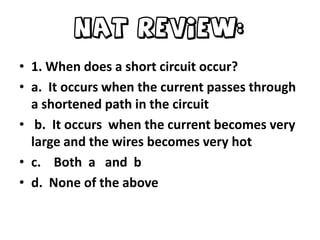
• 1. When does a short circuit occur?
• a. It occurs when the current passes through
a shortened path in the circuit
• b. It occurs when the current becomes very
large and the wires becomes very hot
• c. Both a and b
• d. None of the above
•
•
•
•
•
•
•
•
•
•

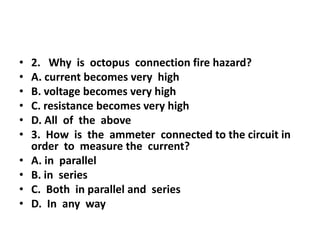
2. Why is octopus connection fire hazard?
A. current becomes very high
B. voltage becomes very high
C. resistance becomes very high
D. All of the above
3. How is the ammeter connected to the circuit in
order to measure the current?
A. in parallel
B. in series
C. Both in parallel and series
D. In any way
•
•
•
•
•
•
•
•
•
•

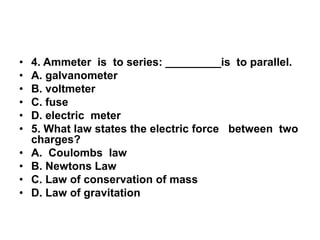
4. Ammeter is to series: _________is to parallel.
A. galvanometer
B. voltmeter
C. fuse
D. electric meter
5. What law states the electric force between two
charges?
A. Coulombs law
B. Newtons Law
C. Law of conservation of mass
D. Law of gravitation
OHM’S LAW
•
•
•
•
•

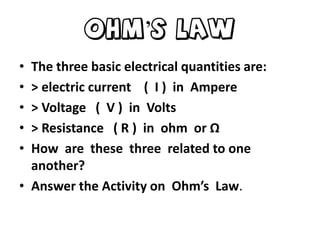
The three basic electrical quantities are:
> electric current ( I ) in Ampere
> Voltage ( V ) in Volts
> Resistance ( R ) in ohm or Ω
How are these three related to one
another?
• Answer the Activity on Ohm’s Law.
• Questions:
• From table A what happens to current as the
voltage increases?
• Describe the graph of voltage against
current? What does the graph indicate?
• In table B describe the values of resistance
in each reading?
• What quantity seems to affect the current?
• Describe the graph of table B. What is the
relationship that exists in table B?
• How do you state Ohm’s Law?
• The relationship
between Voltage, Current and Resistance in any
DC electrical circuit was firstly discovered by the
German physicist Georg Ohm, (1787 1854). Georg Ohm found that, at a constant
temperature, the electrical current flowing
through a fixed linear resistance is directly
proportional to the voltage applied across
it, and also inversely proportional to the
resistance. This relationship between
the Voltage, Current and Resistance forms the
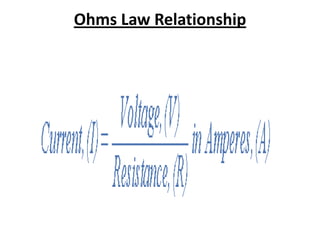
bases of Ohms Law and is shown below.
Ohms Law Relationship
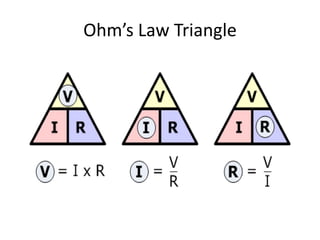
Ohm’s Law Triangle
Application:
• Solve the given problems step by step:
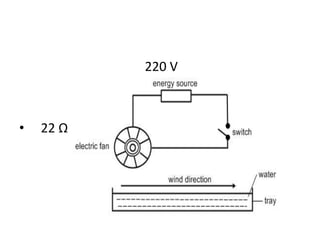
• 1. How much current flows in an electric
fan having a resistance of 22 Ω when
connected across a 220 V line?
• Illustrate /draw the circuit on the board.
• Given:
220 V
I
•

22 Ω
• 2. An electric heater uses 5 A when 220 V
is applied to its terminal ,what is the
resistance in the circuit?

OHM's Law

  • 1.
    NAT Review: • 1.When does a short circuit occur? • a. It occurs when the current passes through a shortened path in the circuit • b. It occurs when the current becomes very large and the wires becomes very hot • c. Both a and b • d. None of the above
  • 2.
    • • • • • • • • • • 2. Why isoctopus connection fire hazard? A. current becomes very high B. voltage becomes very high C. resistance becomes very high D. All of the above 3. How is the ammeter connected to the circuit in order to measure the current? A. in parallel B. in series C. Both in parallel and series D. In any way
  • 3.
    • • • • • • • • • • 4. Ammeter isto series: _________is to parallel. A. galvanometer B. voltmeter C. fuse D. electric meter 5. What law states the electric force between two charges? A. Coulombs law B. Newtons Law C. Law of conservation of mass D. Law of gravitation
  • 4.
    OHM’S LAW • • • • • The threebasic electrical quantities are: > electric current ( I ) in Ampere > Voltage ( V ) in Volts > Resistance ( R ) in ohm or Ω How are these three related to one another? • Answer the Activity on Ohm’s Law.
  • 5.
    • Questions: • Fromtable A what happens to current as the voltage increases? • Describe the graph of voltage against current? What does the graph indicate? • In table B describe the values of resistance in each reading? • What quantity seems to affect the current? • Describe the graph of table B. What is the relationship that exists in table B? • How do you state Ohm’s Law?
  • 6.
    • The relationship betweenVoltage, Current and Resistance in any DC electrical circuit was firstly discovered by the German physicist Georg Ohm, (1787 1854). Georg Ohm found that, at a constant temperature, the electrical current flowing through a fixed linear resistance is directly proportional to the voltage applied across it, and also inversely proportional to the resistance. This relationship between the Voltage, Current and Resistance forms the bases of Ohms Law and is shown below.
  • 7.
  • 8.
  • 9.
    Application: • Solve thegiven problems step by step: • 1. How much current flows in an electric fan having a resistance of 22 Ω when connected across a 220 V line? • Illustrate /draw the circuit on the board. • Given:
  • 10.
  • 11.
    • 2. Anelectric heater uses 5 A when 220 V is applied to its terminal ,what is the resistance in the circuit?