Ohm’s Law
Ohm’s Law
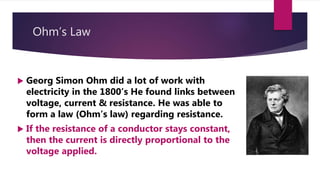
 Georg Simon Ohm did a lot of work with
electricity in the 1800’s He found links between
voltage, current & resistance. He was able to
form a law (Ohm’s law) regarding resistance.
 If the resistance of a conductor stays constant,
then the current is directly proportional to the
voltage applied.
Ohm’s Law
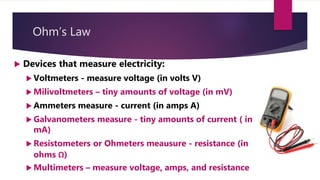
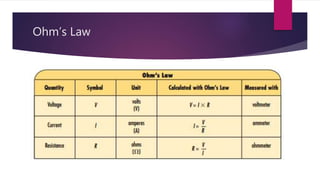
 Devices that measure electricity:
 Voltmeters - measure voltage (in volts V)
 Milivoltmeters – tiny amounts of voltage (in mV)
 Ammeters measure - current (in amps A)
 Galvanometers measure - tiny amounts of current ( in
mA)
 Resistometers or Ohmeters meausure - resistance (in
ohms Ω)
 Multimeters – measure voltage, amps, and resistance
Ohm’s Law
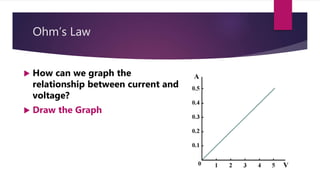
 How can we graph the
relationship between current and
voltage?
 Draw the Graph
Ohm’s Law
 Ohm’s law does not work if there is a change in
temperature. When the temperature pf a resistor changes,
then its resistance changes,
 Resistance is lowest when a conductor is cool. As the
temperature increases the resistance increases.
Ohm’s Law
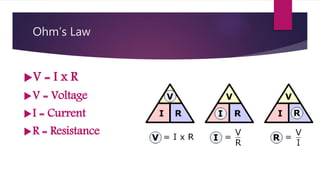
V = I x R
V = Voltage
I = Current
R = Resistance
Ohm’s Law
Ohm’s Law
Ohm’s Law
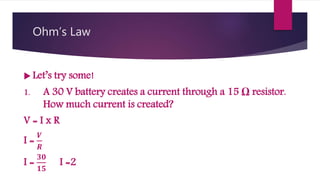
 Let’s try some!
1. A 30 V battery creates a current through a 15 Ω resistor.
How much current is created?
V = I x R
I =
𝑽
𝑹
I =
𝟑𝟎
𝟏𝟓
I =2
Ohm’s Law
 Let’s try some!
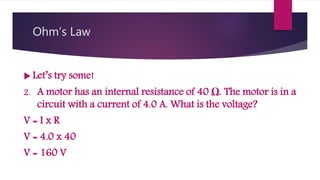
2. A motor has an internal resistance of 40 Ω. The motor is in a
circuit with a current of 4.0 A. What is the voltage?
V = I x R
V = 4.0 x 40
V = 160 V
Ohm’s Law

Unit c electrical principals & technologies notes(ohms law)

  • 1.
  • 2.
    Ohm’s Law  GeorgSimon Ohm did a lot of work with electricity in the 1800’s He found links between voltage, current & resistance. He was able to form a law (Ohm’s law) regarding resistance.  If the resistance of a conductor stays constant, then the current is directly proportional to the voltage applied.
  • 3.
    Ohm’s Law  Devicesthat measure electricity:  Voltmeters - measure voltage (in volts V)  Milivoltmeters – tiny amounts of voltage (in mV)  Ammeters measure - current (in amps A)  Galvanometers measure - tiny amounts of current ( in mA)  Resistometers or Ohmeters meausure - resistance (in ohms Ω)  Multimeters – measure voltage, amps, and resistance
  • 4.
    Ohm’s Law  Howcan we graph the relationship between current and voltage?  Draw the Graph
  • 5.
    Ohm’s Law  Ohm’slaw does not work if there is a change in temperature. When the temperature pf a resistor changes, then its resistance changes,  Resistance is lowest when a conductor is cool. As the temperature increases the resistance increases.
  • 6.
    Ohm’s Law V =I x R V = Voltage I = Current R = Resistance
  • 7.
  • 8.
  • 9.
    Ohm’s Law  Let’stry some! 1. A 30 V battery creates a current through a 15 Ω resistor. How much current is created? V = I x R I = 𝑽 𝑹 I = 𝟑𝟎 𝟏𝟓 I =2
  • 10.
    Ohm’s Law  Let’stry some! 2. A motor has an internal resistance of 40 Ω. The motor is in a circuit with a current of 4.0 A. What is the voltage? V = I x R V = 4.0 x 40 V = 160 V
  • 11.