INTRODUCTION KIRCHOFF’S LAW
KIRCHOFF’S VOLTAGE LAW ( KVL )
ANALYSIS CIRCUIT OF KVL
KIRCHOFF’S CURRENT LAW ( KCL )
ANALYSIS CIRCUIT OF KCL
QUIZ
DET1013 : ELECTRICAL TECHNOLOGY
HISTORY OF KIRCHOFF’S LAW
INTRODUCTION
TYPES OF KIRCHOFF’S LAW
described two laws that became
central to electrical engineering in
1845
The laws were generalized from the
work of Georg Ohm
It’s can also be derived from
Maxwell’s equations, but were
developed prior to Maxwell’s work
Gustav Robert
Kirchhoff
(German physicist)
DET1013 : ELECTRICAL TECHNOLOGY
• A pair of laws stating general restrictions
on the current and voltage in an electric
circuit.
What?
• The first of these states that at any given
instant the sum of the voltages around any
closed path, or loop, in the network is zero.
• The second states that at any junction of paths,
or node, in a network the sum of the currents
arriving at any instant is equal to the sum of
the currents flowing away.
How?
DET1013 : ELECTRICAL TECHNOLOGY
KVL
•Kirchoff Voltage
Law
KCL •Kirchoff Current
Law
DET1013 : ELECTRICAL TECHNOLOGY
INTRODUCTION KVL
MESH ANALYSIS
EXERCISE
Kirchhoff's Voltage Law - KVL - is one of two fundamental laws in
electrical engineering, the other being Kirchhoff's Current Law (KCL)
KVL is a fundamental law, as fundamental as Conservation of Energy
in mechanics, for example, because KVL is really conservation of
electrical energy
KVL and KCL are the starting point for analysis of any circuit
KCL and KVL always hold and are usually the most useful piece of
information you will have about a circuit after the circuit itself
Kirchoff’s Voltage Law (KVL) states that the
algebraic sum of the voltages across any set
of branches in a closed loop is zero. i.e.;
 Vacrossbranches = 0
DET1013 : ELECTRICAL TECHNOLOGY
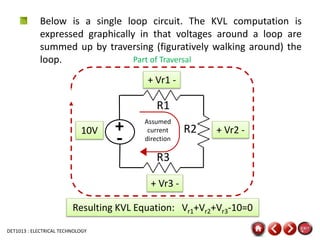
Below is a single loop circuit. The KVL computation is
expressed graphically in that voltages around a loop are
summed up by traversing (figuratively walking around) the
loop.
+
-
+ Vr1 -
+ Vr2 -
+ Vr3 -
10V
R1
R2
R3
Part of Traversal
Resulting KVL Equation: Vr1+Vr2+Vr3-10=0
Assumed
current
direction
DET1013 : ELECTRICAL TECHNOLOGY
The KVL equation is obtained by traversing a circuit loop in either direction
and writing down unchanged the voltage of each element whose “+” terminal
is entered first and writing down the negative of every element’s voltage
where the minus sign is first met.
The loop must start and end at the same point. It does not matter where you
start on the loop.
Note that a current direction must have been assumed. The assumed current
creates a voltage across each resistor and fixes the position of the “+” and “-”
signs so that the passive sign con-vention is obeyed.
The assumed current direction and polarity of the voltage across each resistor
must be in agreement with the passive sign convention for KVL analysis to
work.
The voltages in the loop may be summed in either direction. It makes no
difference except to change all the signs in the resulting equation.
Mathematically speaking, its as if the KVL equation is multiplied by -1. See
the illustration below.
DET1013 : ELECTRICAL TECHNOLOGY
+
-
+ Vr1 -
+ Vr2 -
+ Vr3 -
10V
R1
R2
R3
Part of Traversal
Resulting KVL Equation: Vr1+Vr2+Vr3-10=0
+
-
+ Vr1 -
+ Vr2 -
+ Vr3 -
10V
R1
R2
R3
Part of Traversal
Resulting KVL Equation: -Vr1-Vr2-Vr3+10=0
For both summations, the assumed current direction was the same
Summation of voltage terms may be done in either direction
DET1013 : ELECTRICAL TECHNOLOGY
For both cases shown, the direction of summation was the same
Assuming the current direction fixes the voltage references
+
-
+ Vr1 -
+ Vr2 -
+ Vr3 -
10V
R1
R2
R3
Resulting KVL Equation: Vr1+Vr2+Vr3-10=0
+
-
+ Vr1 -
+ Vr2 -
+ Vr3 -
10V
R1
R2
R3
Resulting KVL Equation: -Vr1-Vr2-Vr3-10=0
Assumed
current
direction
Assumed
current
direction
DET1013 : ELECTRICAL TECHNOLOGY
 Analysis using KVL to solve for the currents around each closed loop of
the network and hence determine the currents through and voltages
across each elements of the network
 Mesh analysis procedure
STEP 1
Assign a distinct current to
each closed loop of the
network
STEP 2
Apply KVL around each
closed loop of the network
STEP 3
Solve the resulting
simultaneous linear equation
for the loop currents
DET1013 : ELECTRICAL TECHNOLOGY
 Exercise 1
Find the current flow through each resistor using mesh analysis for
the circuit below
EXERCISE 1
DET1013 : ELECTRICAL TECHNOLOGY
 SOLUTION
• Assign a
distinct
current to
each closed
loop of the
network
STEP 1
• Apply KVL
around each
closed loop of
the network
STEP 2 • Solve the
resulting
simultaneous
linear equation
for the loop
currents
STEP 3
DET1013 : ELECTRICAL TECHNOLOGY
S
T
E
P
1
DET1013 : ELECTRICAL TECHNOLOGY
1104050
10404010
:1
21
211
1323111
equationII
III
VRIRIRI
Loop



2206040
20404020
:2
21
122
2313222
equationII
III
VRIRIRI
Loop



S
T
E
P
2
DET1013 : ELECTRICAL TECHNOLOGY
AAAIII
FromKCL
A
I
I
A
I
I
I
I
I
I
Matrixform
II
II
286.0429.0143.0
:
429.0
1400
600
143.0
1400
200
6004001000
2040
1050
200800600
6020
4010
140016003000
6040
4050
20
10
6040
4050
:
206040
104050
213
2
2
1
1
2
1
2
1
21
21


































Solve equation 1 and equation 2 using Matrix
S
T
E
P
3
DET1013 : ELECTRICAL TECHNOLOGY
INTRODUCTION KCL
NODES ANALYSIS
EXERCISE
Kirchhoff’s Current
Law is sometimes
called “Kirchhoff’s
First Law” or
“Kirchhoff’s Junction
Rule”
along with Kirchhoff’s
Voltage Law makes up
the two fundamental
laws of Electrical
Engineering
1 In this lesson it will be
shown how Kirchhoff’s
Current Law describes
the current flow
through a junction of
a circuit
2
DET1013 : ELECTRICAL TECHNOLOGY
KCL helps to
solve unknowns
when working
with electrical
circuits
3 KCL with the
addition of KVL
and Ohm’s Law
will allow for
the solution of
complex circuits
4
DET1013 : ELECTRICAL TECHNOLOGY
• Definition that will help in understanding
Kirchhoff’s Current Law:
Examples of a Junction
DET1013 : ELECTRICAL TECHNOLOGY
• Kirchhoff’s Current Law generally states:
• Restated as:
DET1013 : ELECTRICAL TECHNOLOGY
• The algebraic sum of all currents entering (+) and leaving (-)
any point (junction) in a circuit must equal zero.
• Here, the 3 currents entering the node, I1, I2, I3 are all
positive in value and the 2 currents leaving the node, I4 and
I5 are negative in value. Then this means we can also
rewrite the equation as;
𝐼1 + 𝐼2 + 𝐼3 − 𝐼4 − 𝐼5 = 0
DET1013 : ELECTRICAL TECHNOLOGY
Analysis using KCL to solve for
voltages at each common node
of the network and hence
determine the currents though
and voltages across each
elements of the network.
DET1013 : ELECTRICAL TECHNOLOGY
• Determine the number of
common nodes and
reference node within the
network
Common
node
• Assign current and its
direction to each distinct
branch of the nodes in
the network
Current
Direction
• Apply KCL at each
of the common
nodes in the network
KCL
• Solve the resulting
simultaneous linear
equation for the node
voltage
Solve
Equation
Determine
I and V
• Determine the currents
through and voltages
across each elements
in the network
Example 1:
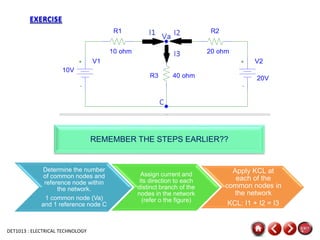
Find the current flow through each resistor using node analysis for
the circuit below.
DET1013 : ELECTRICAL TECHNOLOGY
Determine the number
of common nodes and
reference node within
the network.
1 common node (Va)
and 1 reference node C
Assign current and
its direction to each
distinct branch of the
nodes in the network
(refer o the figure)
Apply KCL at
each of the
common nodes in
the network
KCL: I1 + I2 = I3
REMEMBER THE STEPS EARLIER??
DET1013 : ELECTRICAL TECHNOLOGY
EXERCISE
11.428V=Va
2=)
40
7
(Va
2=)
20
1
+
10
1
+
40
1
(Va
2=
20
Va
+
10
Va
+
40
Va
40
Va
=
20
Va
-1+
10
Va
-1
40
Va
=
20
Va)-(20
+
10
Va)-(10
0.286V=
40
11.428
=I
0.429A=
20
11.428)-(20
=I
0.143A-=
10
11.428)-(10
=I
3
2
1
DET1013 : ELECTRICAL TECHNOLOGY
Example 2:
Find the current flow through each resistor using node analysis for
the circuit below.
DET1013 : ELECTRICAL TECHNOLOGY
Determine the number
of common nodes and
reference node within
the network.
1 common node (Va)
and 1 reference node C
Assign current and
its direction to each
distinct branch of the
nodes in the network
(refer o the figure)
Apply KCL at
each of the
common nodes in
the network
KCL: I1 = I2 + I3
REMEMBER THE STEPS EARLIER??
DET1013 : ELECTRICAL TECHNOLOGY
14.757V-=Va
10x10.33=)10x(700Va-
5k
40
-
3k
55
=
6k
1
+
3k
1
+
5k
1
(Va-
5k
40
-
3k
55
=
6k
Va
-
3k
Va
-
5k
(-Va)
6k
Va
+
3k
55
+
3k
Va
=
6k
Va
-
6k
40
6k
Va
+
3k
(-55))-(Va
=
5k
Va)-(40
3-6-
2.46mA-=
6k
(-14.757)
=I
13.41mA=
3k
55)+(-14.757
=I
10.95mA=
5k
(-14.757))-(40
=I
3
2
1
DET1013 : ELECTRICAL TECHNOLOGY
Q1 Q2 Q3 Q4 Q5
Q6 Q7 Q8 Q9 Q10
Kirchhoff’s First
Law says that:
Current loses strength as it flows about a circuit
Voltage loses strength as it flows about a circuit
Wires need insulation to stop electrons from leaking out
of the wire
Total current flowing into a point is the same as
the current flowing out of that point
KCL is used when solving circuits with…
Closed loops
Sufficient nodes/ junctions
Capacitors
None
Nodal Analysis applies the following principles…
KVL & Ohm’s Law
KCL & Ohm’s Law
KVL & Superposition
KCL & Superposition
Which of the following statements is true?
Mesh Analysis employs KVL to solve loop currents
All of t All of the above
Mesh Analysis is easiest when a circuit has more than two nodes
Mesh Analysis is more difficult than Nodal Analysis
If a circuit contains three loops, how many
independent equations can be obtained with
Kirchhoff’s Second laws?
Three
Four
Five
Six
How much is current I3 in the node shown?
2A
-2A
0A
8A
How much is current I4 in the node shown?
2A
-2A
18A
8A
How much is voltage V3 in the closed loop circuit
shown?
2A
-2A
10A
-10A
How much is voltage V4 in the closed loop circuit
shown?
4A
-4A
8A
-8A
Using KVL, find the value of Rx in the circuit
shown
8Ω
4Ω
2Ω
1Ω
Q2Q1
Q3 Q4
Q6Q5
Q7 Q8
Q10Q9
Q2Q1
Q3 Q4
Q6Q5
Q7 Q8
Q10Q9
DET1013 : ELECTRICAL TECHNOLOGY
ANIS
ABDUL
KAHAR
FARAH
ASYIKIN
ABD
RAHMAN
DAILY
TAYOK
SITI
HADIJAH
NORSANI
WEE SIEW
PING
AUTHORS
MUKAH
KOTA KINABALU
MUADZAM SHAH
KOTA BAHRU
DET1013 : ELECTRICAL TECHNOLOGY
•JABATAN PENGAJIAN POLITEKNIK
•CeLT
•CIDOS
•POLITEKNIK MUKAH, SARAWAK
•POLITEKNIK KOTA KINABALU, SABAH
•POLITEKNIK MUADZAM SHAH, PAHANG
•POLITEKNIK KOTA BHARU, KELANTAN
DET1013 : ELECTRICAL TECHNOLOGY

Kirchoff's Law

  • 2.
    INTRODUCTION KIRCHOFF’S LAW KIRCHOFF’SVOLTAGE LAW ( KVL ) ANALYSIS CIRCUIT OF KVL KIRCHOFF’S CURRENT LAW ( KCL ) ANALYSIS CIRCUIT OF KCL QUIZ DET1013 : ELECTRICAL TECHNOLOGY
  • 3.
    DET1013 : ELECTRICALTECHNOLOGY HISTORY OF KIRCHOFF’S LAW INTRODUCTION TYPES OF KIRCHOFF’S LAW
  • 4.
    described two lawsthat became central to electrical engineering in 1845 The laws were generalized from the work of Georg Ohm It’s can also be derived from Maxwell’s equations, but were developed prior to Maxwell’s work Gustav Robert Kirchhoff (German physicist) DET1013 : ELECTRICAL TECHNOLOGY
  • 5.
    • A pairof laws stating general restrictions on the current and voltage in an electric circuit. What? • The first of these states that at any given instant the sum of the voltages around any closed path, or loop, in the network is zero. • The second states that at any junction of paths, or node, in a network the sum of the currents arriving at any instant is equal to the sum of the currents flowing away. How? DET1013 : ELECTRICAL TECHNOLOGY
  • 6.
    KVL •Kirchoff Voltage Law KCL •KirchoffCurrent Law DET1013 : ELECTRICAL TECHNOLOGY
  • 7.
    DET1013 : ELECTRICALTECHNOLOGY INTRODUCTION KVL MESH ANALYSIS EXERCISE
  • 8.
    Kirchhoff's Voltage Law- KVL - is one of two fundamental laws in electrical engineering, the other being Kirchhoff's Current Law (KCL) KVL is a fundamental law, as fundamental as Conservation of Energy in mechanics, for example, because KVL is really conservation of electrical energy KVL and KCL are the starting point for analysis of any circuit KCL and KVL always hold and are usually the most useful piece of information you will have about a circuit after the circuit itself
  • 9.
    Kirchoff’s Voltage Law(KVL) states that the algebraic sum of the voltages across any set of branches in a closed loop is zero. i.e.;  Vacrossbranches = 0 DET1013 : ELECTRICAL TECHNOLOGY
  • 10.
    Below is asingle loop circuit. The KVL computation is expressed graphically in that voltages around a loop are summed up by traversing (figuratively walking around) the loop. + - + Vr1 - + Vr2 - + Vr3 - 10V R1 R2 R3 Part of Traversal Resulting KVL Equation: Vr1+Vr2+Vr3-10=0 Assumed current direction DET1013 : ELECTRICAL TECHNOLOGY
  • 11.
    The KVL equationis obtained by traversing a circuit loop in either direction and writing down unchanged the voltage of each element whose “+” terminal is entered first and writing down the negative of every element’s voltage where the minus sign is first met. The loop must start and end at the same point. It does not matter where you start on the loop. Note that a current direction must have been assumed. The assumed current creates a voltage across each resistor and fixes the position of the “+” and “-” signs so that the passive sign con-vention is obeyed. The assumed current direction and polarity of the voltage across each resistor must be in agreement with the passive sign convention for KVL analysis to work. The voltages in the loop may be summed in either direction. It makes no difference except to change all the signs in the resulting equation. Mathematically speaking, its as if the KVL equation is multiplied by -1. See the illustration below. DET1013 : ELECTRICAL TECHNOLOGY
  • 12.
    + - + Vr1 - +Vr2 - + Vr3 - 10V R1 R2 R3 Part of Traversal Resulting KVL Equation: Vr1+Vr2+Vr3-10=0 + - + Vr1 - + Vr2 - + Vr3 - 10V R1 R2 R3 Part of Traversal Resulting KVL Equation: -Vr1-Vr2-Vr3+10=0 For both summations, the assumed current direction was the same Summation of voltage terms may be done in either direction DET1013 : ELECTRICAL TECHNOLOGY
  • 13.
    For both casesshown, the direction of summation was the same Assuming the current direction fixes the voltage references + - + Vr1 - + Vr2 - + Vr3 - 10V R1 R2 R3 Resulting KVL Equation: Vr1+Vr2+Vr3-10=0 + - + Vr1 - + Vr2 - + Vr3 - 10V R1 R2 R3 Resulting KVL Equation: -Vr1-Vr2-Vr3-10=0 Assumed current direction Assumed current direction DET1013 : ELECTRICAL TECHNOLOGY
  • 14.
    DET1013 : ELECTRICALTECHNOLOGY  Analysis using KVL to solve for the currents around each closed loop of the network and hence determine the currents through and voltages across each elements of the network  Mesh analysis procedure STEP 1 Assign a distinct current to each closed loop of the network STEP 2 Apply KVL around each closed loop of the network STEP 3 Solve the resulting simultaneous linear equation for the loop currents
  • 15.
    DET1013 : ELECTRICALTECHNOLOGY  Exercise 1 Find the current flow through each resistor using mesh analysis for the circuit below
  • 16.
    EXERCISE 1 DET1013 :ELECTRICAL TECHNOLOGY  SOLUTION • Assign a distinct current to each closed loop of the network STEP 1 • Apply KVL around each closed loop of the network STEP 2 • Solve the resulting simultaneous linear equation for the loop currents STEP 3
  • 17.
    DET1013 : ELECTRICALTECHNOLOGY S T E P 1
  • 18.
    DET1013 : ELECTRICALTECHNOLOGY 1104050 10404010 :1 21 211 1323111 equationII III VRIRIRI Loop    2206040 20404020 :2 21 122 2313222 equationII III VRIRIRI Loop    S T E P 2
  • 19.
    DET1013 : ELECTRICALTECHNOLOGY AAAIII FromKCL A I I A I I I I I I Matrixform II II 286.0429.0143.0 : 429.0 1400 600 143.0 1400 200 6004001000 2040 1050 200800600 6020 4010 140016003000 6040 4050 20 10 6040 4050 : 206040 104050 213 2 2 1 1 2 1 2 1 21 21                                   Solve equation 1 and equation 2 using Matrix S T E P 3
  • 20.
    DET1013 : ELECTRICALTECHNOLOGY INTRODUCTION KCL NODES ANALYSIS EXERCISE
  • 21.
    Kirchhoff’s Current Law issometimes called “Kirchhoff’s First Law” or “Kirchhoff’s Junction Rule” along with Kirchhoff’s Voltage Law makes up the two fundamental laws of Electrical Engineering 1 In this lesson it will be shown how Kirchhoff’s Current Law describes the current flow through a junction of a circuit 2 DET1013 : ELECTRICAL TECHNOLOGY
  • 22.
    KCL helps to solveunknowns when working with electrical circuits 3 KCL with the addition of KVL and Ohm’s Law will allow for the solution of complex circuits 4 DET1013 : ELECTRICAL TECHNOLOGY
  • 23.
    • Definition thatwill help in understanding Kirchhoff’s Current Law: Examples of a Junction DET1013 : ELECTRICAL TECHNOLOGY
  • 24.
    • Kirchhoff’s CurrentLaw generally states: • Restated as: DET1013 : ELECTRICAL TECHNOLOGY
  • 25.
    • The algebraicsum of all currents entering (+) and leaving (-) any point (junction) in a circuit must equal zero. • Here, the 3 currents entering the node, I1, I2, I3 are all positive in value and the 2 currents leaving the node, I4 and I5 are negative in value. Then this means we can also rewrite the equation as; 𝐼1 + 𝐼2 + 𝐼3 − 𝐼4 − 𝐼5 = 0 DET1013 : ELECTRICAL TECHNOLOGY
  • 26.
    Analysis using KCLto solve for voltages at each common node of the network and hence determine the currents though and voltages across each elements of the network. DET1013 : ELECTRICAL TECHNOLOGY
  • 27.
    • Determine thenumber of common nodes and reference node within the network Common node • Assign current and its direction to each distinct branch of the nodes in the network Current Direction • Apply KCL at each of the common nodes in the network KCL • Solve the resulting simultaneous linear equation for the node voltage Solve Equation Determine I and V • Determine the currents through and voltages across each elements in the network
  • 28.
    Example 1: Find thecurrent flow through each resistor using node analysis for the circuit below. DET1013 : ELECTRICAL TECHNOLOGY
  • 29.
    Determine the number ofcommon nodes and reference node within the network. 1 common node (Va) and 1 reference node C Assign current and its direction to each distinct branch of the nodes in the network (refer o the figure) Apply KCL at each of the common nodes in the network KCL: I1 + I2 = I3 REMEMBER THE STEPS EARLIER?? DET1013 : ELECTRICAL TECHNOLOGY EXERCISE
  • 30.
  • 31.
    Example 2: Find thecurrent flow through each resistor using node analysis for the circuit below. DET1013 : ELECTRICAL TECHNOLOGY
  • 32.
    Determine the number ofcommon nodes and reference node within the network. 1 common node (Va) and 1 reference node C Assign current and its direction to each distinct branch of the nodes in the network (refer o the figure) Apply KCL at each of the common nodes in the network KCL: I1 = I2 + I3 REMEMBER THE STEPS EARLIER?? DET1013 : ELECTRICAL TECHNOLOGY
  • 33.
  • 34.
    Q1 Q2 Q3Q4 Q5 Q6 Q7 Q8 Q9 Q10
  • 35.
    Kirchhoff’s First Law saysthat: Current loses strength as it flows about a circuit Voltage loses strength as it flows about a circuit Wires need insulation to stop electrons from leaking out of the wire Total current flowing into a point is the same as the current flowing out of that point
  • 36.
    KCL is usedwhen solving circuits with… Closed loops Sufficient nodes/ junctions Capacitors None
  • 37.
    Nodal Analysis appliesthe following principles… KVL & Ohm’s Law KCL & Ohm’s Law KVL & Superposition KCL & Superposition
  • 38.
    Which of thefollowing statements is true? Mesh Analysis employs KVL to solve loop currents All of t All of the above Mesh Analysis is easiest when a circuit has more than two nodes Mesh Analysis is more difficult than Nodal Analysis
  • 39.
    If a circuitcontains three loops, how many independent equations can be obtained with Kirchhoff’s Second laws? Three Four Five Six
  • 40.
    How much iscurrent I3 in the node shown? 2A -2A 0A 8A
  • 41.
    How much iscurrent I4 in the node shown? 2A -2A 18A 8A
  • 42.
    How much isvoltage V3 in the closed loop circuit shown? 2A -2A 10A -10A
  • 43.
    How much isvoltage V4 in the closed loop circuit shown? 4A -4A 8A -8A
  • 44.
    Using KVL, findthe value of Rx in the circuit shown 8Ω 4Ω 2Ω 1Ω
  • 45.
  • 46.
  • 47.
  • 48.
  • 49.
    •JABATAN PENGAJIAN POLITEKNIK •CeLT •CIDOS •POLITEKNIKMUKAH, SARAWAK •POLITEKNIK KOTA KINABALU, SABAH •POLITEKNIK MUADZAM SHAH, PAHANG •POLITEKNIK KOTA BHARU, KELANTAN DET1013 : ELECTRICAL TECHNOLOGY