RELAY OPERATION PRINCIPLES 
11/26/2014 1
 2.1 Detection of fault :- 
 In general, as faults (short-circuit) occur, current increase in magnitude, and 
voltages go down. Besides these magnitude changes of the ac quantities, other 
changes may occur in one or more of the following parameters: 
 Phase angles of current and voltage phasors. 
 Harmonic components. 
 Active and reactive power. 
 Frequency of the power system. 
 Relay operating principles may be based upon detecting these changes, and 
identifying the changes with the possibility that a fault may exist inside its 
assigned zone of protection . We will divide relays into categories based upon 
which of these input quantities a particular relay responds to :- 
 Level detection :- this is the simplest of all relay operating principles. Fault 
current magnitudes are almost always greater than the normal load current 
that exist in a power system. 
 As an example, consider the motor connection to a 4kv power system. The 
full load current for the motor is I=245 ampers. 
11/26/2014 2
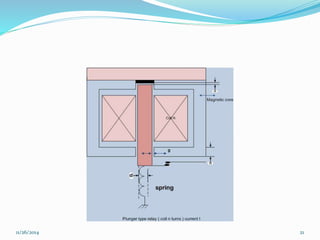
Allowing for an emergency overload capability of 25%, a current of I 
=1.25×245=306 amperes or lower should correspond to normal operation . 
Then any current above a set level(346 amperes ) may be taken to mean 
that a fault, or some other abnormal condition exists inside the zone of 
protection of the motor. The relay should be designed to operate and trip 
the circuit breaker for all currents above the setting value. 
The level above which the relay operate is known as the pickup setting of 
the relay . For all currents above the pickup , the relay operates, and for 
currents smaller than pickup value, the relay takes no action. 
The operating characteristic of an overcurrent relay can be presented as a 
plot of the operating time of the relay versus the current in the relay. 
It is best to normalize the current as a ratio of the actual current to the 
pickup setting(Ip). 
In= 
퐼 
퐼푃 
,the operating time for In less than 1 is infinite, which for values>1 , 
the relay operates. The actual time for operation will depend upon the 
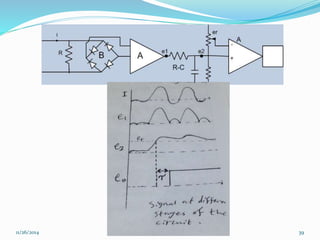
design of the relay. 
11/26/2014 3
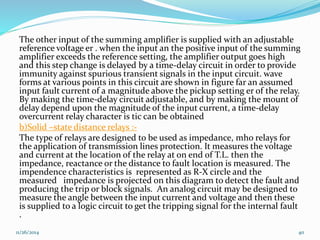
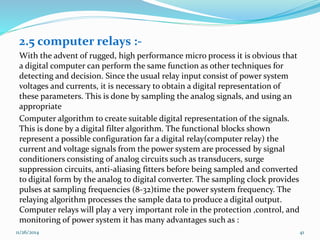
The characteristics show the ideal and practice relay level 
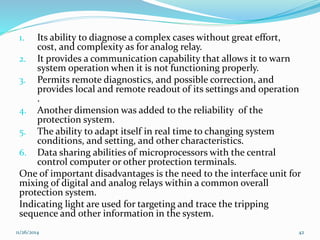
detector relay also known as over current relay ( OV relay ) 
11/26/2014 4
b) Magnitude comparison 
This operation principle is based upon the comparison of one 
or more operating quantities with each other. For example , a 
current balance relay may compare the current in one circuit 
with the current in another circuit ,which should have equal 
or proportional magnitudes under normal operating 
conditions . The relay will operate when the current division 
in the two circuit varies by a given tolerance . 
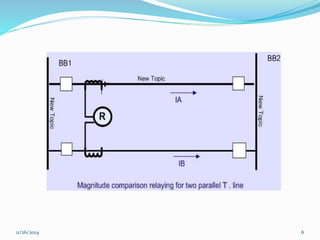
The figure below shows two identical parallel lines which are 
connected to the same bus at either end . One could use a 
magnitude comparison relay which compares the magnitude 
of the two line current 퐼퐴 > 퐼퐵 + ϵ 
Then with the line B is not open , would declare a fault on 
line A and trip it ,where ϵ is a suitable tolerance . 
Similar logic would be used to trip line B . 
11/26/2014 5
11/26/2014 6
c) Differential comparison 
It is one of the most sensitive and effective methods of providing 
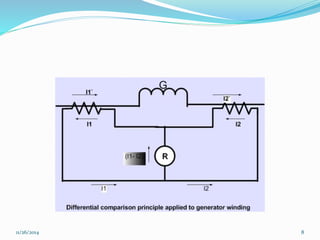
protection against the faults . Consider the generator winding 
shown in the figure , then as the winding is electrically continuous 
, current entering one end I1`must equal the current leaving the 
other end I2` . 
One could use a magnitude comparison relay described below to 
test for a fault on the protected winding . 
When a fault occurs between tow ends the two current are no 
longer equal alternatively , one could from an algebraic sum of the 
two current entering the protected winding ,(I1-I2) and use a level 
detector relay to detect the presence of a fault. In either case , the 
protection is termed a differential protection . In general , the 
differential protection principle is capable of detecting very small 
magnitudes of a fault current . 
11/26/2014 7
11/26/2014 8
Thy only drawback of this technique it requires current 
from both ends of zone of protection which restricts its 
application to power apparatus ( Transformer , 
Generators , Motors , buses , capacitors , reactors …) . 
d) Phase angle comparison 
This type of relay compares the relative phase angle 
between to Ac quantities . Phase angle comparison is 
commonly used to determine direction of a current ( 
w.r.) to a reference quantity . For instance , the normal 
power flow in given direction will result in the phase 
angle between the voltage and the current varying 
around its power factor angle say approximately ±30˚ . 
When power 
11/26/2014 9
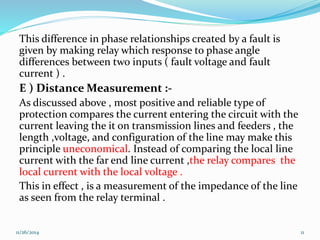
flow in opposite direction ,this angle will become (180˚±30˚) 
similarly , for a fault in forward or revers direction the phase 
angle of the current ( w.r.t ) the voltage will be –Φ and ( 180˚- 
Φ ) respectively ( Φ is impedance angle of the fault circuit ) 
as shown in figure . 
11/26/2014 10
This difference in phase relationships created by a fault is 
given by making relay which response to phase angle 
differences between two inputs ( fault voltage and fault 
current ) . 
E ) Distance Measurement :- 
As discussed above , most positive and reliable type of 
protection compares the current entering the circuit with the 
current leaving the it on transmission lines and feeders , the 
length ,voltage, and configuration of the line may make this 
principle uneconomical. Instead of comparing the local line 
current with the far end line current ,the relay compares the 
local current with the local voltage . 
This in effect , is a measurement of the impedance of the line 
as seen from the relay terminal . 
11/26/2014 11
An impedance relay relies on the fact that the length of the 
line (its distance ) for a given conductor diameter spacing 
determines its impedance . 
F ) pilot relaying :- 
Certain relaying principles are based upon information 
obtained by the relay from a remote location , the 
information could be in the form of the contact status ( open 
or closed ). The information is sent over a communication 
channel using power line carrier , microwave , or telephone 
circuits . 
G ) Harmonic content :- 
Current and voltage in a power system usually have a 
sinusoidal waveform of the fundamental power system 
frequency . There are however , deviations from a pure 
sinusoid , such as the third harmonic voltage and currents 
11/26/2014 12
produced by generators , that are present during 
normal system operation , other harmonic occur 
during abnormal system conditions , such as the odd 
harmonics associated with transformer saturation or 
transient components . These abnormal conditions 
can be detected by sensing the harmonic content 
through filters in electromechanical or solid – state 
relays , or by calculation in digital relays. After the 
detection of these harmonics , a decision can be 
made and control action is required . 
H ) Frequency sensing :- 
Normal power system operation is at 50 or 60 Hz . Any 
deviation from these values indicates that a problem exists . 
Frequency can be measured by filter circuit , by counting of 
11/26/2014 13
zero crossing wave forms in a unit of time , or by 
special sampling and digital computer technique 
frequency – sensing relays may be used to bring 
system frequency back to normal by some corrective 
actions . 
11/26/2014 14
 Relay design 
The various input quantities described above , upon which 
fault detection is based ,may be used either single or in any 
combination to calculated power ,power factor , 
directionality , impedance ….. Some relays are also designed 
to respond to mechanical devices such as fluid detectors , 
pressure or temperature sensors . Relay may be constructed 
from electro mechanical element such as solenoids , 
induction discs , solid – state elements , digital computers 
using analog – to – digital converter and microprocessors . 
However , the construction of a relay does not inherently 
change the protection of a relay dose not inherently change 
the protection concept , although there are advantages and 
disadvantages associated with each type . 
11/26/2014 15
Some relay design aspects are : 
Relays are devices requiring low level inputs ( voltages , 
currents , or contacts ). 
 Derive their inputs from transducers such as current or 
voltage transformers and switch contacts . 
 They are fault detecting devices only and require an 
associated interrupting device ( a circuit breaker ) to clear 
the fault . 
 Separating the fault detection function from the 
interruption function gave the relay designer an ability to 
design a protection system that match the needs of the 
power system . 
11/26/2014 16
 Fuses 
 The fuse is the oldest and simplest of all the 
protective device . The main characteristics are :- 
1. It is a level detector . 
2. It is both the sensor and the interrupting device . 
3. It is installed in series with the equipment being 
protected . 
4. Operating by melting a fusible element in response to the 
current flow . The melting time is inversely proportional 
to the magnitude of the current flowing in the fuse . 
5. It is one – shot device since the fusible link is destroyed in 
the process of interrupting the currents. 
11/26/2014 17
6. Fuse may only be able to interrupt current up to 
their maximum short–circuit rating before it 
reaches its maximum value . 
7. Its application is restricted for radial feeders such as 
distribution lines or auxiliary systems of power 
plants . 
 The two major dis advantages are :- 
a) The single –shot feature requires that a blown fuse be 
replaced before service can be restored ,this means a 
delay ,and the need to have the correct spare fuses . To 
avoid this, it is possible a multi-shot feature by installing 
a number of fuses in parallel with a control unit to 
transfer to another one. 
11/26/2014 18
b) In a three-phase circuit ,a single phase-to- ground fault 
will cause one fuse to blow, de energizing only one phase, 
permitting the connected equipment-such as motors to stay 
connected to the remaining phases , with excessive heating 
and vibration because of the unbalanced voltage supply . 
2.3 Electromechanical Relays :- 
The early replay designs utilized actuating forces that were 
produced be electromagnetic interaction between currents 
and fluxes. Some relays were also based upon the forces 
created by expansion of metals caused by temperature rise 
due to a flow of current. Two main types of 
electromechanical replays and in use , the plunger-type relays 
are usually driven by a single actuating quantity , while the 
induction –type relays may be activated by single or multiple 
inputs . 
11/26/2014 19
a) plunger –Type Relay 
Consider a round moving a stationary electromagnet as 
shown in the figure. With no current in the coil, the plunger 
is held partially out side the coil by the force Fs produced by a 
spring. Let X be the position of the plunger tip inside the 
upper opening of the coil. When the coil is energized by a 
current i , and saturation phenomena are neglected ,the 
energy W(λ, i) and the co-energy w1(i,x),stored in the 
magnetic field are given by : 
푤 휆 , 푖 = 푤1 푖, 푥 = 
1 
2 
푙푖2 ______(2.1) 
Where λ is the flax linkage of the coil and L is the inductance 
of the coil which can be given for this magnetic circuit as 
퐿 = 
훍̻휋 푑2푁2 
4(푋+ 
푔푑 
4푎 
) 
, N :number of turns in the coil 
a: height of the pole –face 
11/26/2014 20
11/26/2014 21
The force which tries to pull the plunger inside the coil given 
by 
푓푚 = 
훅 
훅푥 
w` 푖, 푥 = 푘 
푖2 
푔푑 
4푎 
푥+ 
2 ……………(2.2) 
Where k is a constant depending upon constants of the 
magnetic circuit shown on the figure . 
The plunger moves when 푓푚 exceeds 푓푠 .if the current is 
sinusoidal with an rms value of I ,the average force is 
proportional to I² . The valve of the current (퐼푝) at which the 
plunger just begins to move is known as the pickup setting of 
the replay is given by : 
퐼² 
푓푚 = 푓= 푘 
푝푠 푔푑 
4푎 
(푥 + 
)² 
then 
퐼푝=[ 
푓푠 
푘 
] x + 
푔푑 
4푎 
… … … … ……(2.3) 
11/26/2014 22
Where x is the displacement of the plunger when no 
current is flowing in the coil (stating position ). The 
plunger travels some distance from x to x1 before it 
closes its contacts and hits a stop . The energizing 
current must drop below a value 퐼푑 , known as the 
dropout current before the plunger can return to tis 
original position x . The dropout current is given by : 
퐼푑=[ 
푓푠 
푘 
] 푥1 + 
푔푑 
4푎 
… … … … ……(2.4) 
퐼푑<퐼푝 푎푠 x < 푥1 
11/26/2014 23
The operating time of the relay depends upon the mass of the 
plunger . 
For a normalized current of magnitude 퐼푛 (actual current divided 
by the pickup current ), the accelerating force on the plunger is : 
퐼퐼2 
F=퐹푛 푃 
푚 − 퐹푆 = 푘 
푔푑 
4푎 
푋+ 
2 − 퐹푠 , substituting for 퐼푝 from equation 
(2.3) then , 
F= 퐹푠[ 
(푥0+푔푑/4푎)² 
푔푑 
4푎 
(푥+ 
)² 
퐼푛² − 1] … … … … (2.5) 
The equation of motion for the plunger is , 
M푋 = -F …………….(2.6) 
Where m is the mass of the plunger. 
Equation (2.6)can be integrated twice to provide the operating 
time of the relay (the time it takes the plunger to travel from 
푥 푡표 푥1). The integrals in eqn (2.6) are elliptic integrals and must be 
evaluated numerically for given displacements . 
11/26/2014 24
The general shape of the replay characteristic list operating 
time plotted as a function of the current through the coil is as 
shown in this figure. Operating time calculation is given in 
the next example. 
Ex: consider a plunger-type relay with a pickup current of 5 
amperes (rms).the pole face has a height of 1.5 cm ,while the 
spring holds the plunger 1cm out of the coil when the 
current is below the pickup value. The air gap g=0.2cm , and 
gd/4a=0.05 , let the spring force be a constant ,with a value of 
0.001 Newton , and let the mass of the plunger be 0.005kg . 
Let the travel of the plunger be 3mm before it hits a stop and 
closes its contacts . Calculate : 
a)The dropout current to its pickup current 
b)The accelerating force on the plunger for 퐼푛=2, and x=0.8 
cm 
c)The operating time of the relay for closes its contacts. 
11/26/2014 25
Sol: use the sam construction of plunger-type relay was given 
in section (2.3)then : 
a)From eqns (2.3)and(2.4),we have for dimension in cm:- 
푔푑 
퐼(푥+ 
) 
푑 
1 4푎 
(0.7 + 0.05) 
= 
= 
= 0.714 
퐼푝 
(푥0+푔푑/4푎) 
(1 + 0.05) 
b)From eqn (2.5),the accelerating force F is : 
F=퐹푠 
푥0+ 
푔푑 
4푎 
2 
푥+ 
푔푑 
4푎 
2 퐼푛 
2 
− 1 = 0.001 
1.05 2 
푥+0.005 2 2 2 − 1 
F=0.001 
4.41 
0.7225 
− 1 = 5.1 × 10⁻³N. 
c)Using eqns (2.5)and (2.6) them 
0.005 푥 =-0.001[ 
(1.05)² 
(푥+0.005)² 
퐼푛² -1 ]= -F 
11/26/2014 26
The operating time can be calculated using a constant force 
equal to the average taken over its travel from 푥0푡표 푥1 then 
from the above eqn use x= 푥0 =1cm and x= 푥1=0.7 cm and 
calculate F in both cases. 
For x= 1cm 
퐹1 = 0.001( 퐼푛² - 1 ) newton 
For x= 0.7cm 
퐹2 = 0.001(1.96 퐼푛² - 1 ) newton 
Fav = 0.001(1.48 퐼푛² - 1 )newton 
Using this expression for the force ,then the approximate 
equation of motion for the plunger is : 
0.005푥 = −0.001[1.48 퐼푛² - 1 ] 
푥 = 0.2[1.48 퐼푛² − 1 ] 
11/26/2014 27
푥1 푑푥 = 0.2[1.48 퐼푛² - 1 ] 0 
푥0 
푡 
푑푡 
t²= 
10(푥0−푥1) 
1.48 퐼푛² − 1 
Or t = 
10(푥0−푥1) 
1.48 퐼푛² − 1 
= 
0.3 
1.48 퐼푛² − 1 
= 
0.3 
0.48 
= 0.79 sec. approximately 
This relation shows the inverse –time behavior of the relay for 
larger values of 퐼푛 and can be drown for 퐼푛 ≥ 1 . 
Most plunger relays also have several taps available on the 
winding of the coil to adjust the pickup current over a wide 
range (tap setting 1,2,….10 amperes ). Also the pickup can be 
controlled by adjusting the plunger within the coil. Plunger – 
type relays will operate on dc as well as on ac current . 
11/26/2014 28
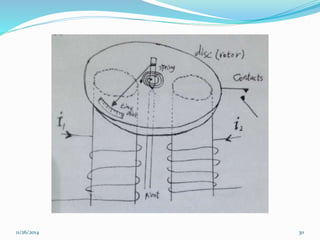
b) Induction – type relays 
These relays are based upon the principle of operation of the single 
phase ac motor. As such ,they cannot be used for dc currents. There 
are two types of these fairly standard : one with an induction disc, 
and the other with an induction cup. In both cases, the moving 
element (disc or cup) is equivalent to the rotor of the induction 
motor. The figure below shows the principle of construction of an 
induction disc relay. The moving element acts as a carrier of rotor 
currents, while the magnetic circuit is completed through 
stationary magnetic elements. Induction type relays require two 
sources of alternating magnetic flux in which the moving element 
may turn. The two fluxes must have a phase difference between 
them, otherwise no operating torque is produced. Let us assume 
that the two currents in the coils of the relay, 푖1 푎푛푑 푖2 are 
sinusoidal : 
푖1 (t)=퐼푚1cos wt , and 푖2 (t)=퐼푚2cos (wt+θ) 
λ1 푡 = 퐿푚 퐼푚1cos wt , and λ2 푡 ² = 퐿푚 퐼푚2cos (wt+θ) where Lm is 
mutual inductance 
11/26/2014 29
11/26/2014 30
Each of these flux linkages in turn induces a voltage in the 
rotor, and since the rotor is a metallic structure with low self-inductance, 
a rotor current in phase with the inducted 
voltages flows in the rotor. Assuming the equivalent rotor 
resistance to be 푅1, the induced rotor current are given by : 
푖푟1 푡 = 
1 
푅푟 
푑λ1 
푑푡 
= - 
ω퐿푚퐿푚1 
푅푟 
sin ωt ………….(2.7) 
푖푟2 푡 = 
1 
푅푟 
푑λ2 
푑푡 
= - 
ω퐿푚퐿푚2 
푅푟 
sin (ωt+θ) ………….(2.8) 
Each of the rotor current interacts with the flux produced by 
the other coil, producing a force. The two forces are in 
opposite direction w.r.t each other, and the net farce, or the 
corresponding net torque T is given by : 
T [λ1 푖푟2-λ2푖푟1 ], substituting for λ,i and simplify to get 
T= k 퐼푚1 퐼푚2 [cos ωt+θ)-cos(ωt+θ)sin ωt] ……….(2.9) 
11/26/2014 31
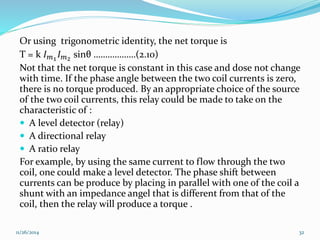
Or using trigonometric identity, the net torque is 
T = k 퐼푚1 퐼푚2 sinθ ………………(2.10) 
Not that the net torque is constant in this case and dose not change 
with time. If the phase angle between the two coil currents is zero, 
there is no torque produced. By an appropriate choice of the source 
of the two coil currents, this relay could be made to take on the 
characteristic of : 
 A level detector (relay) 
 A directional relay 
 A ratio relay 
For example, by using the same current to flow through the two 
coil, one could make a level detector. The phase shift between 
currents can be produce by placing in parallel with one of the coil a 
shunt with an impedance angel that is different from that of the 
coil, then the relay will produce a torque . 
11/26/2014 32
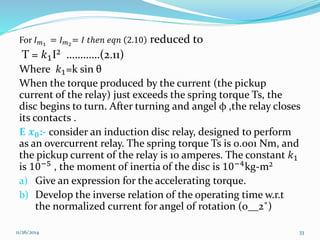
For 퐼푚1 = 퐼푚2= 퐼 푡ℎ푒푛 푒푞푛 2.10 reduced to 
T = 푘1I² …………(2.11) 
Where 푘1=k sin θ 
When the torque produced by the current (the pickup 
current of the relay) just exceeds the spring torque Ts, the 
disc begins to turn. After turning and angel φ ,the relay closes 
its contacts . 
E 풙ퟎ:- consider an induction disc relay, designed to perform 
as an overcurrent relay. The spring torque Ts is 0.001 Nm, and 
the pickup current of the relay is 10 amperes. The constant 푘1 
is 10−5 , the moment of inertia of the disc is 10−4kg-m² 
a) Give an expression for the accelerating torque. 
b) Develop the inverse relation of the operating time w.r.t 
the normalized current for angel of rotation (0__2˚) 
11/26/2014 33
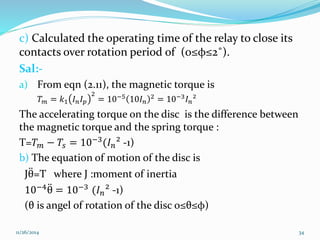
c) Calculated the operating time of the relay to close its 
contacts over rotation period of (0≤φ≤2˚). 
Sal:- 
a) From eqn (2.11), the magnetic torque is 
푇푚 = 푘1 퐼푛퐼푝 
2 
= 10−5 10퐼푛 
2 = 10−3퐼푛² 
The accelerating torque on the disc is the difference between 
the magnetic torque and the spring torque : 
T=푇푚 − 푇푠 = 10−3(퐼푛² -1) 
b) The equation of motion of the disc is 
Jθ =T where J :moment of inertia 
10−4θ = 10−3 (퐼푛² -1) 
(θ is angel of rotation of the disc o≤θ≤φ) 
11/26/2014 34
For φ=2˚=0.035 radian, in tegreting the equation of motion 
twice to get θ=5(퐼푛² − 1)푡² and the operating time of the 
relay is 
t= 
0.035 
5(퐼푛²−1) 
sec 
c) The operation time after relay closes its contact (퐼푛 ≥ 1) 
take 퐼푛= 1.01 then 
t = 
0.035 
= 0.59 sec 
5[ 0.01 2−1] 
11/26/2014 35
2.4 solid –state relays:- 
The expansion and growing complexity of modern power systems 
have brought a need for protective relays with higher level of 
performance and more sophisticated character is tics .this has been 
made possible by the development of solid-state or static relays 
where all of the functions and characteristics available with 
electromechanical relays has can be performed by solid-state 
disadvantages as follow: 
Advantages:- 
1-Use low power compare and devices. 
2-Springs and driving torques from the input quantities are not 
presented. 
3-High reliability than other electromechanical relays. 
4-Performance and economic advantages. 
5-More flexible and reduced size devices. 
6-More accurate in setting process. 
11/26/2014 36
7-Their characteristics can be shaped by adjusting logic 
elements as the fixed characteristics of induction relays. 
8-Solid-state relays are not affected by vibration or dust 
and require less mounting space. 
Disadvantages:- 
1- Limited capability to high temperature and humidity, 
over voltages and over currents . 
2-It requires independent power supplies . 
3-Solid-state relays are designed, assembled and tested 
as a system which puts the overall responsibility for 
proper operation on the manufacturer. 
11/26/2014 37
 Types:- 
 Solid-state relay circuits may be divided into tow categories: 
a) Analog circuits that are either fault- sensing or measuring 
circuits. 
b) Digital logic circuits for operation on logical variables. 
These circuits may arrange to provide desired relay characteristics 
such as : 
a) Solid – state instantaneous over current relays . 
b) Solid – state distance relays . 
We shall consider these as a circuit configuration and its principle 
of operation and characteristics as this are in use . 
a) Solid – state instantaneous overcurrent relays : 
Consider the circuit shown below . The input current I is passed 
through the resistive shunt R , full – wave rectified by the bridge 
rectifier , filtered to remove the ripple by the R-C filter , and 
applied to a high – gain summing amplifier A . 
11/26/2014 38
11/26/2014 39
The other input of the summing amplifier is supplied with an adjustable 
reference voltage er . when the input an the positive input of the summing 
amplifier exceeds the reference setting, the amplifier output goes high 
and this step change is delayed by a time-delay circuit in order to provide 
immunity against spurious transient signals in the input circuit. wave 
forms at various points in this circuit are shown in figure far an assumed 
input fault current of a magnitude above the pickup setting er of the relay. 
By making the time-delay circuit adjustable, and by making the mount of 
delay depend upon the magnitude of the input current, a time-delay 
overcurrent relay character is tic can be obtained 
b)Solid –state distance relays :- 
The type of relays are designed to be used as impedance, mho relays for 
the application of transmission lines protection. It measures the voltage 
and current at the location of the relay at on end of T.L. then the 
impedance, reactance or the distance to fault location is measured. The 
impendence characteristics is represented as R-X circle and the 
measured impedance is projected on this diagram to detect the fault and 
producing the trip or block signals. An analog circuit may be designed to 
measure the angle between the input current and voltage and then these 
is supplied to a logic circuit to get the tripping signal for the internal fault 
. 
11/26/2014 40
2.5 computer relays :- 
With the advent of rugged, high performance micro process it is obvious that 
a digital computer can perform the same function as other techniques for 
detecting and decision. Since the usual relay input consist of power system 
voltages and currents, it is necessary to obtain a digital representation of 
these parameters. This is done by sampling the analog signals, and using an 
appropriate 
Computer algorithm to create suitable digital representation of the signals. 
This is done by a digital filter algorithm. The functional blocks shown 
represent a possible configuration far a digital relay(computer relay) the 
current and voltage signals from the power system are processed by signal 
conditioners consisting of analog circuits such as transducers, surge 
suppression circuits, anti-aliasing fitters before being sampled and converted 
to digital form by the analog to digital converter. The sampling clock provides 
pulses at sampling frequencies (8-32)time the power system frequency. The 
relaying algorithm processes the sample data to produce a digital output. 
Computer relays will play a very important role in the protection ,control, and 
monitoring of power system it has many advantages such as : 
11/26/2014 41
1. Its ability to diagnose a complex cases without great effort, 
cost, and complexity as for analog relay. 
2. It provides a communication capability that allows it to warn 
system operation when it is not functioning properly. 
3. Permits remote diagnostics, and possible correction, and 
provides local and remote readout of its settings and operation 
. 
4. Another dimension was added to the reliability of the 
protection system. 
5. The ability to adapt itself in real time to changing system 
conditions, and setting, and other characteristics. 
6. Data sharing abilities of microprocessors with the central 
control computer or other protection terminals. 
One of important disadvantages is the need to the interface unit for 
mixing of digital and analog relays within a common overall 
protection system. 
Indicating light are used for targeting and trace the tripping 
sequence and other information in the system. 
11/26/2014 42
Numerical relays :- 
The can viewed as natural development of digital relays as a result 
of advances in technology, they use a specialized digital signal 
processor (DSP) as the computational hardware together with the 
associated software tools. 
The input analogue signals are converted into digital 
representation and processed using mathematical algorithm. 
Processing is carried out using a specialized microprocessor that is 
optimized for signal processing application (DSP). Single item of 
hardware is used to provide a rang of functions. 
Advantages :- 
1-several setting groups 2-wider range of parameter 
3- remote communication built in 4-internal fault diagnosis 
5-power system measurements available , 6-distance to fault 
locator 7- disturbance recorder 8- CB monitoring (state, 
condition) 9- backup protection function in – built 
11/26/2014 43

Relay operation principles

  • 1.
  • 2.
     2.1 Detectionof fault :-  In general, as faults (short-circuit) occur, current increase in magnitude, and voltages go down. Besides these magnitude changes of the ac quantities, other changes may occur in one or more of the following parameters:  Phase angles of current and voltage phasors.  Harmonic components.  Active and reactive power.  Frequency of the power system.  Relay operating principles may be based upon detecting these changes, and identifying the changes with the possibility that a fault may exist inside its assigned zone of protection . We will divide relays into categories based upon which of these input quantities a particular relay responds to :-  Level detection :- this is the simplest of all relay operating principles. Fault current magnitudes are almost always greater than the normal load current that exist in a power system.  As an example, consider the motor connection to a 4kv power system. The full load current for the motor is I=245 ampers. 11/26/2014 2
  • 3.
    Allowing for anemergency overload capability of 25%, a current of I =1.25×245=306 amperes or lower should correspond to normal operation . Then any current above a set level(346 amperes ) may be taken to mean that a fault, or some other abnormal condition exists inside the zone of protection of the motor. The relay should be designed to operate and trip the circuit breaker for all currents above the setting value. The level above which the relay operate is known as the pickup setting of the relay . For all currents above the pickup , the relay operates, and for currents smaller than pickup value, the relay takes no action. The operating characteristic of an overcurrent relay can be presented as a plot of the operating time of the relay versus the current in the relay. It is best to normalize the current as a ratio of the actual current to the pickup setting(Ip). In= 퐼 퐼푃 ,the operating time for In less than 1 is infinite, which for values>1 , the relay operates. The actual time for operation will depend upon the design of the relay. 11/26/2014 3
  • 4.
    The characteristics showthe ideal and practice relay level detector relay also known as over current relay ( OV relay ) 11/26/2014 4
  • 5.
    b) Magnitude comparison This operation principle is based upon the comparison of one or more operating quantities with each other. For example , a current balance relay may compare the current in one circuit with the current in another circuit ,which should have equal or proportional magnitudes under normal operating conditions . The relay will operate when the current division in the two circuit varies by a given tolerance . The figure below shows two identical parallel lines which are connected to the same bus at either end . One could use a magnitude comparison relay which compares the magnitude of the two line current 퐼퐴 > 퐼퐵 + ϵ Then with the line B is not open , would declare a fault on line A and trip it ,where ϵ is a suitable tolerance . Similar logic would be used to trip line B . 11/26/2014 5
  • 6.
  • 7.
    c) Differential comparison It is one of the most sensitive and effective methods of providing protection against the faults . Consider the generator winding shown in the figure , then as the winding is electrically continuous , current entering one end I1`must equal the current leaving the other end I2` . One could use a magnitude comparison relay described below to test for a fault on the protected winding . When a fault occurs between tow ends the two current are no longer equal alternatively , one could from an algebraic sum of the two current entering the protected winding ,(I1-I2) and use a level detector relay to detect the presence of a fault. In either case , the protection is termed a differential protection . In general , the differential protection principle is capable of detecting very small magnitudes of a fault current . 11/26/2014 7
  • 8.
  • 9.
    Thy only drawbackof this technique it requires current from both ends of zone of protection which restricts its application to power apparatus ( Transformer , Generators , Motors , buses , capacitors , reactors …) . d) Phase angle comparison This type of relay compares the relative phase angle between to Ac quantities . Phase angle comparison is commonly used to determine direction of a current ( w.r.) to a reference quantity . For instance , the normal power flow in given direction will result in the phase angle between the voltage and the current varying around its power factor angle say approximately ±30˚ . When power 11/26/2014 9
  • 10.
    flow in oppositedirection ,this angle will become (180˚±30˚) similarly , for a fault in forward or revers direction the phase angle of the current ( w.r.t ) the voltage will be –Φ and ( 180˚- Φ ) respectively ( Φ is impedance angle of the fault circuit ) as shown in figure . 11/26/2014 10
  • 11.
    This difference inphase relationships created by a fault is given by making relay which response to phase angle differences between two inputs ( fault voltage and fault current ) . E ) Distance Measurement :- As discussed above , most positive and reliable type of protection compares the current entering the circuit with the current leaving the it on transmission lines and feeders , the length ,voltage, and configuration of the line may make this principle uneconomical. Instead of comparing the local line current with the far end line current ,the relay compares the local current with the local voltage . This in effect , is a measurement of the impedance of the line as seen from the relay terminal . 11/26/2014 11
  • 12.
    An impedance relayrelies on the fact that the length of the line (its distance ) for a given conductor diameter spacing determines its impedance . F ) pilot relaying :- Certain relaying principles are based upon information obtained by the relay from a remote location , the information could be in the form of the contact status ( open or closed ). The information is sent over a communication channel using power line carrier , microwave , or telephone circuits . G ) Harmonic content :- Current and voltage in a power system usually have a sinusoidal waveform of the fundamental power system frequency . There are however , deviations from a pure sinusoid , such as the third harmonic voltage and currents 11/26/2014 12
  • 13.
    produced by generators, that are present during normal system operation , other harmonic occur during abnormal system conditions , such as the odd harmonics associated with transformer saturation or transient components . These abnormal conditions can be detected by sensing the harmonic content through filters in electromechanical or solid – state relays , or by calculation in digital relays. After the detection of these harmonics , a decision can be made and control action is required . H ) Frequency sensing :- Normal power system operation is at 50 or 60 Hz . Any deviation from these values indicates that a problem exists . Frequency can be measured by filter circuit , by counting of 11/26/2014 13
  • 14.
    zero crossing waveforms in a unit of time , or by special sampling and digital computer technique frequency – sensing relays may be used to bring system frequency back to normal by some corrective actions . 11/26/2014 14
  • 15.
     Relay design The various input quantities described above , upon which fault detection is based ,may be used either single or in any combination to calculated power ,power factor , directionality , impedance ….. Some relays are also designed to respond to mechanical devices such as fluid detectors , pressure or temperature sensors . Relay may be constructed from electro mechanical element such as solenoids , induction discs , solid – state elements , digital computers using analog – to – digital converter and microprocessors . However , the construction of a relay does not inherently change the protection of a relay dose not inherently change the protection concept , although there are advantages and disadvantages associated with each type . 11/26/2014 15
  • 16.
    Some relay designaspects are : Relays are devices requiring low level inputs ( voltages , currents , or contacts ).  Derive their inputs from transducers such as current or voltage transformers and switch contacts .  They are fault detecting devices only and require an associated interrupting device ( a circuit breaker ) to clear the fault .  Separating the fault detection function from the interruption function gave the relay designer an ability to design a protection system that match the needs of the power system . 11/26/2014 16
  • 17.
     Fuses The fuse is the oldest and simplest of all the protective device . The main characteristics are :- 1. It is a level detector . 2. It is both the sensor and the interrupting device . 3. It is installed in series with the equipment being protected . 4. Operating by melting a fusible element in response to the current flow . The melting time is inversely proportional to the magnitude of the current flowing in the fuse . 5. It is one – shot device since the fusible link is destroyed in the process of interrupting the currents. 11/26/2014 17
  • 18.
    6. Fuse mayonly be able to interrupt current up to their maximum short–circuit rating before it reaches its maximum value . 7. Its application is restricted for radial feeders such as distribution lines or auxiliary systems of power plants .  The two major dis advantages are :- a) The single –shot feature requires that a blown fuse be replaced before service can be restored ,this means a delay ,and the need to have the correct spare fuses . To avoid this, it is possible a multi-shot feature by installing a number of fuses in parallel with a control unit to transfer to another one. 11/26/2014 18
  • 19.
    b) In athree-phase circuit ,a single phase-to- ground fault will cause one fuse to blow, de energizing only one phase, permitting the connected equipment-such as motors to stay connected to the remaining phases , with excessive heating and vibration because of the unbalanced voltage supply . 2.3 Electromechanical Relays :- The early replay designs utilized actuating forces that were produced be electromagnetic interaction between currents and fluxes. Some relays were also based upon the forces created by expansion of metals caused by temperature rise due to a flow of current. Two main types of electromechanical replays and in use , the plunger-type relays are usually driven by a single actuating quantity , while the induction –type relays may be activated by single or multiple inputs . 11/26/2014 19
  • 20.
    a) plunger –TypeRelay Consider a round moving a stationary electromagnet as shown in the figure. With no current in the coil, the plunger is held partially out side the coil by the force Fs produced by a spring. Let X be the position of the plunger tip inside the upper opening of the coil. When the coil is energized by a current i , and saturation phenomena are neglected ,the energy W(λ, i) and the co-energy w1(i,x),stored in the magnetic field are given by : 푤 휆 , 푖 = 푤1 푖, 푥 = 1 2 푙푖2 ______(2.1) Where λ is the flax linkage of the coil and L is the inductance of the coil which can be given for this magnetic circuit as 퐿 = 훍̻휋 푑2푁2 4(푋+ 푔푑 4푎 ) , N :number of turns in the coil a: height of the pole –face 11/26/2014 20
  • 21.
  • 22.
    The force whichtries to pull the plunger inside the coil given by 푓푚 = 훅 훅푥 w` 푖, 푥 = 푘 푖2 푔푑 4푎 푥+ 2 ……………(2.2) Where k is a constant depending upon constants of the magnetic circuit shown on the figure . The plunger moves when 푓푚 exceeds 푓푠 .if the current is sinusoidal with an rms value of I ,the average force is proportional to I² . The valve of the current (퐼푝) at which the plunger just begins to move is known as the pickup setting of the replay is given by : 퐼² 푓푚 = 푓= 푘 푝푠 푔푑 4푎 (푥 + )² then 퐼푝=[ 푓푠 푘 ] x + 푔푑 4푎 … … … … ……(2.3) 11/26/2014 22
  • 23.
    Where x isthe displacement of the plunger when no current is flowing in the coil (stating position ). The plunger travels some distance from x to x1 before it closes its contacts and hits a stop . The energizing current must drop below a value 퐼푑 , known as the dropout current before the plunger can return to tis original position x . The dropout current is given by : 퐼푑=[ 푓푠 푘 ] 푥1 + 푔푑 4푎 … … … … ……(2.4) 퐼푑<퐼푝 푎푠 x < 푥1 11/26/2014 23
  • 24.
    The operating timeof the relay depends upon the mass of the plunger . For a normalized current of magnitude 퐼푛 (actual current divided by the pickup current ), the accelerating force on the plunger is : 퐼퐼2 F=퐹푛 푃 푚 − 퐹푆 = 푘 푔푑 4푎 푋+ 2 − 퐹푠 , substituting for 퐼푝 from equation (2.3) then , F= 퐹푠[ (푥0+푔푑/4푎)² 푔푑 4푎 (푥+ )² 퐼푛² − 1] … … … … (2.5) The equation of motion for the plunger is , M푋 = -F …………….(2.6) Where m is the mass of the plunger. Equation (2.6)can be integrated twice to provide the operating time of the relay (the time it takes the plunger to travel from 푥 푡표 푥1). The integrals in eqn (2.6) are elliptic integrals and must be evaluated numerically for given displacements . 11/26/2014 24
  • 25.
    The general shapeof the replay characteristic list operating time plotted as a function of the current through the coil is as shown in this figure. Operating time calculation is given in the next example. Ex: consider a plunger-type relay with a pickup current of 5 amperes (rms).the pole face has a height of 1.5 cm ,while the spring holds the plunger 1cm out of the coil when the current is below the pickup value. The air gap g=0.2cm , and gd/4a=0.05 , let the spring force be a constant ,with a value of 0.001 Newton , and let the mass of the plunger be 0.005kg . Let the travel of the plunger be 3mm before it hits a stop and closes its contacts . Calculate : a)The dropout current to its pickup current b)The accelerating force on the plunger for 퐼푛=2, and x=0.8 cm c)The operating time of the relay for closes its contacts. 11/26/2014 25
  • 26.
    Sol: use thesam construction of plunger-type relay was given in section (2.3)then : a)From eqns (2.3)and(2.4),we have for dimension in cm:- 푔푑 퐼(푥+ ) 푑 1 4푎 (0.7 + 0.05) = = = 0.714 퐼푝 (푥0+푔푑/4푎) (1 + 0.05) b)From eqn (2.5),the accelerating force F is : F=퐹푠 푥0+ 푔푑 4푎 2 푥+ 푔푑 4푎 2 퐼푛 2 − 1 = 0.001 1.05 2 푥+0.005 2 2 2 − 1 F=0.001 4.41 0.7225 − 1 = 5.1 × 10⁻³N. c)Using eqns (2.5)and (2.6) them 0.005 푥 =-0.001[ (1.05)² (푥+0.005)² 퐼푛² -1 ]= -F 11/26/2014 26
  • 27.
    The operating timecan be calculated using a constant force equal to the average taken over its travel from 푥0푡표 푥1 then from the above eqn use x= 푥0 =1cm and x= 푥1=0.7 cm and calculate F in both cases. For x= 1cm 퐹1 = 0.001( 퐼푛² - 1 ) newton For x= 0.7cm 퐹2 = 0.001(1.96 퐼푛² - 1 ) newton Fav = 0.001(1.48 퐼푛² - 1 )newton Using this expression for the force ,then the approximate equation of motion for the plunger is : 0.005푥 = −0.001[1.48 퐼푛² - 1 ] 푥 = 0.2[1.48 퐼푛² − 1 ] 11/26/2014 27
  • 28.
    푥1 푑푥 =0.2[1.48 퐼푛² - 1 ] 0 푥0 푡 푑푡 t²= 10(푥0−푥1) 1.48 퐼푛² − 1 Or t = 10(푥0−푥1) 1.48 퐼푛² − 1 = 0.3 1.48 퐼푛² − 1 = 0.3 0.48 = 0.79 sec. approximately This relation shows the inverse –time behavior of the relay for larger values of 퐼푛 and can be drown for 퐼푛 ≥ 1 . Most plunger relays also have several taps available on the winding of the coil to adjust the pickup current over a wide range (tap setting 1,2,….10 amperes ). Also the pickup can be controlled by adjusting the plunger within the coil. Plunger – type relays will operate on dc as well as on ac current . 11/26/2014 28
  • 29.
    b) Induction –type relays These relays are based upon the principle of operation of the single phase ac motor. As such ,they cannot be used for dc currents. There are two types of these fairly standard : one with an induction disc, and the other with an induction cup. In both cases, the moving element (disc or cup) is equivalent to the rotor of the induction motor. The figure below shows the principle of construction of an induction disc relay. The moving element acts as a carrier of rotor currents, while the magnetic circuit is completed through stationary magnetic elements. Induction type relays require two sources of alternating magnetic flux in which the moving element may turn. The two fluxes must have a phase difference between them, otherwise no operating torque is produced. Let us assume that the two currents in the coils of the relay, 푖1 푎푛푑 푖2 are sinusoidal : 푖1 (t)=퐼푚1cos wt , and 푖2 (t)=퐼푚2cos (wt+θ) λ1 푡 = 퐿푚 퐼푚1cos wt , and λ2 푡 ² = 퐿푚 퐼푚2cos (wt+θ) where Lm is mutual inductance 11/26/2014 29
  • 30.
  • 31.
    Each of theseflux linkages in turn induces a voltage in the rotor, and since the rotor is a metallic structure with low self-inductance, a rotor current in phase with the inducted voltages flows in the rotor. Assuming the equivalent rotor resistance to be 푅1, the induced rotor current are given by : 푖푟1 푡 = 1 푅푟 푑λ1 푑푡 = - ω퐿푚퐿푚1 푅푟 sin ωt ………….(2.7) 푖푟2 푡 = 1 푅푟 푑λ2 푑푡 = - ω퐿푚퐿푚2 푅푟 sin (ωt+θ) ………….(2.8) Each of the rotor current interacts with the flux produced by the other coil, producing a force. The two forces are in opposite direction w.r.t each other, and the net farce, or the corresponding net torque T is given by : T [λ1 푖푟2-λ2푖푟1 ], substituting for λ,i and simplify to get T= k 퐼푚1 퐼푚2 [cos ωt+θ)-cos(ωt+θ)sin ωt] ……….(2.9) 11/26/2014 31
  • 32.
    Or using trigonometricidentity, the net torque is T = k 퐼푚1 퐼푚2 sinθ ………………(2.10) Not that the net torque is constant in this case and dose not change with time. If the phase angle between the two coil currents is zero, there is no torque produced. By an appropriate choice of the source of the two coil currents, this relay could be made to take on the characteristic of :  A level detector (relay)  A directional relay  A ratio relay For example, by using the same current to flow through the two coil, one could make a level detector. The phase shift between currents can be produce by placing in parallel with one of the coil a shunt with an impedance angel that is different from that of the coil, then the relay will produce a torque . 11/26/2014 32
  • 33.
    For 퐼푚1 =퐼푚2= 퐼 푡ℎ푒푛 푒푞푛 2.10 reduced to T = 푘1I² …………(2.11) Where 푘1=k sin θ When the torque produced by the current (the pickup current of the relay) just exceeds the spring torque Ts, the disc begins to turn. After turning and angel φ ,the relay closes its contacts . E 풙ퟎ:- consider an induction disc relay, designed to perform as an overcurrent relay. The spring torque Ts is 0.001 Nm, and the pickup current of the relay is 10 amperes. The constant 푘1 is 10−5 , the moment of inertia of the disc is 10−4kg-m² a) Give an expression for the accelerating torque. b) Develop the inverse relation of the operating time w.r.t the normalized current for angel of rotation (0__2˚) 11/26/2014 33
  • 34.
    c) Calculated theoperating time of the relay to close its contacts over rotation period of (0≤φ≤2˚). Sal:- a) From eqn (2.11), the magnetic torque is 푇푚 = 푘1 퐼푛퐼푝 2 = 10−5 10퐼푛 2 = 10−3퐼푛² The accelerating torque on the disc is the difference between the magnetic torque and the spring torque : T=푇푚 − 푇푠 = 10−3(퐼푛² -1) b) The equation of motion of the disc is Jθ =T where J :moment of inertia 10−4θ = 10−3 (퐼푛² -1) (θ is angel of rotation of the disc o≤θ≤φ) 11/26/2014 34
  • 35.
    For φ=2˚=0.035 radian,in tegreting the equation of motion twice to get θ=5(퐼푛² − 1)푡² and the operating time of the relay is t= 0.035 5(퐼푛²−1) sec c) The operation time after relay closes its contact (퐼푛 ≥ 1) take 퐼푛= 1.01 then t = 0.035 = 0.59 sec 5[ 0.01 2−1] 11/26/2014 35
  • 36.
    2.4 solid –staterelays:- The expansion and growing complexity of modern power systems have brought a need for protective relays with higher level of performance and more sophisticated character is tics .this has been made possible by the development of solid-state or static relays where all of the functions and characteristics available with electromechanical relays has can be performed by solid-state disadvantages as follow: Advantages:- 1-Use low power compare and devices. 2-Springs and driving torques from the input quantities are not presented. 3-High reliability than other electromechanical relays. 4-Performance and economic advantages. 5-More flexible and reduced size devices. 6-More accurate in setting process. 11/26/2014 36
  • 37.
    7-Their characteristics canbe shaped by adjusting logic elements as the fixed characteristics of induction relays. 8-Solid-state relays are not affected by vibration or dust and require less mounting space. Disadvantages:- 1- Limited capability to high temperature and humidity, over voltages and over currents . 2-It requires independent power supplies . 3-Solid-state relays are designed, assembled and tested as a system which puts the overall responsibility for proper operation on the manufacturer. 11/26/2014 37
  • 38.
     Types:- Solid-state relay circuits may be divided into tow categories: a) Analog circuits that are either fault- sensing or measuring circuits. b) Digital logic circuits for operation on logical variables. These circuits may arrange to provide desired relay characteristics such as : a) Solid – state instantaneous over current relays . b) Solid – state distance relays . We shall consider these as a circuit configuration and its principle of operation and characteristics as this are in use . a) Solid – state instantaneous overcurrent relays : Consider the circuit shown below . The input current I is passed through the resistive shunt R , full – wave rectified by the bridge rectifier , filtered to remove the ripple by the R-C filter , and applied to a high – gain summing amplifier A . 11/26/2014 38
  • 39.
  • 40.
    The other inputof the summing amplifier is supplied with an adjustable reference voltage er . when the input an the positive input of the summing amplifier exceeds the reference setting, the amplifier output goes high and this step change is delayed by a time-delay circuit in order to provide immunity against spurious transient signals in the input circuit. wave forms at various points in this circuit are shown in figure far an assumed input fault current of a magnitude above the pickup setting er of the relay. By making the time-delay circuit adjustable, and by making the mount of delay depend upon the magnitude of the input current, a time-delay overcurrent relay character is tic can be obtained b)Solid –state distance relays :- The type of relays are designed to be used as impedance, mho relays for the application of transmission lines protection. It measures the voltage and current at the location of the relay at on end of T.L. then the impedance, reactance or the distance to fault location is measured. The impendence characteristics is represented as R-X circle and the measured impedance is projected on this diagram to detect the fault and producing the trip or block signals. An analog circuit may be designed to measure the angle between the input current and voltage and then these is supplied to a logic circuit to get the tripping signal for the internal fault . 11/26/2014 40
  • 41.
    2.5 computer relays:- With the advent of rugged, high performance micro process it is obvious that a digital computer can perform the same function as other techniques for detecting and decision. Since the usual relay input consist of power system voltages and currents, it is necessary to obtain a digital representation of these parameters. This is done by sampling the analog signals, and using an appropriate Computer algorithm to create suitable digital representation of the signals. This is done by a digital filter algorithm. The functional blocks shown represent a possible configuration far a digital relay(computer relay) the current and voltage signals from the power system are processed by signal conditioners consisting of analog circuits such as transducers, surge suppression circuits, anti-aliasing fitters before being sampled and converted to digital form by the analog to digital converter. The sampling clock provides pulses at sampling frequencies (8-32)time the power system frequency. The relaying algorithm processes the sample data to produce a digital output. Computer relays will play a very important role in the protection ,control, and monitoring of power system it has many advantages such as : 11/26/2014 41
  • 42.
    1. Its abilityto diagnose a complex cases without great effort, cost, and complexity as for analog relay. 2. It provides a communication capability that allows it to warn system operation when it is not functioning properly. 3. Permits remote diagnostics, and possible correction, and provides local and remote readout of its settings and operation . 4. Another dimension was added to the reliability of the protection system. 5. The ability to adapt itself in real time to changing system conditions, and setting, and other characteristics. 6. Data sharing abilities of microprocessors with the central control computer or other protection terminals. One of important disadvantages is the need to the interface unit for mixing of digital and analog relays within a common overall protection system. Indicating light are used for targeting and trace the tripping sequence and other information in the system. 11/26/2014 42
  • 43.
    Numerical relays :- The can viewed as natural development of digital relays as a result of advances in technology, they use a specialized digital signal processor (DSP) as the computational hardware together with the associated software tools. The input analogue signals are converted into digital representation and processed using mathematical algorithm. Processing is carried out using a specialized microprocessor that is optimized for signal processing application (DSP). Single item of hardware is used to provide a rang of functions. Advantages :- 1-several setting groups 2-wider range of parameter 3- remote communication built in 4-internal fault diagnosis 5-power system measurements available , 6-distance to fault locator 7- disturbance recorder 8- CB monitoring (state, condition) 9- backup protection function in – built 11/26/2014 43