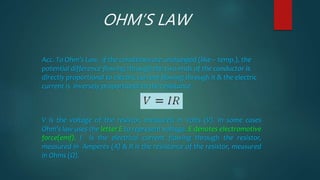
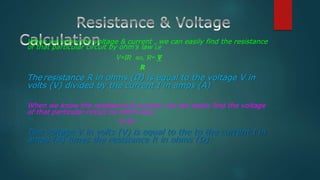
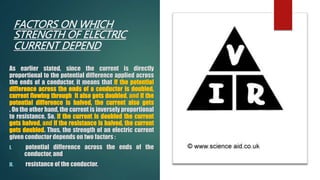
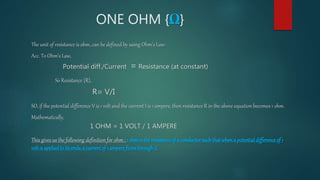
Georg Simon Ohm was a German physicist born in 1789 who discovered Ohm's Law, which states that the current through a conductor is directly proportional to the voltage applied and inversely proportional to the resistance of the conductor. Ohm spent nine years studying electric circuits experimentally and took great care to ensure accuracy in his experiments. In 1827, he was able to show from his experiments the simple mathematical relationship between resistance, current, and voltage that became known as Ohm's Law. Ohm's Law can be expressed as V=IR, where V is voltage, I is current, and R is resistance.






![Polymer [ बहुलक ] Chemistry Notes PDF - Irfanullah Mehar - JJ Sir Chemistry.pdf](https://cdn.slidesharecdn.com/ss_thumbnails/polymerchemistrynotespdf-irfanullahmehar-jjsirchemistry-260210172118-3f9b37f7-thumbnail.jpg?width=640&height=640&fit=bounds)


