Basic Electricity Current & Ohm’s Law E-mail  [email_address] Consulting
Meaning of Current!! ‘ Current ’ is the  rate  of electron Flow. The symbol for current is  I. The  rate  of electron flow is expressed in  ‘ amperes ’ . The symbol for an ampere is  A.
Interesting Electrons !! 1 ‘ FREE ELECTRON ’ is the electron that orbits in the valence shell of a conductive atom. Silver has a greater number of free electrons per unit volume than any other conducting element or matter. More ‘COULOMBS’ of free electrons would be present in a given volume of an  atom of Silver than other conducting matter..
Electron Drift !! Electron ‘DRIFT’ more closely defines the ‘FLOW’ of electrons. Electron movement is a chain reaction along a conducting medium. This movement or drift resembles the Pool Ball that moves at the end of a row of pool balls when the first one is hit.
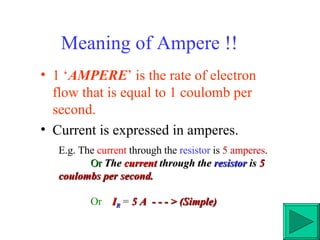
Meaning of Ampere !! 1 ‘ AMPERE ’ is the rate of electron flow that is equal to 1 coulomb per second. Current is expressed in amperes. E.g. The  current  through the  resistor  is  5 amperes . Or   The  current  through the  resistor  is  5 coulombs per second. Or  I R  =  5 A  - - - > (Simple)
Meaning of Coulomb !! 1 ‘ COULOMB ’ is a specific number of electrons. A coulomb is the equivalent of 6.24 x 10 18  electrons. For a given volume of any conducting element, the number of electrons would not be the same.
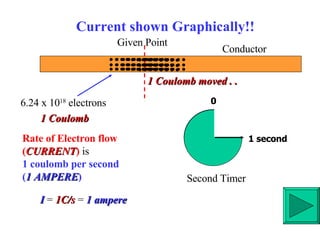
Current shown Graphically!! Conductor Given Point 0 1 second Second Timer 1 Coulomb Rate of Electron flow ( CURRENT )  is  1 coulomb per second ( 1 AMPERE ) I  =  1C/s  =  1 ampere 1 Coulomb moved . .  6.24 x 10 18  electrons
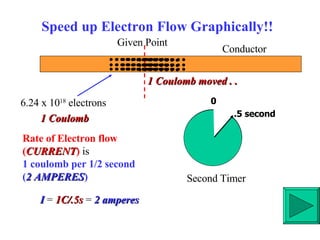
Speed up Electron Flow Graphically!! Conductor Given Point Second Timer 1 Coulomb Rate of Electron flow ( CURRENT )  is  1 coulomb per 1/2 second ( 2 AMPERES ) I  =  1C/.5s  =  2 amperes 1 Coulomb moved . .  0 .5 second 6.24 x 10 18  electrons
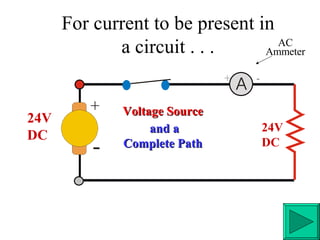
24V DC 24V DC For current to be present in a circuit . . . AC Ammeter Voltage Source  and a Complete Path  + -
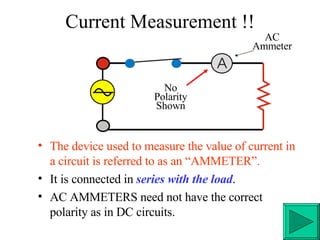
Current Measurement !! The device used to measure the value of current in a circuit is referred to as an “AMMETER”. It is connected in  series with the load . AC AMMETERS need not have the correct polarity as in DC circuits. AC Ammeter No Polarity Shown
Ohm’s Law then & now! Ohm’s original Law was determined when capacitance and inductance was still not studied in detail. So that  Ohm’s Law  can be used in any circuit, a modification is required. Modification: “ The current is directly proportional to the voltage and indirectly proportional to the impedance.” Using the original law in some AC circuits does not return the value of current, and the  modified version  does.
Clamp-On Ammeter This ammeter is simply clamped around any current carrying wire. There are 2 types of clamp-on ammeter. AC (depends on induction) DC (depends on strength of field) When current to be read is very small, just wrap the wire around one tong and divide the readout by the number of wraps of wire around the tong. 10A
Current Facts! A current can not be applied. Current is the rate of electron flow and therefore the term ‘Current Flow’ is redundant but seemingly  acceptable . Current through a resistive component will result in heat produced by the resistive component. Current requires an electrical path. The symbol for current is ‘ I  ’  ( Intensity ) The symbol  for an ampere is  ‘ A ’.
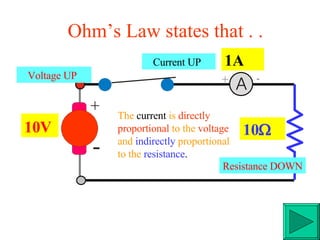
1A 10V Ohm’s Law states that . .   The  current  is   directly proportional   to the   voltage   and   indirectly   proportional   to the   resistance . 10  20  10  2A 20V 1A .25A .5A 1A 5V 10V Voltage UP Current UP  Resistance UP Current DOWN Voltage DOWN Current DOWN Resistance DOWN Current UP  Voltage UP  Current UP  + -
Ohm’s Law This is a law that helps in the understanding of how voltage and opposition in a circuit affect  current . It  does not  help in the determination of  how a voltage is produced. It  does not  help in the determination of the  factors  affecting resistance .
Original Ohm’s Law When this law was ascertained by George Simon Ohm, the only circuit property known at the time was  Resistance . I = E / R  . . . . . Good  only  in resistive circuits!! Michael Faraday, John Henry and others later discovered  Inductance  and  Capacitance Inductance  and/or  capacitance  in an alternating current circuit also exhibit ‘Opposition” to circuit current.  Z =   (R 2  +(X L  - X C ) 2 ) To be able to use the Ohm’s Law concept in all circuits one must use  I = E / Z . . . Good in all Circuits!
Using Ohm’s  Law Since the equation for Ohm’s Law is mathematical, any of the variables in the formula of the equation may be found by manipulating the equation to make a variable the subject. E = IR  (current & resistance do not affect voltage) R = E/I  (voltage & current do not affect resistance) The 2 equations above do not state the  LAW  but are simply relationships in a circuit! The Law  - ->  I = E / R   or  I = E / Z
Ohm’s  Law in Action (I)! 2A 10  20V A.  I = E / R = 20 / 10 =  2A Q. What is the current through the  resistor? + -
Ohm’s  Law in Action (V) ! 2.8A 5  14V Ans.  E = IR = 2.8 x 5 =  14V Q. What is the voltage across the  resistor? + -
Ohm’s  Law in Action (  ) ! .1A 240  24V Ans.  R = E/I = 24 ÷ .1 =  240  Q. What is the resistance of the  resistor? + -
Hydraulic Analogy Electricity might be compared to water: A  battery  could be likened onto a  water pump . Voltage (V) or water pressure (pounds per square inch). Current  could be likened onto the  flow rate  of water. Coulombs per second or gallons per minute. A  wire  could be likened onto a water  hose . Small diameter wire is like a small diameter water hose. An  open switch  is like a  closed valve  . . Either way you have infinite opposition (resistance)(impedance).
Electrons move in a circuit at a given rate if a voltage source is present and there is a closed circuit. The rate is determined by the voltage and the opposition by the circuit components. 1 ampere is a rate of 1 coulomb per second. Current is the rate of electron flow. I = E / R   (Resistive Circuits Only) I = E / Z   (All circuits) Ohm’s Law:   “ The current is directly proportional to the voltage and indirectly proportional to the impedance.”   (any single phase or DC circuit) Summary . . .
The End  ivan.tandberg@shaw.ca  Ph 1-403-361-0703 Silver  Sage I =  E R

Current & Ohms Law 03 2000

  • 1.
    Basic Electricity Current& Ohm’s Law E-mail [email_address] Consulting
  • 2.
    Meaning of Current!!‘ Current ’ is the rate of electron Flow. The symbol for current is I. The rate of electron flow is expressed in ‘ amperes ’ . The symbol for an ampere is A.
  • 3.
    Interesting Electrons !!1 ‘ FREE ELECTRON ’ is the electron that orbits in the valence shell of a conductive atom. Silver has a greater number of free electrons per unit volume than any other conducting element or matter. More ‘COULOMBS’ of free electrons would be present in a given volume of an atom of Silver than other conducting matter..
  • 4.
    Electron Drift !!Electron ‘DRIFT’ more closely defines the ‘FLOW’ of electrons. Electron movement is a chain reaction along a conducting medium. This movement or drift resembles the Pool Ball that moves at the end of a row of pool balls when the first one is hit.
  • 5.
    Meaning of Ampere!! 1 ‘ AMPERE ’ is the rate of electron flow that is equal to 1 coulomb per second. Current is expressed in amperes. E.g. The current through the resistor is 5 amperes . Or The current through the resistor is 5 coulombs per second. Or I R = 5 A - - - > (Simple)
  • 6.
    Meaning of Coulomb!! 1 ‘ COULOMB ’ is a specific number of electrons. A coulomb is the equivalent of 6.24 x 10 18 electrons. For a given volume of any conducting element, the number of electrons would not be the same.
  • 7.
    Current shown Graphically!!Conductor Given Point 0 1 second Second Timer 1 Coulomb Rate of Electron flow ( CURRENT ) is 1 coulomb per second ( 1 AMPERE ) I = 1C/s = 1 ampere 1 Coulomb moved . . 6.24 x 10 18 electrons
  • 8.
    Speed up ElectronFlow Graphically!! Conductor Given Point Second Timer 1 Coulomb Rate of Electron flow ( CURRENT ) is 1 coulomb per 1/2 second ( 2 AMPERES ) I = 1C/.5s = 2 amperes 1 Coulomb moved . . 0 .5 second 6.24 x 10 18 electrons
  • 9.
    24V DC 24VDC For current to be present in a circuit . . . AC Ammeter Voltage Source and a Complete Path + -
  • 10.
    Current Measurement !!The device used to measure the value of current in a circuit is referred to as an “AMMETER”. It is connected in series with the load . AC AMMETERS need not have the correct polarity as in DC circuits. AC Ammeter No Polarity Shown
  • 11.
    Ohm’s Law then& now! Ohm’s original Law was determined when capacitance and inductance was still not studied in detail. So that Ohm’s Law can be used in any circuit, a modification is required. Modification: “ The current is directly proportional to the voltage and indirectly proportional to the impedance.” Using the original law in some AC circuits does not return the value of current, and the modified version does.
  • 12.
    Clamp-On Ammeter Thisammeter is simply clamped around any current carrying wire. There are 2 types of clamp-on ammeter. AC (depends on induction) DC (depends on strength of field) When current to be read is very small, just wrap the wire around one tong and divide the readout by the number of wraps of wire around the tong. 10A
  • 13.
    Current Facts! Acurrent can not be applied. Current is the rate of electron flow and therefore the term ‘Current Flow’ is redundant but seemingly acceptable . Current through a resistive component will result in heat produced by the resistive component. Current requires an electrical path. The symbol for current is ‘ I ’ ( Intensity ) The symbol for an ampere is ‘ A ’.
  • 14.
    1A 10V Ohm’sLaw states that . . The current is directly proportional to the voltage and indirectly proportional to the resistance . 10  20  10  2A 20V 1A .25A .5A 1A 5V 10V Voltage UP Current UP Resistance UP Current DOWN Voltage DOWN Current DOWN Resistance DOWN Current UP Voltage UP Current UP + -
  • 15.
    Ohm’s Law Thisis a law that helps in the understanding of how voltage and opposition in a circuit affect current . It does not help in the determination of how a voltage is produced. It does not help in the determination of the factors affecting resistance .
  • 16.
    Original Ohm’s LawWhen this law was ascertained by George Simon Ohm, the only circuit property known at the time was Resistance . I = E / R . . . . . Good only in resistive circuits!! Michael Faraday, John Henry and others later discovered Inductance and Capacitance Inductance and/or capacitance in an alternating current circuit also exhibit ‘Opposition” to circuit current. Z =  (R 2 +(X L - X C ) 2 ) To be able to use the Ohm’s Law concept in all circuits one must use I = E / Z . . . Good in all Circuits!
  • 17.
    Using Ohm’s Law Since the equation for Ohm’s Law is mathematical, any of the variables in the formula of the equation may be found by manipulating the equation to make a variable the subject. E = IR (current & resistance do not affect voltage) R = E/I (voltage & current do not affect resistance) The 2 equations above do not state the LAW but are simply relationships in a circuit! The Law - -> I = E / R or I = E / Z
  • 18.
    Ohm’s Lawin Action (I)! 2A 10  20V A. I = E / R = 20 / 10 = 2A Q. What is the current through the resistor? + -
  • 19.
    Ohm’s Lawin Action (V) ! 2.8A 5  14V Ans. E = IR = 2.8 x 5 = 14V Q. What is the voltage across the resistor? + -
  • 20.
    Ohm’s Lawin Action (  ) ! .1A 240  24V Ans. R = E/I = 24 ÷ .1 = 240  Q. What is the resistance of the resistor? + -
  • 21.
    Hydraulic Analogy Electricitymight be compared to water: A battery could be likened onto a water pump . Voltage (V) or water pressure (pounds per square inch). Current could be likened onto the flow rate of water. Coulombs per second or gallons per minute. A wire could be likened onto a water hose . Small diameter wire is like a small diameter water hose. An open switch is like a closed valve . . Either way you have infinite opposition (resistance)(impedance).
  • 22.
    Electrons move ina circuit at a given rate if a voltage source is present and there is a closed circuit. The rate is determined by the voltage and the opposition by the circuit components. 1 ampere is a rate of 1 coulomb per second. Current is the rate of electron flow. I = E / R (Resistive Circuits Only) I = E / Z (All circuits) Ohm’s Law: “ The current is directly proportional to the voltage and indirectly proportional to the impedance.” (any single phase or DC circuit) Summary . . .
  • 23.
    The End ivan.tandberg@shaw.ca Ph 1-403-361-0703 Silver Sage I = E R