Grunt Productions 2004
Ocean Circulation
• A Brief By Lance Grindley
Grunt Productions 2004
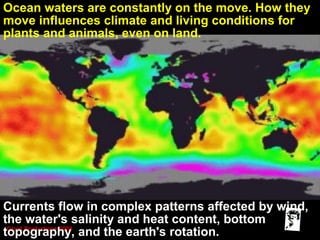
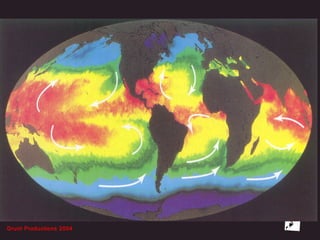
Currents flow in complex patterns affected by wind,
the water's salinity and heat content, bottom
topography, and the earth's rotation.
Ocean waters are constantly on the move. How they
move influences climate and living conditions for
plants and animals, even on land.
Grunt Productions 2004
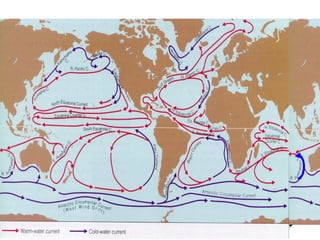
Types of Ocean Currents
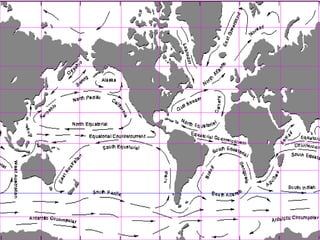
• Surface currents
– Anti-cyclonic current gyres are driven
by the westward flow of equatorial
surface wind.
– Gravity driven roll-back from the
resulting rise of western sea surface
runs equatorial counter current.
– Circum-Antarctic circulation, or “West
Wind Drift” is driven by Earth’s
rotation.
• Deep-water current
– This is thermohaline circulation or the
“Global Conveyor Belt”.
Grunt Productions 2004
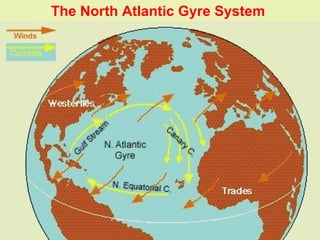
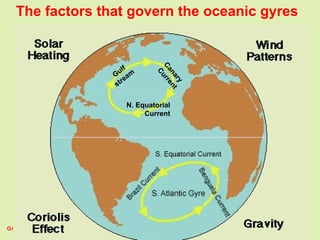
The North Atlantic Gyre System
Grunt Productions 2004
The factors that govern the oceanic gyres
Gulf
stream
N. Equatorial
Current
Canary
Current
Grunt Productions 2004
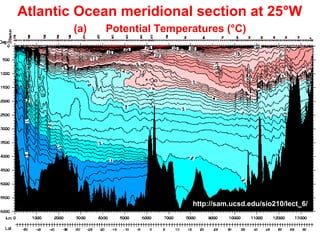
Atlantic Ocean meridional section at 25°W
(a) Potential Temperatures (°C)
http://sam.ucsd.edu/sio210/lect_6/
Grunt Productions 2004
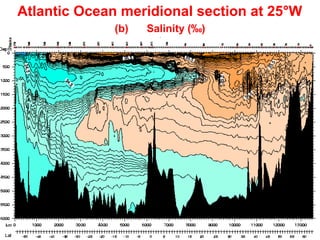
Atlantic Ocean meridional section at 25°W
(b) Salinity (‰)
Grunt Productions 2004
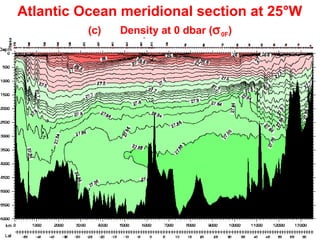
Atlantic Ocean meridional section at 25°W
(c) Density at 0 dbar (σ0F)
Grunt Productions 2004
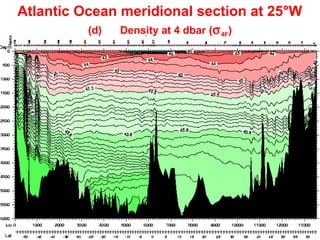
Atlantic Ocean meridional section at 25°W
(d) Density at 4 dbar (σ4F)
Grunt Productions 2004
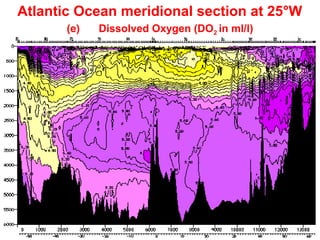
Atlantic Ocean meridional section at 25°W
(e) Dissolved Oxygen (DO2 in ml/l)
Grunt Productions 2004
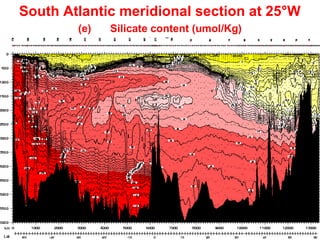
South Atlantic meridional section at 25°W
(e) Silicate content (umol/Kg)
Grunt Productions 2004
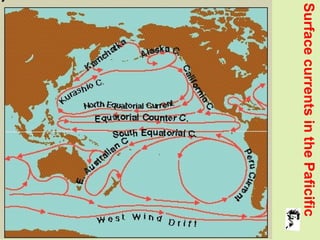
SurfacecurrentsinthePaficific
Grunt Productions 2004
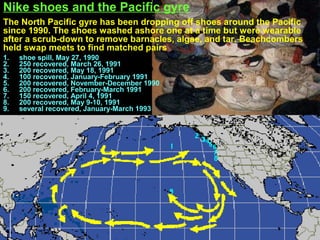
1. shoe spill, May 27, 1990
2. 250 recovered, March 26, 1991
3. 200 recovered, May 18, 1991
4. 100 recovered, January-February 1991
5. 200 recovered, November-December 1990
6. 200 recovered, February-March 1991
7. 150 recovered, April 4, 1991
8. 200 recovered, May 9-10, 1991
9. several recovered, January-March 1993
Nike shoes and the Pacific gyre
The North Pacific gyre has been dropping off shoes around the Pacific
since 1990. The shoes washed ashore one at a time but were wearable
after a scrub-down to remove barnacles, algae, and tar. Beachcombers
held swap meets to find matched pairs
Grunt Productions 2004
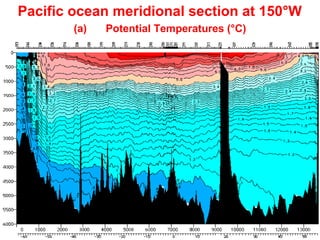
Pacific ocean meridional section at 150°W
(a) Potential Temperatures (°C)
Grunt Productions 2004
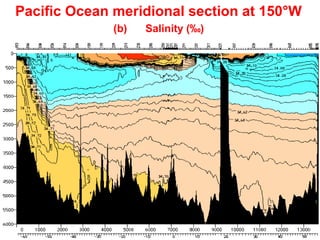
Pacific Ocean meridional section at 150°W
(b) Salinity (‰)
Grunt Productions 2004
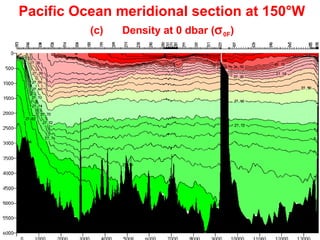
Pacific Ocean meridional section at 150°W
(c) Density at 0 dbar (σ0F)
Grunt Productions 2004
Pacific Ocean meridional section at 150°W
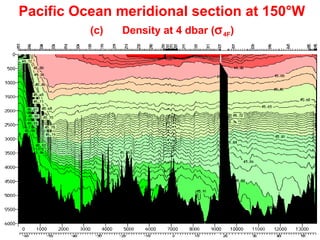
(c) Density at 4 dbar (σ4F)
Grunt Productions 2004
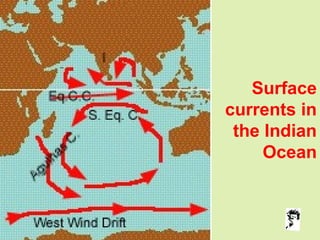
Surface
currents in
the Indian
Ocean
Grunt Productions 2004
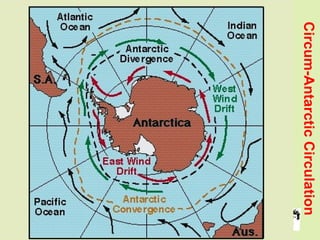
Circum-AntarcticCirculation
Grunt Productions 2004
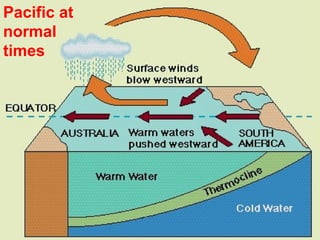
Pacific at
normal
times
Grunt Productions 2004
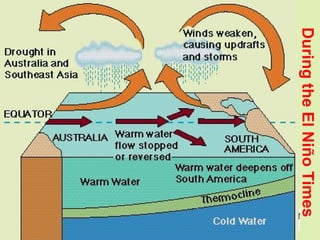
DuringtheElNiñoTimes
Grunt Productions 2004
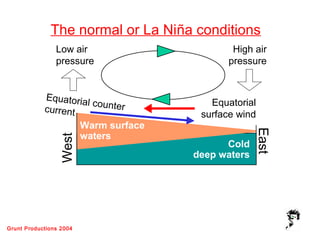
Equatorial
surface wind
High air
pressure
West
East
Cold
deep waters
Equatorial countercurrent
The normal or La Niña conditions
Warm surface
waters
Low air
pressure
Grunt Productions 2004
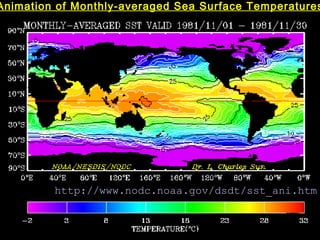
http://www.nodc.noaa.gov/dsdt/sst_ani.htm
Animation of Monthly-averaged Sea Surface Temperatures
Grunt Productions 2004
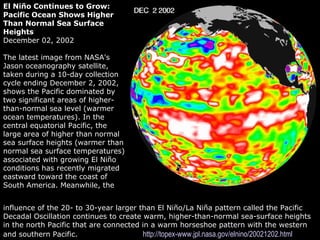
El Niño Continues to Grow:
Pacific Ocean Shows Higher
Than Normal Sea Surface
Heights
December 02, 2002
The latest image from NASA's
Jason oceanography satellite,
taken during a 10-day collection
cycle ending December 2, 2002,
shows the Pacific dominated by
two significant areas of higher-
than-normal sea level (warmer
ocean temperatures). In the
central equatorial Pacific, the
large area of higher than normal
sea surface heights (warmer than
normal sea surface temperatures)
associated with growing El Niño
conditions has recently migrated
eastward toward the coast of
South America. Meanwhile, the
influence of the 20- to 30-year larger than El Niño/La Niña pattern called the Pacific
Decadal Oscillation continues to create warm, higher-than-normal sea-surface heights
in the north Pacific that are connected in a warm horseshoe pattern with the western
and southern Pacific. http://topex-www.jpl.nasa.gov/elnino/20021202.html
Grunt Productions 2004
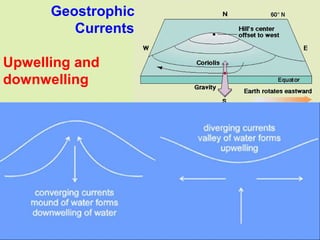
Geostrophic
Currents
Upwelling and
downwelling
Grunt Productions 2004
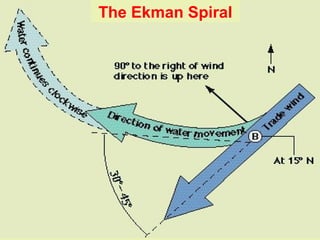
The Ekman Spiral
Grunt Productions 2004
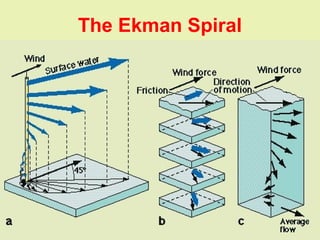
The Ekman Spiral
Grunt Productions 2004
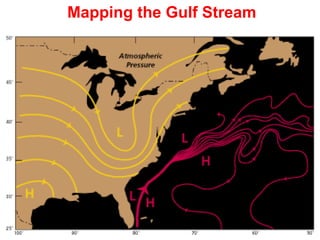
Mapping the Gulf Stream
Grunt Productions 2004
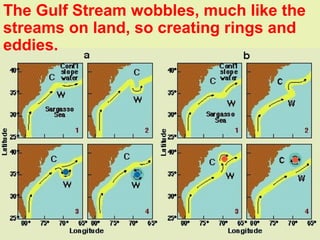
The Gulf Stream wobbles, much like the
streams on land, so creating rings and
eddies.
Grunt Productions 2004
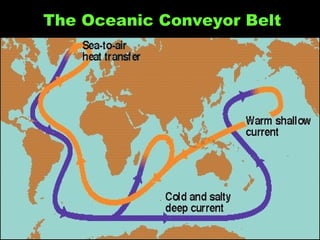
The Oceanic Conveyor Belt
Grunt Productions 2004

Ocean circulation lrg