Thermohaline Circulation
              and
         Climate Change

Prof./Dr.Krishna AchutaRao
 Science of Climate Change        ­ by
          ASL 715            Arulalan.T
                             2012 AST 2532
                               M.Tech, CAS,
                                 IIT Delhi
Ocean Circulation

• What drives the Ocean circulation?
• Two kinds of circulation (?)
    – Wind­driven (surface) circulation.
    – Thermohaline circulation (deep), driven by   
       fluxes of heat and freshwater across the sea 
       Surface.
●
   Role of Oceans in climate
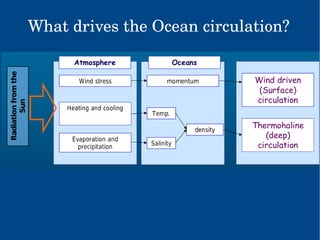
What drives the Ocean circulation?
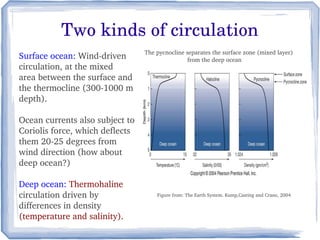
Two kinds of circulation
                                 The pycnocline separates the surface zone (mixed layer)            
Surface ocean: Wind­driven                       from the deep ocean
circulation, at the mixed
area between the surface and
the thermocline (300­1000 m
depth).

Ocean currents also subject to
Coriolis force, which deflects
them 20­25 degrees from
wind direction (how about 
deep ocean?)

Deep ocean: Thermohaline
circulation driven by                Figure from: The Earth System. Kump,Casting and Crane, 2004

differences in density
(temperature and salinity).
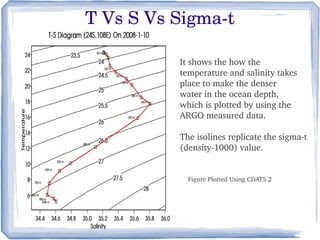
T Vs S Vs Sigma­t

               It shows the how the  
               temperature and salinity takes 
               place to make the denser
               water in the ocean depth,
               which is plotted by using the    
               ARGO measured data. 

               The isolines replicate the sigma­t 
               (density­1000) value. 


               Figure Plotted Using CDAT5.2
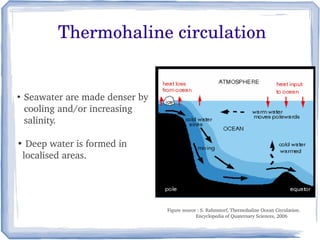
Thermohaline circulation


●
    Seawater are made denser by 
    cooling and/or increasing
    salinity.

• Deep water is formed in  
  localised areas.


                                   Figure source : S. Rahmstorf, Thermohaline Ocean Circulation.   
                                                Encyclopedia of Quaternary Sciences, 2006
What drives the THC ?
• The high­latitude cooling
●
   filling box dynamics
●
  Sandström’s  theorem – heating at greater depth than 
  cooling, by turbulent mixing (~1000 years)
●
  Mechanism to drive ocean circulation is through fluxes of 
  heat and freshwater ?

●
    Deep water is formed in localised areas.

●
    when the water column then becomes Unstable, leading to 
    large­scale deep overturning of the oceans.

●
    It is estimated time period 1000 ­5000 years.
Key features of the THC
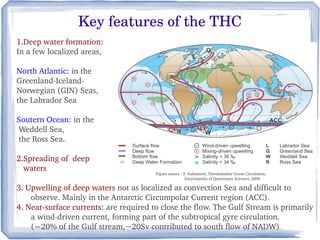
1.Deep water formation:
In a few localized areas,

North Atlantic: in the 
Greenland­Iceland­
Norwegian (GIN) Seas,
the Labrador Sea

Soutern Ocean: in the
 Weddell Sea, 
 the Ross Sea.

2.Spreading of  deep 
   waters
                                        Figure source : S. Rahmstorf, Thermohaline Ocean Circulation.
                                                         Encyclopedia of Quaternary Sciences, 2006

3. Upwelling of deep waters not as localized as convection Sea and difficult to 
    observe. Mainly in the Antarctic Circumpolar Current region (ACC). 
4. Near­surface currents: are required to close the flow. The Gulf Stream is primarily
    a wind­driven current, forming part of the subtropical gyre circulation.
    (~20% of the Gulf stream,~20Sv contributed to south flow of NADW)
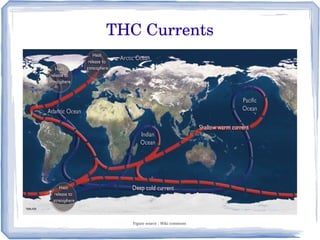
THC Currents


   Figure source : Wiki commons
Spreading of deep waters
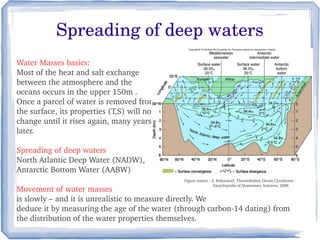
Water Masses basics:
Most of the heat and salt exchange
between the atmosphere and the
oceans occurs in the upper 150m .
Once a parcel of water is removed from
the surface, its properties (T,S) will not
change until it rises again, many years
later.

Spreading of deep waters
North Atlantic Deep Water (NADW),
Antarctic Bottom Water (AABW)
                                              Figure source : S. Rahmstorf, Thermohaline Ocean Circulation.   
                                                               Encyclopedia of Quaternary Sciences, 2006
Movement of water masses
is slowly – and it is unrealistic to measure directly. We
deduce it by measuring the age of the water (through carbon­14 dating) from 
the distribution of the water properties themselves.
History of the THC 
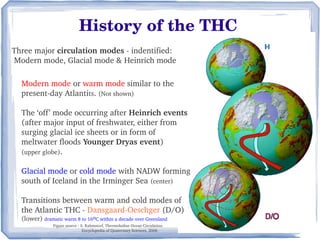
Three major circulation modes ­ indentified: 
 Modern mode, Glacial mode & Heinrich mode

  Modern mode or warm mode similar to the
  present­day Atlantits. (Not shown)

  The ‘off’ mode occurring after Heinrich events
  (after major input of freshwater, either from 
  surging glacial ice sheets or in form of 
  meltwater floods Younger Dryas event) 
  (upper globe). 


  Glacial mode or cold mode with NADW forming 
  south of Iceland in the Irminger Sea (center)

  Transitions between warm and cold modes of 
  the Atlantic THC ­ Dansgaard­Oeschger (D/O)
  (lower) dramatic warm 8 to 16oC within a decade over Greenland
               Figure source : S. Rahmstorf, Thermohaline Ocean Circulation.   
                                Encyclopedia of Quaternary Sciences, 2006
The future of the THC
Global warming can affect the THC in two ways: 
surface warming and surface freshening, both reducing the density of 
high­latitude surface waters & deep water formation. 

Most models predict a significant weakening of NADW formation 
(by 20­50%) in response to anthropogenic global warming during the 
21st century [IPCC, 2001]. Some also find a reduction in AABW 
formation.

A major weakening or shut­down of NADW formation could have 
serious impacts on marine ecosystems, sea level and surface climate, 
including a shift in ITCZ & tropical rainfall belts. 
In 2050s
●
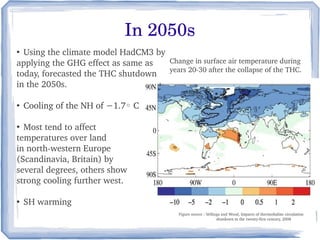
  Using the climate model HadCM3 by 
applying the GHG effect as same as   Change in surface air temperature during 
today, forecasted the THC shutdown  years 20­30 after the collapse of the THC. 
in the 2050s.

●
    Cooling of the NH of −1.7◦ C

●
  Most tend to affect
temperatures over land
in north­western Europe
(Scandinavia, Britain) by
several degrees, others show
strong cooling further west.

●
    SH warming
                                            Figure source : Vellinga and Wood, Impacts of thermohaline circulation
                                                                     shutdown in the twenty­first century, 2008
MOC

●
    The meridional overturning circulation (MOC) refers to the north­south 
    flow as a function of latitude and depth.

●
    MOC describing a meridional flow field, a mix of both wind­driven and 
    thermohaline­flow, often integrated in east­west direction across an 
    ocean basin or the globe and graphically depicted as a stream function.

●
    THC associated with zonal overturning cells and it describing the 
    influence of cooling or freshwater forcing on the ocean circulation.
Transporting the heat to the poles
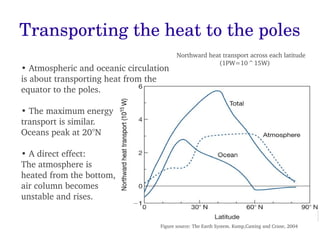
                                         Northward heat transport across each latitude
                                                      (1PW=10^15W)
• Atmospheric and oceanic circulation
is about transporting heat from the
equator to the poles.

• The maximum energy 
transport is similar.
Oceans peak at 20°N

• A direct effect: 
The atmosphere is
heated from the bottom,
air column becomes
unstable and rises.


                                  Figure source: The Earth System. Kump,Casting and Crane, 2004
Role of Oceans in Climate variations

●
    On time­scale of months or years Oceans are vast reservoir of heat 
    and will regulate the climate by heating or cooling the atmosphere 
    (hurricanes / El Niño).

●
    On longer time­scale it is the large heat transport (~1PW) of the 
    deep circulation that could change the climate.

●
    Oceans can absorb heat in one region and restore it to the 
    atmosphere (perhaps decades or centuries later) at a quite different 
    place.

●
    A THC collapse is seen to have happen in the past. It is widely 
    discussed as one of a number of "low probability ­ high impact" 
    risks associated with global warming.
References
[1] Wallace S. Broecker, James P . Kennett, Benjamin P. Flower, James T. Teller, Sue Trumbore, 
      Georges Bonani, and Willy Wolfli. Routing of meltwater from the laurentide ice sheet 
      during the younger dryas cold episode. Nature, 341(6240):318–321, September 1989. 

[2] Peter U. Clark, Nicklas G. Pisias, Thomas F. Stocker, and Andrew J. Weaver.  The role of 
      the thermohaline circulation in abrupt climate change. Nature, 415(6874):863–869, 
      February 2002. 

[3] J. F. McManus, R. Francois, J. M. Gherardi, L. D. Keigwin, and S. Brown­Leger. Collapse
      and rapid resumption of atlantic meridional circulation linked to deglacial climate 
      changes. Nature, 428(6985):834–837, April 2004.

[4] Michael Vellinga and RichardA Wood. Impacts of thermohaline circulation shutdown in 
      the twenty­first century. Climatic Change , 91(1­2):43–63+, 2008.

[5] S. Rahmstorf, S. A. Elias. Elsevier and Amsterdam. Thermohaline Ocean Circulation.   
      Encyclopedia of Quaternary Sciences, 2006.
Thank you

Thermohaline Circulation & Climate Change