ARE YOU READY……..
TsunamiA Dreadful DisasterPresented By: AnkitMittal© Tsunamis/ AnkitMittal. All Rights Reserved.
Do you know about a Tsunami?-In the next several slides you will learn about how a tsunami is…….
-Formed (1 slide)
-How it effects us (1 slide)
-History/timeline(3 slides)
-How to be aware ( 3 slide)-Before-During -AfterHow fast a tsunami moves (1 slide)
How big do they get (1 slide)
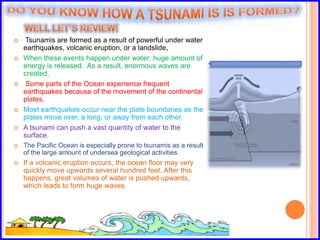
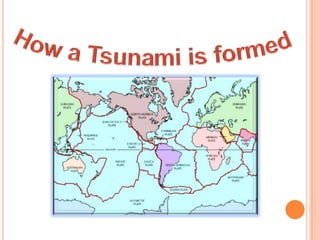
FactsDo you know HOW A Tsunami is is formed?  Well let’s review!Tsunamis are formed as a result of powerful under water earthquakes, volcanic eruption, or a landslide, When these events happen under water, huge amount of energy is released.  As a result, enormous waves are created.   Some parts of the Ocean experience frequent earthquakes because of the movement of the continental  plates. Most earthquakes occur near the plate boundaries as the plates move over, a long, or away from each other.A tsunami can push a vast quantity of water to the surface.The Pacific Ocean is especially prone to tsunamis as a result of the large amount of undersea geological activities. If a volcanic eruption occurs, the ocean floor may very quickly move upwards several hundred feet. After this happens, great volumes of water is pushed upwards, which leads to form huge waves.
How a Tsunami is formed
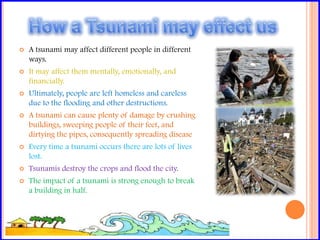
How a Tsunami may effect usA tsunami may affect different people in different ways. It may affect them mentally, emotionally, and financially.Ultimately, people are left homeless and careless due to the flooding and other destructions.A tsunami can cause plenty of damage by crushing buildings, sweeping people of their feet, and dirtying the pipes, consequently spreading disease  Every time a tsunami occurs there are lots of lives lost.Tsunamis destroy the crops and flood the city.The impact of a tsunami is strong enough to break a building in half.
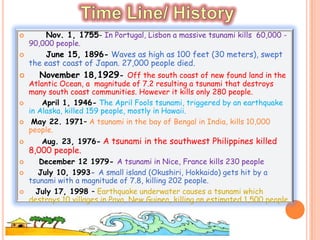
Time Line/ History     Nov. 1, 1755- In Portugal, Lisbon a massive tsunami kills  60,000 - 90,000 people.     June 15, 1896-Waves as high as 100 feet (30 meters), swept the east coast of Japan. 27,000 people died.November 18,1929- Off the south coast of new found land in the Atlantic Ocean, a  magnitude of 7.2 resulting a tsunami that destroys many south coast communities. However it kills only 280 people.    April 1, 1946-The April Fools tsunami, triggered by an earthquake in Alaska, killed 159 people, mostly in Hawaii.May 22. 1971– A tsunami in the bay of Bengal in India, kills 10,000 people.    Aug. 23, 1976-A tsunami in the southwest Philippines killed 8,000 people. December 12 1979- A tsunami in Nice, France kills 230 peopleJuly 10, 1993- A small island (Okushiri, Hokkaido) gets hit by a tsunami with a magnitude of 7.8, killing 202 people.  July 17, 1998 – Earthquake underwater causes a tsunami which destroys 10 villages in Pava, New Guinea, killing an estimated 1,500 people.
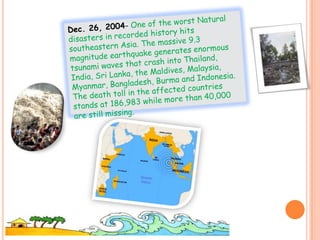
Dec. 26, 2004- One of the worst Natural disasters in recorded history hits southeastern Asia. The massive 9.3 magnitude earthquake generates enormous tsunami waves that crash into Thailand, India, Sri Lanka, the Maldives, Malaysia, Myanmar, Bangladesh, Burma and Indonesia. The death toll in the affected countries stands at 186,983 while more than 40,000 are still missing.
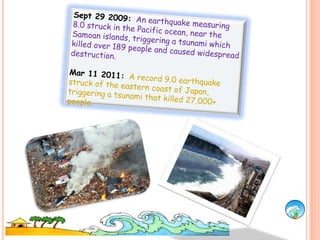
Sept 29 2009:  An earthquake measuring 8.0 struck in the Pacific ocean, near the Samoan islands, triggering a tsunami which killed over 189 people and caused widespread destruction.Mar 11 2011:  A record 9.0 earthquake struck of the eastern coast of Japan, triggering a tsunami that killed 27,000+ people.
Did you know that most of the tsunamis occur within the ring of fire/ in the pacific ocean!!
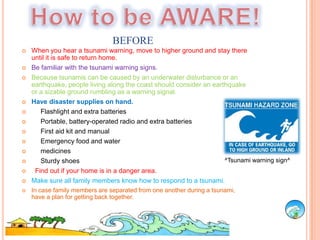
How to be AWARE!BEFOREWhen you hear a tsunami warning, move to higher ground and stay there until it is safe to return home. Be familiar with the tsunami warning signs.Because tsunamis can be caused by an underwater disturbance or an earthquake, people living along the coast should consider an earthquake or a sizable ground rumbling as a warning signal.Have disaster supplies on hand.      Flashlight and extra batteries      Portable, battery-operated radio and extra batteries      First aid kit and manual      Emergency food and water      medicines     Sturdy shoes Find out if your home is in a danger area.Make sure all family members know how to respond to a tsunami. In case family members are separated from one another during a tsunami, have a plan for getting back together. ^Tsunami warning sign^
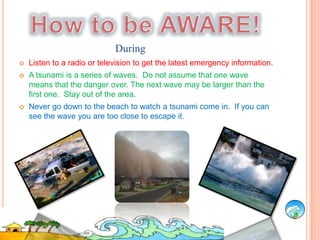
Listen to a radio or television to get the latest emergency information.A tsunami is a series of waves.  Do not assume that one wave means that the danger over. The next wave may be larger than the first one.  Stay out of the area.Never go down to the beach to watch a tsunami come in.  If you can see the wave you are too close to escape it.How to be AWARE!During
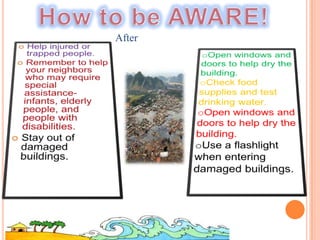
How to be AWARE!Help injured or trapped people.Remember to help your neighbors who may require special assistance- infants, elderly people, and people with disabilities. Stay out of damaged buildings.Open windows and doors to help dry the building.

Tsunami

  • 1.
  • 2.
    TsunamiA Dreadful DisasterPresentedBy: AnkitMittal© Tsunamis/ AnkitMittal. All Rights Reserved.
  • 3.
    Do you knowabout a Tsunami?-In the next several slides you will learn about how a tsunami is…….
  • 4.
  • 5.
    -How it effectsus (1 slide)
  • 6.
  • 7.
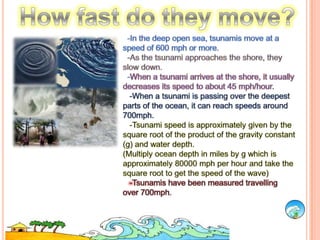
    -How to beaware ( 3 slide)-Before-During -AfterHow fast a tsunami moves (1 slide)
  • 8.
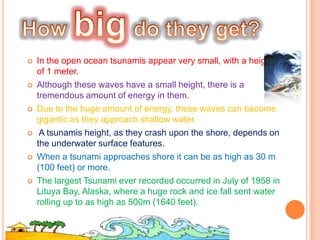
    How big dothey get (1 slide)
  • 9.
    FactsDo you knowHOW A Tsunami is is formed? Well let’s review!Tsunamis are formed as a result of powerful under water earthquakes, volcanic eruption, or a landslide, When these events happen under water, huge amount of energy is released. As a result, enormous waves are created. Some parts of the Ocean experience frequent earthquakes because of the movement of the continental plates. Most earthquakes occur near the plate boundaries as the plates move over, a long, or away from each other.A tsunami can push a vast quantity of water to the surface.The Pacific Ocean is especially prone to tsunamis as a result of the large amount of undersea geological activities. If a volcanic eruption occurs, the ocean floor may very quickly move upwards several hundred feet. After this happens, great volumes of water is pushed upwards, which leads to form huge waves.
  • 10.
    How a Tsunamiis formed
  • 11.
    How a Tsunamimay effect usA tsunami may affect different people in different ways. It may affect them mentally, emotionally, and financially.Ultimately, people are left homeless and careless due to the flooding and other destructions.A tsunami can cause plenty of damage by crushing buildings, sweeping people of their feet, and dirtying the pipes, consequently spreading disease Every time a tsunami occurs there are lots of lives lost.Tsunamis destroy the crops and flood the city.The impact of a tsunami is strong enough to break a building in half.
  • 12.
    Time Line/ History Nov. 1, 1755- In Portugal, Lisbon a massive tsunami kills 60,000 - 90,000 people. June 15, 1896-Waves as high as 100 feet (30 meters), swept the east coast of Japan. 27,000 people died.November 18,1929- Off the south coast of new found land in the Atlantic Ocean, a magnitude of 7.2 resulting a tsunami that destroys many south coast communities. However it kills only 280 people. April 1, 1946-The April Fools tsunami, triggered by an earthquake in Alaska, killed 159 people, mostly in Hawaii.May 22. 1971– A tsunami in the bay of Bengal in India, kills 10,000 people. Aug. 23, 1976-A tsunami in the southwest Philippines killed 8,000 people. December 12 1979- A tsunami in Nice, France kills 230 peopleJuly 10, 1993- A small island (Okushiri, Hokkaido) gets hit by a tsunami with a magnitude of 7.8, killing 202 people. July 17, 1998 – Earthquake underwater causes a tsunami which destroys 10 villages in Pava, New Guinea, killing an estimated 1,500 people.
  • 13.
    Dec. 26, 2004-One of the worst Natural disasters in recorded history hits southeastern Asia. The massive 9.3 magnitude earthquake generates enormous tsunami waves that crash into Thailand, India, Sri Lanka, the Maldives, Malaysia, Myanmar, Bangladesh, Burma and Indonesia. The death toll in the affected countries stands at 186,983 while more than 40,000 are still missing.
  • 14.
    Sept 29 2009: An earthquake measuring 8.0 struck in the Pacific ocean, near the Samoan islands, triggering a tsunami which killed over 189 people and caused widespread destruction.Mar 11 2011:  A record 9.0 earthquake struck of the eastern coast of Japan, triggering a tsunami that killed 27,000+ people.
  • 15.
    Did you knowthat most of the tsunamis occur within the ring of fire/ in the pacific ocean!!
  • 16.
    How to beAWARE!BEFOREWhen you hear a tsunami warning, move to higher ground and stay there until it is safe to return home. Be familiar with the tsunami warning signs.Because tsunamis can be caused by an underwater disturbance or an earthquake, people living along the coast should consider an earthquake or a sizable ground rumbling as a warning signal.Have disaster supplies on hand. Flashlight and extra batteries Portable, battery-operated radio and extra batteries First aid kit and manual Emergency food and water medicines Sturdy shoes Find out if your home is in a danger area.Make sure all family members know how to respond to a tsunami. In case family members are separated from one another during a tsunami, have a plan for getting back together. ^Tsunami warning sign^
  • 17.
    Listen to aradio or television to get the latest emergency information.A tsunami is a series of waves.  Do not assume that one wave means that the danger over. The next wave may be larger than the first one.  Stay out of the area.Never go down to the beach to watch a tsunami come in.  If you can see the wave you are too close to escape it.How to be AWARE!During
  • 18.
    How to beAWARE!Help injured or trapped people.Remember to help your neighbors who may require special assistance- infants, elderly people, and people with disabilities. Stay out of damaged buildings.Open windows and doors to help dry the building.