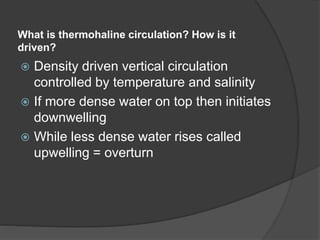
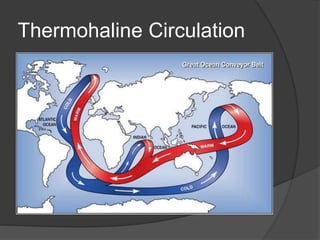
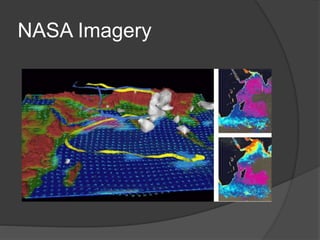
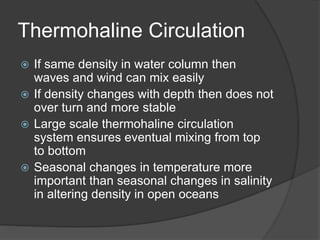
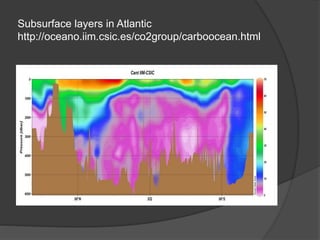
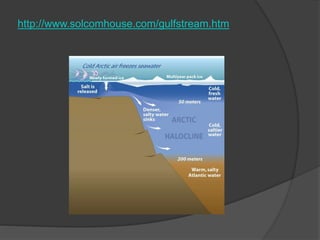
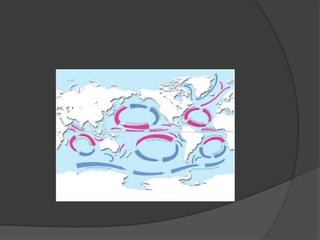
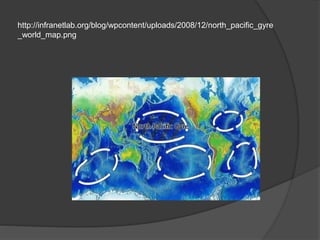
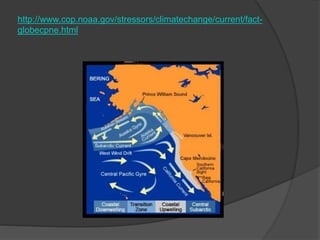
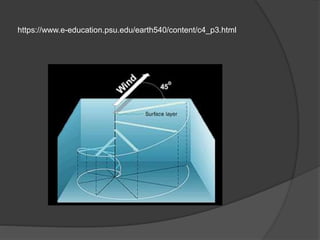
This document discusses ocean circulation patterns driven by temperature and salinity differences. It explains that surface waters are well-mixed to 100m depth, below which density changes rapidly due to temperature decreases. Latitude also affects density, with warmer, lower salinity water at the equator being less dense than cooler, higher salinity water at 30 and 60 degrees latitude. Thermohaline circulation refers to global-scale density-driven vertical circulation controlled by temperature and salinity. Gyres are large circular ocean currents driven by winds and the Coriolis effect. Different ocean basins have varying circulation patterns influenced by factors like incoming rivers and surrounding land masses.