Oceanic currents
Mohammed Zahid Jameel Shaikh B-38
Hello My name is Mohammed Zahid
Jameel Shaikh B-38 This is my
presentation On Oceanic currents
(lesson number.5)
This is what I have made 
Introduction
Warm currents flow away from the
equator.
€
Cold currents flow toward the equator.
Ocean Currents
It will occur to you that as the temperature
of water increases, the plastic sequins move
from one place to another. As the temperature
rises, the density of water decreases and it
becomes lighter. And, therefore, the water
having lower temperature which is heavier
replaces the water with higher temperatures.
After sometime, the sequins start moving in a
circular motion. There is movement of these
sequins because of the flow of water.
Geographical Explanation
Strange Incident in Pacific occean in
1992
 A very strange incident
occurred in the
 Pacific Ocean in the year
1992. A cargo ship
 sailed towards America
from Hong Kong.
 While travelling through
the Pacific Ocean,
 near the Hawaii Islands, a
container full of toys
 fell into the ocean and
broke. Around 28000
Continue of 6th slide
the Arctic ocean by the year
2000. Some of them also
floated to Atlantic Ocean from
the
Arctic. Some of these reached the
eastern coast
of America in 2003 and some of
the toys had
even reached the European coast
by 2007.
Continue of 5th Slide
rubber toys started floating
on the ocean. This
incident occurred on 10th
January, 1992. Now
a strange thing happened.
After around 10
months, on 16th November,
1992, some of
these toys reached the
coast of Alaska. Some of
them crossed the Bering
Strait and moved upto
Continue of 7th slide
From the Hawaii Islands, some
toys took the
route to Australia! See figure 5.2
and 5.3
Explanation
The region from sea level to the depth of
500 m. is considered to be the surface water.
Sunlight can reach till this depth. The movements
in this layer occur mainly due to differences in
temperature and salinity. The planetary winds
give speed to the ocean currents.
Because of the rotation
of the earth, the ocean currents
move in
Rotation of the
Earth
Horizontal Surface Occean Current
Horizontal (Surface) Ocean Current :
The flow on the surface of the ocean moves
only 10% of the oceanic water. The surface
flow is considered up to 500 metres of depth.
The discharge of water in the oceans is
measured in Sverdrup unit. It is equivalent to 1
million cu.m./second discharge. The horizontal
flow of ocean water occurs as warm and cold
currents. These currents flow from the equator
to the poles and from the poles to the equator.
These currents are pushed to long distances by
the planetary winds. As a result, the ocean
waters flow from equator to both the poles and
vice versa.
There is similarity between the patterns
of the ocean currents of the Pacific and
Atlantic Ocean but the flow of the ocean
currents of the Indian Ocean are different.
The Indian Ocean is land-locked in the
north. The equator divides this ocean into
two parts- northern and southern. The
Monsoon winds influence this ocean
tremendously. These winds change their
direction according to the season. In the
northern part of the Indian Ocean, currents
flow in clockwise direction in summer while
in winter they flow in the opposite direction
due to reversal of Monsson Winds.
Fact of THE OCEAN CURRENTS OF THE
INDIAN OCEAN :
We have studied that ocean currents are
formed due to differences in temperature,
density and planetary winds. In addition, the
following reasons are also responsible for the
direction of flow of ocean currents and their velocity
clockwise direction in the Northern Hemisphere and in anti-clockwise direction
in the Southern Hemisphere.
Geographical Explanation
According to the
alignment of the coastline, the direction of the
ocean current changes. The velocity of the
ocean currents is around 2 to 10 km per hour.
The ocean currents are divided into two types-
cold currents and warm currents.
Continental Structure
Effects of Ocean Surface Currents on Human
life :
Ocean currents especially affect the
climate of the regions having proximity to the
sea. In cold regions where warm ocean currents
flow, climate becomes warmer. In some regions,
the amount of precipitation increases. For
example, the warm ocean currents flowing near
Western Europe, Southern Alaska, and
Japanese coast, reduce the intensity of the
winters there and make them warmer. As a
result, these ports do not freeze in winters.
Had ocean currents been absent, the ocean
water would have remained still. In such waters,
the biotic components would have been devoid
of food. Consequently, marine life and its
ecosystems would have been limited in its extent
In regions where cold and warm
currents meet, plankton, vegetation, algae, etc.
grow. This is food for the fish. Therefore, fish
come here in large numbers and breed……..
This
has, in turn, led to formation of large fishing
grounds. Grand Bank near the North American
coast in Atlantic Ocean and Dogger Bank near
the European coast are some of the examples.
With respect to the water transport too, the
ocean currents are very important. If the
transportation is done according to the flow of
ocean currents, the speed of the ships increase
and the fuel is saved too.
Near the coasts where cold currents flow,
the amount of precipitation is low. For example,
in Peru, Chile and the arid desert of South-West
Africa.
At places where the cold and the warm
currents meet, thick fog is formed. Such fogs
create problems for transportation. The warm
Gulf Stream and the cold Labrador currents
meet near the Newfoundland island. This leads
to dense fog. Because of the cold currents,
icebergs are carried away from the polar areas.
If such icebergs come along the marine routes,
they are hazardous to the ships.
Deep occean currrents img
Deep Occean currents
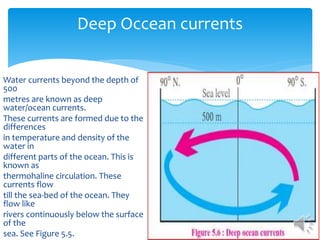
Water currents beyond the depth of
500
metres are known as deep
water/ocean currents.
These currents are formed due to the
differences
in temperature and density of the
water in
different parts of the ocean. This is
known as
thermohaline circulation. These
currents flow
till the sea-bed of the ocean. They
flow like
rivers continuously below the surface
of the
sea. See Figure 5.5.
Deep occean currents
The difference in temperatures of various
parts of the ocean is the major reason behind
the deep-sea currents. Warm water has lower
salinity and density. Such water comes to the
surface of the sea. Cold water with high
density
goes down. This movement causes the deep
sea
water currents. See figure 5.6. Generally, the
surface water near Greenland and Europe
moves to more depths. This water moves to
the
Antarctica at these depths. Later the water
moves to the surface. Thus, the redistribution
of the ocean water keeps occurring. This
redistribution takes around 500 years to
complete. This type of movement is also
known
as conveyor belt.
of this circulation, ocean water
moves from thesurface to the
bottom and from the bottom
tothe surface. Warm water is
transferred to thebottom from
the surface and the nutrient-
richcold water is circulated to the
surface.
Due to thermohaline circulation, movement of sea water occurs on a
large scale. Because of this circulation, ocean water moves from the
surface to the bottom and from the bottom to
the surface. Warm water is transferred to the
bottom from the surface and the nutrient-rich
cold water is circulated to the surface.
These circular pattern of themovements of the ocean currents, give
riseto certain peculiar features in the ocean.They are called gyres. The
Sargasso Sea inthe Atlantic Ocean is such an example. It ismarked by
the circular patterns of oceancurrents . It does not have land
boundariesand is only surrounded by ocean currents.It gets its name
from the Sargassumseaweed. The water is still here. This sea is1100
km wide and 3200km long.
Importance of deep occean currents
Outro

Oceanic currents GEography

  • 1.
  • 2.
    Hello My nameis Mohammed Zahid Jameel Shaikh B-38 This is my presentation On Oceanic currents (lesson number.5) This is what I have made  Introduction
  • 3.
    Warm currents flowaway from the equator. € Cold currents flow toward the equator. Ocean Currents
  • 4.
    It will occurto you that as the temperature of water increases, the plastic sequins move from one place to another. As the temperature rises, the density of water decreases and it becomes lighter. And, therefore, the water having lower temperature which is heavier replaces the water with higher temperatures. After sometime, the sequins start moving in a circular motion. There is movement of these sequins because of the flow of water. Geographical Explanation
  • 5.
    Strange Incident inPacific occean in 1992  A very strange incident occurred in the  Pacific Ocean in the year 1992. A cargo ship  sailed towards America from Hong Kong.  While travelling through the Pacific Ocean,  near the Hawaii Islands, a container full of toys  fell into the ocean and broke. Around 28000
  • 6.
    Continue of 6thslide the Arctic ocean by the year 2000. Some of them also floated to Atlantic Ocean from the Arctic. Some of these reached the eastern coast of America in 2003 and some of the toys had even reached the European coast by 2007.
  • 7.
    Continue of 5thSlide rubber toys started floating on the ocean. This incident occurred on 10th January, 1992. Now a strange thing happened. After around 10 months, on 16th November, 1992, some of these toys reached the coast of Alaska. Some of them crossed the Bering Strait and moved upto
  • 8.
    Continue of 7thslide From the Hawaii Islands, some toys took the route to Australia! See figure 5.2 and 5.3
  • 9.
    Explanation The region fromsea level to the depth of 500 m. is considered to be the surface water. Sunlight can reach till this depth. The movements in this layer occur mainly due to differences in temperature and salinity. The planetary winds give speed to the ocean currents.
  • 10.
    Because of therotation of the earth, the ocean currents move in Rotation of the Earth
  • 11.
    Horizontal Surface OcceanCurrent Horizontal (Surface) Ocean Current : The flow on the surface of the ocean moves only 10% of the oceanic water. The surface flow is considered up to 500 metres of depth. The discharge of water in the oceans is measured in Sverdrup unit. It is equivalent to 1 million cu.m./second discharge. The horizontal flow of ocean water occurs as warm and cold currents. These currents flow from the equator to the poles and from the poles to the equator. These currents are pushed to long distances by the planetary winds. As a result, the ocean waters flow from equator to both the poles and vice versa.
  • 12.
    There is similaritybetween the patterns of the ocean currents of the Pacific and Atlantic Ocean but the flow of the ocean currents of the Indian Ocean are different. The Indian Ocean is land-locked in the north. The equator divides this ocean into two parts- northern and southern. The Monsoon winds influence this ocean tremendously. These winds change their direction according to the season. In the northern part of the Indian Ocean, currents flow in clockwise direction in summer while in winter they flow in the opposite direction due to reversal of Monsson Winds. Fact of THE OCEAN CURRENTS OF THE INDIAN OCEAN :
  • 13.
    We have studiedthat ocean currents are formed due to differences in temperature, density and planetary winds. In addition, the following reasons are also responsible for the direction of flow of ocean currents and their velocity clockwise direction in the Northern Hemisphere and in anti-clockwise direction in the Southern Hemisphere. Geographical Explanation
  • 14.
    According to the alignmentof the coastline, the direction of the ocean current changes. The velocity of the ocean currents is around 2 to 10 km per hour. The ocean currents are divided into two types- cold currents and warm currents. Continental Structure
  • 15.
    Effects of OceanSurface Currents on Human life : Ocean currents especially affect the climate of the regions having proximity to the sea. In cold regions where warm ocean currents flow, climate becomes warmer. In some regions, the amount of precipitation increases. For example, the warm ocean currents flowing near Western Europe, Southern Alaska, and Japanese coast, reduce the intensity of the winters there and make them warmer. As a result, these ports do not freeze in winters. Had ocean currents been absent, the ocean water would have remained still. In such waters, the biotic components would have been devoid of food. Consequently, marine life and its ecosystems would have been limited in its extent In regions where cold and warm currents meet, plankton, vegetation, algae, etc. grow. This is food for the fish. Therefore, fish come here in large numbers and breed…….. This has, in turn, led to formation of large fishing grounds. Grand Bank near the North American coast in Atlantic Ocean and Dogger Bank near the European coast are some of the examples. With respect to the water transport too, the ocean currents are very important. If the transportation is done according to the flow of ocean currents, the speed of the ships increase and the fuel is saved too. Near the coasts where cold currents flow, the amount of precipitation is low. For example, in Peru, Chile and the arid desert of South-West Africa. At places where the cold and the warm currents meet, thick fog is formed. Such fogs create problems for transportation. The warm Gulf Stream and the cold Labrador currents meet near the Newfoundland island. This leads to dense fog. Because of the cold currents, icebergs are carried away from the polar areas. If such icebergs come along the marine routes, they are hazardous to the ships.
  • 16.
  • 17.
    Deep Occean currents Watercurrents beyond the depth of 500 metres are known as deep water/ocean currents. These currents are formed due to the differences in temperature and density of the water in different parts of the ocean. This is known as thermohaline circulation. These currents flow till the sea-bed of the ocean. They flow like rivers continuously below the surface of the sea. See Figure 5.5.
  • 18.
    Deep occean currents Thedifference in temperatures of various parts of the ocean is the major reason behind the deep-sea currents. Warm water has lower salinity and density. Such water comes to the surface of the sea. Cold water with high density goes down. This movement causes the deep sea water currents. See figure 5.6. Generally, the surface water near Greenland and Europe moves to more depths. This water moves to the Antarctica at these depths. Later the water moves to the surface. Thus, the redistribution of the ocean water keeps occurring. This redistribution takes around 500 years to complete. This type of movement is also known as conveyor belt. of this circulation, ocean water moves from thesurface to the bottom and from the bottom tothe surface. Warm water is transferred to thebottom from the surface and the nutrient- richcold water is circulated to the surface.
  • 19.
    Due to thermohalinecirculation, movement of sea water occurs on a large scale. Because of this circulation, ocean water moves from the surface to the bottom and from the bottom to the surface. Warm water is transferred to the bottom from the surface and the nutrient-rich cold water is circulated to the surface. These circular pattern of themovements of the ocean currents, give riseto certain peculiar features in the ocean.They are called gyres. The Sargasso Sea inthe Atlantic Ocean is such an example. It ismarked by the circular patterns of oceancurrents . It does not have land boundariesand is only surrounded by ocean currents.It gets its name from the Sargassumseaweed. The water is still here. This sea is1100 km wide and 3200km long. Importance of deep occean currents
  • 20.