NEW JERSEY
Climate Change, Rising Sea Level

2014 - Jolene Schwartz
During the last century, New Jersey has experienced record breaking
climate change: rising temperatures, increased precipitation, more frequent
severe weather, and rising sea levels. Average annual temperatures have
increased by 2° F since 1900 and the sea level along the New Jersey
coastline has risen at a rate of about 1.5 inches every 10 years during the
past 100 years, which is nearly twice the global average.
New Jersey’s coastal infrastructure and development are thought to be the
most susceptible to the impacts of climate change. By the end of the
century, 1 - 3 % of New Jersey’s 210-mile shoreline is likely to be lost to
rising sea levels, and 6.5 – 9 % of the state’s coastal area will be inundated
by occasional flooding. Rising waters are predicted to claim more land in
New Jersey than the national average due to local conditions that make the
state’s shoreline particularly vulnerable to soil erosion and land subsidence.
A 1 foot rise in sea level along the New Jersey coast will advance the
shoreline inward 120 feet; the U.S. average is 78 feet.
Source: Oppenheimer et al., Future Sea Level Rise and The New
Jersey Coast: Assessing Potential Impacts and Opportunities.

Check out the interactive Global Sea Rise Map to see what will happen to
NJ or your local beach community when sea levels rise.
http://geology.com/sea-level-rise/
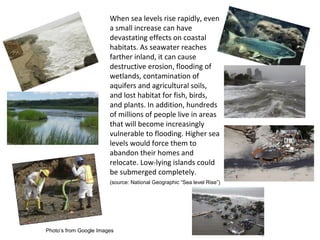
When sea levels rise rapidly, even
a small increase can have
devastating effects on coastal
habitats. As seawater reaches
farther inland, it can cause
destructive erosion, flooding of
wetlands, contamination of
aquifers and agricultural soils,
and lost habitat for fish, birds,
and plants. In addition, hundreds
of millions of people live in areas
that will become increasingly
vulnerable to flooding. Higher sea
levels would force them to
abandon their homes and
relocate. Low-lying islands could
be submerged completely.
(source: National Geographic “Sea level Rise”)

Photo’s from Google Images
Proactive steps to mitigating sea-level rise:
• Elevate homes - One solution, say environmentalists, would be for New
Jersey to enact stricter, more forward-looking construction regulations such as
mandating that residents and business owners elevate three feet above the
FEMA requirements
(source: Scott Gurian -Sandy Recovery Writer for NJ Spotlight)
• Reduce fossil-fuel – By releasing carbon dioxide and other heat-trapping
gases into the atmosphere, we have warmed the Earth by more than a full
degree Fahrenheit over the past century and raised sea level by about eight
inches.
(source: National Geographic Sept. 2013)
• Humans are definitely having an effect on climate change. A Danish study
published in 2009, shows a strong correlation between the strength of the
earth's magnetic field and the amount of precipitation in the tropics, the study
claims carbon dioxide emissions due to human activity are having a smaller
impact on climate change than scientists think. Given the difficulty and
complexity of the problem, it is unclear what an individual can do to make a
difference at this time, but if it is correct, it means that mankind has more time
to reduce our effect on the climate. We should not ignore the problem.
(source: The earth's magnetic field impacts climate: Danish study (AFP) – Jan 12, 2009)

Turn Down the Heat - Final Project

  • 1.
    NEW JERSEY Climate Change,Rising Sea Level 2014 - Jolene Schwartz
  • 2.
    During the lastcentury, New Jersey has experienced record breaking climate change: rising temperatures, increased precipitation, more frequent severe weather, and rising sea levels. Average annual temperatures have increased by 2° F since 1900 and the sea level along the New Jersey coastline has risen at a rate of about 1.5 inches every 10 years during the past 100 years, which is nearly twice the global average. New Jersey’s coastal infrastructure and development are thought to be the most susceptible to the impacts of climate change. By the end of the century, 1 - 3 % of New Jersey’s 210-mile shoreline is likely to be lost to rising sea levels, and 6.5 – 9 % of the state’s coastal area will be inundated by occasional flooding. Rising waters are predicted to claim more land in New Jersey than the national average due to local conditions that make the state’s shoreline particularly vulnerable to soil erosion and land subsidence. A 1 foot rise in sea level along the New Jersey coast will advance the shoreline inward 120 feet; the U.S. average is 78 feet. Source: Oppenheimer et al., Future Sea Level Rise and The New Jersey Coast: Assessing Potential Impacts and Opportunities. Check out the interactive Global Sea Rise Map to see what will happen to NJ or your local beach community when sea levels rise. http://geology.com/sea-level-rise/
  • 3.
    When sea levelsrise rapidly, even a small increase can have devastating effects on coastal habitats. As seawater reaches farther inland, it can cause destructive erosion, flooding of wetlands, contamination of aquifers and agricultural soils, and lost habitat for fish, birds, and plants. In addition, hundreds of millions of people live in areas that will become increasingly vulnerable to flooding. Higher sea levels would force them to abandon their homes and relocate. Low-lying islands could be submerged completely. (source: National Geographic “Sea level Rise”) Photo’s from Google Images
  • 4.
    Proactive steps tomitigating sea-level rise: • Elevate homes - One solution, say environmentalists, would be for New Jersey to enact stricter, more forward-looking construction regulations such as mandating that residents and business owners elevate three feet above the FEMA requirements (source: Scott Gurian -Sandy Recovery Writer for NJ Spotlight) • Reduce fossil-fuel – By releasing carbon dioxide and other heat-trapping gases into the atmosphere, we have warmed the Earth by more than a full degree Fahrenheit over the past century and raised sea level by about eight inches. (source: National Geographic Sept. 2013) • Humans are definitely having an effect on climate change. A Danish study published in 2009, shows a strong correlation between the strength of the earth's magnetic field and the amount of precipitation in the tropics, the study claims carbon dioxide emissions due to human activity are having a smaller impact on climate change than scientists think. Given the difficulty and complexity of the problem, it is unclear what an individual can do to make a difference at this time, but if it is correct, it means that mankind has more time to reduce our effect on the climate. We should not ignore the problem. (source: The earth's magnetic field impacts climate: Danish study (AFP) – Jan 12, 2009)