Hematuria & obstructive Uropathy
Hematuria
 Physical Examination of Urinean evaluation of color, turbidity, specific gravity and osmolality, and pH.
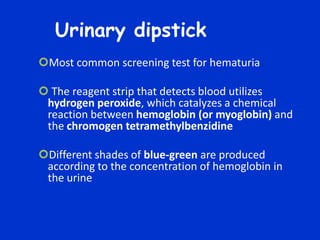
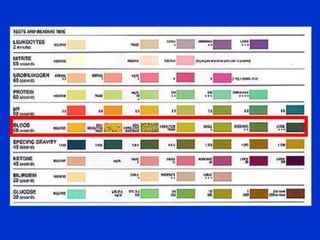
Urinary dipstickMost common screening test for hematuria
 The reagent strip that detects blood utilizes hydrogen peroxide, which catalyzes a chemical reaction between hemoglobin (or myoglobin) and the chromogentetramethylbenzidine
Different shades of blue-green are produced according to the concentration of hemoglobin in the urine
Centrifuged urine
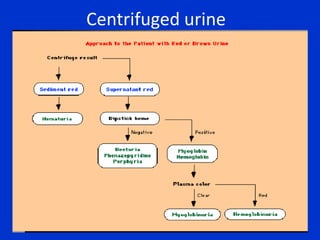
Centrifuged urineIn hemoglobinuria, the supernatant will be pink. This is because free hemoglobin in the serum binds to haptoglobin, which is water insoluble and has a high molecular weight. This complex remains in the serum, causing a pink color. Free hemoglobin will appear in the urine only when all of the haptoglobin-binding sites have been saturated.
Centrifuged urineIn myoglobinuria, the myoglobin released from muscle is of low molecular weight and water soluble. It does not bind to haptoglobin and is therefore excreted immediately into the urine. Therefore, in myoglobinuria the serum remains clear.
Quantity of HematuriaMicroscopic Hematuria : 	seen only under microscopeGross Hematuria : 	visible, urine is pink, cola, red5 times the number of life-threatening conditions when compared with patients with microscopic hematuria.

How to evaluate hematuria?By asking questionIs the hematuria gross or microscopic?
At what time during urination does the hematuria occur (beginning or end of stream or during entire stream)?
Is the hematuria associated with pain?

Is the patient passing clots?
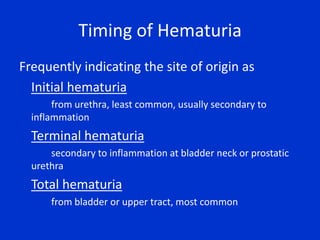
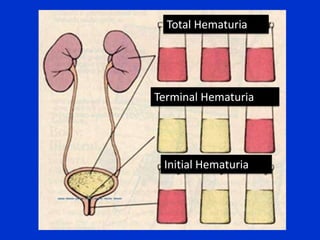
If the patient is passing clots, do the clots have a specific shape? Timing of HematuriaFrequently indicating the site of origin asInitial hematuria		from urethra, least common, usually secondary to inflammationTerminal hematuria		secondary to inflammation at bladder neck or prostatic urethraTotal hematuria		from bladder or upper tract, most common
Total HematuriaTerminal HematuriaInitial Hematuria
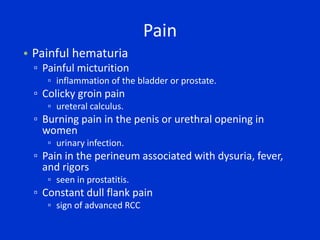
PainPainful hematuria
Painful micturition
inflammation of the bladder or prostate.
Colicky groin pain
ureteral calculus.
Burning pain in the penis or urethral opening in women
urinary infection.
Pain in the perineum associated with dysuria, fever, and rigors
seen in prostatitis.
Constant dull flank pain
sign of advanced RCCClassification : PainPainless (Gross) HematuriaWith Age > 50 years ( Mostly Men ) is HALLMARK for bladder cancer.
ClotsThe presence of clots usually indicates a more significant degree of hematuria, and, accordingly, the probability of identifying significant urologic pathology increases.
Shape of ClotsAmorphous clots : bladder or prostatic urethral origin
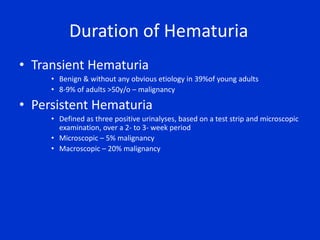
Vermiform (wormlike) clots, particularly if associated with flank pain : the upper urinary tract : ureterDuration of HematuriaTransient HematuriaBenign & without any obvious etiology in 39%of young adults 8-9% of adults >50y/o – malignancyPersistent HematuriaDefined as three positive urinalyses, based on a test strip and microscopic examination, over a 2- to 3- week periodMicroscopic – 5% malignancyMacroscopic – 20% malignancy
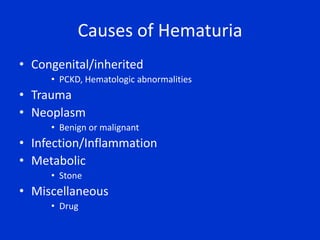
Causes of HematuriaCongenital/inherited
PCKD, Hematologic abnormalities
Trauma
Neoplasm
Benign or malignant
Infection/Inflammation
Metabolic
Stone
Miscellaneous
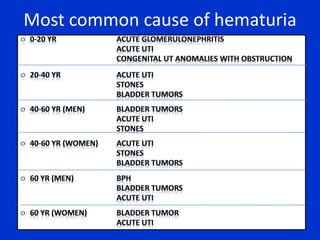
DrugMost common cause of hematuria 0-20 yr		Acute glomerulonephritis				Acute UTI				Congenital UT anomalies with obstruction 20-40 yr		Acute UTI				Stones				Bladder tumors40-60 yr (men)	Bladder tumors				Acute UTI			Stones40-60 yr (women)	Acute UTI				Stones				Bladder tumors60 yr (men) 		BPH				Bladder tumors				Acute UTI60 yr (women)	Bladder Tumor				Acute UTI
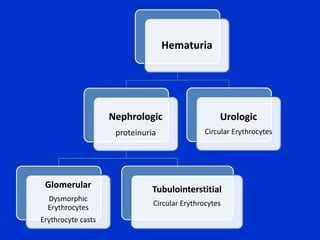
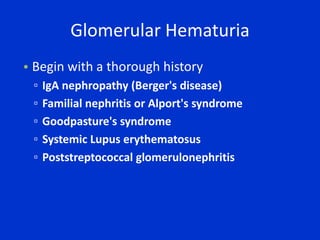
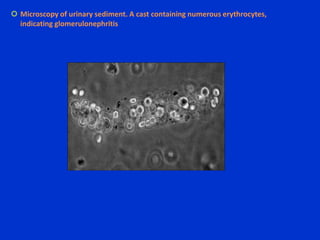
Glomerular HematuriaBegin with a thorough history
IgA nephropathy (Berger's disease)
Familial nephritis or Alport's syndrome
Goodpasture's syndrome
Systemic Lupus erythematosus
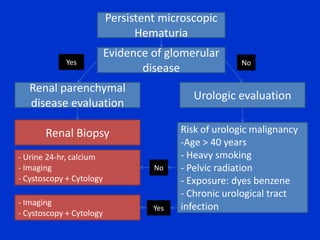
PoststreptococcalglomerulonephritisNon-glomerular Hematuria Non-glomerular hematuria or essential hematuria includes primarily urologic rather than nephrologic diseasesCommon causes of essential hematuria include urologic tumors, stones, and UTIs
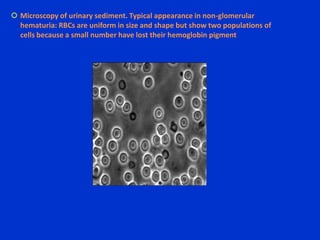
Non-glomerular Hematuria Characterized by circular erythrocytes and the absence of erythrocyte casts
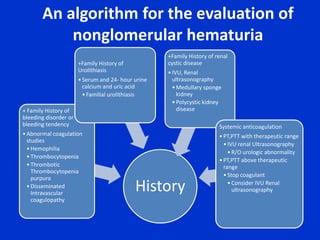
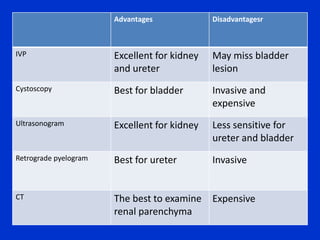
An algorithm for the evaluation of nonglomerular hematuria
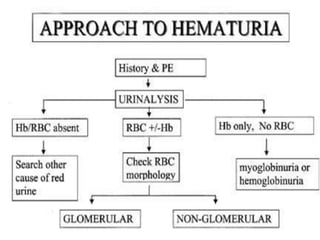
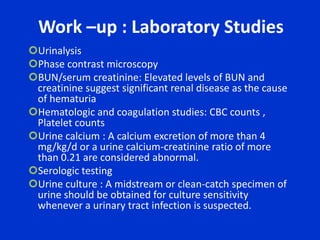
Work –up : Laboratory StudiesUrinalysis
Phase contrast microscopy
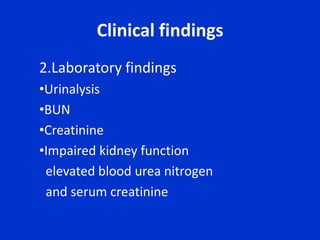
BUN/serum creatinine: Elevated levels of BUN and creatinine suggest significant renal disease as the cause of hematuria

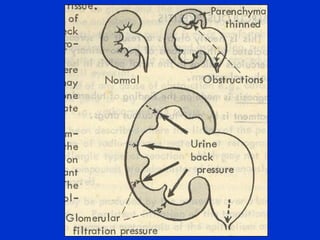
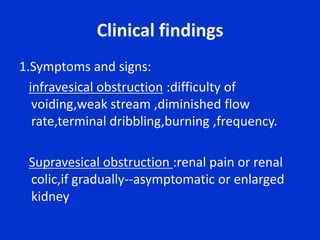
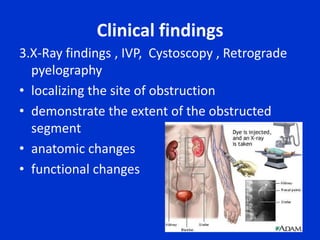
Hematuria and obstructive uropathy