OBSTRUCTIVEUROPATHY (Dr MohamedShafik)
Definitions:
Obstructive uropathy:
Resistance tothe flowof urine anywhere alongthe urinarytract.
Obstructive nephropathy:
Damage to the renal parenchymaasa resultof obstructive uropathy.
Hydronephrosis:
Descriptive termreferringtodilatationof the pelvisandcalyces.Itcanoccur withor
withoutobstruction.
Duringthe past 20 yearswe have learnedthaturinarytract dilatationisnotthe
same as UT obstruction.
Clinical presentation:symptoms
Wide range:asymptomatic→ renal colic
Dependingon:
Degree:complete orpartial
Time interval:acute orchronic
Etiology:intrinsicVsextrinsic
Laterality:unilateral orbilateral
Signs:Wide range:no signs
- Abdominal mass
- Volume overload
- Azootemia
Pathophysiology:
CorrelationbetweenRBF&UP.
Mediatorsof acute obstruction.
Clinical implicationsof pathophysiologyformanagementof obstructiveuropathy.
Pathophysiology
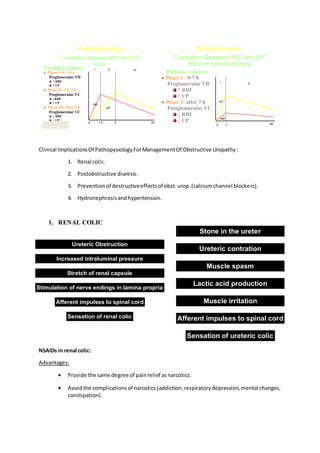
Tri phasic response:
Phase I: 0- 1.5 h
Preglomerular VD
↑ RBF
↑ UP
Phase II: 1.5- 5 h
Preglomerular VC
↓RBF
↑ UP
Phase III: after 5 h
Preglomerular VC
↓ RBF
↓ UP
“Correlation between RBF and UP”
UUO
I II III
0 1.5 5 24
RBF
UP
Pathophysiology
Biphasic response:
Phase 1 : 0-7 h
Preglomerular VD
↑ RBF
↑ UP
Phase 2: after 7 h
Postglomerular VC
↓ RBF
↓ UP
I II
UP
RBF
“Correlation Between RBF And UP”
BUO or Solitary Kidney
0 7 48
Clinical ImplicationsOf PathopysiologyForManagementOf Obstructive Uropathy :
1. Renal colic.
2. Postobstructive diuresis.
3. Preventionof destructiveeffectsof obst.urop.(calciumchannel blockers).
4. Hydronephrosisandhypertension.
1. RENAL COLIC
NSAIDs in renal colic:
Advantages:
 Provide the same degree of painrelief asnarcotics.
 Avoidthe complicationsof narcotics(addiction,respiratorydepression,mental changes,
constipation).
Sensation of renal colic
Afferent impulses to spinal cord
Stimulation of nerve endings in lamina propria
Stretch of renal capsule
Increased intraluminal pressure
Ureteric Obstruction
Sensation of ureteric colic
Afferent impulses to spinal cord
Muscle irritation
Lactic acid production
Muscle spasm
Ureteric contration
Stone in the ureter
Disadvantages:
 Decrease RBFby 35%
 Considerrenal function
Routesof Administration:
 IV,IM, Rectal,Oral,Sublingual.
 IV indomethacinismore effective thanIMdiclofenac.
 Rectal route is lesseffectivethanparentral route.
 Oral diclofenacprophylaxispreventsnew episodesof renal colic.
 Sublingual piroxicamisaseffective asparentral diclofenac.
2. POSTOBSTRUCTIVE DIURESIS
Definition:
Polyuria(>200 ml/hourfor 24 hours) that occurs afterrelief of BUOor obstructionof a
solitarykidney.
Pathogenesis:
Physiologic:Retainedurea,sodium&water.
Pathologic:Impairment of concentratingabilityof sodiumreabsorption.
Clinical Manifestations:
 Edema
 Congestive heartfailure
 Hypertension
 Weightgain
 Azotemia
 Sometimesuremicencephalophathy
Followup:
 Vital signs/2h.
 Urine output/ 2h.
 Bodyweight/24 h.
 S. Creatinine /24 h.
 S. electrolytes/12 h.
 Urine electrolytes/24 h.
 Urine osmolarity/24 h.
TreatmentPhysiologicDiuresis:
Characters:
 It isthe mostcommon.
 S.creat.& BUN → normal within1-2 days
 The patientisalert.
Replacement: Oral fluidsissufficient
TreatmentPathologicdiuresis:
Characters:
 It islesscommon.
 Diuresispersists>2 days.
 S.creat.& BUN remainelevated.
 Urine osmolarityremainslow.
 Patientisusuallynotalert.
Replacement:
 Replace half of urine outputuntil S.creat&BUN become normal.
 SupplementwithsodiumcontainingIV fluids( 5% dextrose in0.45% saline).
Diagnosis:
IVP:IVPisthe goldstandard forthe detectionof ureteral obstructioninpatientswhohave:
1. Normal renal function.
2. No allergies
3. Not pregnant.
(acute obstruction)
4. Obstructive nephrogram.
5. Delayinfillingof the collectingsystemwithcontrast.
6. Dilatationof the collectingsystem.
7. Possible fornix rupture withurinaryextravasation.
(chronicobstruction)
8. Ureteral dilatationandtortuosity.
9. Standingcolumnof contrastmaterial inthe ureterto the pointof obstruction.
10. The kidneymaydemonstrate markedparenchymal thinning.
US:
1. Gray-scale US
2. DiureticUS:
Gray–scale US isdone before andafterinjectionof a
diuretic
Diagnosisof obstructionisbasedupon:
 Increase of pelvicalyceal diameterafterdiuretic.
 Prolongationof the time takenforthe renal collectingsystemtoreturnto initial
diameter.
Criticism:notobjective.
Currentvalue:of limiteduse.
3. DopplerUS :
Resisitive index (RI):(Peaksystolicvelocitydiastolicvelocity)/peaksystolicvelocity.
Relationtoobstruction: Value diagnosticof chronicobstruction:>0.7
Uretericjets:It isuseful onlyforunilateralobstruction.
Symptomaticside iscomparedtothe normal side for10-15 minutesaftergoodhydration.
Interpretation: - Complete obstruction:nojets - Partial obstruction:asymetricjets
Criticism: -Technicallydifficult- Time consuming
Currentuse:pregnancy
4. Ultrasonographicmultivariate scoringsystem
(Garcia-Penaetal 1997): 7 items
a) Increasedechogenicity
b) Parenchymal thickness≤5 mm
c) Contralateral hypertrophy
d) RIR ≥ 1.10
e) ∆RI ≥ 0.07
f) Uretericdiameter≥ 10mm
g) Aprestalticureter
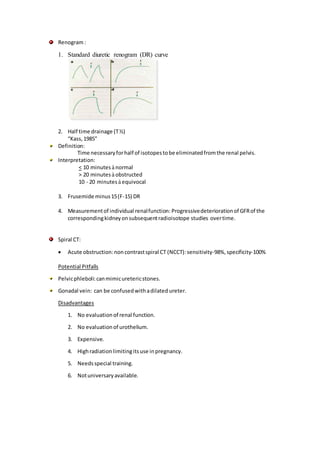
Renogram:
1. Standard diuretic renogram (DR) curve
2. Half time drainage (T½)
“Kass,1985”
Definition:
Time necessaryforhalf of isotopestobe eliminatedfromthe renal pelvis.
Interpretation:
< 10 minutes à normal
> 20 minutes à obstructed
10 - 20 minutes à equivocal
3. Frusemide minus15(F-15) DR
4. Measurementof individual renalfunction: Progressivedeteriorationof GFRof the
correspondingkidneyonsubsequentradioisotope studies overtime.
Spiral CT:
 Acute obstruction:noncontrastspiral CT (NCCT):sensitivity-98%,specificity-100%
Potential Pitfalls
Pelvicphleboli:canmimicuretericstones.
Gonadal vein: can be confusedwithadilated ureter.
Disadvantages
1. No evaluationof renal function.
2. No evaluationof urothelium.
3. Expensive.
4. Highradiationlimitingitsuse inpregnancy.
5. Needsspecial training.
6. Notuniversaryavailable.
 Chronicobstruction:contrast-enhancedspiral CT
Limitations:
1. Renal impairment.
2. Pregnancy.
3. Allergytocontrastmaterials
MRU
Principle:The staticcolumnof urine inthe dilatedurinarytractiseasilyvisualizedbyT2-
weightedMRUas a brightwhite column,butwithoutinjectionof radiocontrastmaterial
Indicationsof T2 MRU:
ContraindicationstoIVP
 Allergy
 Pregnancy
 Renal impairment
Failure of IVPtoreach diagnosis
 No excretion
 Persistentnephrogram
 Poorexcretion
 No definite diagnosis
Advantages:
1. No injectionof contrastmaterials
2. No exposure toionizingradiation
3. Noninvasive
4. Can save the patientinvasive procedures(ante&retrograde studies).
Diagnosticvalue inobstructive uropathy:
It can accuratelyidentify:
 Presence of obstruction
 Degree of dilation
 Level of obstruction
Cause of obstruction
 Calcular:not accurate
 Noncalcular: sensitive andspecific
Whitakertest
Ante andRetrograde studies
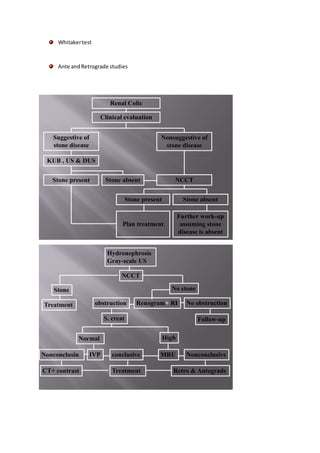
Renal Colic
Clinical evaluation
Suggestive of
stone disease
Nonsuggestive of
stone disease
KUB , US & DUS
Stone present Stone absent NCCT
Stone present Stone absent
Plan treatment
Further work-up
assuming stone
disease is absent
Hydronephrosis
Gray-scale US
NCCT
Stone No stone
Treatment obstruction Renogram+ RI No obstruction
S. creat Follow-up
Normal High
Nonconclusin IVP conclusive MRU Nonconclusive
CT+ contrast Treatment Retro & Antegrade

5 obstructive uropathy written

  • 1.
    OBSTRUCTIVEUROPATHY (Dr MohamedShafik) Definitions: Obstructiveuropathy: Resistance tothe flowof urine anywhere alongthe urinarytract. Obstructive nephropathy: Damage to the renal parenchymaasa resultof obstructive uropathy. Hydronephrosis: Descriptive termreferringtodilatationof the pelvisandcalyces.Itcanoccur withor withoutobstruction. Duringthe past 20 yearswe have learnedthaturinarytract dilatationisnotthe same as UT obstruction. Clinical presentation:symptoms Wide range:asymptomatic→ renal colic Dependingon: Degree:complete orpartial Time interval:acute orchronic Etiology:intrinsicVsextrinsic Laterality:unilateral orbilateral Signs:Wide range:no signs - Abdominal mass - Volume overload - Azootemia Pathophysiology: CorrelationbetweenRBF&UP. Mediatorsof acute obstruction. Clinical implicationsof pathophysiologyformanagementof obstructiveuropathy.
  • 2.
    Pathophysiology Tri phasic response: PhaseI: 0- 1.5 h Preglomerular VD ↑ RBF ↑ UP Phase II: 1.5- 5 h Preglomerular VC ↓RBF ↑ UP Phase III: after 5 h Preglomerular VC ↓ RBF ↓ UP “Correlation between RBF and UP” UUO I II III 0 1.5 5 24 RBF UP Pathophysiology Biphasic response: Phase 1 : 0-7 h Preglomerular VD ↑ RBF ↑ UP Phase 2: after 7 h Postglomerular VC ↓ RBF ↓ UP I II UP RBF “Correlation Between RBF And UP” BUO or Solitary Kidney 0 7 48 Clinical ImplicationsOf PathopysiologyForManagementOf Obstructive Uropathy : 1. Renal colic. 2. Postobstructive diuresis. 3. Preventionof destructiveeffectsof obst.urop.(calciumchannel blockers). 4. Hydronephrosisandhypertension. 1. RENAL COLIC NSAIDs in renal colic: Advantages:  Provide the same degree of painrelief asnarcotics.  Avoidthe complicationsof narcotics(addiction,respiratorydepression,mental changes, constipation). Sensation of renal colic Afferent impulses to spinal cord Stimulation of nerve endings in lamina propria Stretch of renal capsule Increased intraluminal pressure Ureteric Obstruction Sensation of ureteric colic Afferent impulses to spinal cord Muscle irritation Lactic acid production Muscle spasm Ureteric contration Stone in the ureter
  • 3.
    Disadvantages:  Decrease RBFby35%  Considerrenal function Routesof Administration:  IV,IM, Rectal,Oral,Sublingual.  IV indomethacinismore effective thanIMdiclofenac.  Rectal route is lesseffectivethanparentral route.  Oral diclofenacprophylaxispreventsnew episodesof renal colic.  Sublingual piroxicamisaseffective asparentral diclofenac. 2. POSTOBSTRUCTIVE DIURESIS Definition: Polyuria(>200 ml/hourfor 24 hours) that occurs afterrelief of BUOor obstructionof a solitarykidney. Pathogenesis: Physiologic:Retainedurea,sodium&water. Pathologic:Impairment of concentratingabilityof sodiumreabsorption. Clinical Manifestations:  Edema  Congestive heartfailure  Hypertension  Weightgain  Azotemia  Sometimesuremicencephalophathy Followup:  Vital signs/2h.  Urine output/ 2h.  Bodyweight/24 h.  S. Creatinine /24 h.  S. electrolytes/12 h.  Urine electrolytes/24 h.  Urine osmolarity/24 h.
  • 4.
    TreatmentPhysiologicDiuresis: Characters:  It isthemostcommon.  S.creat.& BUN → normal within1-2 days  The patientisalert. Replacement: Oral fluidsissufficient TreatmentPathologicdiuresis: Characters:  It islesscommon.  Diuresispersists>2 days.  S.creat.& BUN remainelevated.  Urine osmolarityremainslow.  Patientisusuallynotalert. Replacement:  Replace half of urine outputuntil S.creat&BUN become normal.  SupplementwithsodiumcontainingIV fluids( 5% dextrose in0.45% saline). Diagnosis: IVP:IVPisthe goldstandard forthe detectionof ureteral obstructioninpatientswhohave: 1. Normal renal function. 2. No allergies 3. Not pregnant. (acute obstruction) 4. Obstructive nephrogram. 5. Delayinfillingof the collectingsystemwithcontrast. 6. Dilatationof the collectingsystem. 7. Possible fornix rupture withurinaryextravasation. (chronicobstruction) 8. Ureteral dilatationandtortuosity. 9. Standingcolumnof contrastmaterial inthe ureterto the pointof obstruction. 10. The kidneymaydemonstrate markedparenchymal thinning.
  • 5.
    US: 1. Gray-scale US 2.DiureticUS: Gray–scale US isdone before andafterinjectionof a diuretic Diagnosisof obstructionisbasedupon:  Increase of pelvicalyceal diameterafterdiuretic.  Prolongationof the time takenforthe renal collectingsystemtoreturnto initial diameter. Criticism:notobjective. Currentvalue:of limiteduse. 3. DopplerUS : Resisitive index (RI):(Peaksystolicvelocitydiastolicvelocity)/peaksystolicvelocity. Relationtoobstruction: Value diagnosticof chronicobstruction:>0.7 Uretericjets:It isuseful onlyforunilateralobstruction. Symptomaticside iscomparedtothe normal side for10-15 minutesaftergoodhydration. Interpretation: - Complete obstruction:nojets - Partial obstruction:asymetricjets Criticism: -Technicallydifficult- Time consuming Currentuse:pregnancy 4. Ultrasonographicmultivariate scoringsystem (Garcia-Penaetal 1997): 7 items a) Increasedechogenicity b) Parenchymal thickness≤5 mm c) Contralateral hypertrophy d) RIR ≥ 1.10 e) ∆RI ≥ 0.07 f) Uretericdiameter≥ 10mm g) Aprestalticureter
  • 6.
    Renogram: 1. Standard diureticrenogram (DR) curve 2. Half time drainage (T½) “Kass,1985” Definition: Time necessaryforhalf of isotopestobe eliminatedfromthe renal pelvis. Interpretation: < 10 minutes à normal > 20 minutes à obstructed 10 - 20 minutes à equivocal 3. Frusemide minus15(F-15) DR 4. Measurementof individual renalfunction: Progressivedeteriorationof GFRof the correspondingkidneyonsubsequentradioisotope studies overtime. Spiral CT:  Acute obstruction:noncontrastspiral CT (NCCT):sensitivity-98%,specificity-100% Potential Pitfalls Pelvicphleboli:canmimicuretericstones. Gonadal vein: can be confusedwithadilated ureter. Disadvantages 1. No evaluationof renal function. 2. No evaluationof urothelium. 3. Expensive. 4. Highradiationlimitingitsuse inpregnancy. 5. Needsspecial training. 6. Notuniversaryavailable.
  • 7.
     Chronicobstruction:contrast-enhancedspiral CT Limitations: 1.Renal impairment. 2. Pregnancy. 3. Allergytocontrastmaterials MRU Principle:The staticcolumnof urine inthe dilatedurinarytractiseasilyvisualizedbyT2- weightedMRUas a brightwhite column,butwithoutinjectionof radiocontrastmaterial Indicationsof T2 MRU: ContraindicationstoIVP  Allergy  Pregnancy  Renal impairment Failure of IVPtoreach diagnosis  No excretion  Persistentnephrogram  Poorexcretion  No definite diagnosis Advantages: 1. No injectionof contrastmaterials 2. No exposure toionizingradiation 3. Noninvasive 4. Can save the patientinvasive procedures(ante&retrograde studies). Diagnosticvalue inobstructive uropathy: It can accuratelyidentify:  Presence of obstruction  Degree of dilation  Level of obstruction Cause of obstruction  Calcular:not accurate  Noncalcular: sensitive andspecific
  • 8.
    Whitakertest Ante andRetrograde studies RenalColic Clinical evaluation Suggestive of stone disease Nonsuggestive of stone disease KUB , US & DUS Stone present Stone absent NCCT Stone present Stone absent Plan treatment Further work-up assuming stone disease is absent Hydronephrosis Gray-scale US NCCT Stone No stone Treatment obstruction Renogram+ RI No obstruction S. creat Follow-up Normal High Nonconclusin IVP conclusive MRU Nonconclusive CT+ contrast Treatment Retro & Antegrade