Congenital anomalies of kidney and urinary
system
Prepared By:
Sanjay Sir
Lecturer
Govt. CON
Surat
India
CONTENTS:
1- Anatomy of urinary system
2- Function of urinary system
3- Normal development
4- Congenital anomalies of urinary system:
-Dysgenesis of the kidney
-Agenesis
- Hypo plastic
- Dysplastic
- A plastic
-Abnormalities in shape & position
- Ectopic Kidney
- Horse shoe Kidney
- Crossed fused Ectopia
-Abnormalities of collecting system
- Hydronephrosis
- Bladder extrophy
- PUV
- Patent Urachus
-Clinical presentation
- Antenatal screening
- Postnatal Evaluation
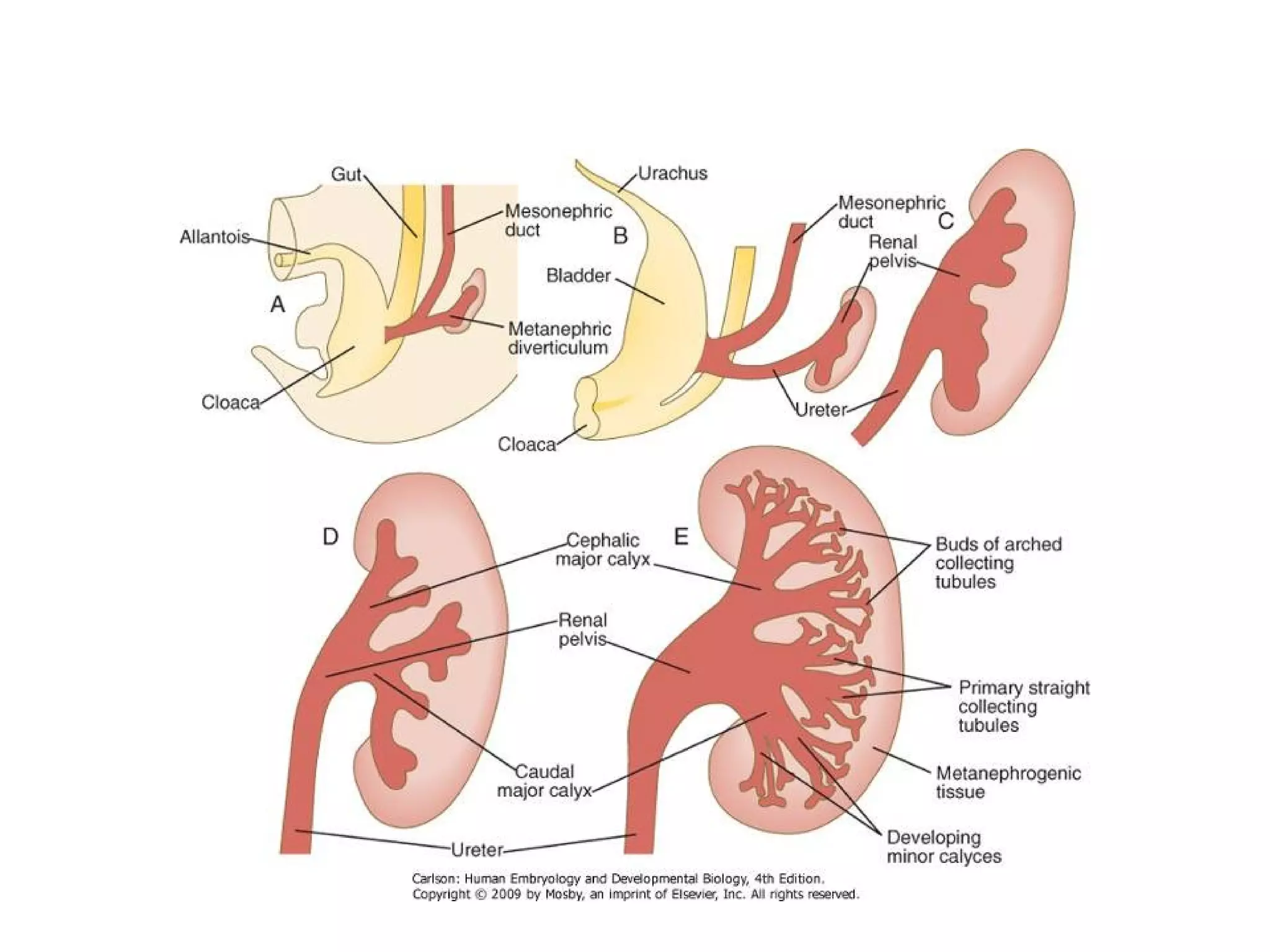
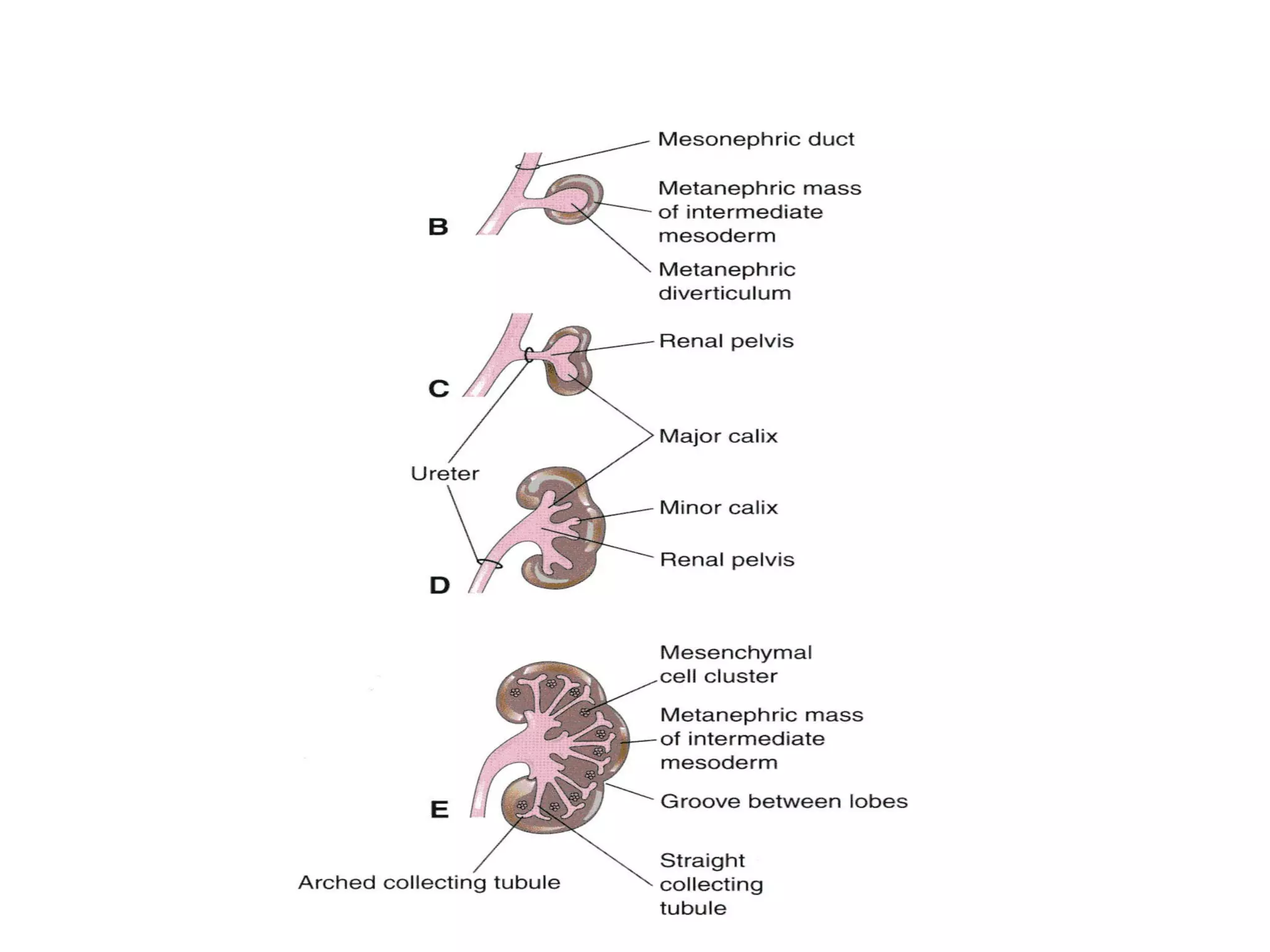
Development of Urinary system(kidney):
Kidney development, or nephrogenesis, describes the
embryologic origins of the kidney, a major organ in the
urinary system. It is observed in most reptiles, birds and
mammals, including humans.
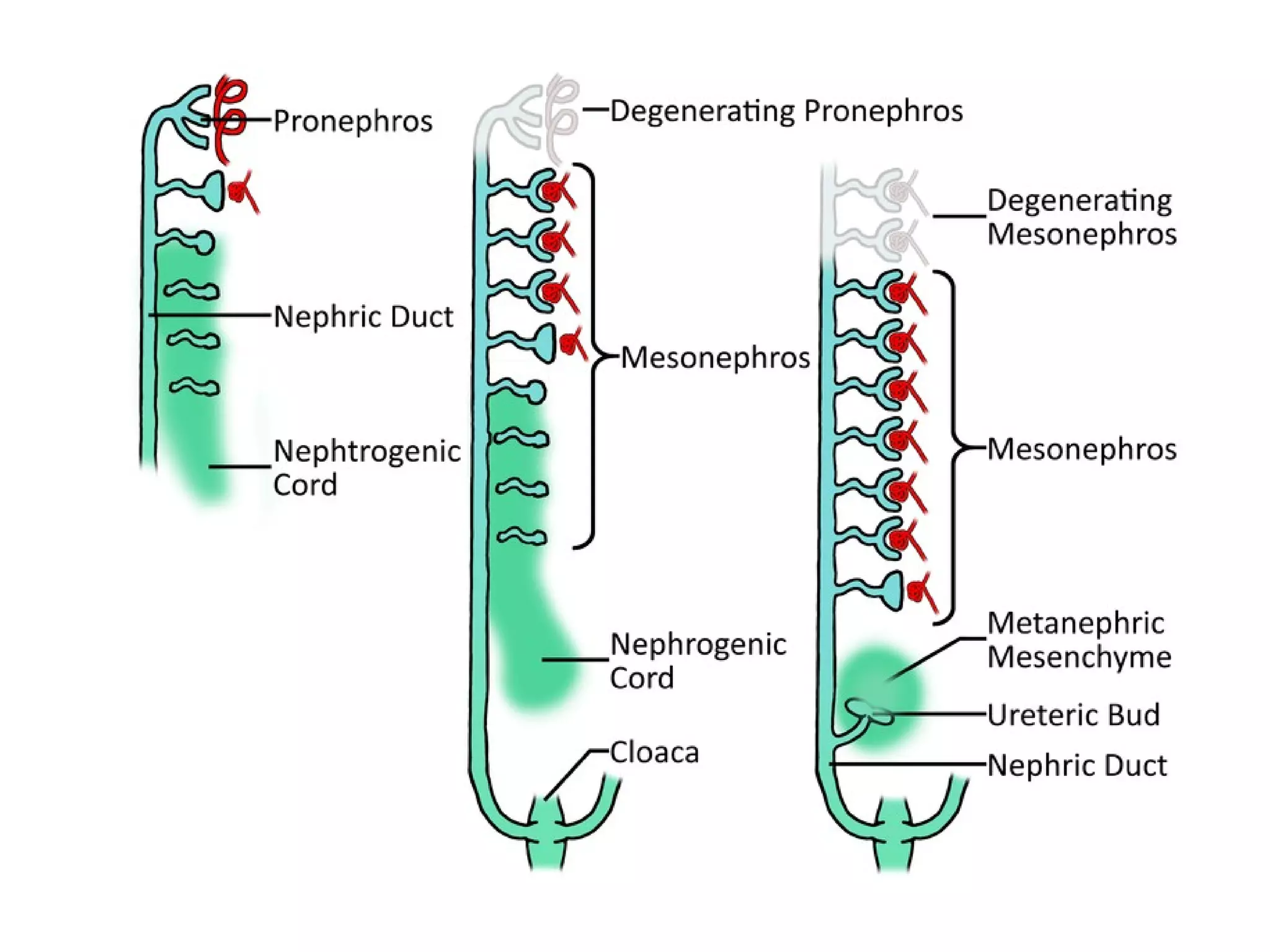
The Urinary system goes through three phases on its way to
becoming fully functioning :
1- Pronephros
2- Mesonephros
3- Metanephros
Starting from 4th
wk & end on 36 wk of intra uterine life
The development of the kidney proceeds through a series of
successive phases, each marked by the development of a more
advanced kidney: the pronephros, mesonephros, and metanephros.
The pronephros is the most immature form of kidney,
while the metanephros is most developed.
The metanephros persists as the definitive adult kidney.
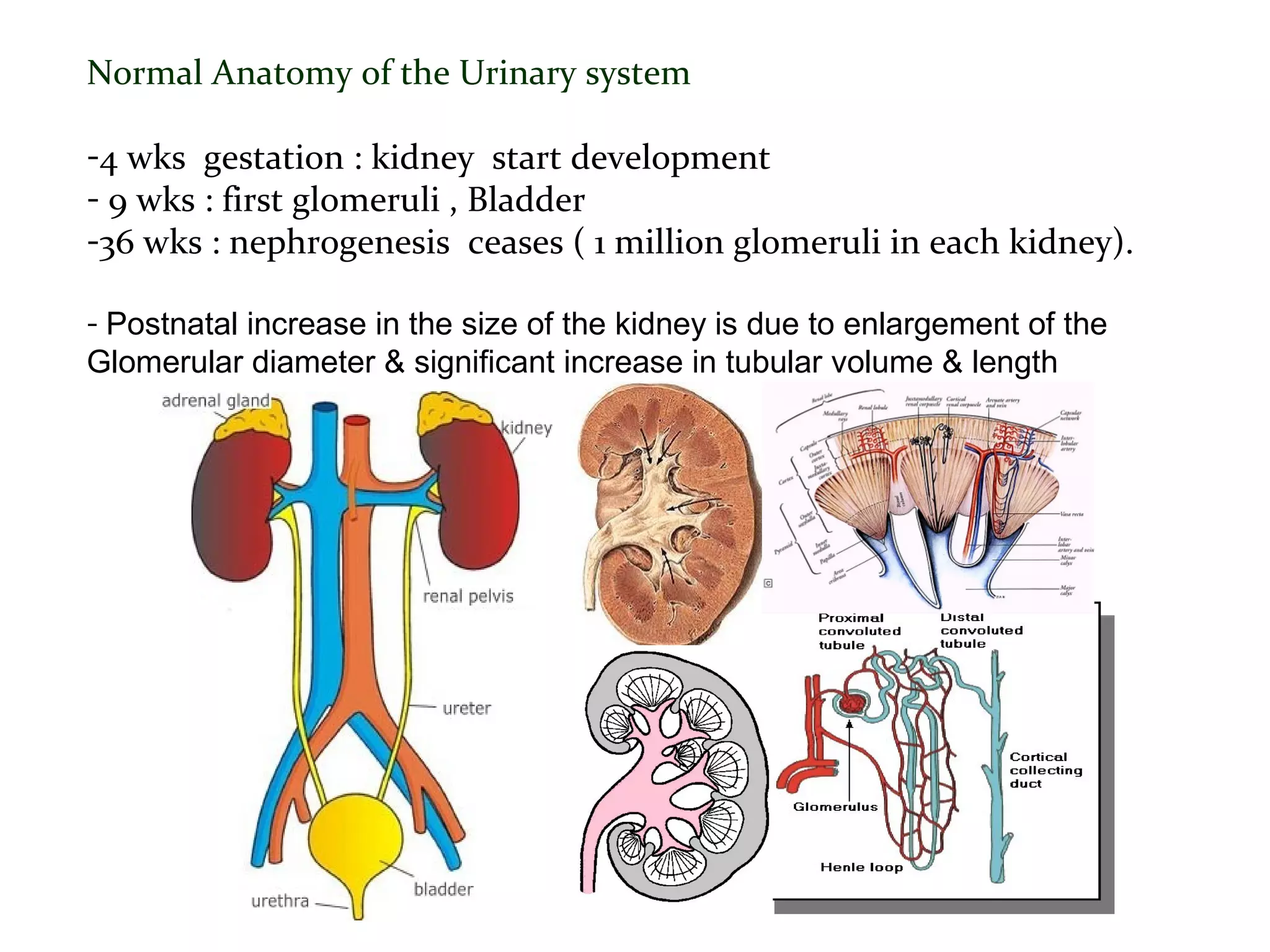
Normal Anatomy of the Urinary system
-4 wks gestation : kidney start development
- 9 wks : first glomeruli , Bladder
-36 wks : nephrogenesis ceases ( 1 million glomeruli in each kidney).
- Postnatal increase in the size of the kidney is due to enlargement of the
Glomerular diameter & significant increase in tubular volume & length
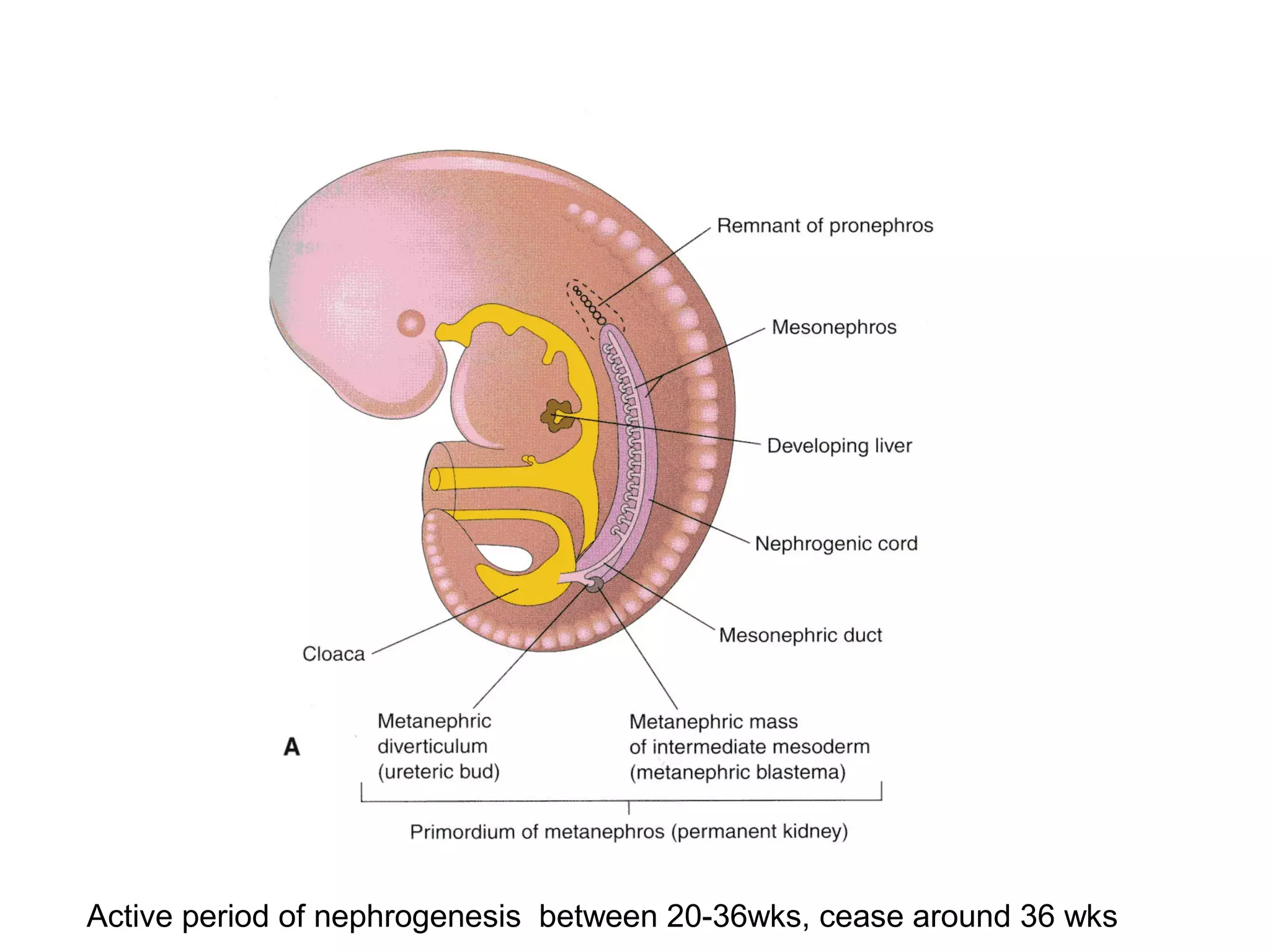
Active period of nephrogenesis between 20-36wks, cease around 36 wks
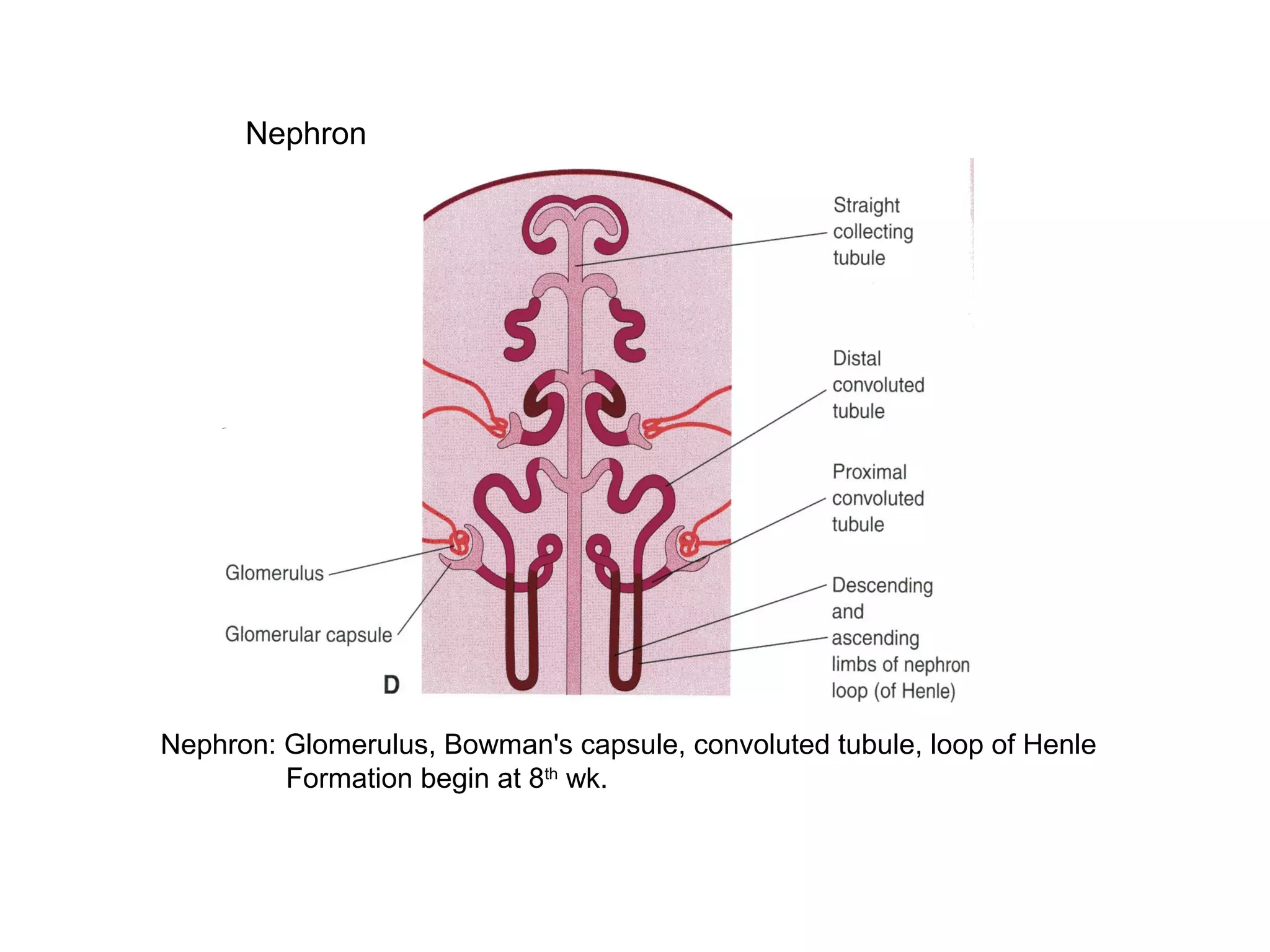
Nephron: Glomerulus, Bowman's capsule, convoluted tubule, loop of Henle
Formation begin at 8th
wk.
Nephron
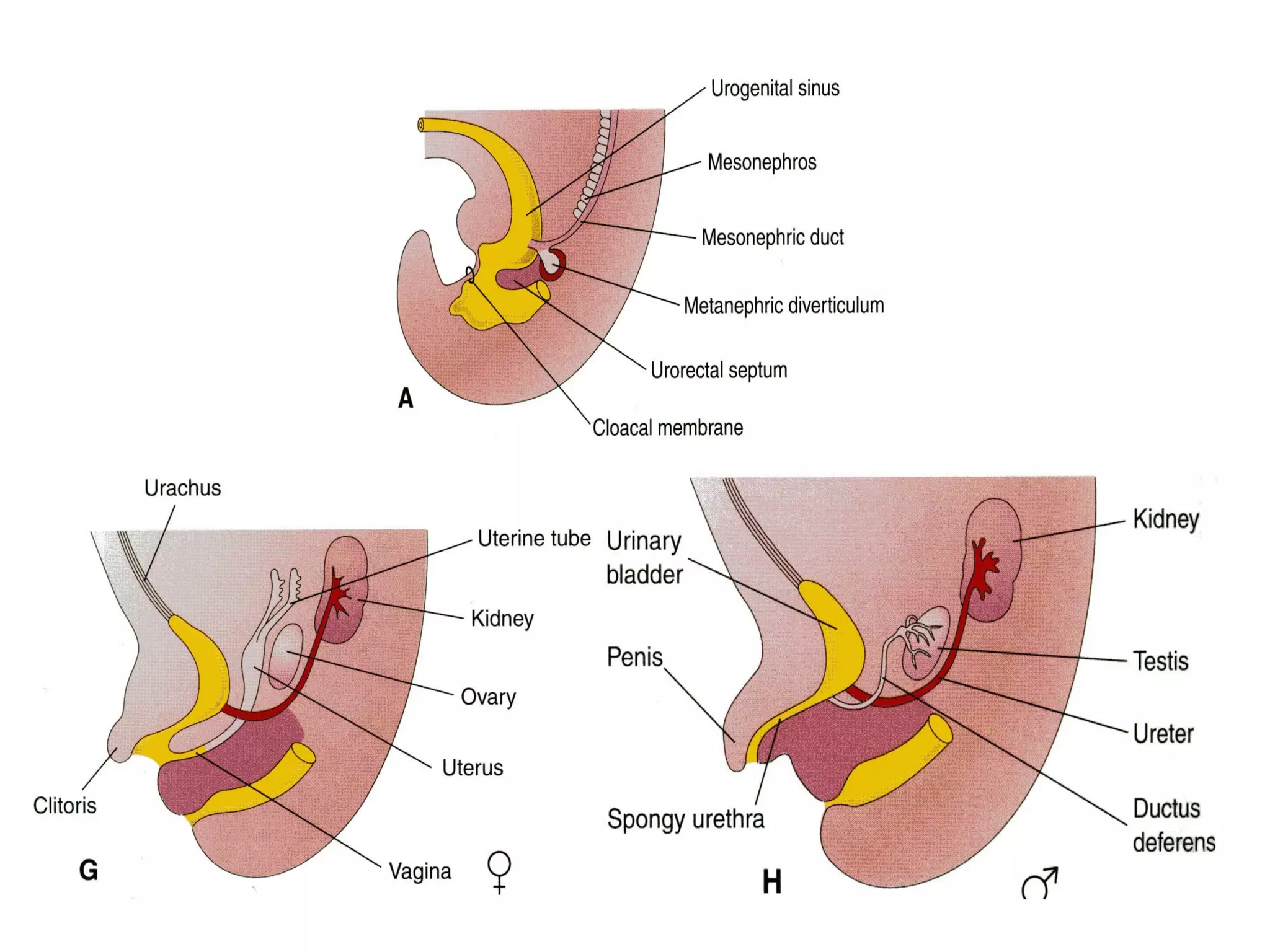
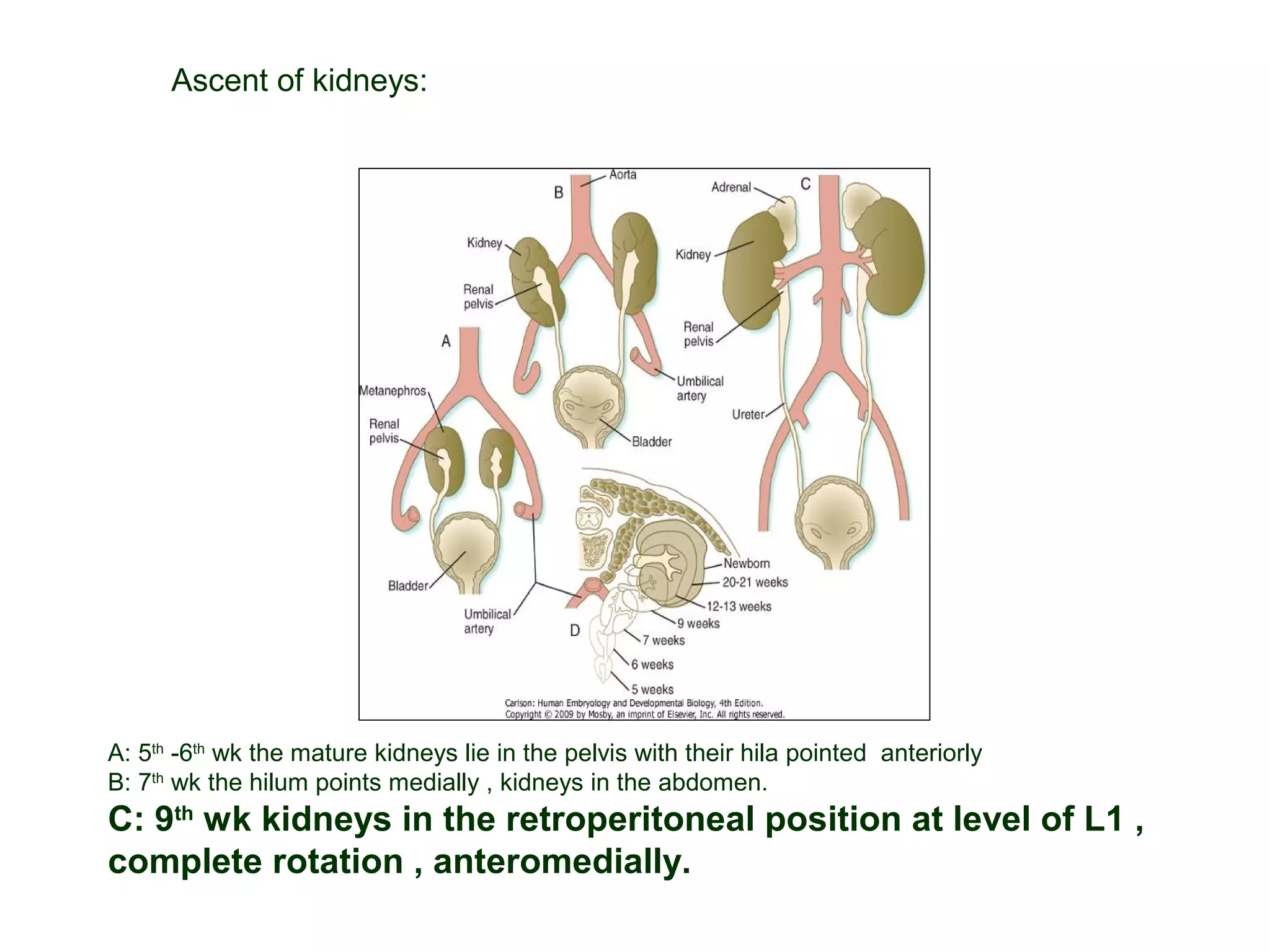
Ascent of kidneys:
A: 5th
-6th
wk the mature kidneys lie in the pelvis with their hila pointed anteriorly
B: 7th
wk the hilum points medially , kidneys in the abdomen.
C: 9th
wk kidneys in the retroperitoneal position at level of L1 ,
complete rotation , anteromedially.
Normal Function of the Urinary system:
Kidney :
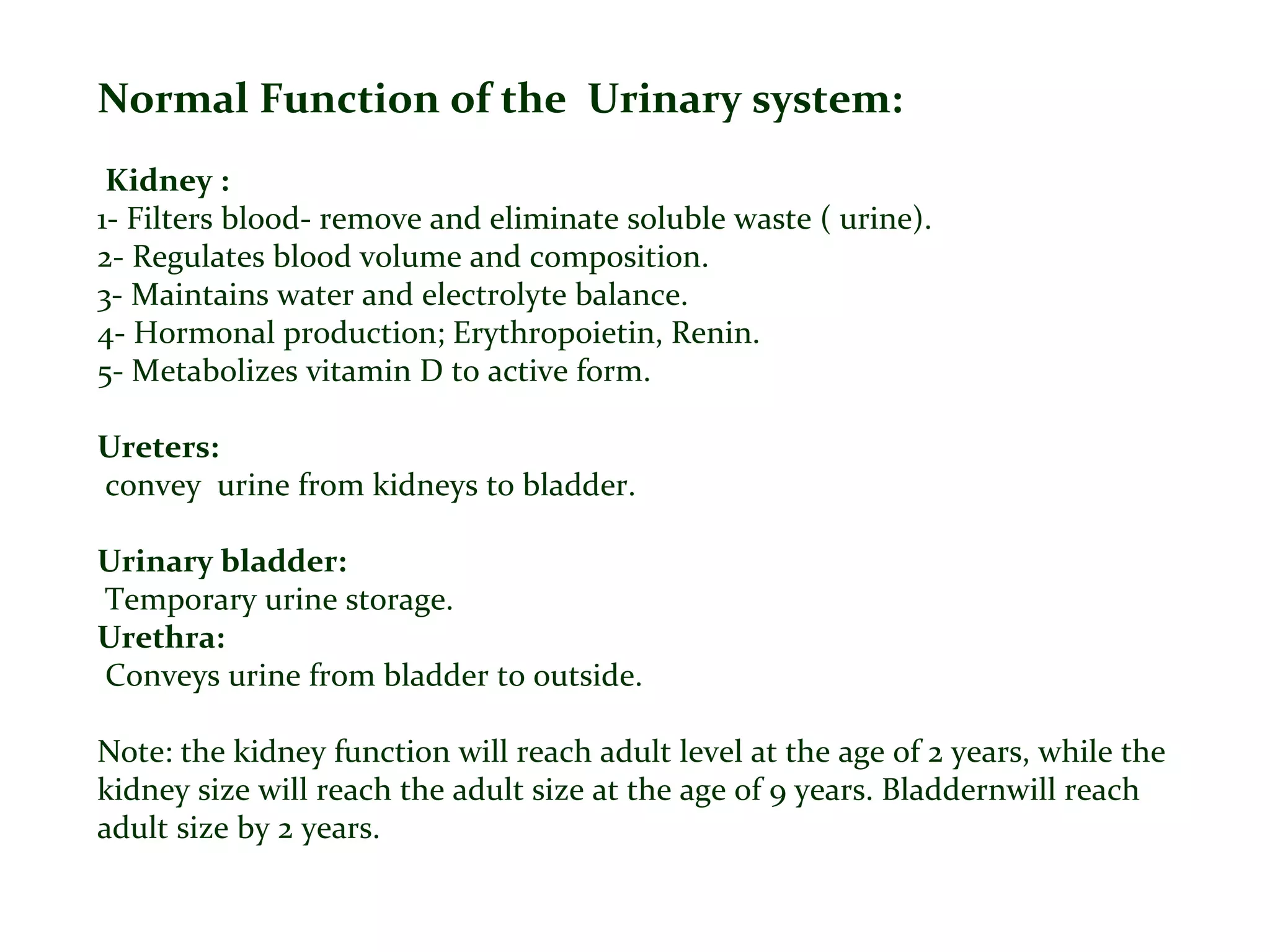
1- Filters blood- remove and eliminate soluble waste ( urine).
2- Regulates blood volume and composition.
3- Maintains water and electrolyte balance.
4- Hormonal production; Erythropoietin, Renin.
5- Metabolizes vitamin D to active form.
Ureters:
convey urine from kidneys to bladder.
Urinary bladder:
Temporary urine storage.
Urethra:
Conveys urine from bladder to outside.
Note: the kidney function will reach adult level at the age of 2 years, while the
kidney size will reach the adult size at the age of 9 years. Bladdernwill reach
adult size by 2 years.
Abnormalities during development:
1- Dysgenesis of the Kidney(underdevelopment of kidney)
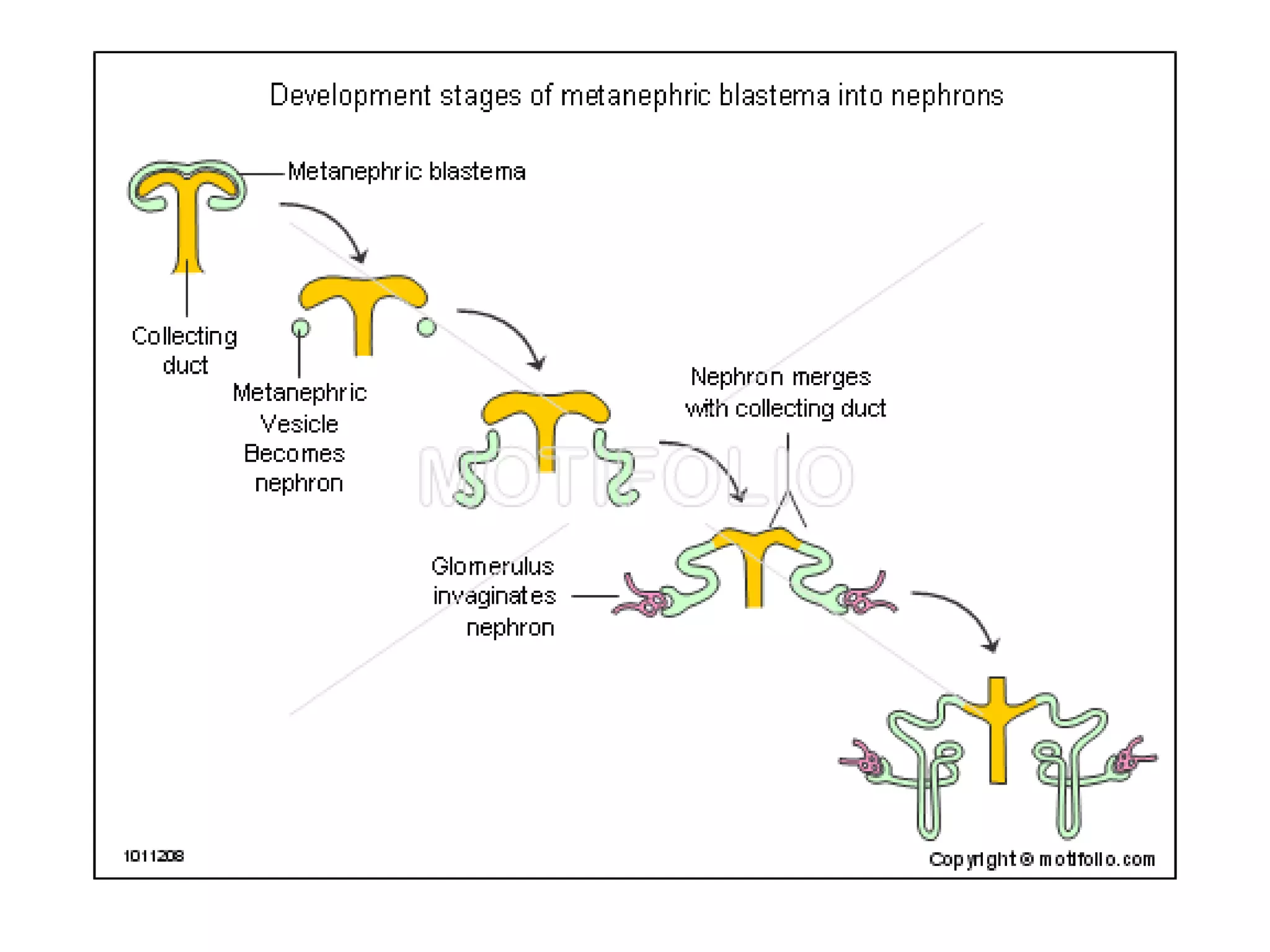
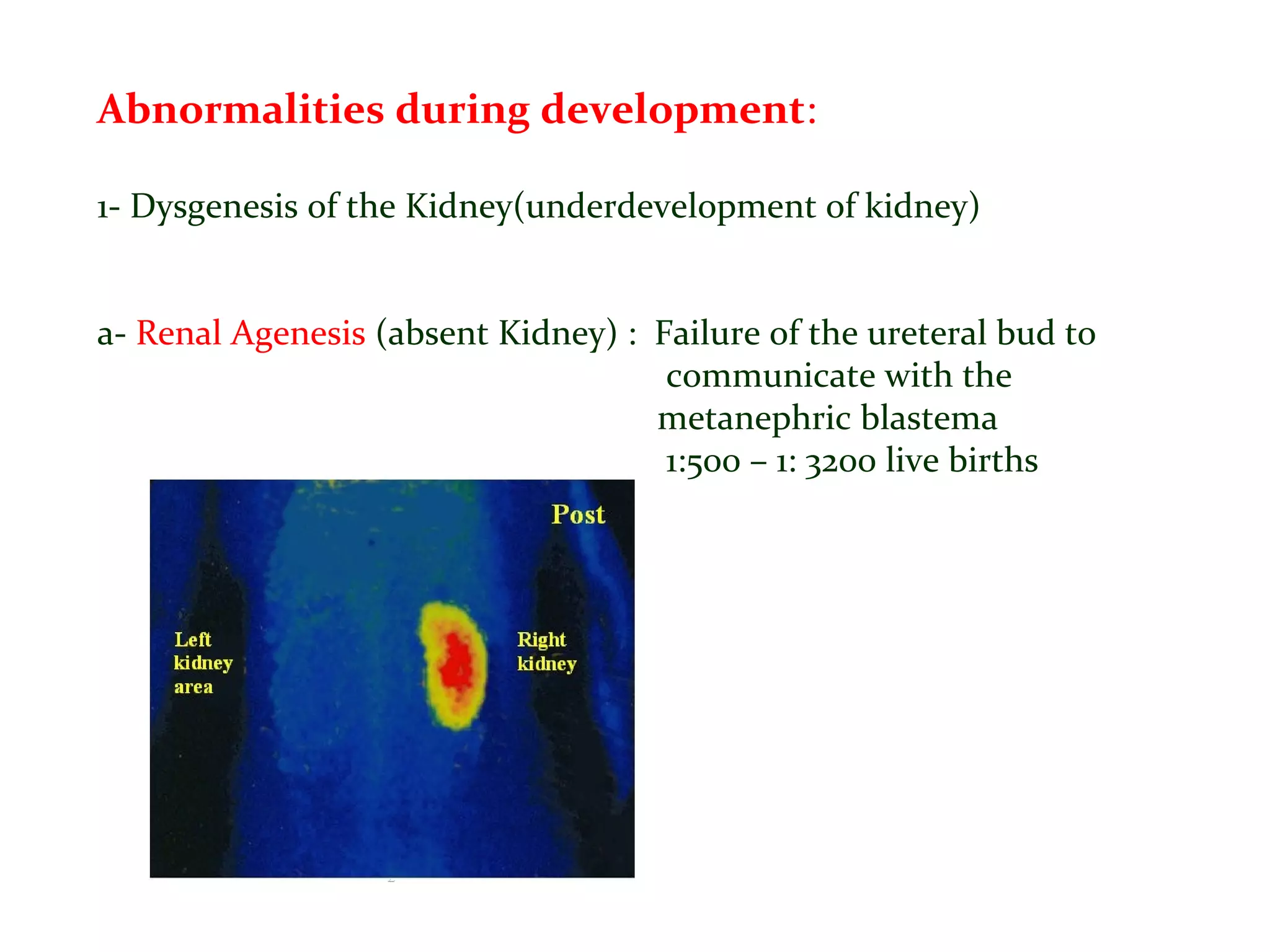
a- Renal Agenesis (absent Kidney) : Failure of the ureteral bud to
communicate with the
metanephric blastema
1:500 – 1: 3200 live births
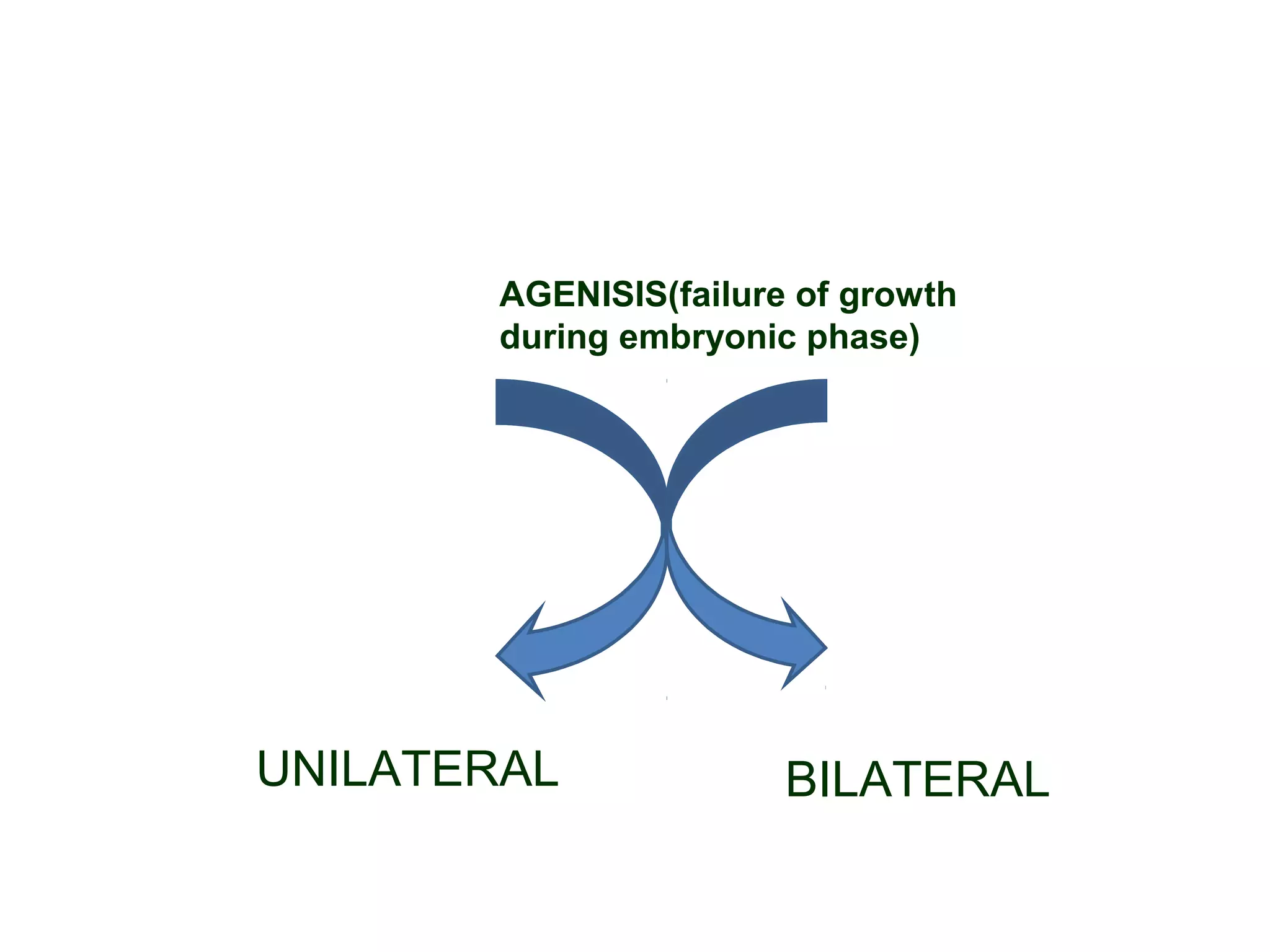
AGENISIS(failure of growth
during embryonic phase)
UNILATERAL BILATERAL
1- Unilateral : absent kidney, no symptoms. Avoid contact sport to protect the
contralateral kidney, other kidney will be hypertrophied due to increase workload. There
is an increased incidence with single umbilical artery; therefore, do an U/S to check for
unilateral kidney agenesis), absent ureter & hemitrigone. Hypertrophy, VUR(VESICO
URETERAL REFLUX) in contra lateral kidney, because in 50% of the cases, there may be
other urinary anomalies specially VUR. Sometimes unilateral agenesis might be
asymptomatic and discovered incidentally with UTI or hypertension, but can lose the
kidney when exposed to harsh trauma.
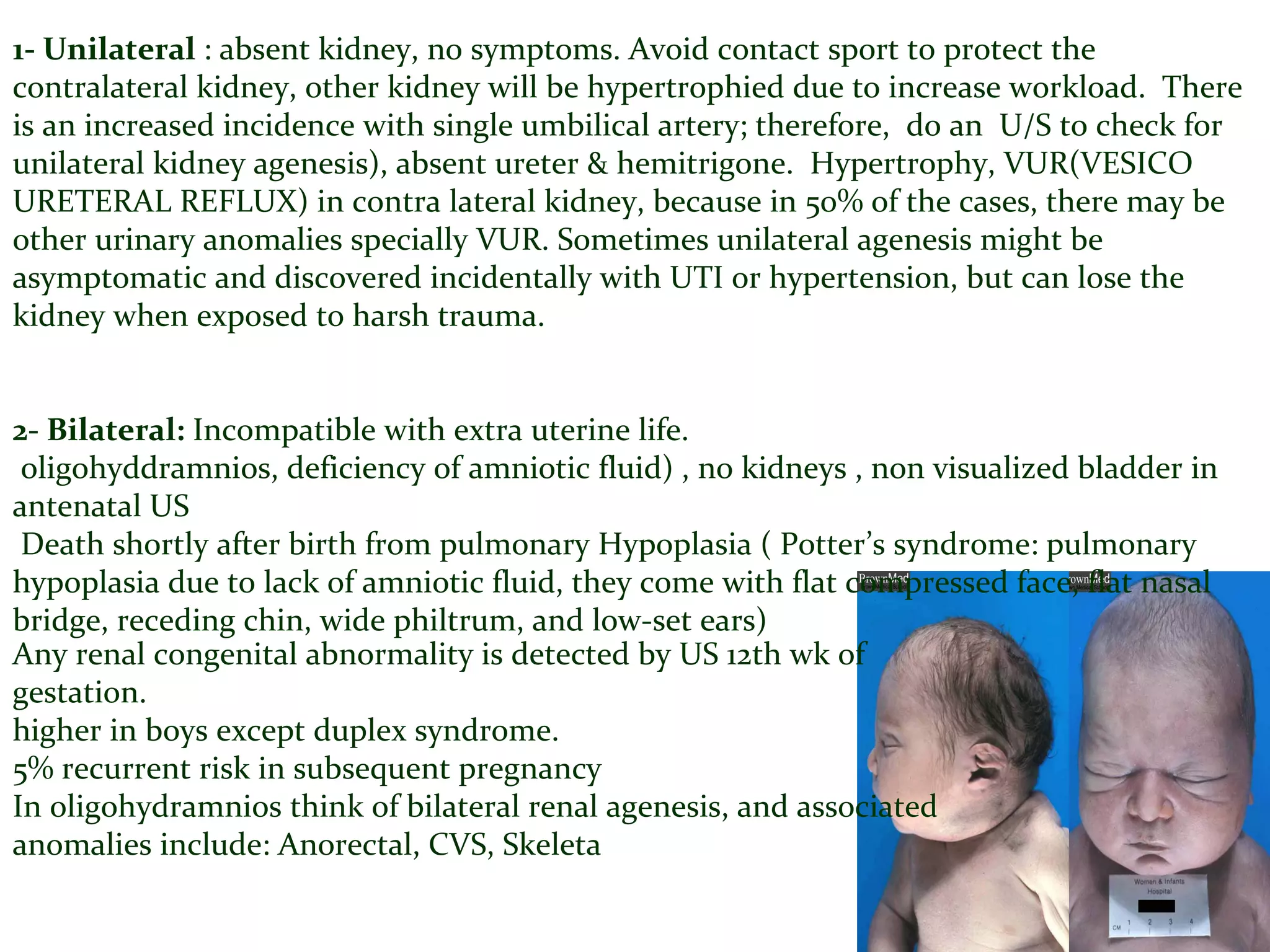
2- Bilateral: Incompatible with extra uterine life.
oligohyddramnios, deficiency of amniotic fluid) , no kidneys , non visualized bladder in
antenatal US
Death shortly after birth from pulmonary Hypoplasia ( Potter’s syndrome: pulmonary
hypoplasia due to lack of amniotic fluid, they come with flat compressed face, flat nasal
bridge, receding chin, wide philtrum, and low-set ears)
Any renal congenital abnormality is detected by US 12th wk of
gestation.
higher in boys except duplex syndrome.
5% recurrent risk in subsequent pregnancy
In oligohydramnios think of bilateral renal agenesis, and associated
anomalies include: Anorectal, CVS, Skeleta
B- Renal Hypoplasia : Small size, non dysplastic, less than normal # of
calyces & nephrons. Everything is the same, but smaller size and less #
of glomeruli.
1- Unilateral: Incident diagnosis ( another urinary tract problem or
HTN).
2- Bilateral: CRF manifestations. It’s compatible with life.
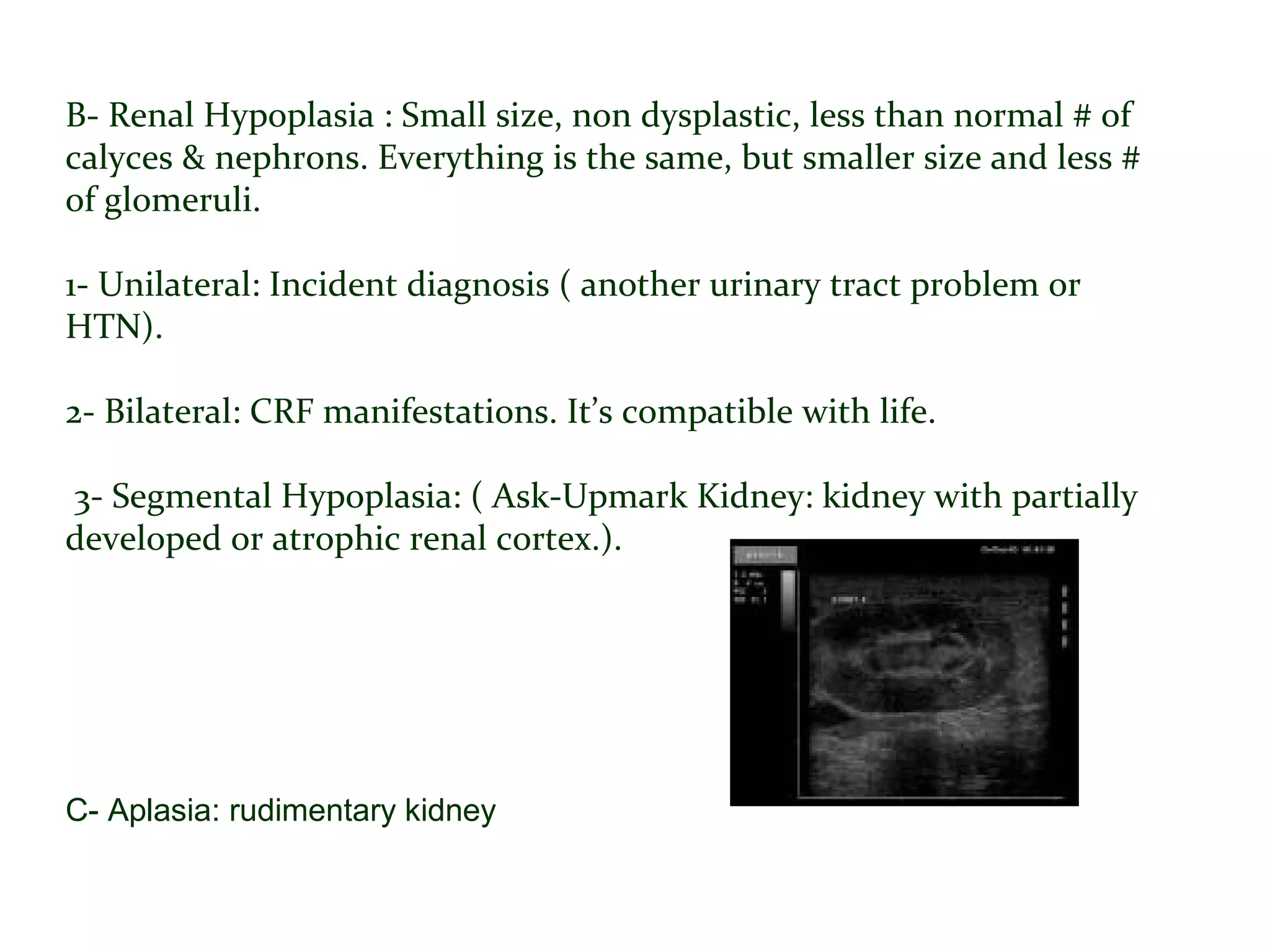
3- Segmental Hypoplasia: ( Ask-Upmark Kidney: kidney with partially
developed or atrophic renal cortex.).
C- Aplasia: rudimentary kidney
D- Renal dysplasia: Abnormality in the structure cartilages, cyst
( Abnormal metanephric differentiation) May affect all or part of the kidney.
1- Cystic
2- cartilages
Hereditary (polycystic is always bilateral): ARPKD(aotosomal recessive
pocystic kidney disease) bilateral in children.
ADPKD(autosomal dominant polycystic kidney disease) mainly
occurs in adults, but can occur in children
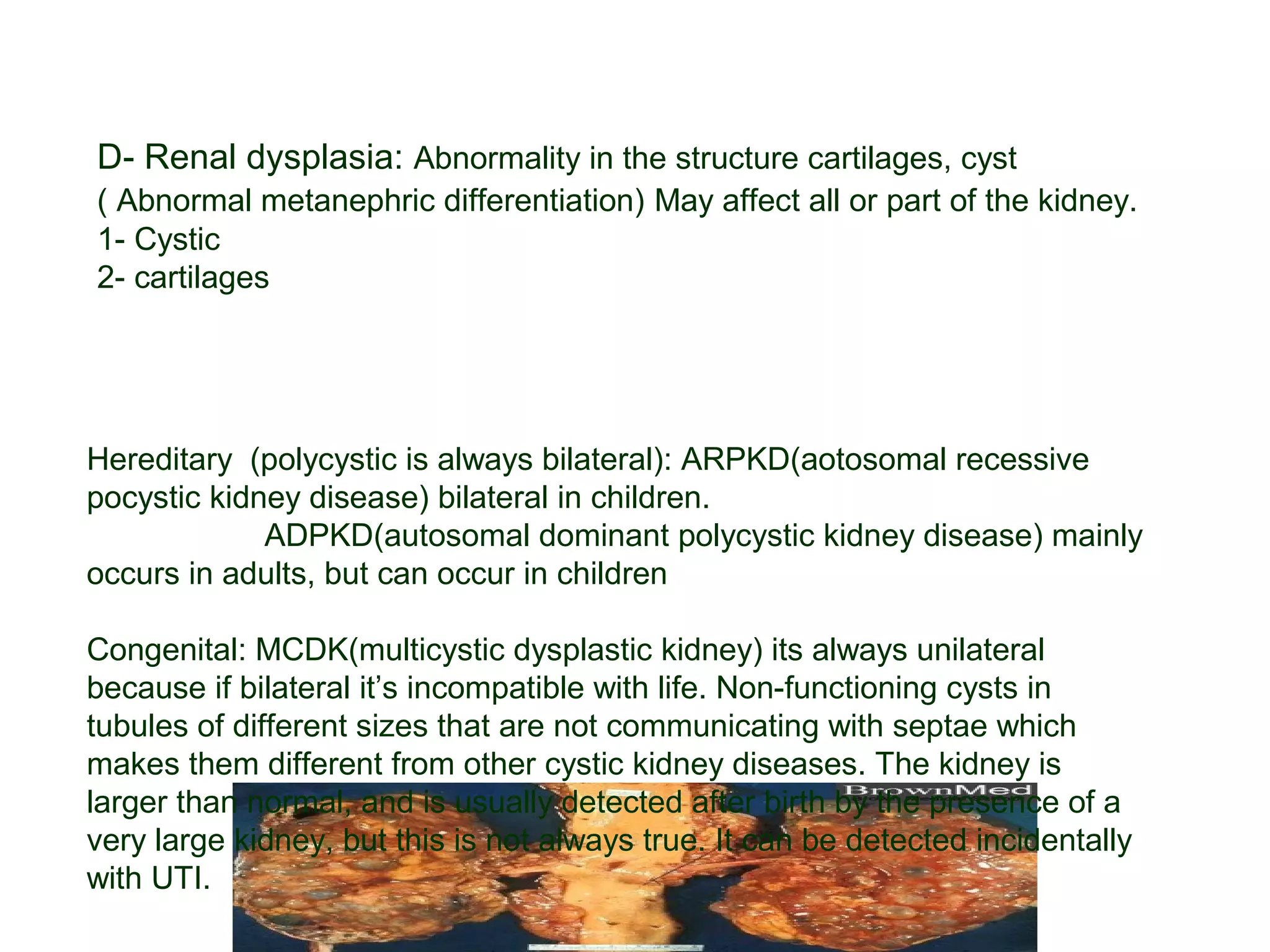
Congenital: MCDK(multicystic dysplastic kidney) its always unilateral
because if bilateral it’s incompatible with life. Non-functioning cysts in
tubules of different sizes that are not communicating with septae which
makes them different from other cystic kidney diseases. The kidney is
larger than normal, and is usually detected after birth by the presence of a
very large kidney, but this is not always true. It can be detected incidentally
with UTI.
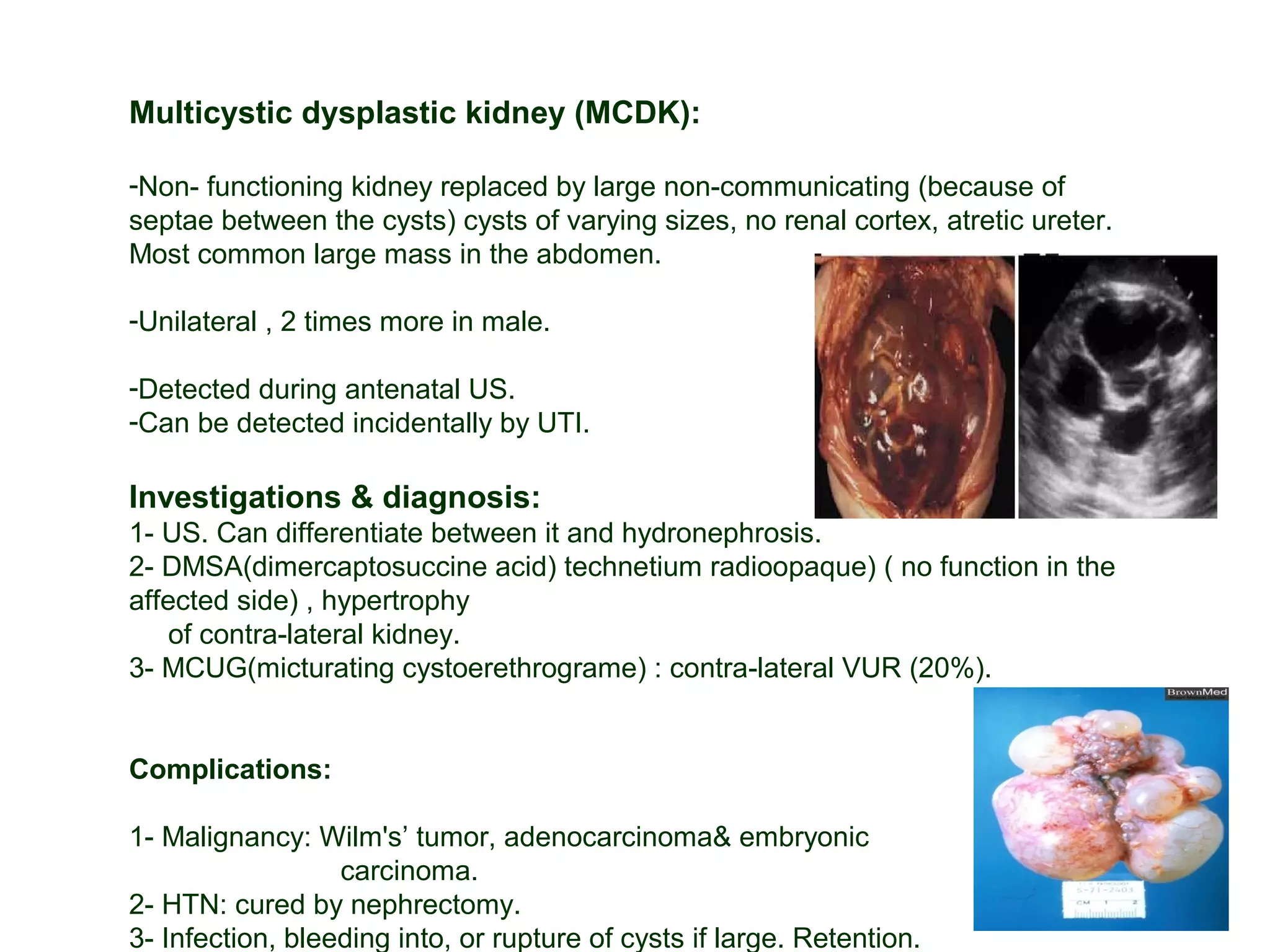
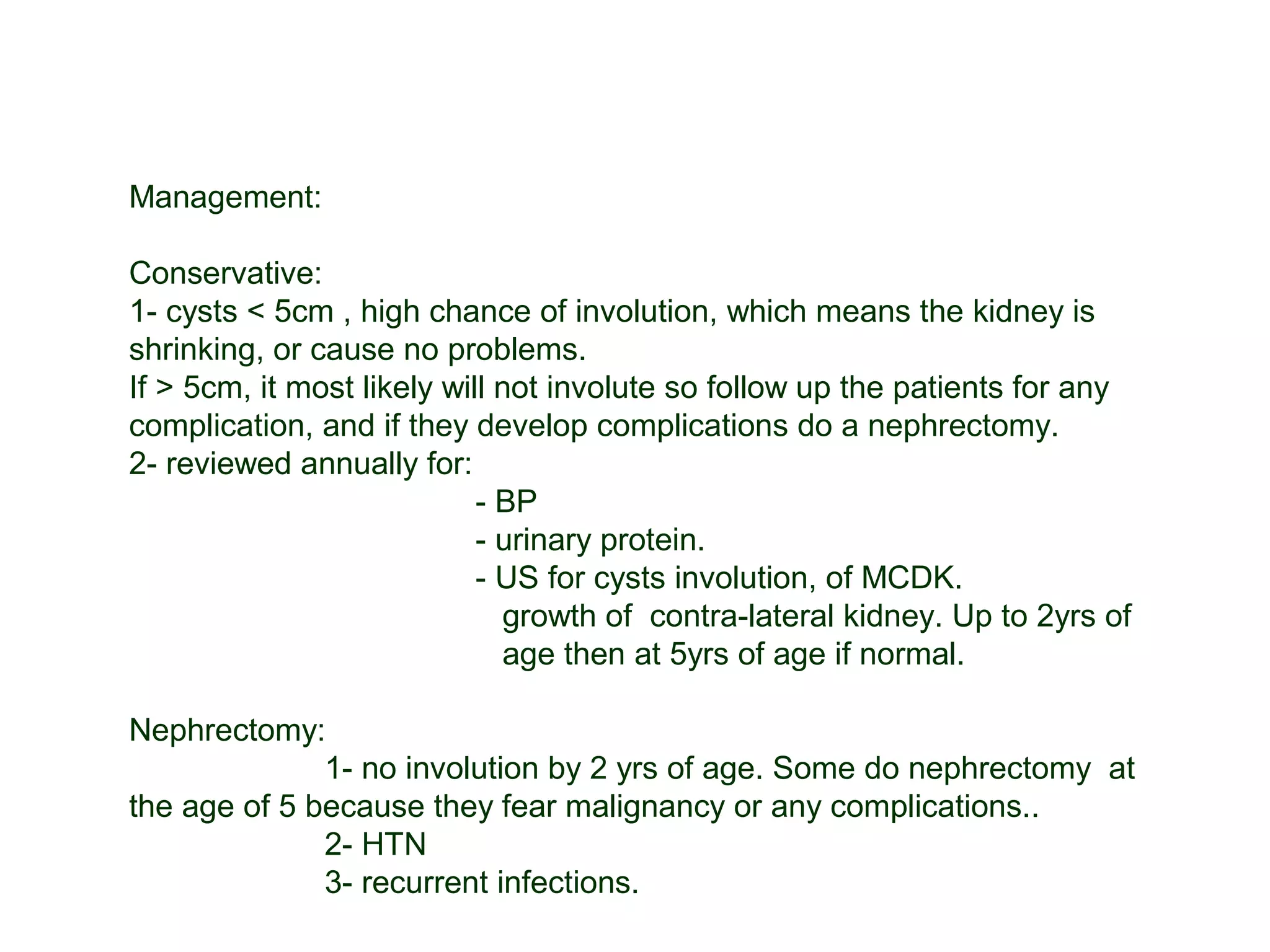
Multicystic dysplastic kidney (MCDK):
-Non- functioning kidney replaced by large non-communicating (because of
septae between the cysts) cysts of varying sizes, no renal cortex, atretic ureter.
Most common large mass in the abdomen.
-Unilateral , 2 times more in male.
-Detected during antenatal US.
-Can be detected incidentally by UTI.
Investigations & diagnosis:
1- US. Can differentiate between it and hydronephrosis.
2- DMSA(dimercaptosuccine acid) technetium radioopaque) ( no function in the
affected side) , hypertrophy
of contra-lateral kidney.
3- MCUG(micturating cystoerethrograme) : contra-lateral VUR (20%).
Complications:
1- Malignancy: Wilm's’ tumor, adenocarcinoma& embryonic
carcinoma.
2- HTN: cured by nephrectomy.
3- Infection, bleeding into, or rupture of cysts if large. Retention.
Management:
Conservative:
1- cysts < 5cm , high chance of involution, which means the kidney is
shrinking, or cause no problems.
If > 5cm, it most likely will not involute so follow up the patients for any
complication, and if they develop complications do a nephrectomy.
2- reviewed annually for:
- BP
- urinary protein.
- US for cysts involution, of MCDK.
growth of contra-lateral kidney. Up to 2yrs of
age then at 5yrs of age if normal.
Nephrectomy:
1- no involution by 2 yrs of age. Some do nephrectomy at
the age of 5 because they fear malignancy or any complications..
2- HTN
3- recurrent infections.
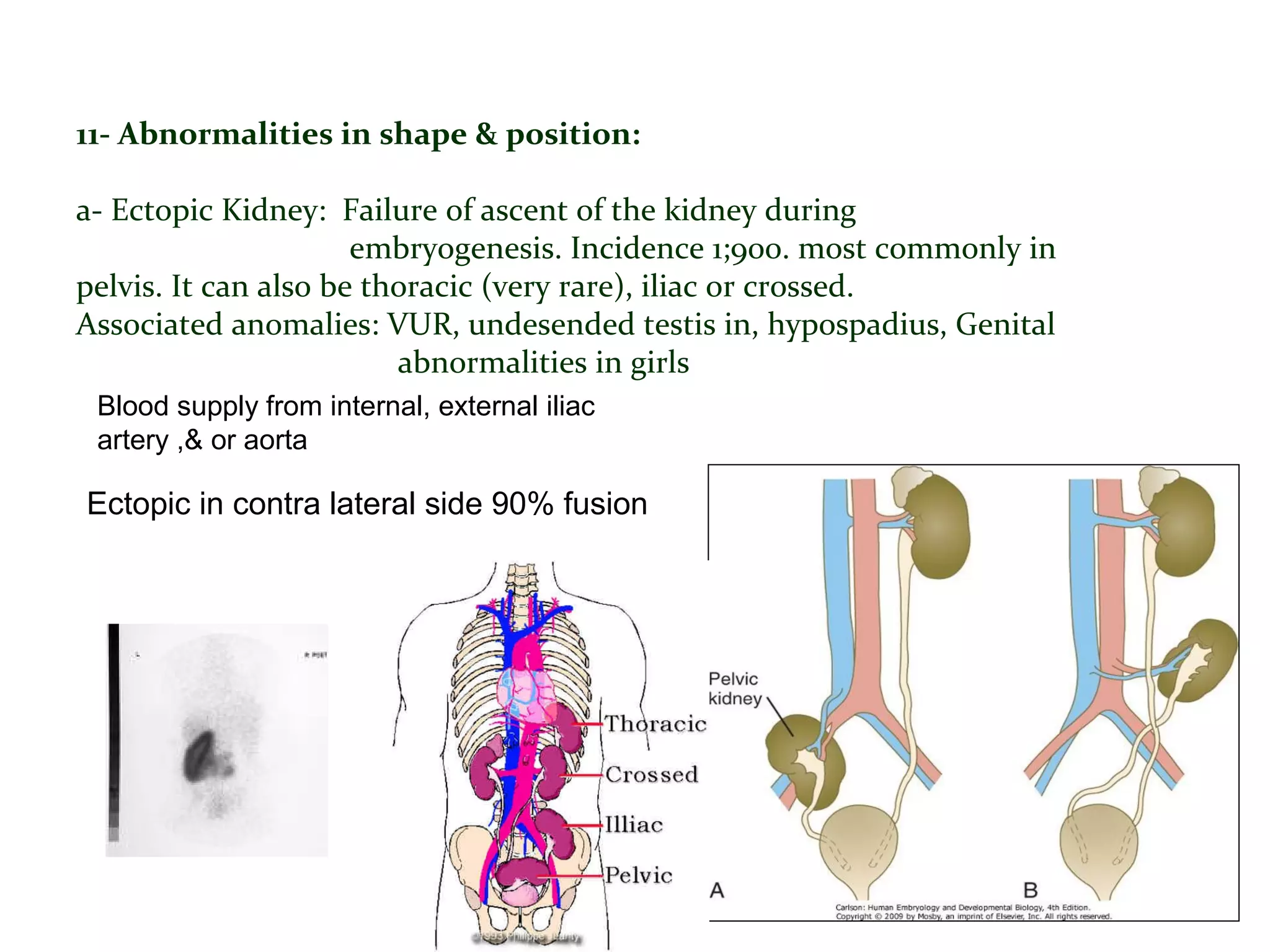
11- Abnormalities in shape & position:
a- Ectopic Kidney: Failure of ascent of the kidney during
embryogenesis. Incidence 1;900. most commonly in
pelvis. It can also be thoracic (very rare), iliac or crossed.
Associated anomalies: VUR, undesended testis in, hypospadius, Genital
abnormalities in girls
Blood supply from internal, external iliac
artery ,& or aorta
Ectopic in contra lateral side 90% fusion
b- Fusion Anomalies
1- horseshoe Kidney: 1:500
-Commonest form of fusion (95%).
-The lower poles of both kidneys unite across the midline
-The isthmus of horse shoe kidney lie at the level of L4-L5, is more
susceptible to trauma (avoid severe aggressive sports)
-More common in male, Turner syndrome (always look for horseshoe
kidney), trisomy 18
Complications:
-50% VUR, abnormal vascular supply.
- Stone (ureter is no longer positioned anterolaterally, and kidney
causes pressure on it, leading to hydronephrosis .
- Wilm’s tumor
- HTN due to vascular abnormality.
Diagnosis: DMSA, MCUG ,dtpa(diethylene triamine pentaacitic acid)
(to assess the function of the ureter) can be missed by U/S.
Always assess the external genitalia and check for VUR (by
urogram) in all patients with fusion anomalies.
Due to its abnormal position, it is affected easily by trauma,
therefore restrain kids from fighting
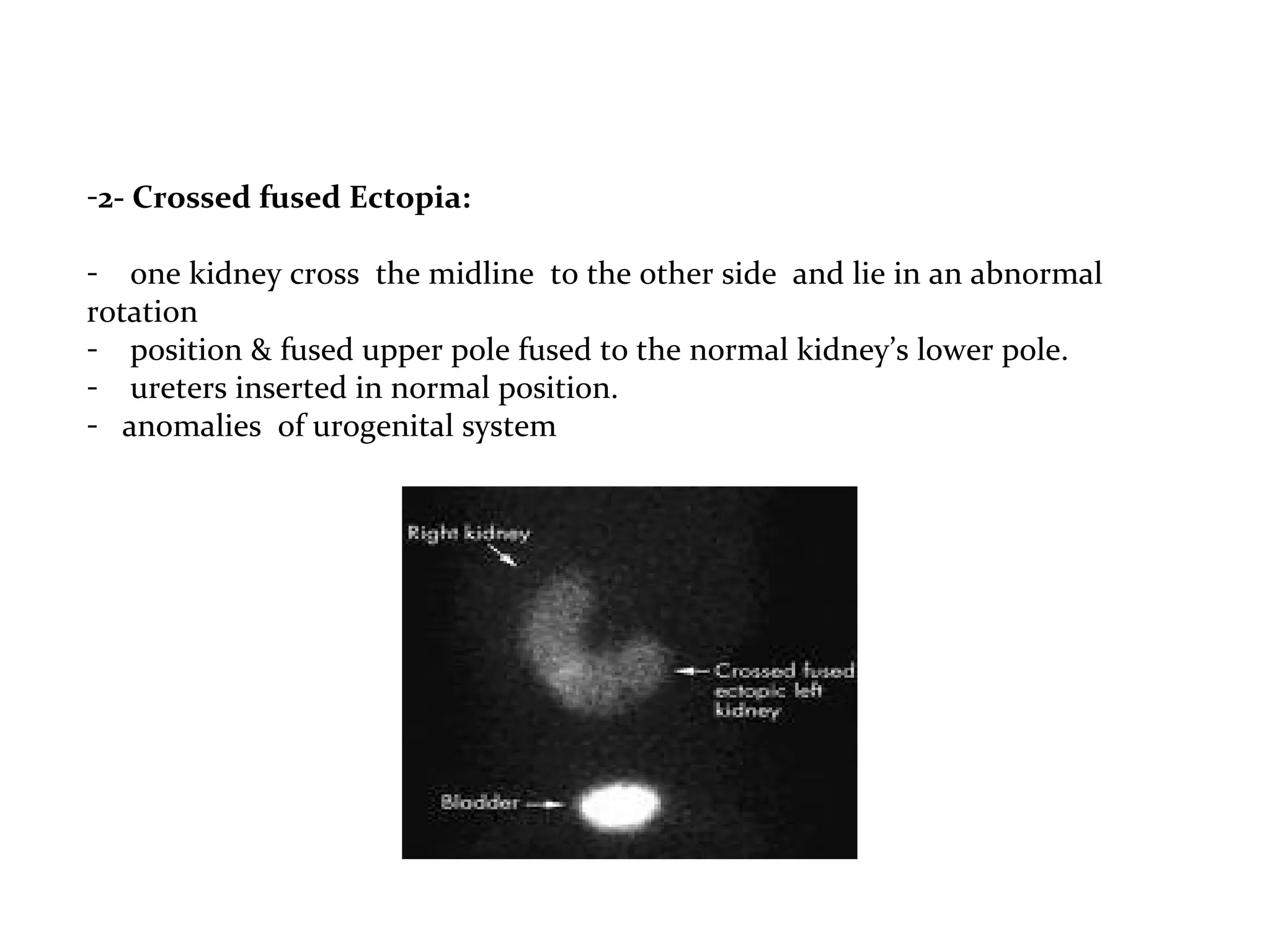
-2- Crossed fused Ectopia:
- one kidney cross the midline to the other side and lie in an abnormal
rotation
- position & fused upper pole fused to the normal kidney’s lower pole.
- ureters inserted in normal position.
- anomalies of urogenital system
III-Abnormalities of the collecting system:
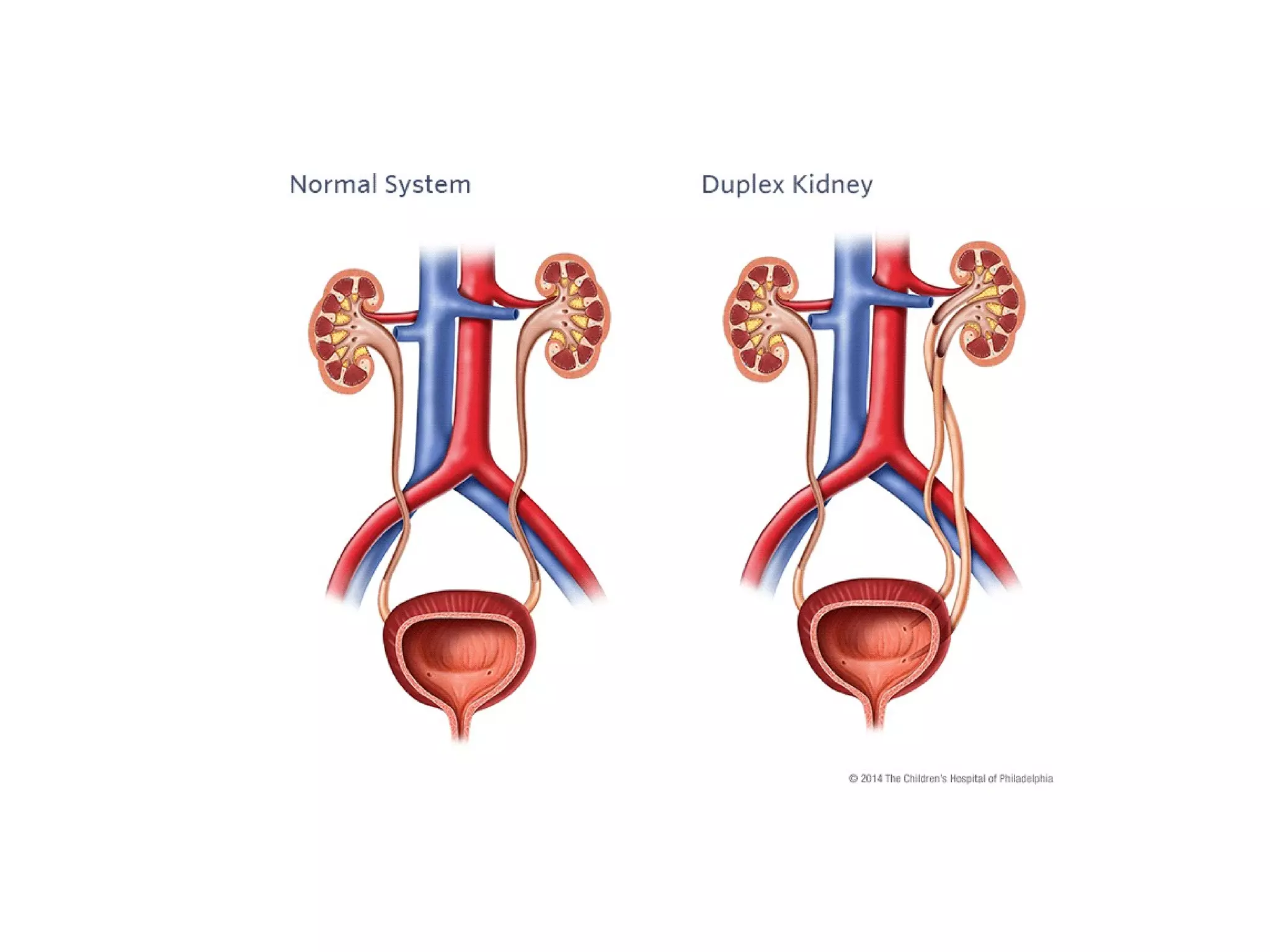
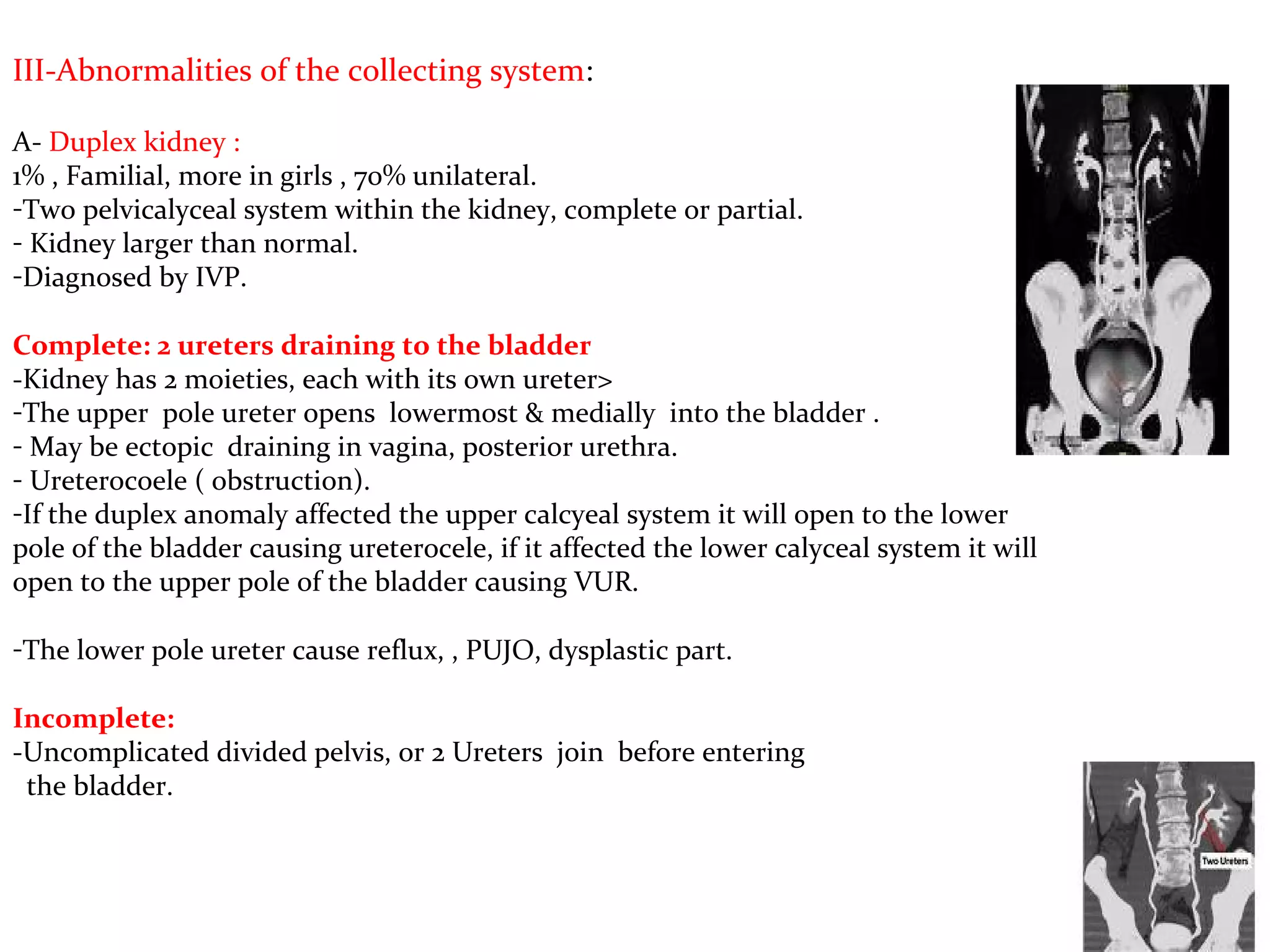
A- Duplex kidney :
1% , Familial, more in girls , 70% unilateral.
-Two pelvicalyceal system within the kidney, complete or partial.
- Kidney larger than normal.
-Diagnosed by IVP.
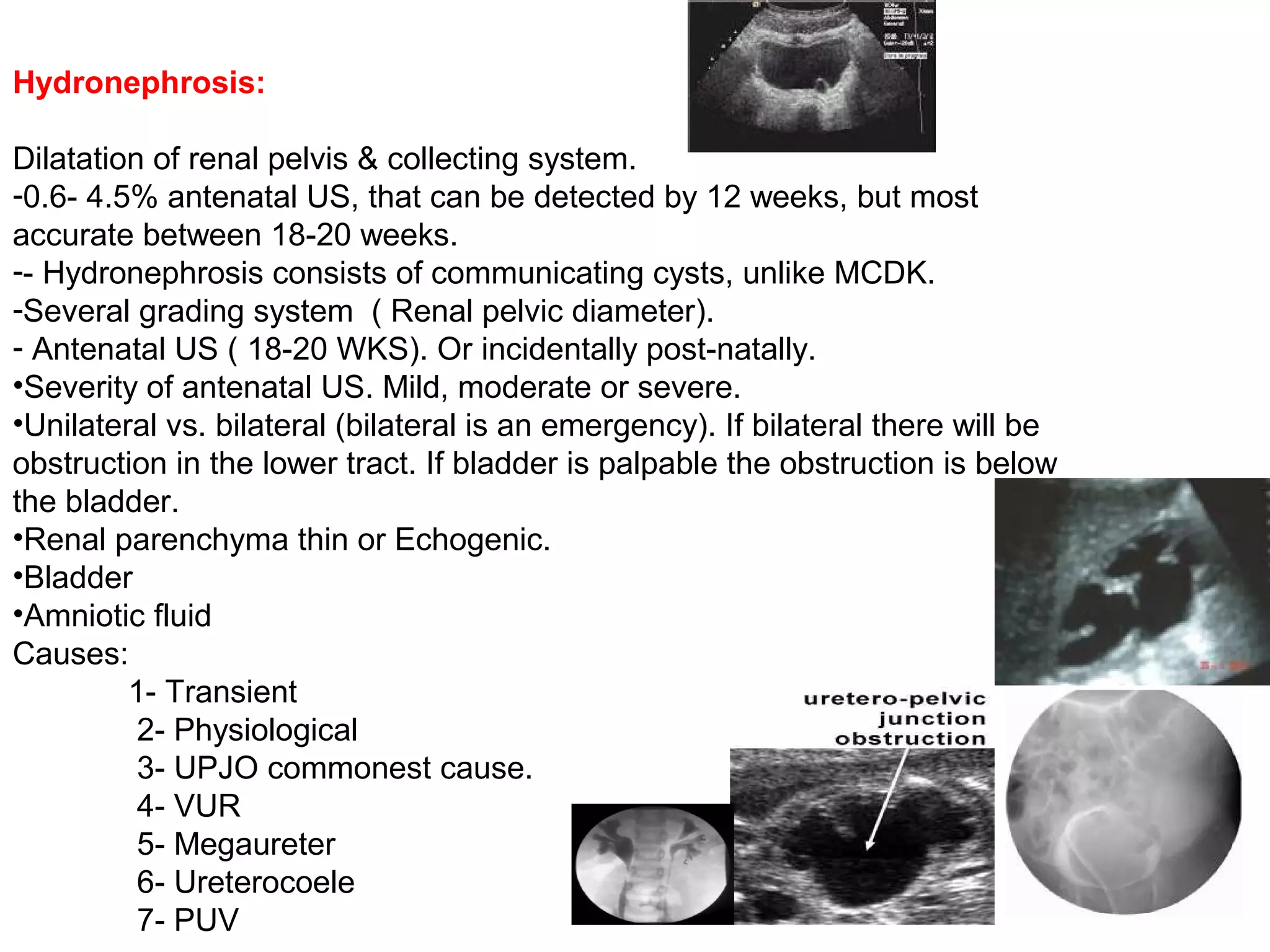
Complete: 2 ureters draining to the bladder
-Kidney has 2 moieties, each with its own ureter>
-The upper pole ureter opens lowermost & medially into the bladder .
- May be ectopic draining in vagina, posterior urethra.
- Ureterocoele ( obstruction).
-If the duplex anomaly affected the upper calcyeal system it will open to the lower
pole of the bladder causing ureterocele, if it affected the lower calyceal system it will
open to the upper pole of the bladder causing VUR.
-The lower pole ureter cause reflux, , PUJO, dysplastic part.
Incomplete:
-Uncomplicated divided pelvis, or 2 Ureters join before entering
the bladder.
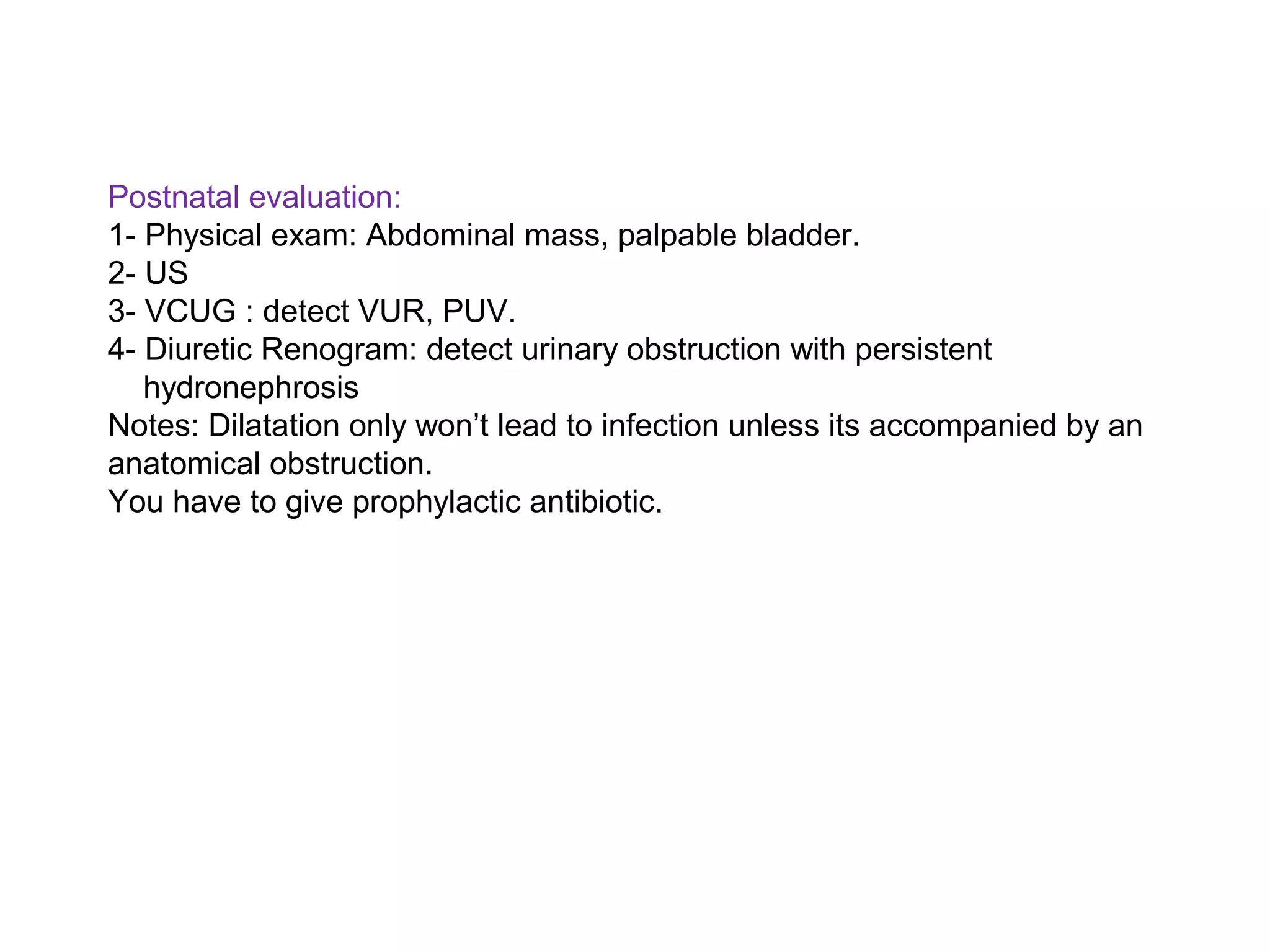
Hydronephrosis:
Dilatation of renal pelvis & collecting system.
-0.6- 4.5% antenatal US, that can be detected by 12 weeks, but most
accurate between 18-20 weeks.
-- Hydronephrosis consists of communicating cysts, unlike MCDK.
-Several grading system ( Renal pelvic diameter).
- Antenatal US ( 18-20 WKS). Or incidentally post-natally.
•Severity of antenatal US. Mild, moderate or severe.
•Unilateral vs. bilateral (bilateral is an emergency). If bilateral there will be
obstruction in the lower tract. If bladder is palpable the obstruction is below
the bladder.
•Renal parenchyma thin or Echogenic.
•Bladder
•Amniotic fluid
Causes:
1- Transient
2- Physiological
3- UPJO commonest cause.
4- VUR
5- Megaureter
6- Ureterocoele
7- PUV
Postnatal evaluation:
1- Physical exam: Abdominal mass, palpable bladder.
2- US
3- VCUG : detect VUR, PUV.
4- Diuretic Renogram: detect urinary obstruction with persistent
hydronephrosis
Notes: Dilatation only won’t lead to infection unless its accompanied by an
anatomical obstruction.
You have to give prophylactic antibiotic.
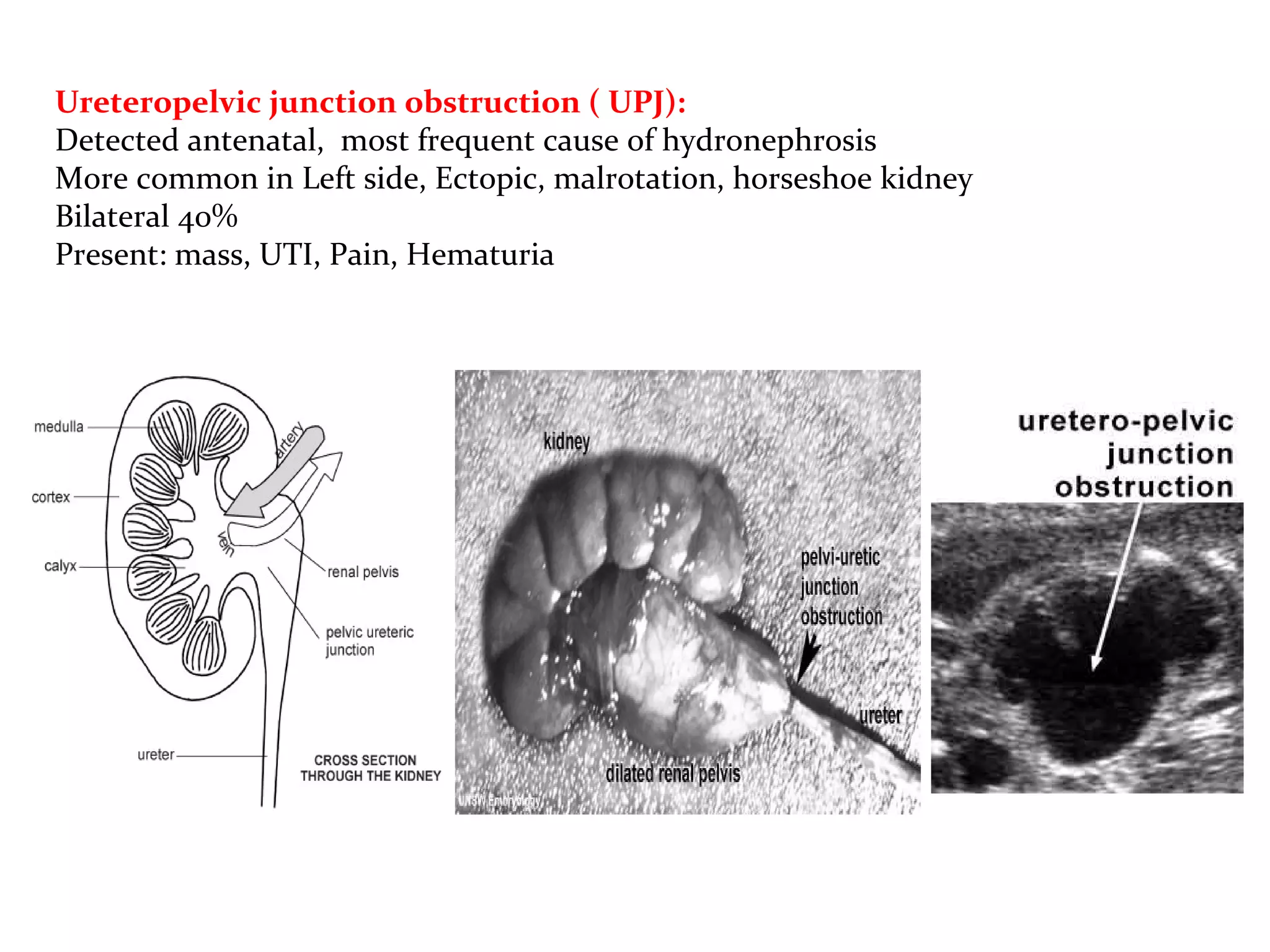
Ureteropelvic junction obstruction ( UPJ):
Detected antenatal, most frequent cause of hydronephrosis
More common in Left side, Ectopic, malrotation, horseshoe kidney
Bilateral 40%
Present: mass, UTI, Pain, Hematuria
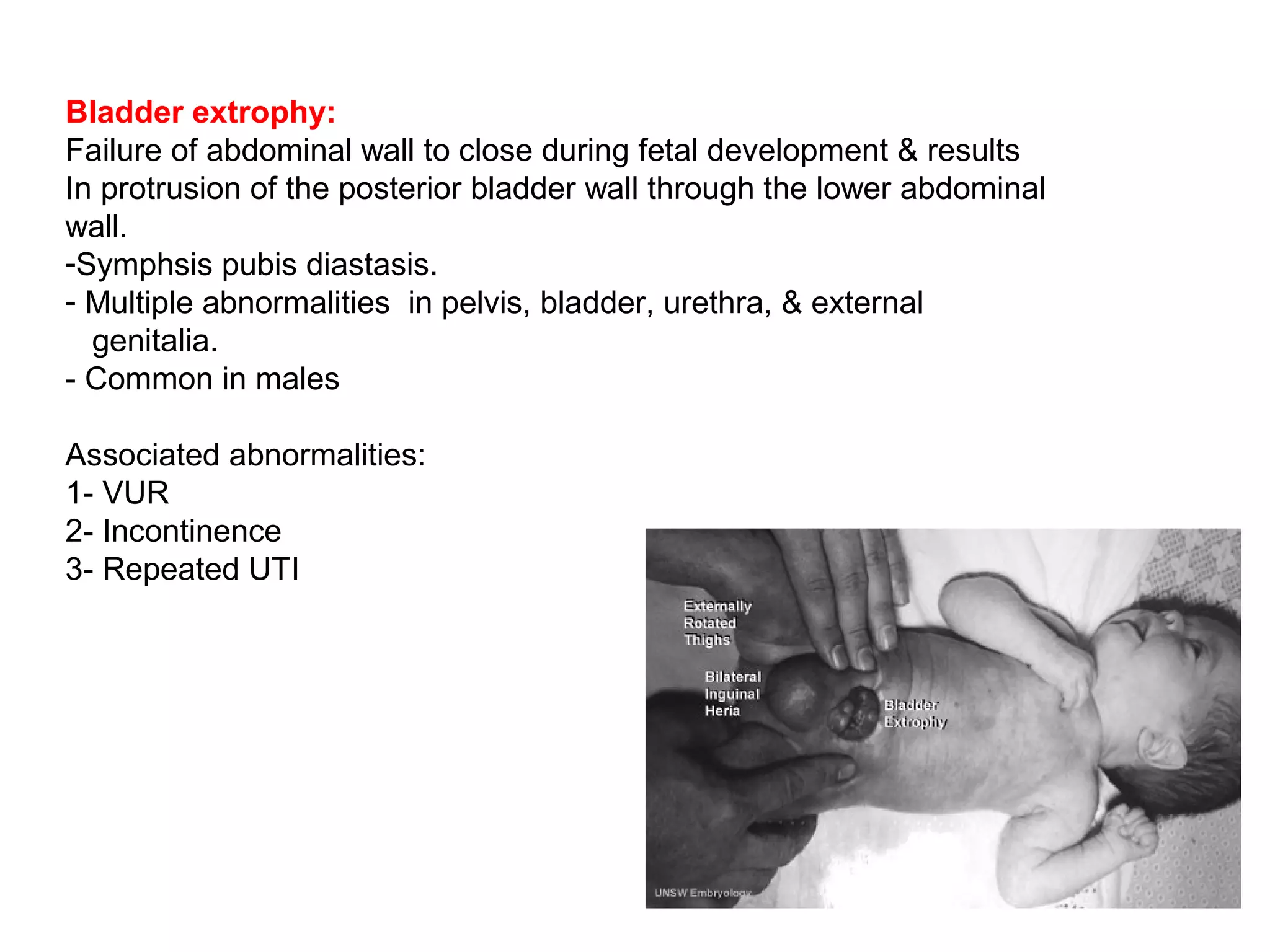
Bladder extrophy:
Failure of abdominal wall to close during fetal development & results
In protrusion of the posterior bladder wall through the lower abdominal
wall.
-Symphsis pubis diastasis.
- Multiple abnormalities in pelvis, bladder, urethra, & external
genitalia.
- Common in males
Associated abnormalities:
1- VUR
2- Incontinence
3- Repeated UTI
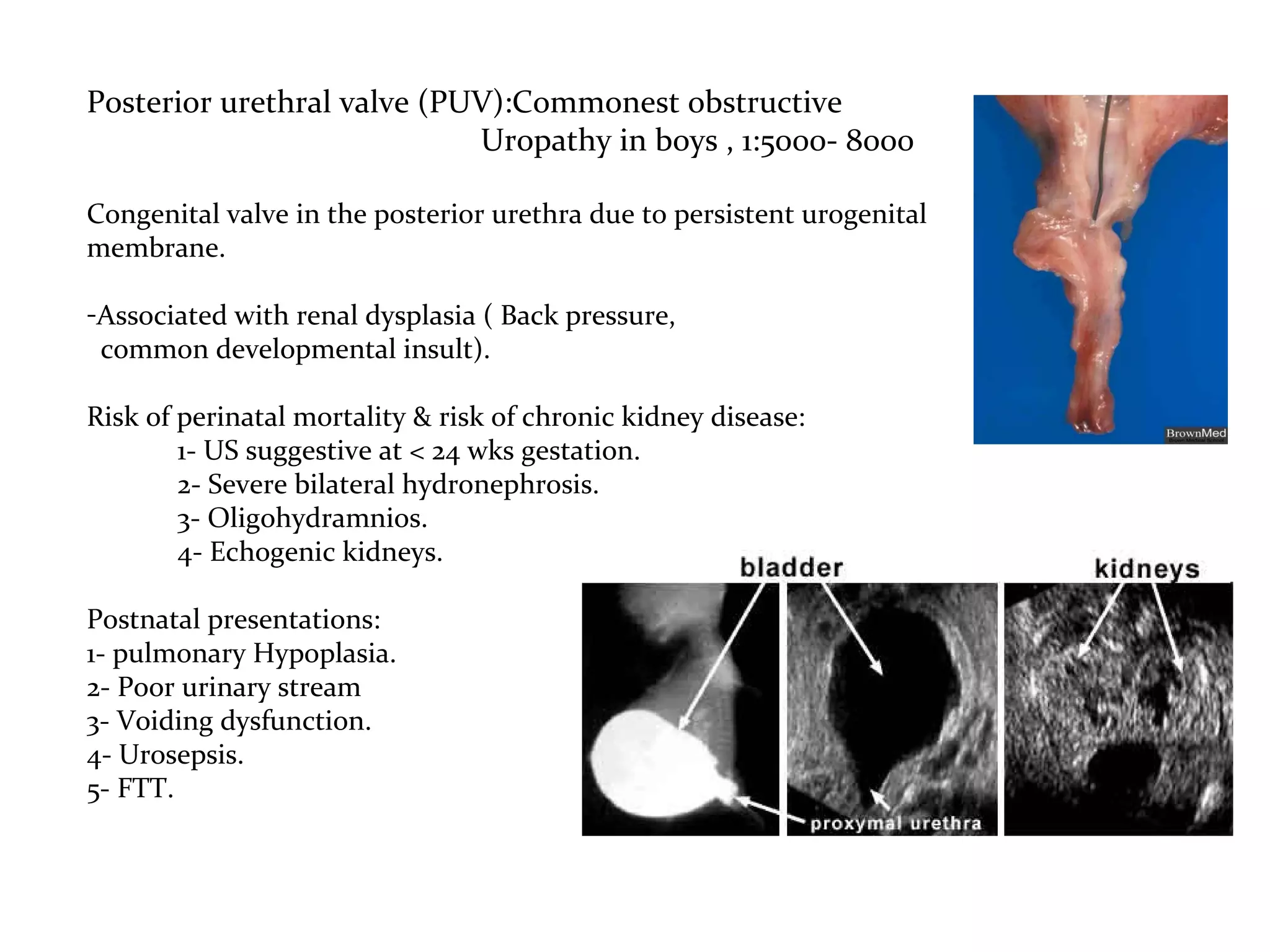
Posterior urethral valve (PUV):Commonest obstructive
Uropathy in boys , 1:5000- 8000
Congenital valve in the posterior urethra due to persistent urogenital
membrane.
-Associated with renal dysplasia ( Back pressure,
common developmental insult).
Risk of perinatal mortality & risk of chronic kidney disease:
1- US suggestive at < 24 wks gestation.
2- Severe bilateral hydronephrosis.
3- Oligohydramnios.
4- Echogenic kidneys.
Postnatal presentations:
1- pulmonary Hypoplasia.
2- Poor urinary stream
3- Voiding dysfunction.
4- Urosepsis.
5- FTT.
Renal & urological manifestation:
1- Chronic kidney diseases (if discovered late it will lead to CRF). 60%
dysplastic kidney.
2- VUR
3- Bladder dysfunction.
Management:
1- correction of electrolytes.
2- Treatment of sepsis.
3- Resp.distress
4- Temporary relieve of pressure
5- cystoscopy : valve ablation
6- Vesicostomy(openning into the bladder)
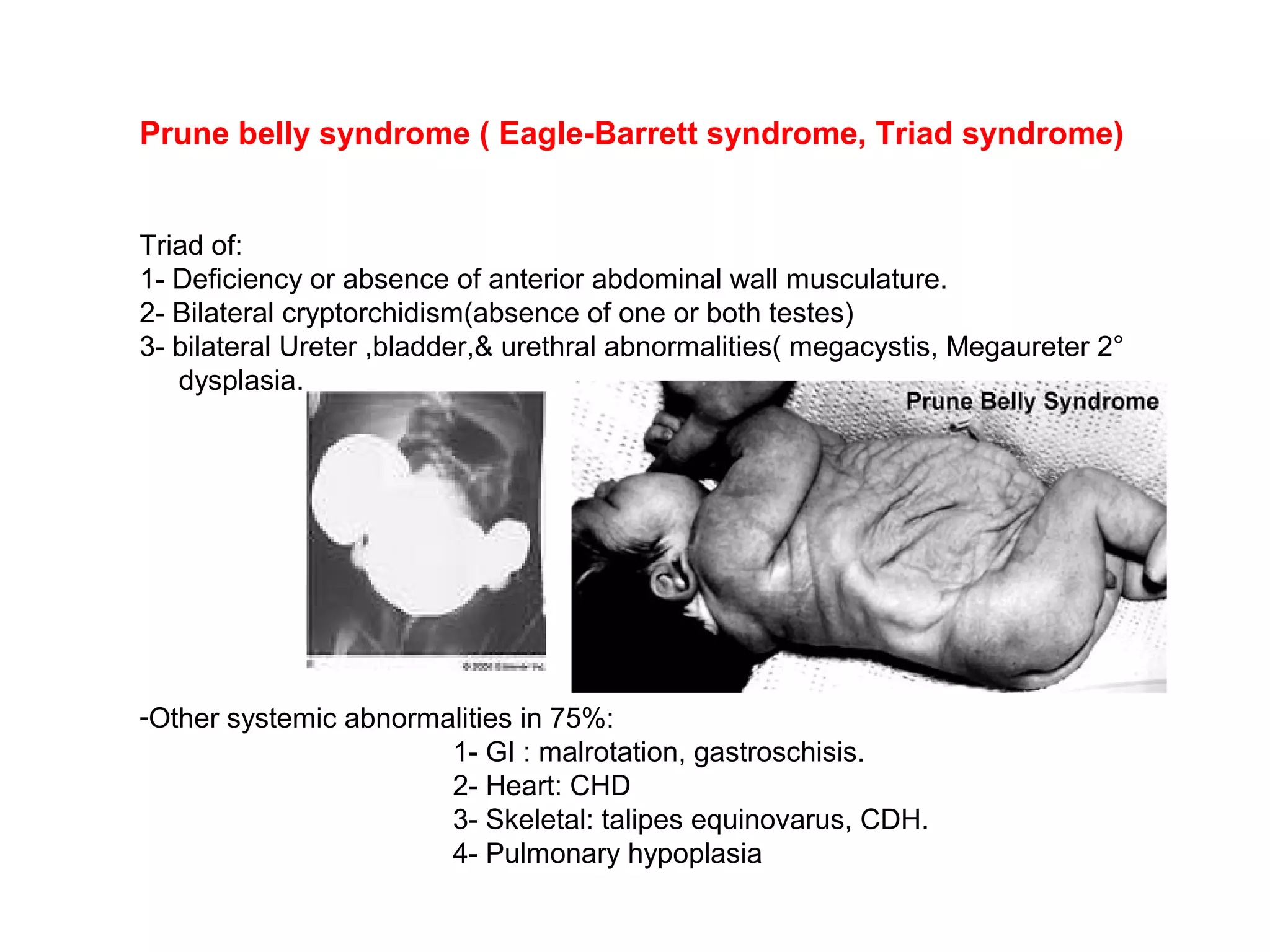
Prune belly syndrome ( Eagle-Barrett syndrome, Triad syndrome)
Triad of:
1- Deficiency or absence of anterior abdominal wall musculature.
2- Bilateral cryptorchidism(absence of one or both testes)
3- bilateral Ureter ,bladder,& urethral abnormalities( megacystis, Megaureter 2°
dysplasia.
-Other systemic abnormalities in 75%:
1- GI : malrotation, gastroschisis.
2- Heart: CHD
3- Skeletal: talipes equinovarus, CDH.
4- Pulmonary hypoplasia
Clinical presentation :
Wide spectrum
1- Antenatal screening 0.1- 0.7%.
2- UTI
3- Hypertension
4- Proteinuria
5- Renal impairment
6- Hematuria
7- Stones
Antenatal Screening US
1- Fetal kidney
2- Collecting system
3- Amniotic fluid
Postnatal Exam:
Physical exam: Associated anomalies
Urgent evaluation : Bilateral involvement, solitary affected kidney,
oligohyddramnios.
Renal studies: Renal US, VCUG, MAG3
Take home messages:
1- Congenital anomalies of the kidney are significant causes of ESRF in
children.
2- These anomalies often do not exist in isolation.
3- May present beyond the neonatal period.
4- Bilateral involvement. Oligohyddramnios, solitary kidney require urgent
evaluation.
5- Long –term follow-up of renal & bladder function is important.
Congenital anomaly of urinary system.

Congenital anomaly of urinary system.

  • 1.
    Congenital anomalies ofkidney and urinary system Prepared By: Sanjay Sir Lecturer Govt. CON Surat India
  • 2.
    CONTENTS: 1- Anatomy ofurinary system 2- Function of urinary system 3- Normal development 4- Congenital anomalies of urinary system: -Dysgenesis of the kidney -Agenesis - Hypo plastic - Dysplastic - A plastic -Abnormalities in shape & position - Ectopic Kidney - Horse shoe Kidney - Crossed fused Ectopia -Abnormalities of collecting system - Hydronephrosis - Bladder extrophy - PUV - Patent Urachus -Clinical presentation - Antenatal screening - Postnatal Evaluation
  • 3.
    Development of Urinarysystem(kidney): Kidney development, or nephrogenesis, describes the embryologic origins of the kidney, a major organ in the urinary system. It is observed in most reptiles, birds and mammals, including humans. The Urinary system goes through three phases on its way to becoming fully functioning : 1- Pronephros 2- Mesonephros 3- Metanephros Starting from 4th wk & end on 36 wk of intra uterine life
  • 4.
    The development ofthe kidney proceeds through a series of successive phases, each marked by the development of a more advanced kidney: the pronephros, mesonephros, and metanephros. The pronephros is the most immature form of kidney, while the metanephros is most developed. The metanephros persists as the definitive adult kidney.
  • 7.
    Normal Anatomy ofthe Urinary system -4 wks gestation : kidney start development - 9 wks : first glomeruli , Bladder -36 wks : nephrogenesis ceases ( 1 million glomeruli in each kidney). - Postnatal increase in the size of the kidney is due to enlargement of the Glomerular diameter & significant increase in tubular volume & length
  • 8.
    Active period ofnephrogenesis between 20-36wks, cease around 36 wks
  • 11.
    Nephron: Glomerulus, Bowman'scapsule, convoluted tubule, loop of Henle Formation begin at 8th wk. Nephron
  • 13.
    Ascent of kidneys: A:5th -6th wk the mature kidneys lie in the pelvis with their hila pointed anteriorly B: 7th wk the hilum points medially , kidneys in the abdomen. C: 9th wk kidneys in the retroperitoneal position at level of L1 , complete rotation , anteromedially.
  • 14.
    Normal Function ofthe Urinary system: Kidney : 1- Filters blood- remove and eliminate soluble waste ( urine). 2- Regulates blood volume and composition. 3- Maintains water and electrolyte balance. 4- Hormonal production; Erythropoietin, Renin. 5- Metabolizes vitamin D to active form. Ureters: convey urine from kidneys to bladder. Urinary bladder: Temporary urine storage. Urethra: Conveys urine from bladder to outside. Note: the kidney function will reach adult level at the age of 2 years, while the kidney size will reach the adult size at the age of 9 years. Bladdernwill reach adult size by 2 years.
  • 15.
    Abnormalities during development: 1-Dysgenesis of the Kidney(underdevelopment of kidney) a- Renal Agenesis (absent Kidney) : Failure of the ureteral bud to communicate with the metanephric blastema 1:500 – 1: 3200 live births
  • 16.
    AGENISIS(failure of growth duringembryonic phase) UNILATERAL BILATERAL
  • 17.
    1- Unilateral :absent kidney, no symptoms. Avoid contact sport to protect the contralateral kidney, other kidney will be hypertrophied due to increase workload. There is an increased incidence with single umbilical artery; therefore, do an U/S to check for unilateral kidney agenesis), absent ureter & hemitrigone. Hypertrophy, VUR(VESICO URETERAL REFLUX) in contra lateral kidney, because in 50% of the cases, there may be other urinary anomalies specially VUR. Sometimes unilateral agenesis might be asymptomatic and discovered incidentally with UTI or hypertension, but can lose the kidney when exposed to harsh trauma. 2- Bilateral: Incompatible with extra uterine life. oligohyddramnios, deficiency of amniotic fluid) , no kidneys , non visualized bladder in antenatal US Death shortly after birth from pulmonary Hypoplasia ( Potter’s syndrome: pulmonary hypoplasia due to lack of amniotic fluid, they come with flat compressed face, flat nasal bridge, receding chin, wide philtrum, and low-set ears) Any renal congenital abnormality is detected by US 12th wk of gestation. higher in boys except duplex syndrome. 5% recurrent risk in subsequent pregnancy In oligohydramnios think of bilateral renal agenesis, and associated anomalies include: Anorectal, CVS, Skeleta
  • 19.
    B- Renal Hypoplasia: Small size, non dysplastic, less than normal # of calyces & nephrons. Everything is the same, but smaller size and less # of glomeruli. 1- Unilateral: Incident diagnosis ( another urinary tract problem or HTN). 2- Bilateral: CRF manifestations. It’s compatible with life. 3- Segmental Hypoplasia: ( Ask-Upmark Kidney: kidney with partially developed or atrophic renal cortex.). C- Aplasia: rudimentary kidney
  • 20.
    D- Renal dysplasia:Abnormality in the structure cartilages, cyst ( Abnormal metanephric differentiation) May affect all or part of the kidney. 1- Cystic 2- cartilages Hereditary (polycystic is always bilateral): ARPKD(aotosomal recessive pocystic kidney disease) bilateral in children. ADPKD(autosomal dominant polycystic kidney disease) mainly occurs in adults, but can occur in children Congenital: MCDK(multicystic dysplastic kidney) its always unilateral because if bilateral it’s incompatible with life. Non-functioning cysts in tubules of different sizes that are not communicating with septae which makes them different from other cystic kidney diseases. The kidney is larger than normal, and is usually detected after birth by the presence of a very large kidney, but this is not always true. It can be detected incidentally with UTI.
  • 21.
    Multicystic dysplastic kidney(MCDK): -Non- functioning kidney replaced by large non-communicating (because of septae between the cysts) cysts of varying sizes, no renal cortex, atretic ureter. Most common large mass in the abdomen. -Unilateral , 2 times more in male. -Detected during antenatal US. -Can be detected incidentally by UTI. Investigations & diagnosis: 1- US. Can differentiate between it and hydronephrosis. 2- DMSA(dimercaptosuccine acid) technetium radioopaque) ( no function in the affected side) , hypertrophy of contra-lateral kidney. 3- MCUG(micturating cystoerethrograme) : contra-lateral VUR (20%). Complications: 1- Malignancy: Wilm's’ tumor, adenocarcinoma& embryonic carcinoma. 2- HTN: cured by nephrectomy. 3- Infection, bleeding into, or rupture of cysts if large. Retention.

  • 22.
    Management: Conservative: 1- cysts <5cm , high chance of involution, which means the kidney is shrinking, or cause no problems. If > 5cm, it most likely will not involute so follow up the patients for any complication, and if they develop complications do a nephrectomy. 2- reviewed annually for: - BP - urinary protein. - US for cysts involution, of MCDK. growth of contra-lateral kidney. Up to 2yrs of age then at 5yrs of age if normal. Nephrectomy: 1- no involution by 2 yrs of age. Some do nephrectomy at the age of 5 because they fear malignancy or any complications.. 2- HTN 3- recurrent infections.
  • 23.
    11- Abnormalities inshape & position: a- Ectopic Kidney: Failure of ascent of the kidney during embryogenesis. Incidence 1;900. most commonly in pelvis. It can also be thoracic (very rare), iliac or crossed. Associated anomalies: VUR, undesended testis in, hypospadius, Genital abnormalities in girls Blood supply from internal, external iliac artery ,& or aorta Ectopic in contra lateral side 90% fusion
  • 24.
    b- Fusion Anomalies 1-horseshoe Kidney: 1:500 -Commonest form of fusion (95%). -The lower poles of both kidneys unite across the midline -The isthmus of horse shoe kidney lie at the level of L4-L5, is more susceptible to trauma (avoid severe aggressive sports) -More common in male, Turner syndrome (always look for horseshoe kidney), trisomy 18 Complications: -50% VUR, abnormal vascular supply. - Stone (ureter is no longer positioned anterolaterally, and kidney causes pressure on it, leading to hydronephrosis . - Wilm’s tumor - HTN due to vascular abnormality. Diagnosis: DMSA, MCUG ,dtpa(diethylene triamine pentaacitic acid) (to assess the function of the ureter) can be missed by U/S. Always assess the external genitalia and check for VUR (by urogram) in all patients with fusion anomalies. Due to its abnormal position, it is affected easily by trauma, therefore restrain kids from fighting
  • 25.
    -2- Crossed fusedEctopia: - one kidney cross the midline to the other side and lie in an abnormal rotation - position & fused upper pole fused to the normal kidney’s lower pole. - ureters inserted in normal position. - anomalies of urogenital system
  • 26.
    III-Abnormalities of thecollecting system: A- Duplex kidney : 1% , Familial, more in girls , 70% unilateral. -Two pelvicalyceal system within the kidney, complete or partial. - Kidney larger than normal. -Diagnosed by IVP. Complete: 2 ureters draining to the bladder -Kidney has 2 moieties, each with its own ureter> -The upper pole ureter opens lowermost & medially into the bladder . - May be ectopic draining in vagina, posterior urethra. - Ureterocoele ( obstruction). -If the duplex anomaly affected the upper calcyeal system it will open to the lower pole of the bladder causing ureterocele, if it affected the lower calyceal system it will open to the upper pole of the bladder causing VUR. -The lower pole ureter cause reflux, , PUJO, dysplastic part. Incomplete: -Uncomplicated divided pelvis, or 2 Ureters join before entering the bladder.
  • 27.
    Hydronephrosis: Dilatation of renalpelvis & collecting system. -0.6- 4.5% antenatal US, that can be detected by 12 weeks, but most accurate between 18-20 weeks. -- Hydronephrosis consists of communicating cysts, unlike MCDK. -Several grading system ( Renal pelvic diameter). - Antenatal US ( 18-20 WKS). Or incidentally post-natally. •Severity of antenatal US. Mild, moderate or severe. •Unilateral vs. bilateral (bilateral is an emergency). If bilateral there will be obstruction in the lower tract. If bladder is palpable the obstruction is below the bladder. •Renal parenchyma thin or Echogenic. •Bladder •Amniotic fluid Causes: 1- Transient 2- Physiological 3- UPJO commonest cause. 4- VUR 5- Megaureter 6- Ureterocoele 7- PUV
  • 28.
    Postnatal evaluation: 1- Physicalexam: Abdominal mass, palpable bladder. 2- US 3- VCUG : detect VUR, PUV. 4- Diuretic Renogram: detect urinary obstruction with persistent hydronephrosis Notes: Dilatation only won’t lead to infection unless its accompanied by an anatomical obstruction. You have to give prophylactic antibiotic.
  • 29.
    Ureteropelvic junction obstruction( UPJ): Detected antenatal, most frequent cause of hydronephrosis More common in Left side, Ectopic, malrotation, horseshoe kidney Bilateral 40% Present: mass, UTI, Pain, Hematuria
  • 30.
    Bladder extrophy: Failure ofabdominal wall to close during fetal development & results In protrusion of the posterior bladder wall through the lower abdominal wall. -Symphsis pubis diastasis. - Multiple abnormalities in pelvis, bladder, urethra, & external genitalia. - Common in males Associated abnormalities: 1- VUR 2- Incontinence 3- Repeated UTI
  • 31.
    Posterior urethral valve(PUV):Commonest obstructive Uropathy in boys , 1:5000- 8000 Congenital valve in the posterior urethra due to persistent urogenital membrane. -Associated with renal dysplasia ( Back pressure, common developmental insult). Risk of perinatal mortality & risk of chronic kidney disease: 1- US suggestive at < 24 wks gestation. 2- Severe bilateral hydronephrosis. 3- Oligohydramnios. 4- Echogenic kidneys. Postnatal presentations: 1- pulmonary Hypoplasia. 2- Poor urinary stream 3- Voiding dysfunction. 4- Urosepsis. 5- FTT.
  • 32.
    Renal & urologicalmanifestation: 1- Chronic kidney diseases (if discovered late it will lead to CRF). 60% dysplastic kidney. 2- VUR 3- Bladder dysfunction. Management: 1- correction of electrolytes. 2- Treatment of sepsis. 3- Resp.distress 4- Temporary relieve of pressure 5- cystoscopy : valve ablation 6- Vesicostomy(openning into the bladder)
  • 33.
    Prune belly syndrome( Eagle-Barrett syndrome, Triad syndrome) Triad of: 1- Deficiency or absence of anterior abdominal wall musculature. 2- Bilateral cryptorchidism(absence of one or both testes) 3- bilateral Ureter ,bladder,& urethral abnormalities( megacystis, Megaureter 2° dysplasia. -Other systemic abnormalities in 75%: 1- GI : malrotation, gastroschisis. 2- Heart: CHD 3- Skeletal: talipes equinovarus, CDH. 4- Pulmonary hypoplasia
  • 34.
    Clinical presentation : Widespectrum 1- Antenatal screening 0.1- 0.7%. 2- UTI 3- Hypertension 4- Proteinuria 5- Renal impairment 6- Hematuria 7- Stones Antenatal Screening US 1- Fetal kidney 2- Collecting system 3- Amniotic fluid Postnatal Exam: Physical exam: Associated anomalies Urgent evaluation : Bilateral involvement, solitary affected kidney, oligohyddramnios. Renal studies: Renal US, VCUG, MAG3
  • 35.
    Take home messages: 1-Congenital anomalies of the kidney are significant causes of ESRF in children. 2- These anomalies often do not exist in isolation. 3- May present beyond the neonatal period. 4- Bilateral involvement. Oligohyddramnios, solitary kidney require urgent evaluation. 5- Long –term follow-up of renal & bladder function is important.