Observation
Zacharias (2011) - Research Methods
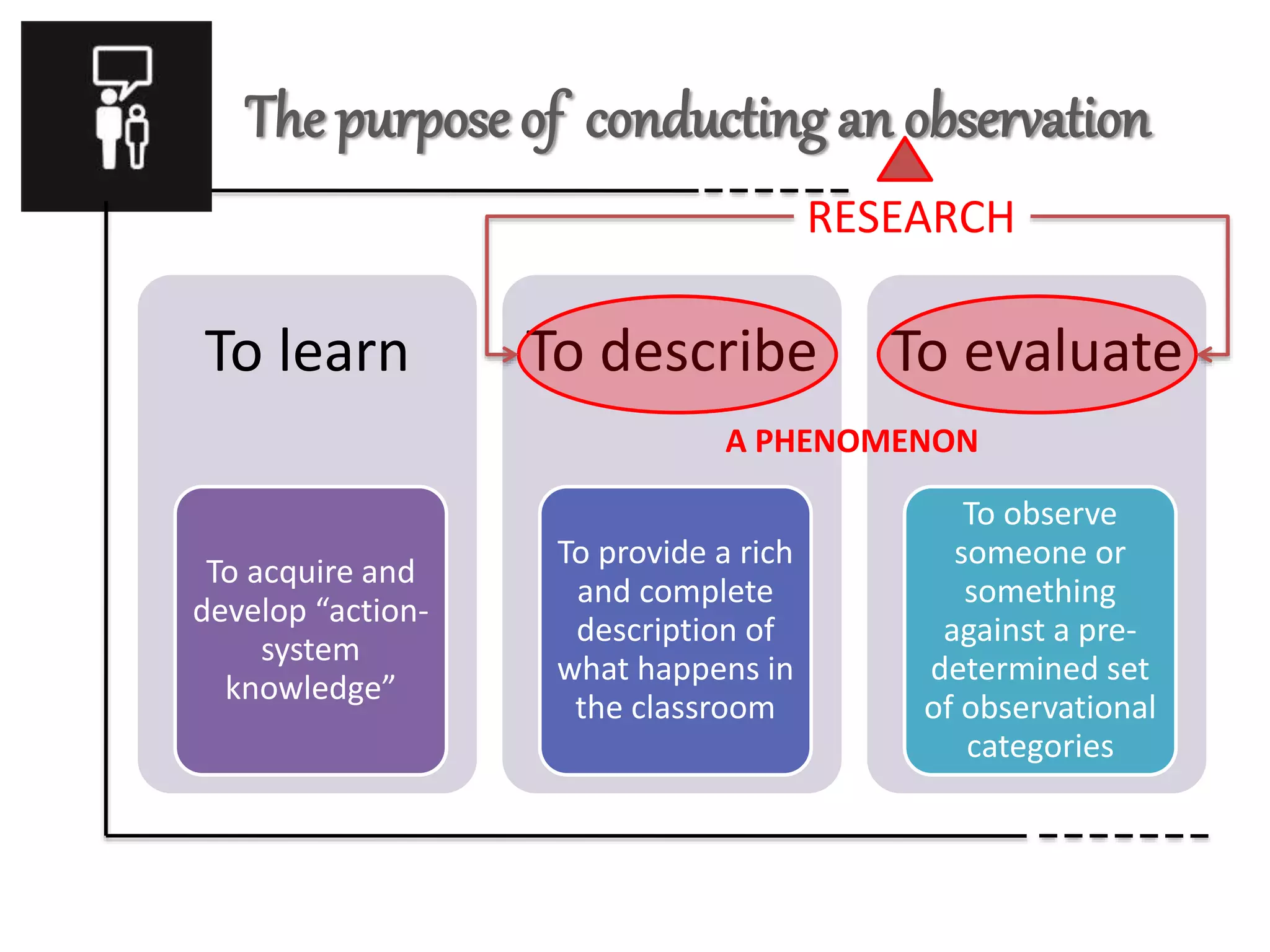
The purpose of conducting an observation
To learn
To acquire and
develop “action-
system
knowledge”
To describe
To provide a rich
and complete
description of
what happens in
the classroom
To evaluate
To observe
someone or
something
against a pre-
determined set
of observational
categories
RESEARCH
A PHENOMENON
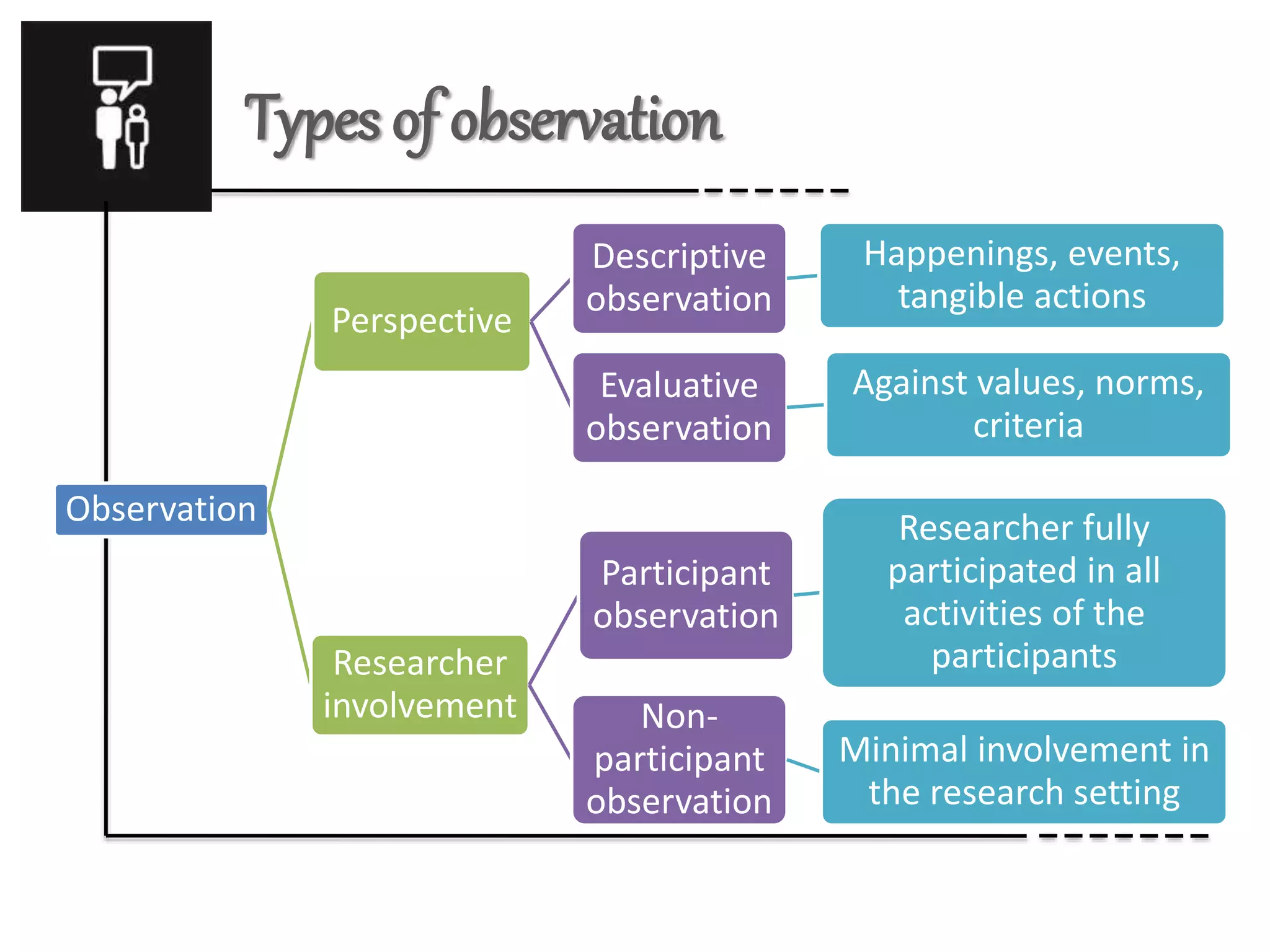
Types of observation
Observation
Perspective
Descriptive
observation
Happenings, events,
tangible actions
Evaluative
observation
Against values, norms,
criteria
Researcher
involvement
Participant
observation
Researcher fully
participated in all
activities of the
participants
Non-
participant
observation
Minimal involvement in
the research setting
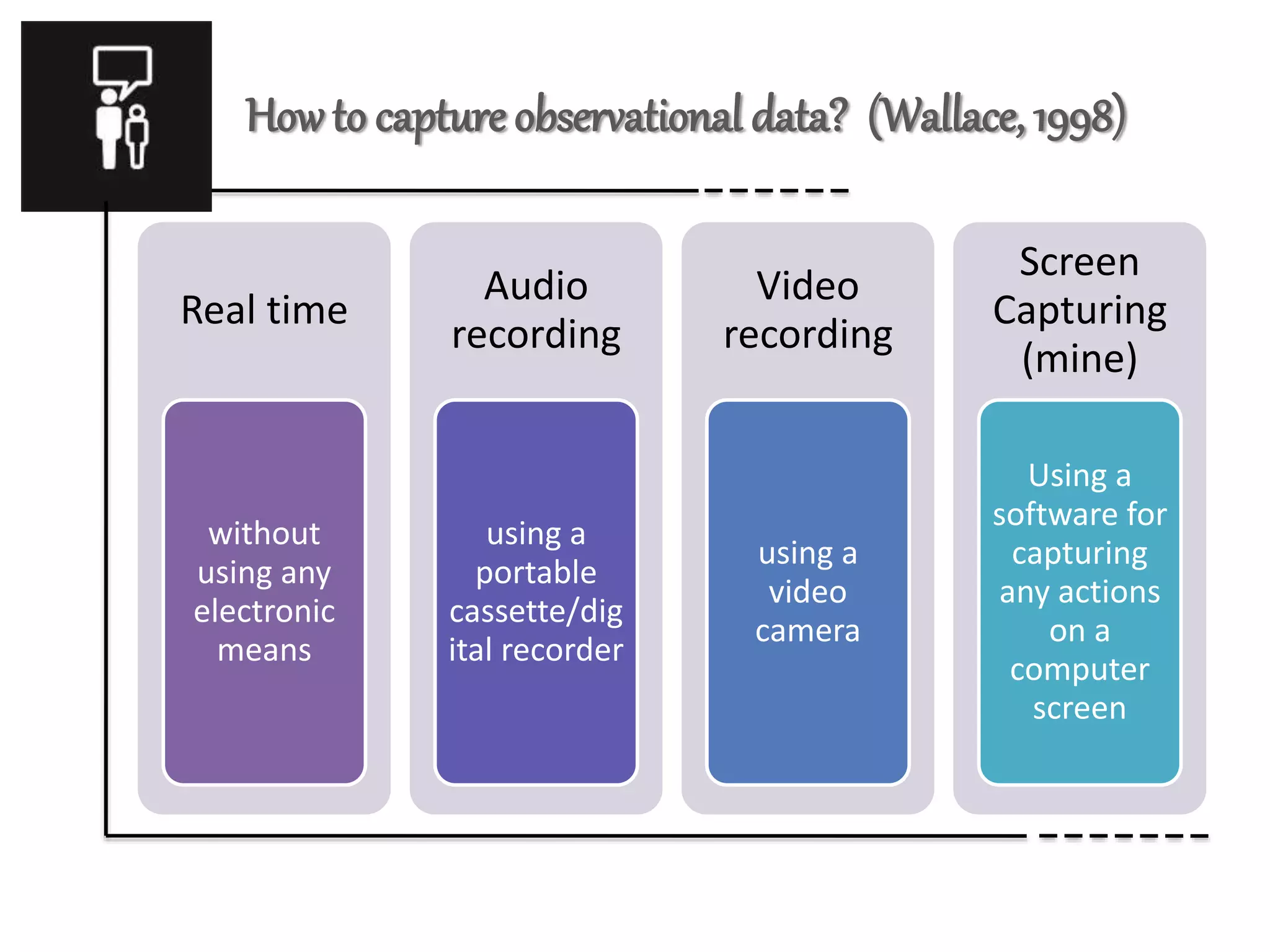
Howto capture observational data? (Wallace, 1998)
Real time
without
using any
electronic
means
Audio
recording
using a
portable
cassette/dig
ital recorder
Video
recording
using a
video
camera
Screen
Capturing
(mine)
Using a
software for
capturing
any actions
on a
computer
screen
Real time Capturing
Real time
observation
tools
Field notes
Broad
Dynamics of the class
Generating ideas for
research
Focus
Specific issues
Research questions
Observation
protocol
For data appropriateness,
points to observe
Tips for writing a field note
• Write descriptive account only
 What you can see & listen
 Descriptive, NOT evaluative
 Example: Which one is descriptive?
o Students were very active in responding to the
teacher’s questions.
o Students did not seem to understand the
teacher’s instruction.
Tips for writing a field note
• Try to write as descriptively as you can.
 Numbers, mental picture, details
 Examples
o When the teacher asked the question, ‘Who can
explain what past tense is?’, ten out of twenty
students raised their hands.
o When teaching the word ‘car,’ the teacher showed
photographs of a blue VW, a bright red sedan, and a
brown pick-up.
Tips for writing a field note
• If you happen to write evaluative accounts, accompany
them with descriptive account.
 Examples:
o The teacher’s voice was too soft. I could barely hear what
she said from the back row (the place where I was sitting).
o When the teacher lectured about a good introduction,
many of the students seem bored. Many of the students
looked down and played with their mobile phones, several
students flipped their coursebooks aimlessly, and some
even felt asleep.
Tips for writing a field note
• Write in the language you are comfortable in
 More details
 More understandable to transfer later
Observation Protocol
• Developed before the observation
• Focus, focus, focus!
 Selective observation
• Only write things that can be observed,
instead of your impression and feelings of
what happens.
Types of Observation Protocol
Observation
Protocol
(Dornyei,
2007)
An event-
sampling
protocol
The total
frequency of the
events or
procedures
observed
A time-
sampling
protocol
The time when it
occurs,
“chronological
representation”
Focus of classroomobservation (Mackay & Gass, 2005)
Teacher
StudentsContext
See some ideas
for each focus in
Zacharias (2011)
Preparation for observation
Pick strategic
seating
Prepare your
equipment
Prepare you
observation
protocol
Pilot your
observational
protocol
and/or field
notes

Observation

  • 1.
  • 2.
    The purpose ofconducting an observation To learn To acquire and develop “action- system knowledge” To describe To provide a rich and complete description of what happens in the classroom To evaluate To observe someone or something against a pre- determined set of observational categories RESEARCH A PHENOMENON
  • 3.
    Types of observation Observation Perspective Descriptive observation Happenings,events, tangible actions Evaluative observation Against values, norms, criteria Researcher involvement Participant observation Researcher fully participated in all activities of the participants Non- participant observation Minimal involvement in the research setting
  • 4.
    Howto capture observationaldata? (Wallace, 1998) Real time without using any electronic means Audio recording using a portable cassette/dig ital recorder Video recording using a video camera Screen Capturing (mine) Using a software for capturing any actions on a computer screen
  • 5.
    Real time Capturing Realtime observation tools Field notes Broad Dynamics of the class Generating ideas for research Focus Specific issues Research questions Observation protocol For data appropriateness, points to observe
  • 6.
    Tips for writinga field note • Write descriptive account only  What you can see & listen  Descriptive, NOT evaluative  Example: Which one is descriptive? o Students were very active in responding to the teacher’s questions. o Students did not seem to understand the teacher’s instruction.
  • 7.
    Tips for writinga field note • Try to write as descriptively as you can.  Numbers, mental picture, details  Examples o When the teacher asked the question, ‘Who can explain what past tense is?’, ten out of twenty students raised their hands. o When teaching the word ‘car,’ the teacher showed photographs of a blue VW, a bright red sedan, and a brown pick-up.
  • 8.
    Tips for writinga field note • If you happen to write evaluative accounts, accompany them with descriptive account.  Examples: o The teacher’s voice was too soft. I could barely hear what she said from the back row (the place where I was sitting). o When the teacher lectured about a good introduction, many of the students seem bored. Many of the students looked down and played with their mobile phones, several students flipped their coursebooks aimlessly, and some even felt asleep.
  • 9.
    Tips for writinga field note • Write in the language you are comfortable in  More details  More understandable to transfer later
  • 10.
    Observation Protocol • Developedbefore the observation • Focus, focus, focus!  Selective observation • Only write things that can be observed, instead of your impression and feelings of what happens.
  • 11.
    Types of ObservationProtocol Observation Protocol (Dornyei, 2007) An event- sampling protocol The total frequency of the events or procedures observed A time- sampling protocol The time when it occurs, “chronological representation”
  • 12.
    Focus of classroomobservation(Mackay & Gass, 2005) Teacher StudentsContext See some ideas for each focus in Zacharias (2011)
  • 13.
    Preparation for observation Pickstrategic seating Prepare your equipment Prepare you observation protocol Pilot your observational protocol and/or field notes