MANUAL
TEACHING PRACTICE-I
(WRITING FIELD NOTES)
Hina Jalal
• Fieldnotes are what Spradley calls an “ethnographic record.” What this means is that fieldnotes are the record of
your fieldwork that provides a description of the “culture” you’re working with for your study. Fieldnotes are most
often taken during observations, but a researcher could also take fieldnotes for other research methods.
• It refers to notes created by the trainee teacher during the act of conducting a field study to remember and record
the behaviors, activities, events, and other features of an observation. Field notes are intended to be read by the
teacher as evidence to produce meaning and an understanding of the culture, social situation, or phenomenon
being studied.
Approaching Field Notes
The ways in which you take notes during an observational study is very
much a personal decision developed over time as you become more
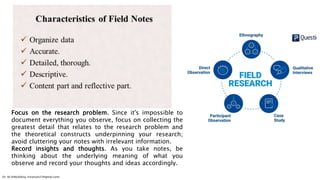
experienced in fieldwork. Field notes generally consist of two parts:
Descriptive information, in which you attempt to accurately document
factual data [e.g., date and time] along with the settings, actions,
behaviors, and conversations that you observe; and,
Reflective information, in which you record your thoughts, ideas,
questions, and concerns during the observation.
Field Notes
Dr. HJ (@AksEAina, hinansari23@gmail.com)
Focus on the research problem. Since it's impossible to
document everything you observe, focus on collecting the
greatest detail that relates to the research problem and
the theoretical constructs underpinning your research;
avoid cluttering your notes with irrelevant information.
Record insights and thoughts. As you take notes, be
thinking about the underlying meaning of what you
observe and record your thoughts and ideas accordingly.
Dr. HJ (@AksEAina, hinansari23@gmail.com)
What is the teacher doing? Why?
1. Space: the physical place or places
2. Actor: the people involved
3. Activity: a set of related acts people do
4. Object: the physical things that are present
5. Act: single actions that people do
6. Event: a set of related activities that people carry out
7. Time: the sequencing that takes place over time
8. Goal: the things people are trying to accomplish
9. Feeling: the emotions felt and expressed
Writing Field Notes by observing:
 different subjects
different teachers
 different places in the school
different events and activities in the school ( prize
distribution, parent teacher meeting, co curricular
activities etc.)
Dr. HJ (@AksEAina, hinansari23@gmail.com)
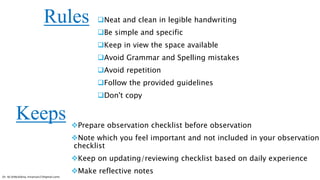
Neat and clean in legible handwriting
Be simple and specific
Keep in view the space available
Avoid Grammar and Spelling mistakes
Avoid repetition
Follow the provided guidelines
Don't copy
Prepare observation checklist before observation
Note which you feel important and not included in your observation
checklist
Keep on updating/reviewing checklist based on daily experience
Make reflective notes
Rules
Keeps
Dr. HJ (@AksEAina, hinansari23@gmail.com)
General Guidelines for the Descriptive Content
The descriptive content of your notes can vary in detail depending upon what needs to be emphasized
in order to address the research problem.
Describe the physical setting.
Describe the social environment and the way in which participants interacted within the setting.
Describe the participants and their roles in the setting.
Describe, as best you can, the meaning of what was observed from the perspectives of the participants.
Record exact quotes or close approximations of comments that relate directly to the purpose of the
study.
Describe any impact you might have had on the situation you observed [important!].
Dr. HJ (@AksEAina, hinansari23@gmail.com)
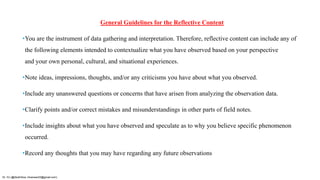
General Guidelines for the Reflective Content
•You are the instrument of data gathering and interpretation. Therefore, reflective content can include any of
the following elements intended to contextualize what you have observed based on your perspective
and your own personal, cultural, and situational experiences.
•Note ideas, impressions, thoughts, and/or any criticisms you have about what you observed.
•Include any unanswered questions or concerns that have arisen from analyzing the observation data.
•Clarify points and/or correct mistakes and misunderstandings in other parts of field notes.
•Include insights about what you have observed and speculate as to why you believe specific phenomenon
occurred.
•Record any thoughts that you may have regarding any future observations
Dr. HJ (@AksEAina, hinansari23@gmail.com)
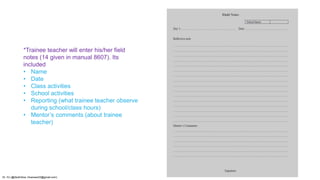
*Trainee teacher will enter his/her field
notes (14 given in manual 8607). Its
included
• Name
• Date
• Class activities
• School activities
• Reporting (what trainee teacher observe
during school/class hours)
• Mentor’s comments (about trainee
teacher)
Dr. HJ (@AksEAina, hinansari23@gmail.com)
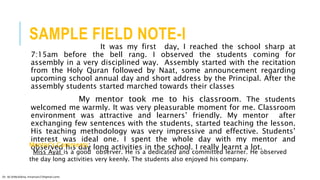
SAMPLE FIELD NOTE-I
It was my first day, I reached the school sharp at
7:15am before the bell rang. I observed the students coming for
assembly in a very disciplined way. Assembly started with the recitation
from the Holy Quran followed by Naat, some announcement regarding
upcoming school annual day and short address by the Principal. After the
assembly students started marched towards their classes
My mentor took me to his classroom. The students
welcomed me warmly. It was very pleasurable moment for me. Classroom
environment was attractive and learners’ friendly. My mentor after
exchanging few sentences with the students, started teaching the lesson.
His teaching methodology was very impressive and effective. Students’
interest was ideal one. I spent the whole day with my mentor and
observed his day long activities in the school. I really learnt a lot.Mentor’s Comments:
Miss Ayat is a good observer. He is a dedicated and committed learner. He observed
the day long activities very keenly. The students also enjoyed his company.
Dr. HJ (@AksEAina, hinansari23@gmail.com)
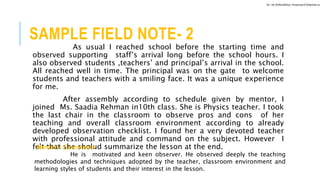
SAMPLE FIELD NOTE- 2
As usual I reached school before the starting time and
observed supporting staff’s arrival long before the school hours. I
also observed students ,teachers’ and principal’s arrival in the school.
All reached well in time. The principal was on the gate to welcome
students and teachers with a smiling face. It was a unique experience
for me.
After assembly according to schedule given by mentor, I
joined Ms. Saadia Rehman in10th class. She is Physics teacher. I took
the last chair in the classroom to observe pros and cons of her
teaching and overall classroom environment according to already
developed observation checklist. I found her a very devoted teacher
with professional attitude and command on the subject. However I
felt that she sholud summarize the lesson at the end.Mentor’s Comments
He is motivated and keen observer. He observed deeply the teaching
methodologies and techniques adopted by the teacher, classroom environment and
learning styles of students and their interest in the lesson.
Dr. HJ (@AksEAina, hinansari23@gmail.co
Dr. Hina Jalal
hinansari23@gmail.com
@AksEAina

Field notes (Teaching Practice Manual Code-8607)

  • 1.
  • 2.
    • Fieldnotes arewhat Spradley calls an “ethnographic record.” What this means is that fieldnotes are the record of your fieldwork that provides a description of the “culture” you’re working with for your study. Fieldnotes are most often taken during observations, but a researcher could also take fieldnotes for other research methods. • It refers to notes created by the trainee teacher during the act of conducting a field study to remember and record the behaviors, activities, events, and other features of an observation. Field notes are intended to be read by the teacher as evidence to produce meaning and an understanding of the culture, social situation, or phenomenon being studied. Approaching Field Notes The ways in which you take notes during an observational study is very much a personal decision developed over time as you become more experienced in fieldwork. Field notes generally consist of two parts: Descriptive information, in which you attempt to accurately document factual data [e.g., date and time] along with the settings, actions, behaviors, and conversations that you observe; and, Reflective information, in which you record your thoughts, ideas, questions, and concerns during the observation. Field Notes Dr. HJ (@AksEAina, hinansari23@gmail.com)
  • 3.
    Focus on theresearch problem. Since it's impossible to document everything you observe, focus on collecting the greatest detail that relates to the research problem and the theoretical constructs underpinning your research; avoid cluttering your notes with irrelevant information. Record insights and thoughts. As you take notes, be thinking about the underlying meaning of what you observe and record your thoughts and ideas accordingly. Dr. HJ (@AksEAina, hinansari23@gmail.com)
  • 4.
    What is theteacher doing? Why? 1. Space: the physical place or places 2. Actor: the people involved 3. Activity: a set of related acts people do 4. Object: the physical things that are present 5. Act: single actions that people do 6. Event: a set of related activities that people carry out 7. Time: the sequencing that takes place over time 8. Goal: the things people are trying to accomplish 9. Feeling: the emotions felt and expressed Writing Field Notes by observing:  different subjects different teachers  different places in the school different events and activities in the school ( prize distribution, parent teacher meeting, co curricular activities etc.) Dr. HJ (@AksEAina, hinansari23@gmail.com)
  • 5.
    Neat and cleanin legible handwriting Be simple and specific Keep in view the space available Avoid Grammar and Spelling mistakes Avoid repetition Follow the provided guidelines Don't copy Prepare observation checklist before observation Note which you feel important and not included in your observation checklist Keep on updating/reviewing checklist based on daily experience Make reflective notes Rules Keeps Dr. HJ (@AksEAina, hinansari23@gmail.com)
  • 6.
    General Guidelines forthe Descriptive Content The descriptive content of your notes can vary in detail depending upon what needs to be emphasized in order to address the research problem. Describe the physical setting. Describe the social environment and the way in which participants interacted within the setting. Describe the participants and their roles in the setting. Describe, as best you can, the meaning of what was observed from the perspectives of the participants. Record exact quotes or close approximations of comments that relate directly to the purpose of the study. Describe any impact you might have had on the situation you observed [important!]. Dr. HJ (@AksEAina, hinansari23@gmail.com)
  • 7.
    General Guidelines forthe Reflective Content •You are the instrument of data gathering and interpretation. Therefore, reflective content can include any of the following elements intended to contextualize what you have observed based on your perspective and your own personal, cultural, and situational experiences. •Note ideas, impressions, thoughts, and/or any criticisms you have about what you observed. •Include any unanswered questions or concerns that have arisen from analyzing the observation data. •Clarify points and/or correct mistakes and misunderstandings in other parts of field notes. •Include insights about what you have observed and speculate as to why you believe specific phenomenon occurred. •Record any thoughts that you may have regarding any future observations Dr. HJ (@AksEAina, hinansari23@gmail.com)
  • 8.
    *Trainee teacher willenter his/her field notes (14 given in manual 8607). Its included • Name • Date • Class activities • School activities • Reporting (what trainee teacher observe during school/class hours) • Mentor’s comments (about trainee teacher) Dr. HJ (@AksEAina, hinansari23@gmail.com)
  • 9.
    SAMPLE FIELD NOTE-I Itwas my first day, I reached the school sharp at 7:15am before the bell rang. I observed the students coming for assembly in a very disciplined way. Assembly started with the recitation from the Holy Quran followed by Naat, some announcement regarding upcoming school annual day and short address by the Principal. After the assembly students started marched towards their classes My mentor took me to his classroom. The students welcomed me warmly. It was very pleasurable moment for me. Classroom environment was attractive and learners’ friendly. My mentor after exchanging few sentences with the students, started teaching the lesson. His teaching methodology was very impressive and effective. Students’ interest was ideal one. I spent the whole day with my mentor and observed his day long activities in the school. I really learnt a lot.Mentor’s Comments: Miss Ayat is a good observer. He is a dedicated and committed learner. He observed the day long activities very keenly. The students also enjoyed his company. Dr. HJ (@AksEAina, hinansari23@gmail.com)
  • 10.
    SAMPLE FIELD NOTE-2 As usual I reached school before the starting time and observed supporting staff’s arrival long before the school hours. I also observed students ,teachers’ and principal’s arrival in the school. All reached well in time. The principal was on the gate to welcome students and teachers with a smiling face. It was a unique experience for me. After assembly according to schedule given by mentor, I joined Ms. Saadia Rehman in10th class. She is Physics teacher. I took the last chair in the classroom to observe pros and cons of her teaching and overall classroom environment according to already developed observation checklist. I found her a very devoted teacher with professional attitude and command on the subject. However I felt that she sholud summarize the lesson at the end.Mentor’s Comments He is motivated and keen observer. He observed deeply the teaching methodologies and techniques adopted by the teacher, classroom environment and learning styles of students and their interest in the lesson. Dr. HJ (@AksEAina, hinansari23@gmail.co
  • 11.