SPED4
Child Observational Study
Marlyn C. Saludes, Maed-SPED
Topics: Prelim (Nov. 5-Dec. 9)
 What is observation
 Purposes of observation
 How to do observation in
 SPED classroom
 Observation: A major part of the assessment
process.
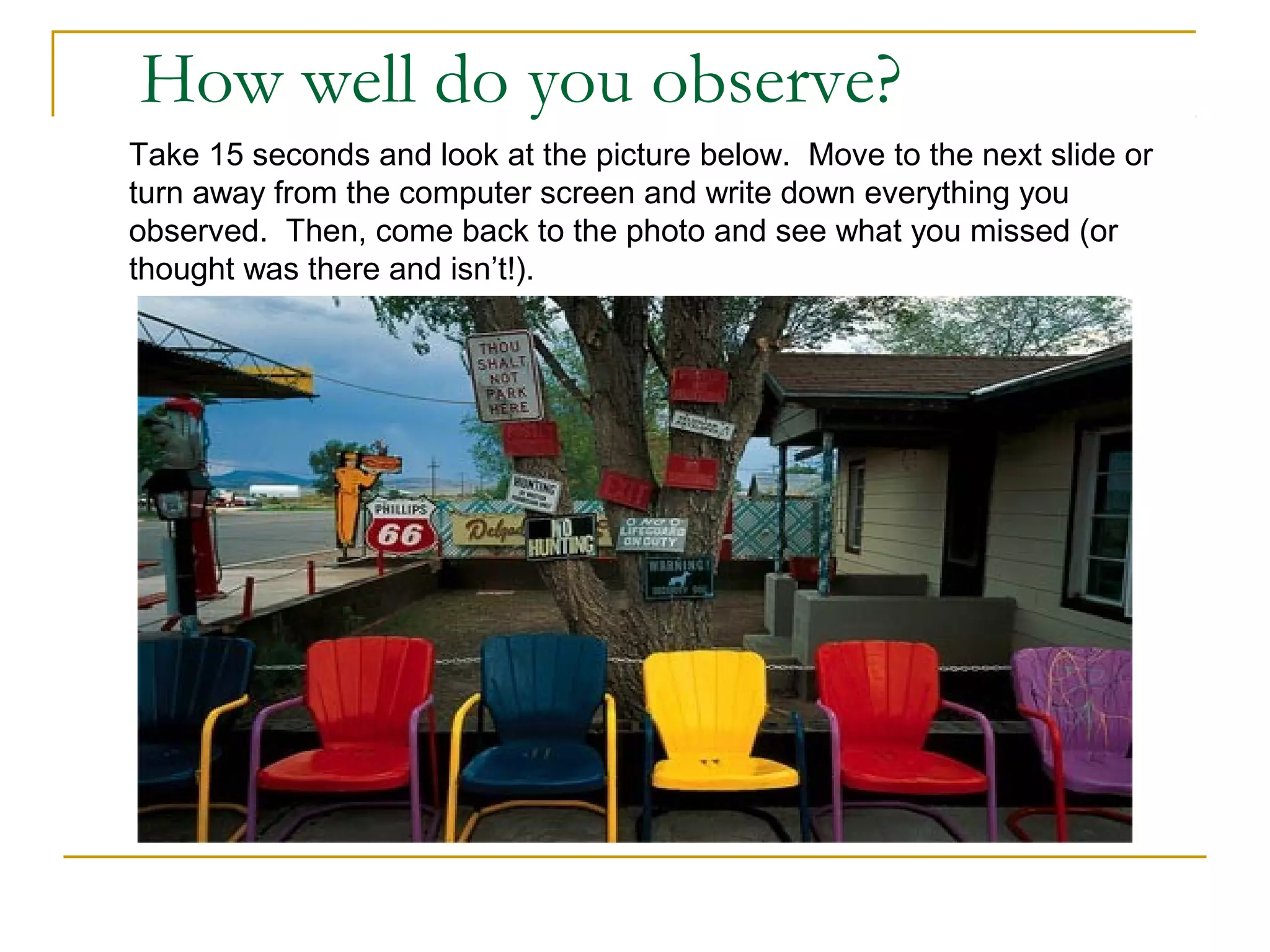
How well do you observe?
Take 15 seconds and look at the picture below. Move to the next slide or
turn away from the computer screen and write down everything you
observed. Then, come back to the photo and see what you missed (or
thought was there and isn’t!).
What is observation?
 an observation is information or data about
objects, events, moves, attitudes, calamities,
realities or phenomena using directly one or
more senses.
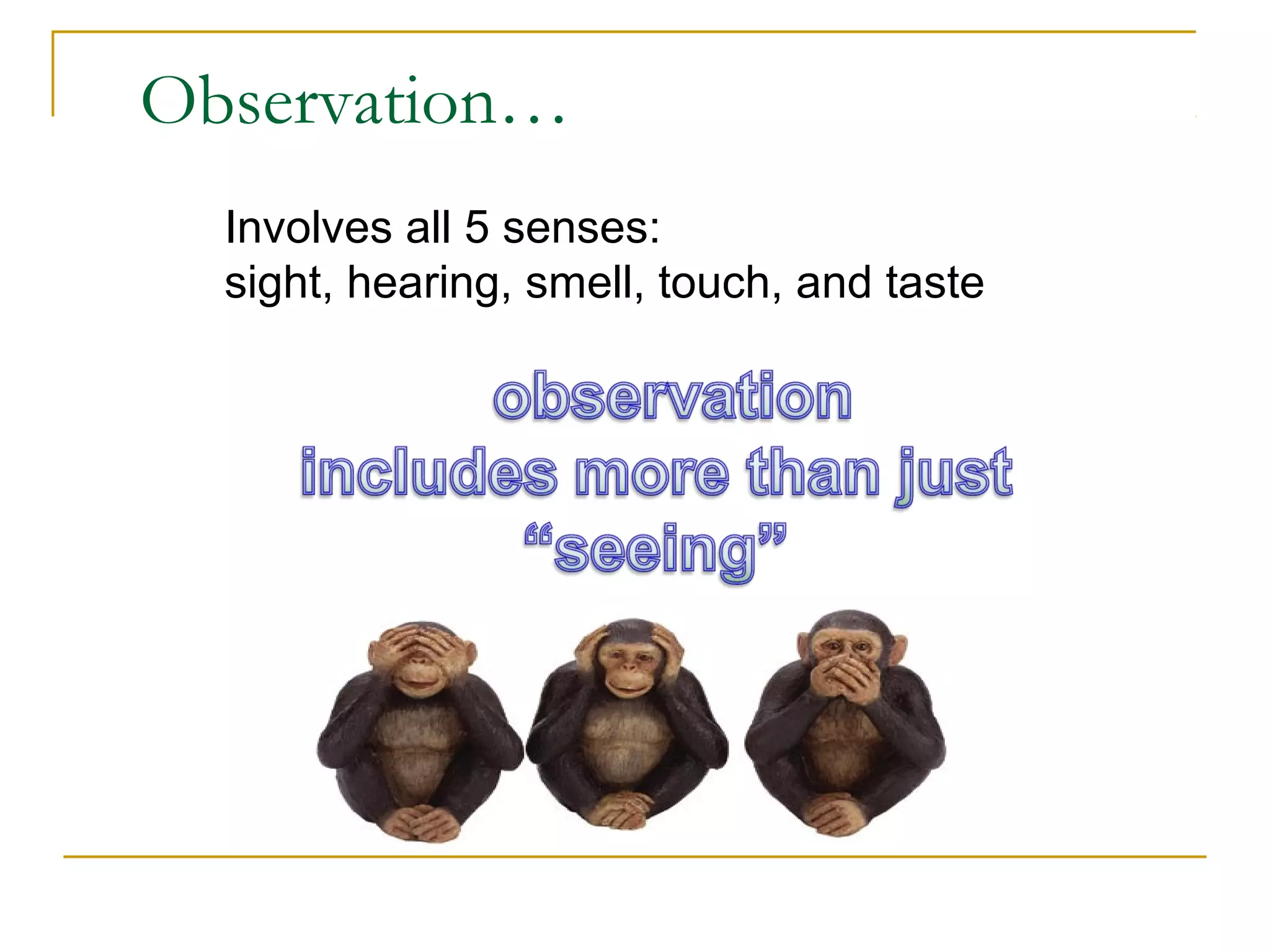
Observation…
Involves all 5 senses:
sight, hearing, smell, touch, and taste
Why do we observe?
• To improve our teaching
– understanding our biases and
improving our objectivity
• To construct theory
• To help parents
• To use as an assessment tool
• To wonder why and solve a
problem
• To communicate with children
Observations
Advantages
 Most direct
measure of
behavior
 Provides direct
information
 Easy to complete,
saves time
 Can be used in
natural or
experimental
settings
Disadvantages
 May require training
 Observer’s presence
may create artificial
situation
 Potential for bias
 Potential to overlook
meaningful aspects
 Potential for
misinterpretation
 Difficult to analyze
What is Observation for?
 Children are observed for
developmental progress .
 Observations take place primarily
through children’s normal daily
activities, their use of language, social
interactions with others and work
samples that demonstrate learning.
 Focus
 System
 Tools
 Environment
Fundamentals of Observations
Fundamentals of Observations… Con’t
Focus
 What do you want to know?
 Whom/what do you want to
observe?
 What aspects of behavior
do you want to know about?
 What is your purpose?
Systems
What will you do?
How will you record
information?
How detailed will you be?
How long will you record?
Fundamentals of Observations… Con’t
Tools
What will you need for your
observation?
How will you record what you
want to know?
Fundamentals of Observations… Con’t
Environment
Where will you watch?
What restraints are
inherent in the setting
Fundamentals of Observations… Con’t
Summary
Observation
 We observe to learn about the whole child.
 These four concepts work in tandem to provide the most complete
understanding of an individual child and the child within the group:
 Scripted or required observation
 Intuitive observation
 Planned observation
 Spontaneous observation
 The environment affects how, when, where, and what we observe.
 We plan with prompts to elicit actions to observe and document.
 We observe to provide information for assessment.
What is the end result?
Understanding of the whole child
Assessment and Evaluation
Communication with parents and caregivers
Activities
 Developmental checklist
 Ethical procedure
Methods of Observation
 Naturalistic Observation
 Observe and record behaviors at time of
occurrence in natural setting
 Uses trained, objective observers
 Behavioral description system requiring little
inference
 Minimally intrusive
 School is highly conducive to this type of
observation
Methods of Observation
 Participant and Non Participant
observation
 . In participant observation, the degree of the
participation is largely affected by the nature
of the study and it also depends on the type
of the situation and also on its demands.
 But in the non participant type of observation,
no participation of the observer in the
activities of the group takes place and also
there occurs no relationship between the
researcher and the group.
Methods of Observation
 Analogue Observation
 Designed to simulate the conditions of the natural
environment
 Requires a highly structured and controlled setting
in which behaviors of concern are likely
observed.
 Indirect measurement procedure
 Examples – parent child role play interactions
 Generalization issues - / high degree of inference
 Allows for greater control of environment
 Requires structure of observational setting to
closely resemble natural environment
Methods of Observation
 Self Monitoring
 Target child is trained in observing and recording
their own behavior
 Advantages – low cost and efficiency, can tap into
covert private thoughts and its lack of
intrusiveness
 Disadvantages – reliability / validity, difficult to
train child
 Need to provide sufficient training, use formal
observation forms, require minimal energy for self
monitoring procedures, conduct reliability checks
and reinforce subject.
Methods of Observation
 Subjective and Objective Observation
 All the observations consist of the two main
components, the subject and the object.
 The subject refers to the observer whereas the
object refers to the activity or any type of
operation that is being observed.
 Subjective observation involves the observation of
the one’s own immediate experience whereas the
observations involving observer as an entity apart
from the thing being observed, are referred to as
the objective observation. Objective observation
is also called as the retrospection.
Practice:
Structured/unstructured observations
Imagine you are sitting in a room where ten
youth are sitting at computers learning about
Web 2.0 applications.
1) If you want to assess to what extent
students are interested and learning, what
specifically would you look (listen) for?
2) If you aren’t sure what specifically indicates
student interest or learning and you want to see
what is going on during the demonstration, how
would you proceed?
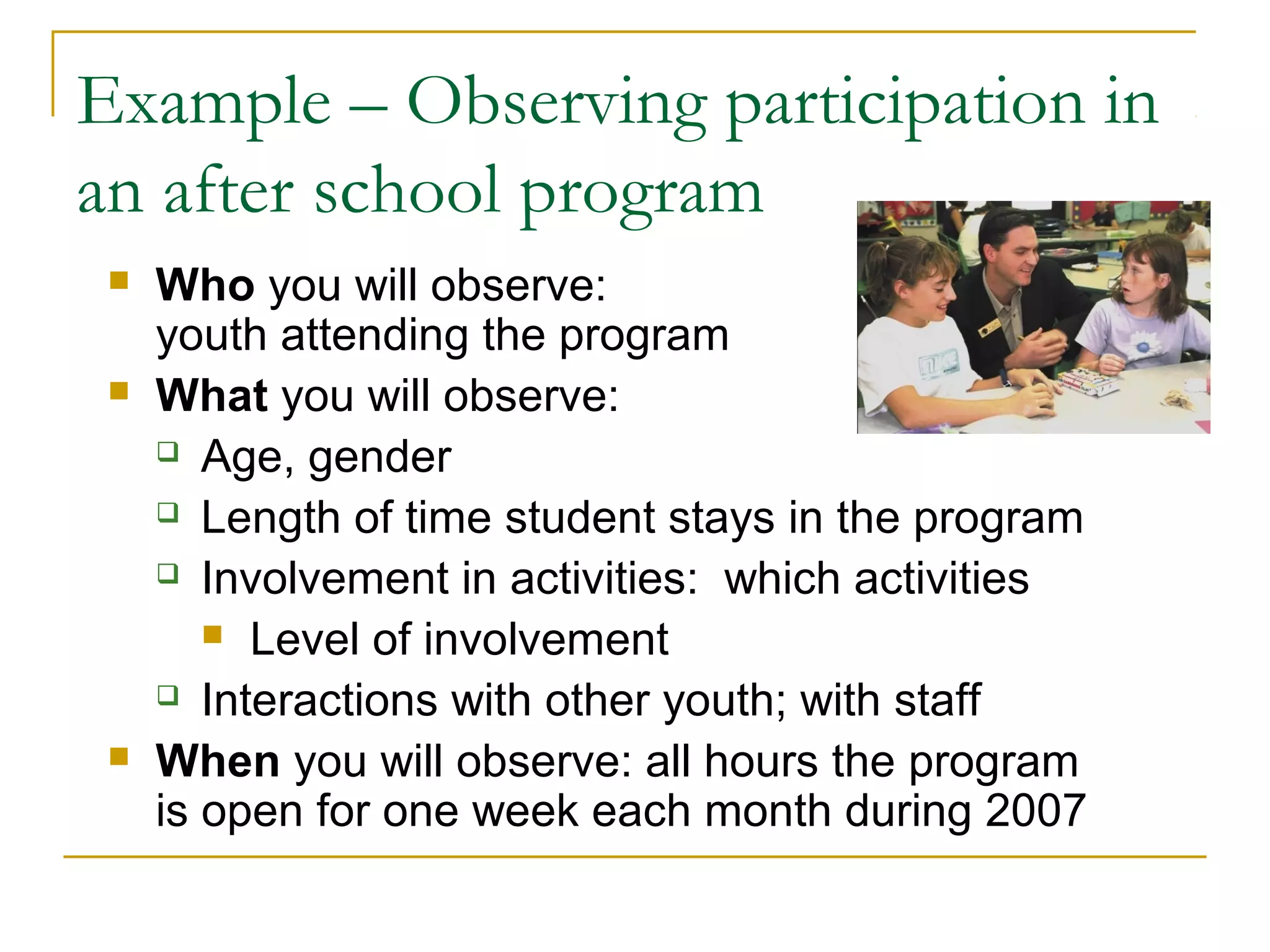
Example – Observing participation in
an after school program
 Who you will observe:
youth attending the program
 What you will observe:
 Age, gender
 Length of time student stays in the program
 Involvement in activities: which activities
 Level of involvement
 Interactions with other youth; with staff
 When you will observe: all hours the program
is open for one week each month during 2007
Types of Observations
• Narratives-The most valuable, but also the most
difficult.
– Running records: keeping track of everything that
happens in a specified time period
– Anecdotal records: a brief description or “word picture”
• Time Sampling -The measuring of a behavior
over time. A quantitative method where you
count the number of times a behavior occurs at
uniform time intervals
• Event Sampling -where the observer records a
specific behavior only when it occurs. Often
used for recording less frequent behavior
Topics: Midterm
The role of observation in SPED
Participation in SPED setting
The need for field experience.
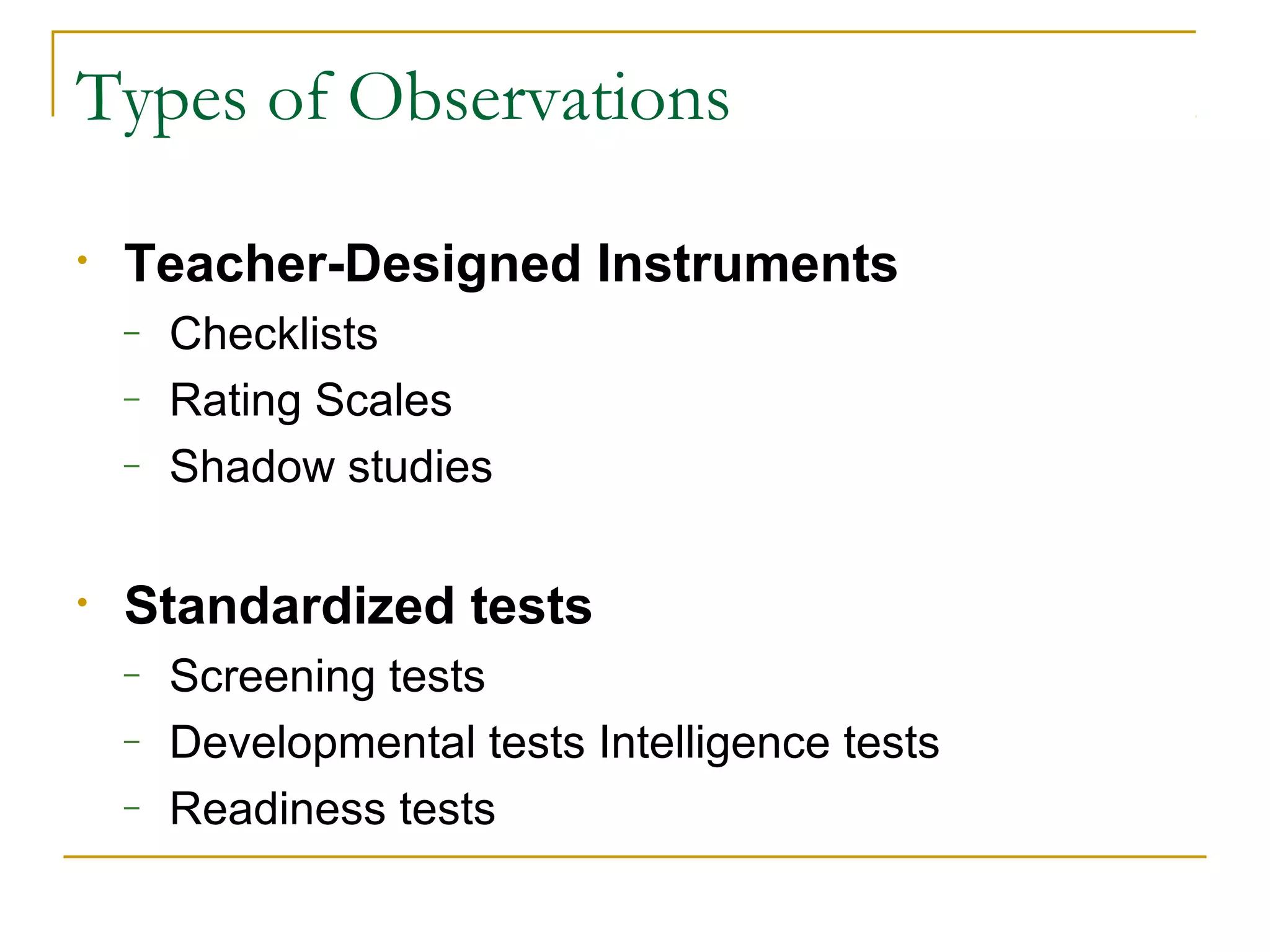
Types of Observations
• Teacher-Designed Instruments
– Checklists
– Rating Scales
– Shadow studies
• Standardized tests
– Screening tests
– Developmental tests Intelligence tests
– Readiness tests
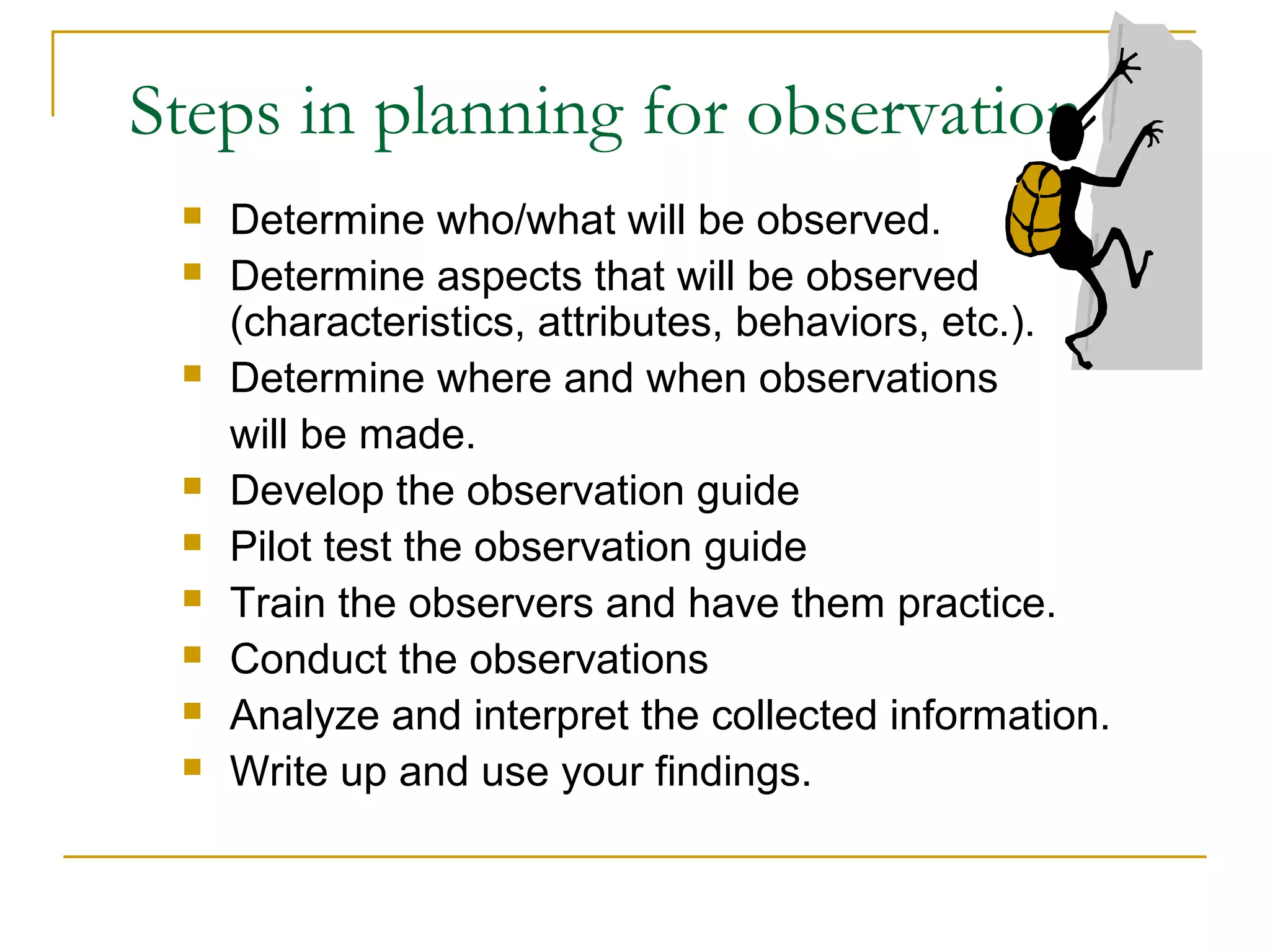
Steps in planning for observation
 Determine who/what will be observed.
 Determine aspects that will be observed
(characteristics, attributes, behaviors, etc.).
 Determine where and when observations
will be made.
 Develop the observation guide
 Pilot test the observation guide
 Train the observers and have them practice.
 Conduct the observations
 Analyze and interpret the collected information.
 Write up and use your findings.
Who does the observations?
 You – program staff
 Participants - Youth
 Parents
 Teachers
 Volunteers
 Other stakeholders
 Colleagues
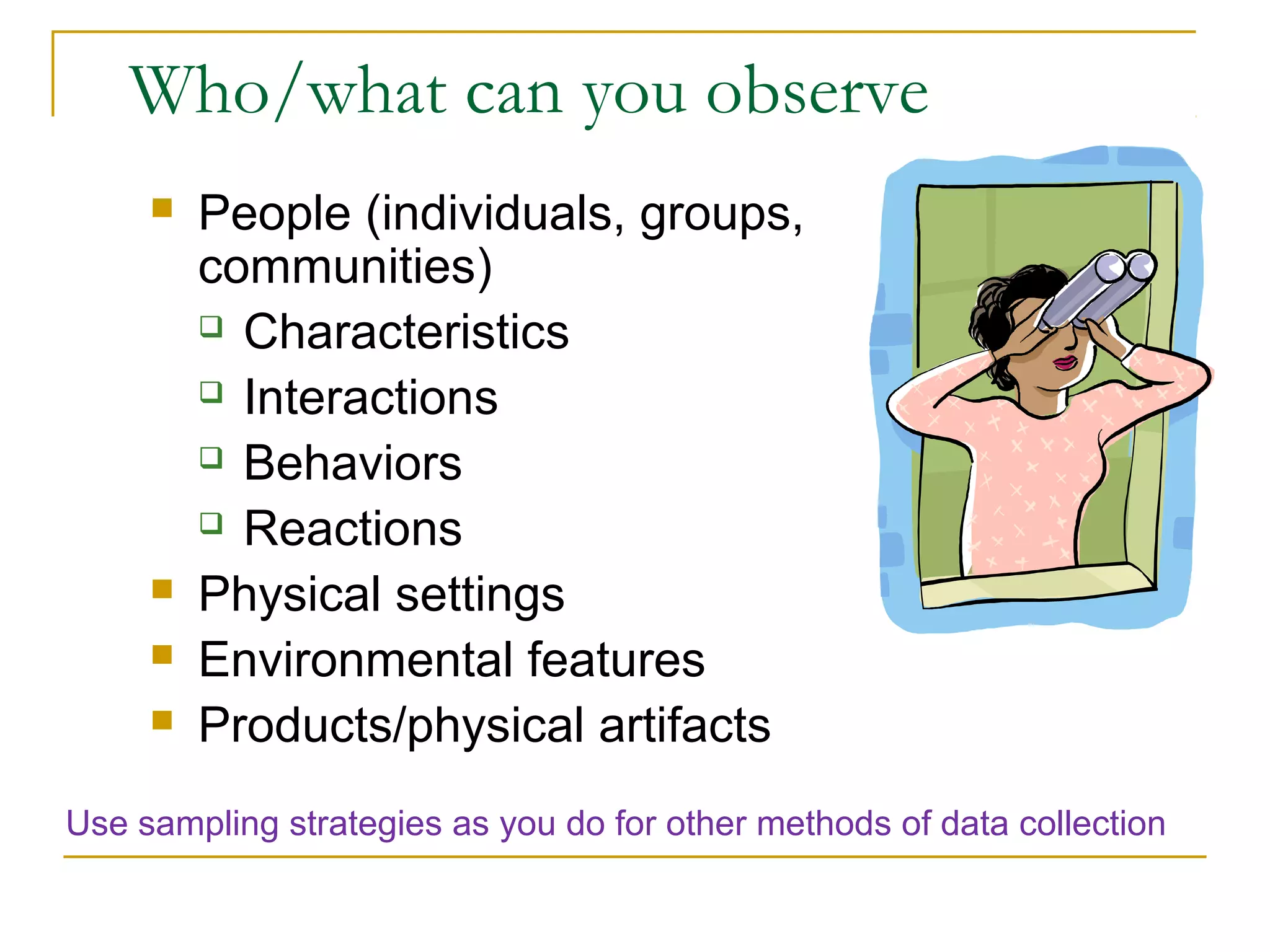
Who/what can you observe
 People (individuals, groups,
communities)
 Characteristics
 Interactions
 Behaviors
 Reactions
 Physical settings
 Environmental features
 Products/physical artifacts
Use sampling strategies as you do for other methods of data collection
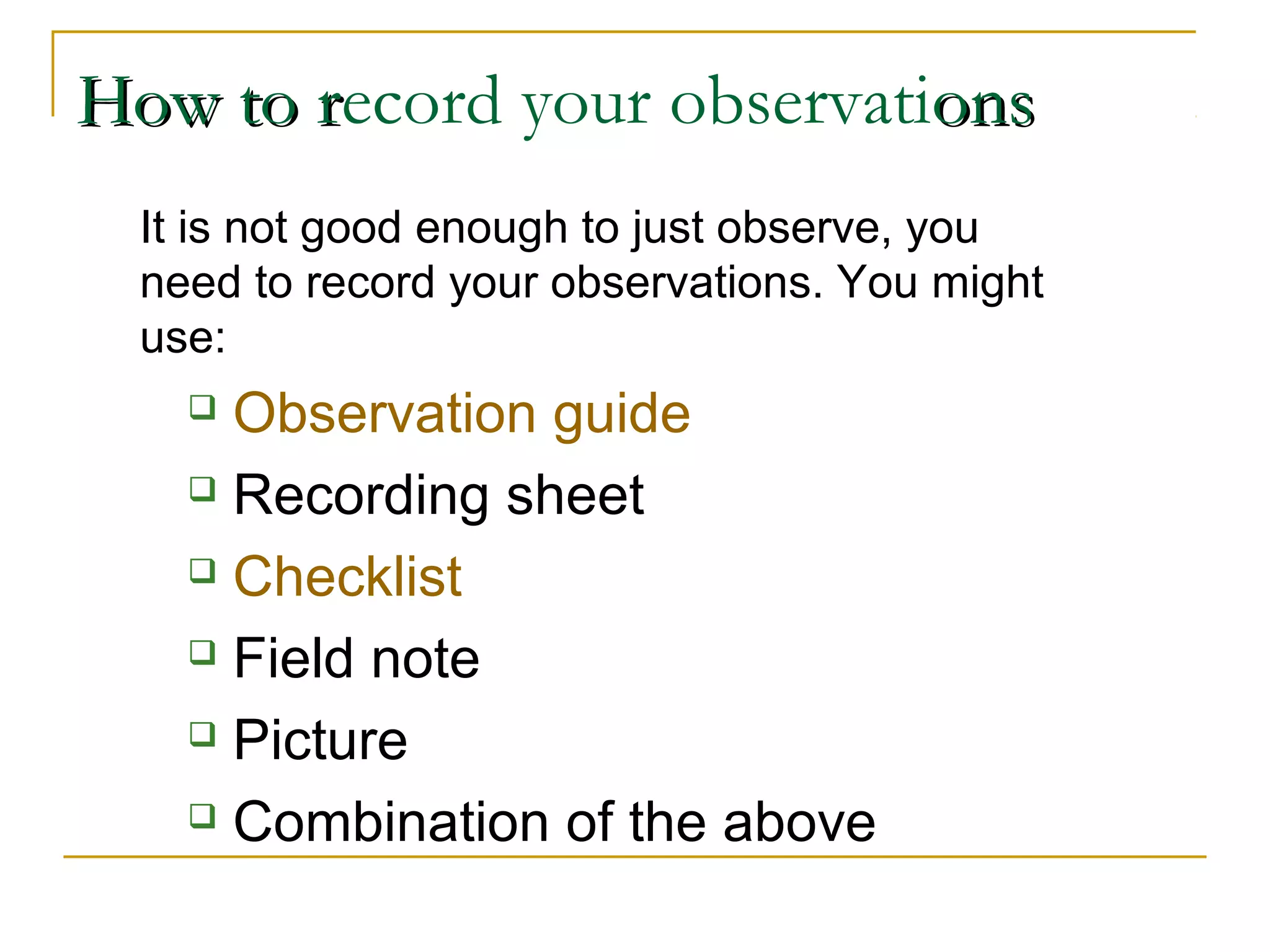
How to rHow to record your observationsons
It is not good enough to just observe, you
need to record your observations. You might
use:
 Observation guide
 Recording sheet
 Checklist
 Field note
 Picture
 Combination of the above
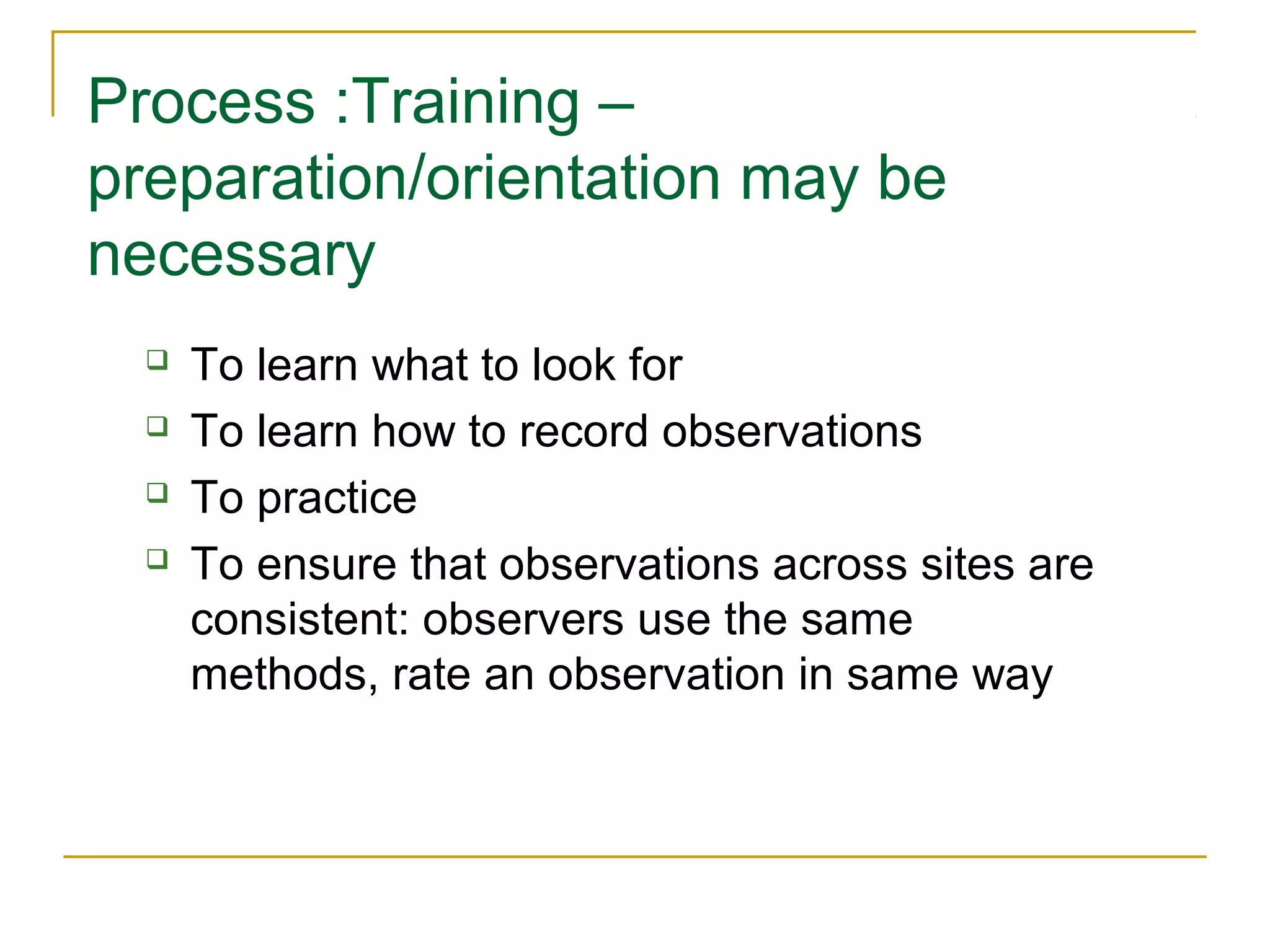
Process :Training –
preparation/orientation may be
necessary
 To learn what to look for
 To learn how to record observations
 To practice
 To ensure that observations across sites are
consistent: observers use the same
methods, rate an observation in same way
Summary
 What have you learned in this lecture?
Homework
 Visit a basic education classroom.
 Use the guide questions in the classroom
observation handout
 Due November 17
Guide questions
 What did you do first?
What is behavior?
What should be observed?
 Behavior
 Academic
 Performance
 Skills
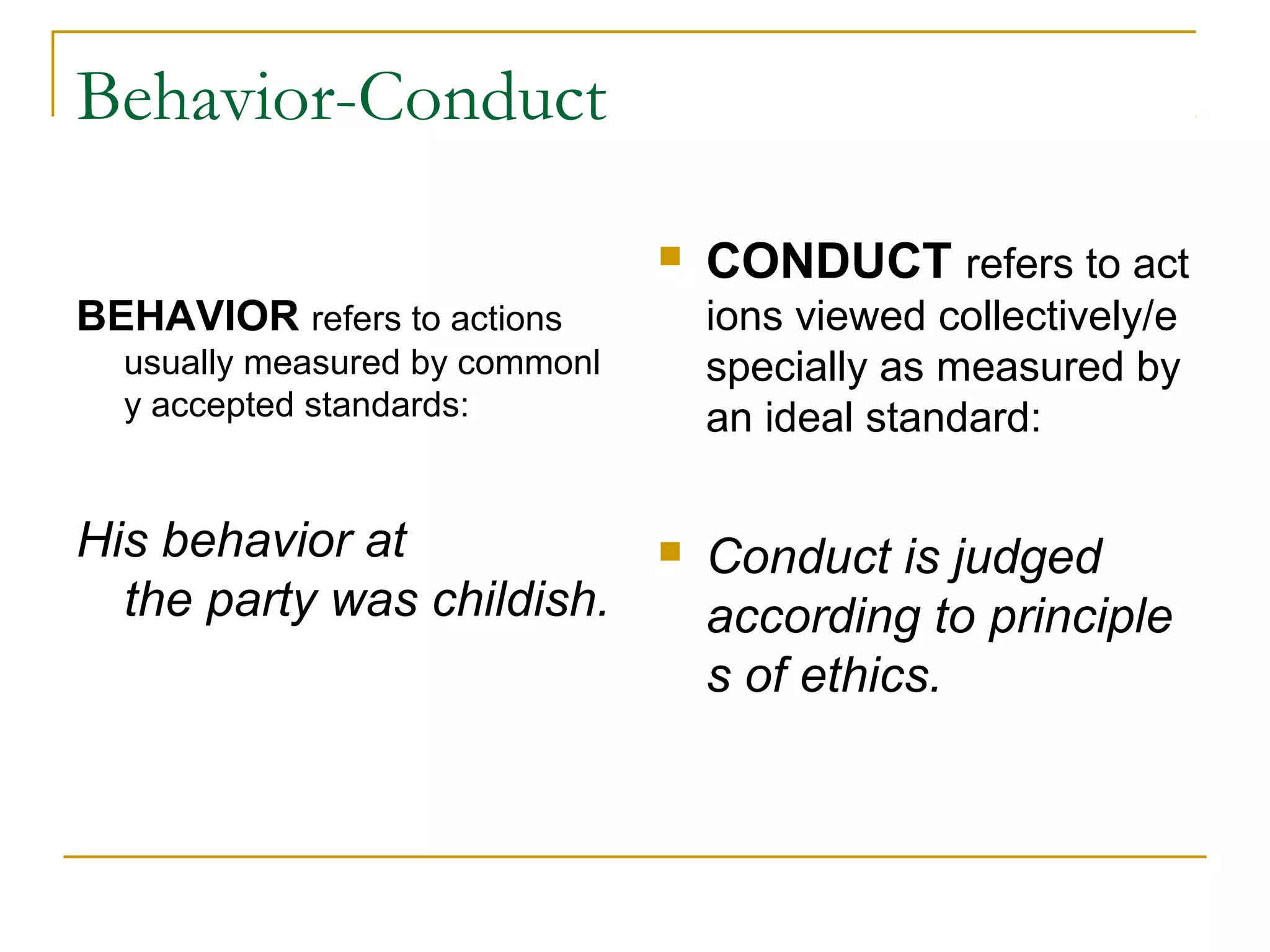
Behavior-Conduct
BEHAVIOR refers to actions
usually measured by commonl
y accepted standards:
His behavior at 
the party was childish.
 
 CONDUCT refers to act
ions viewed collectively/e
specially as measured by
an ideal standard:
 Conduct is judged 
according to principle
s of ethics. 
Deportment-Comforment
DEPORTMENT is behavior
related to a code
or to an arbitrary
standard: Deportment is g
uided by rules of etiquette.
 
The teacher gave Susan a m
ark of B in deportment.
 COMPORTMENT is
behavior as viewed from th
e standpoint of
one's management of one's
own actions:
 His comportment was 
marked by a 
quiet assurance.
Checking in…
What do you think?
Answer YES or NO to each of the following
1.Observation involves “seeing” and “listening”
2.People may behave differently when they know
they are being observed so it is better not to tell them
3.Structured observations provide more accurate and
useful information
4.As long as you see it, it doesn’t matter if you record what
you saw
5.You, as someone who “knows” the program and the
participants, are best suited to conduct the observations
6.The same principles of sampling apply to observation as
to other forms of data collection
Check your answers at the end
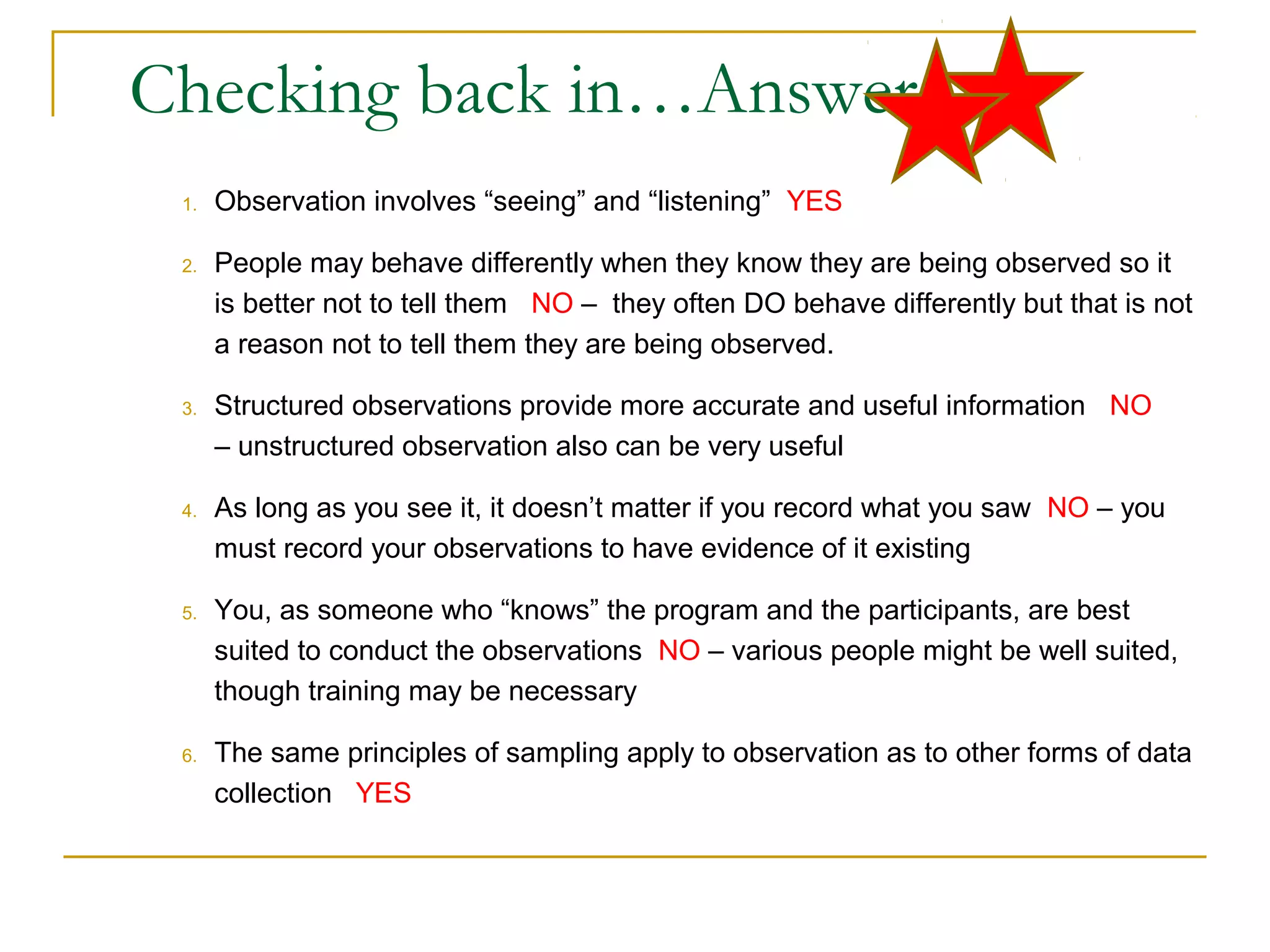
Checking back in…Answers
1. Observation involves “seeing” and “listening” YES
2. People may behave differently when they know they are being observed so it
is better not to tell them NO – they often DO behave differently but that is not
a reason not to tell them they are being observed.
3. Structured observations provide more accurate and useful information NO
– unstructured observation also can be very useful
4. As long as you see it, it doesn’t matter if you record what you saw NO – you
must record your observations to have evidence of it existing
5. You, as someone who “knows” the program and the participants, are best
suited to conduct the observations NO – various people might be well suited,
though training may be necessary
6. The same principles of sampling apply to observation as to other forms of data
collection YES

Introduction: What is Observation?

  • 1.
  • 2.
    Topics: Prelim (Nov.5-Dec. 9)  What is observation  Purposes of observation  How to do observation in  SPED classroom  Observation: A major part of the assessment process.
  • 3.
    How well doyou observe? Take 15 seconds and look at the picture below. Move to the next slide or turn away from the computer screen and write down everything you observed. Then, come back to the photo and see what you missed (or thought was there and isn’t!).
  • 4.
    What is observation? an observation is information or data about objects, events, moves, attitudes, calamities, realities or phenomena using directly one or more senses.
  • 5.
    Observation… Involves all 5senses: sight, hearing, smell, touch, and taste
  • 6.
    Why do weobserve? • To improve our teaching – understanding our biases and improving our objectivity • To construct theory • To help parents • To use as an assessment tool • To wonder why and solve a problem • To communicate with children
  • 7.
    Observations Advantages  Most direct measureof behavior  Provides direct information  Easy to complete, saves time  Can be used in natural or experimental settings Disadvantages  May require training  Observer’s presence may create artificial situation  Potential for bias  Potential to overlook meaningful aspects  Potential for misinterpretation  Difficult to analyze
  • 8.
    What is Observationfor?  Children are observed for developmental progress .  Observations take place primarily through children’s normal daily activities, their use of language, social interactions with others and work samples that demonstrate learning.
  • 9.
     Focus  System Tools  Environment Fundamentals of Observations
  • 10.
    Fundamentals of Observations…Con’t Focus  What do you want to know?  Whom/what do you want to observe?  What aspects of behavior do you want to know about?  What is your purpose?
  • 11.
    Systems What will youdo? How will you record information? How detailed will you be? How long will you record? Fundamentals of Observations… Con’t
  • 12.
    Tools What will youneed for your observation? How will you record what you want to know? Fundamentals of Observations… Con’t
  • 13.
    Environment Where will youwatch? What restraints are inherent in the setting Fundamentals of Observations… Con’t
  • 14.
    Summary Observation  We observeto learn about the whole child.  These four concepts work in tandem to provide the most complete understanding of an individual child and the child within the group:  Scripted or required observation  Intuitive observation  Planned observation  Spontaneous observation  The environment affects how, when, where, and what we observe.  We plan with prompts to elicit actions to observe and document.  We observe to provide information for assessment. What is the end result? Understanding of the whole child Assessment and Evaluation Communication with parents and caregivers
  • 15.
  • 16.
    Methods of Observation Naturalistic Observation  Observe and record behaviors at time of occurrence in natural setting  Uses trained, objective observers  Behavioral description system requiring little inference  Minimally intrusive  School is highly conducive to this type of observation
  • 17.
    Methods of Observation Participant and Non Participant observation  . In participant observation, the degree of the participation is largely affected by the nature of the study and it also depends on the type of the situation and also on its demands.  But in the non participant type of observation, no participation of the observer in the activities of the group takes place and also there occurs no relationship between the researcher and the group.
  • 18.
    Methods of Observation Analogue Observation  Designed to simulate the conditions of the natural environment  Requires a highly structured and controlled setting in which behaviors of concern are likely observed.  Indirect measurement procedure  Examples – parent child role play interactions  Generalization issues - / high degree of inference  Allows for greater control of environment  Requires structure of observational setting to closely resemble natural environment
  • 19.
    Methods of Observation Self Monitoring  Target child is trained in observing and recording their own behavior  Advantages – low cost and efficiency, can tap into covert private thoughts and its lack of intrusiveness  Disadvantages – reliability / validity, difficult to train child  Need to provide sufficient training, use formal observation forms, require minimal energy for self monitoring procedures, conduct reliability checks and reinforce subject.
  • 20.
    Methods of Observation Subjective and Objective Observation  All the observations consist of the two main components, the subject and the object.  The subject refers to the observer whereas the object refers to the activity or any type of operation that is being observed.  Subjective observation involves the observation of the one’s own immediate experience whereas the observations involving observer as an entity apart from the thing being observed, are referred to as the objective observation. Objective observation is also called as the retrospection.
  • 21.
    Practice: Structured/unstructured observations Imagine youare sitting in a room where ten youth are sitting at computers learning about Web 2.0 applications. 1) If you want to assess to what extent students are interested and learning, what specifically would you look (listen) for? 2) If you aren’t sure what specifically indicates student interest or learning and you want to see what is going on during the demonstration, how would you proceed?
  • 22.
    Example – Observingparticipation in an after school program  Who you will observe: youth attending the program  What you will observe:  Age, gender  Length of time student stays in the program  Involvement in activities: which activities  Level of involvement  Interactions with other youth; with staff  When you will observe: all hours the program is open for one week each month during 2007
  • 23.
    Types of Observations •Narratives-The most valuable, but also the most difficult. – Running records: keeping track of everything that happens in a specified time period – Anecdotal records: a brief description or “word picture” • Time Sampling -The measuring of a behavior over time. A quantitative method where you count the number of times a behavior occurs at uniform time intervals • Event Sampling -where the observer records a specific behavior only when it occurs. Often used for recording less frequent behavior
  • 24.
    Topics: Midterm The roleof observation in SPED Participation in SPED setting The need for field experience.
  • 25.
    Types of Observations •Teacher-Designed Instruments – Checklists – Rating Scales – Shadow studies • Standardized tests – Screening tests – Developmental tests Intelligence tests – Readiness tests
  • 26.
    Steps in planningfor observation  Determine who/what will be observed.  Determine aspects that will be observed (characteristics, attributes, behaviors, etc.).  Determine where and when observations will be made.  Develop the observation guide  Pilot test the observation guide  Train the observers and have them practice.  Conduct the observations  Analyze and interpret the collected information.  Write up and use your findings.
  • 27.
    Who does theobservations?  You – program staff  Participants - Youth  Parents  Teachers  Volunteers  Other stakeholders  Colleagues
  • 28.
    Who/what can youobserve  People (individuals, groups, communities)  Characteristics  Interactions  Behaviors  Reactions  Physical settings  Environmental features  Products/physical artifacts Use sampling strategies as you do for other methods of data collection
  • 29.
    How to rHowto record your observationsons It is not good enough to just observe, you need to record your observations. You might use:  Observation guide  Recording sheet  Checklist  Field note  Picture  Combination of the above
  • 30.
    Process :Training – preparation/orientationmay be necessary  To learn what to look for  To learn how to record observations  To practice  To ensure that observations across sites are consistent: observers use the same methods, rate an observation in same way
  • 31.
    Summary  What haveyou learned in this lecture?
  • 32.
    Homework  Visit abasic education classroom.  Use the guide questions in the classroom observation handout  Due November 17
  • 33.
    Guide questions  Whatdid you do first?
  • 34.
  • 35.
    What should beobserved?  Behavior  Academic  Performance  Skills
  • 36.
    Behavior-Conduct BEHAVIOR refers toactions usually measured by commonl y accepted standards: His behavior at  the party was childish.    CONDUCT refers to act ions viewed collectively/e specially as measured by an ideal standard:  Conduct is judged  according to principle s of ethics. 
  • 37.
    Deportment-Comforment DEPORTMENT is behavior relatedto a code or to an arbitrary standard: Deportment is g uided by rules of etiquette.   The teacher gave Susan a m ark of B in deportment.  COMPORTMENT is behavior as viewed from th e standpoint of one's management of one's own actions:  His comportment was  marked by a  quiet assurance.
  • 38.
    Checking in… What doyou think? Answer YES or NO to each of the following 1.Observation involves “seeing” and “listening” 2.People may behave differently when they know they are being observed so it is better not to tell them 3.Structured observations provide more accurate and useful information 4.As long as you see it, it doesn’t matter if you record what you saw 5.You, as someone who “knows” the program and the participants, are best suited to conduct the observations 6.The same principles of sampling apply to observation as to other forms of data collection Check your answers at the end
  • 39.
    Checking back in…Answers 1.Observation involves “seeing” and “listening” YES 2. People may behave differently when they know they are being observed so it is better not to tell them NO – they often DO behave differently but that is not a reason not to tell them they are being observed. 3. Structured observations provide more accurate and useful information NO – unstructured observation also can be very useful 4. As long as you see it, it doesn’t matter if you record what you saw NO – you must record your observations to have evidence of it existing 5. You, as someone who “knows” the program and the participants, are best suited to conduct the observations NO – various people might be well suited, though training may be necessary 6. The same principles of sampling apply to observation as to other forms of data collection YES