BICS and CALP
1.The Common Underlying Proficiency
Theory
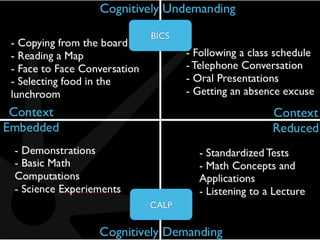
2.Context Embedded and Context
Reduced Communication
(Cummins, 1981)
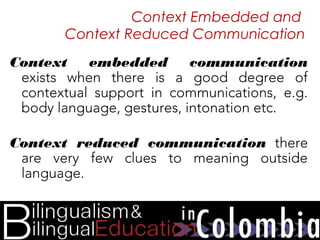
Context embedded communication
exists when there is a good degree of
contextual support in communications, e.g.
body language, gestures, intonation etc.
Context reduced communication there
are very few clues to meaning outside
language.
Context Embedded and
Context Reduced Communication
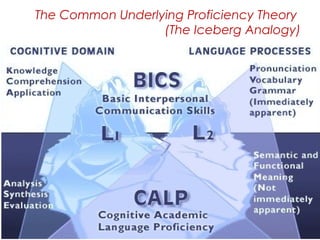
Jim Cummins’ Interdependence hypothesis
BICS in first language BICS in second language
CALP in first language CALP in second language
CommonCommon
UnderlyingUnderlying
ProficiencyProficiency
The Common Underlying Proficiency Theory
(The Iceberg Analogy)
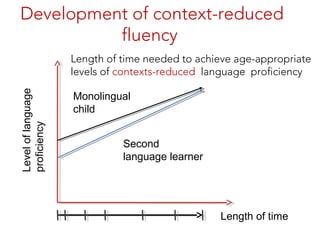
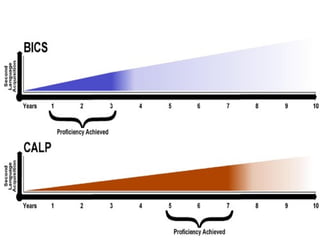
Length of time needed to achieve age-appropriate
levels of contexts-reduced language proficiency
Leveloflanguage
proficiency
Monolingual
child
Second
language learner
Length of time
Development of context-reduced
fluency
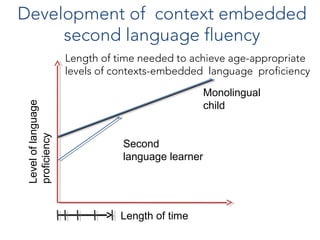
Length of time needed to achieve age-appropriate
levels of contexts-embedded language proficiency
Leveloflanguage
proficiency
Monolingual
child
Second
language learner
Length of time
Development of context embedded
second language fluency
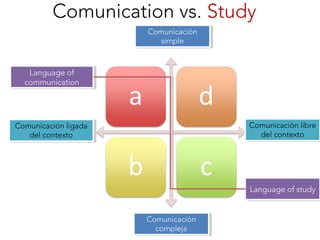
Comunication vs. Study
Comunicación
simple
Comunicación
simple
Comunicación libre
del contexto
Comunicación libre
del contexto
Comunicación ligada
del contexto
Comunicación ligada
del contexto
Comunicación
compleja
Comunicación
compleja
Language of
communication
Language of
communication
Language of studyLanguage of study
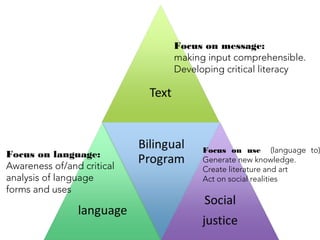
Focus on message:
making input comprehensible.
Developing critical literacy
Focus on use (language to)
Generate new knowledge.
Create literature and art
Act on social realities
Focus on language:
Awareness of/and critical
analysis of language
forms and uses
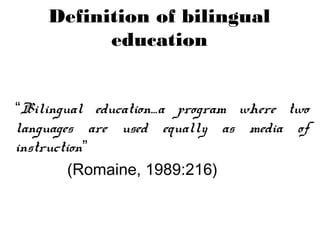
“Bilingual education…a program where two
languages are used equally as media of
instruction”
(Romaine, 1989:216)
Definition of bilingual
education
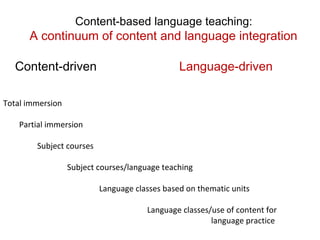
Content-driven Language-driven
Content-based language teaching:
A continuum of content and language integration
Total immersion
Partial immersion
Subject courses
Subject courses/language teaching
Language classes based on thematic units
Language classes/use of content for
language practice
Speak English,
please

Bics and calp

  • 1.
  • 2.
    1.The Common UnderlyingProficiency Theory 2.Context Embedded and Context Reduced Communication (Cummins, 1981)
  • 3.
    Context embedded communication existswhen there is a good degree of contextual support in communications, e.g. body language, gestures, intonation etc. Context reduced communication there are very few clues to meaning outside language. Context Embedded and Context Reduced Communication
  • 4.
    Jim Cummins’ Interdependencehypothesis BICS in first language BICS in second language CALP in first language CALP in second language CommonCommon UnderlyingUnderlying ProficiencyProficiency
  • 5.
    The Common UnderlyingProficiency Theory (The Iceberg Analogy)
  • 6.
    Length of timeneeded to achieve age-appropriate levels of contexts-reduced language proficiency Leveloflanguage proficiency Monolingual child Second language learner Length of time Development of context-reduced fluency
  • 7.
    Length of timeneeded to achieve age-appropriate levels of contexts-embedded language proficiency Leveloflanguage proficiency Monolingual child Second language learner Length of time Development of context embedded second language fluency
  • 8.
    Comunication vs. Study Comunicación simple Comunicación simple Comunicaciónlibre del contexto Comunicación libre del contexto Comunicación ligada del contexto Comunicación ligada del contexto Comunicación compleja Comunicación compleja Language of communication Language of communication Language of studyLanguage of study
  • 11.
    Focus on message: makinginput comprehensible. Developing critical literacy Focus on use (language to) Generate new knowledge. Create literature and art Act on social realities Focus on language: Awareness of/and critical analysis of language forms and uses
  • 12.
    “Bilingual education…a programwhere two languages are used equally as media of instruction” (Romaine, 1989:216) Definition of bilingual education
  • 13.
    Content-driven Language-driven Content-based languageteaching: A continuum of content and language integration Total immersion Partial immersion Subject courses Subject courses/language teaching Language classes based on thematic units Language classes/use of content for language practice
  • 14.