UNIVERSIDAD PEDAGÓGICA EXPERIMENTAL LIBERTADOR
            INSTITUTO PEDAGÓGICO DE CARACAS
                   PROGRAMA DE INGLÉS
  CURSO: SEMINARIO DE INGLÉS PARA PROPÓSITOS ESPECÍFICOS


COURSE DESIGN BASED ON THE SKILL-CENTERED APPROACH
          WITH EMPHASIS ON READING SKILLS


      AUTHORS: WILLIAM BENJAMIN & MAURY RODRIGUEZ
WHAT IS READING?

        According to Dechant (1991) cited by Macceca (2007,
p.4), reading is a visual process that begins with one´s ability
to use ones´s vision to interpret graphic symbols.


    WHAT IS READING COMPREHENSION?

          According to Dechant (1991) cited by Macceca (2007,
p.4), It refers to understand what is read, so readers must be
able to cognitively process the words by drawing meaning from
their own experience and knowledge to understand the author
´s message.
There are two approaches which describe the nature
of the reading learning process:

        Bottom-up processing, readers must recognize a
variety of linguistic signals (letters, morphemes, syllables,
etc.), and impose some sort of order them, so as to make
them cohere.
        Top-down processing, it focuses on the background
knowledge a reader uses to comprehend a written text.
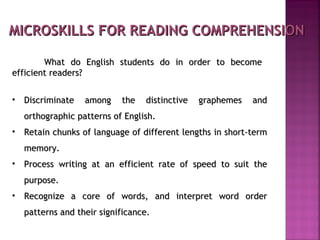
SCHEMA THEORY AND READING

        According to Nunan (1999,
201), "schema theory is based on
the notion that past experiences
lead to the creation of mental
frameworks that help us make sense
of new experiences."

        Anderson (1994) presents research showing that recall
of information in a text is affected by the reader's schemata
and explains that "a reader comprehends a message when he is
able to bring to mind a schema that gives account of the
objects and events described in the message" (469).
Comprehension is "activating or constructing a schema that
provides a coherent explanation of objects and events
mentioned in a discourse" (473).
MICROSKILLS FOR READING COMPREHENSION

        What do English students do in order to become
efficient readers?


•   Discriminate   among    the   distinctive   graphemes   and
    orthographic patterns of English.
•   Retain chunks of language of different lengths in short-term
    memory.
•   Process writing at an efficient rate of speed to suit the
    purpose.
•   Recognize a core of words, and interpret word order
    patterns and their significance.
•   Recognize grammatical word classes, patterns, rules and
    elliptical forms.
•   Recognize that a particular meaning may be expressed in
    different grammatical forms.
•   Recognize cohesive devices in written discourse and their
    role in signaling the relationship between and among
    clauses.
•   Recognize the communicative functions of written texts,
    according to form and purpose.
•   Infer context that is not explicit by using background
    knowledge.
• Infer links and connections between events, ideas, etc.,
  deduce causes and effects, and detect such relations as
  main idea, supporting idea, new information, given
  information, generalization, and exemplification.
• Distinguish between literal and implied meaning.
• Detect culturally specific references and interpret them in a
  context of the appropriate cultural schemata.
• Develop and use a battery of reading strategies such as
  scanning ans skimming, detecting discurse markers, guessing
  the meaning of words from context, and activating
  schemata for the interpretation of texts.
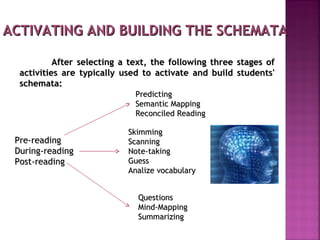
ACTIVATING AND BUILDING THE SCHEMATA

           After selecting a text, the following three stages of
  activities are typically used to activate and build students'
  schemata:
                              Predicting
                              Semantic Mapping
                              Reconciled Reading

                            Skimming
 Pre-reading                Scanning
 During-reading             Note-taking
 Post-reading               Guess
                            Analize vocabulary


                              Questions
                              Mind-Mapping
                              Summarizing
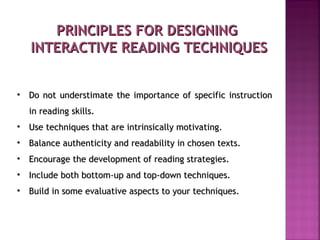
PRINCIPLES FOR DESIGNING
    INTERACTIVE READING TECHNIQUES


•   Do not understimate the importance of specific instruction
    in reading skills.
•   Use techniques that are intrinsically motivating.
•   Balance authenticity and readability in chosen texts.
•   Encourage the development of reading strategies.
•   Include both bottom-up and top-down techniques.
•   Build in some evaluative aspects to your techniques.
BIBLIOGRAPHY

Brown, H. Douglas. ( 1994). Teaching by Principles: An
    Approach to Language Pedagogy. 2nd ed. New Jersey, USA:
    Prentice Hall.
 
Macceca, S. (2007). Reading Stategies for Science. Huntington
    Beach, USA: Shell Education.
 

Teaching Reading Skills

  • 1.
    UNIVERSIDAD PEDAGÓGICA EXPERIMENTALLIBERTADOR INSTITUTO PEDAGÓGICO DE CARACAS PROGRAMA DE INGLÉS CURSO: SEMINARIO DE INGLÉS PARA PROPÓSITOS ESPECÍFICOS COURSE DESIGN BASED ON THE SKILL-CENTERED APPROACH WITH EMPHASIS ON READING SKILLS AUTHORS: WILLIAM BENJAMIN & MAURY RODRIGUEZ
  • 2.
    WHAT IS READING? According to Dechant (1991) cited by Macceca (2007, p.4), reading is a visual process that begins with one´s ability to use ones´s vision to interpret graphic symbols. WHAT IS READING COMPREHENSION? According to Dechant (1991) cited by Macceca (2007, p.4), It refers to understand what is read, so readers must be able to cognitively process the words by drawing meaning from their own experience and knowledge to understand the author ´s message.
  • 3.
    There are twoapproaches which describe the nature of the reading learning process: Bottom-up processing, readers must recognize a variety of linguistic signals (letters, morphemes, syllables, etc.), and impose some sort of order them, so as to make them cohere. Top-down processing, it focuses on the background knowledge a reader uses to comprehend a written text.
  • 4.
    SCHEMA THEORY ANDREADING According to Nunan (1999, 201), "schema theory is based on the notion that past experiences lead to the creation of mental frameworks that help us make sense of new experiences." Anderson (1994) presents research showing that recall of information in a text is affected by the reader's schemata and explains that "a reader comprehends a message when he is able to bring to mind a schema that gives account of the objects and events described in the message" (469). Comprehension is "activating or constructing a schema that provides a coherent explanation of objects and events mentioned in a discourse" (473).
  • 5.
    MICROSKILLS FOR READINGCOMPREHENSION What do English students do in order to become efficient readers? • Discriminate among the distinctive graphemes and orthographic patterns of English. • Retain chunks of language of different lengths in short-term memory. • Process writing at an efficient rate of speed to suit the purpose. • Recognize a core of words, and interpret word order patterns and their significance.
  • 6.
    Recognize grammatical word classes, patterns, rules and elliptical forms. • Recognize that a particular meaning may be expressed in different grammatical forms. • Recognize cohesive devices in written discourse and their role in signaling the relationship between and among clauses. • Recognize the communicative functions of written texts, according to form and purpose. • Infer context that is not explicit by using background knowledge.
  • 7.
    • Infer linksand connections between events, ideas, etc., deduce causes and effects, and detect such relations as main idea, supporting idea, new information, given information, generalization, and exemplification. • Distinguish between literal and implied meaning. • Detect culturally specific references and interpret them in a context of the appropriate cultural schemata. • Develop and use a battery of reading strategies such as scanning ans skimming, detecting discurse markers, guessing the meaning of words from context, and activating schemata for the interpretation of texts.
  • 8.
    ACTIVATING AND BUILDINGTHE SCHEMATA After selecting a text, the following three stages of activities are typically used to activate and build students' schemata: Predicting Semantic Mapping Reconciled Reading Skimming Pre-reading Scanning During-reading Note-taking Post-reading Guess Analize vocabulary Questions Mind-Mapping Summarizing
  • 9.
    PRINCIPLES FOR DESIGNING INTERACTIVE READING TECHNIQUES • Do not understimate the importance of specific instruction in reading skills. • Use techniques that are intrinsically motivating. • Balance authenticity and readability in chosen texts. • Encourage the development of reading strategies. • Include both bottom-up and top-down techniques. • Build in some evaluative aspects to your techniques.
  • 10.
    BIBLIOGRAPHY Brown, H. Douglas.( 1994). Teaching by Principles: An Approach to Language Pedagogy. 2nd ed. New Jersey, USA: Prentice Hall.   Macceca, S. (2007). Reading Stategies for Science. Huntington Beach, USA: Shell Education.