Questionnaires
Coombes, 2001, Research Using IT
Stages of Questionnaires
1. Selecting the population
2. Designing the questionnaire
a. Preparatory work
b. Question content
c. Questionnaire format
d. Pre-testing
3. Training the interviewers
4. Coding the data
5. Analyzing the data
Questionnaire should be…
• Objectives  questions
• Completion  easy and simple
• Answers  data needed & data analysis
• Good Questions
 Clear
 Explicit
 No ambiguity
• Wrong questions
 Confusing
 Wrong
 Not crucial
Open vs. Closed Questions
• Number of subjects
• Data analysis
• Advantages & disadvantages (p. 126)
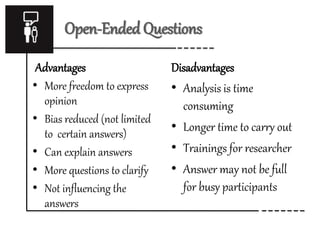
Open-Ended Questions
Advantages
• More freedom to express
opinion
• Bias reduced (not limited
to certain answers)
• Can explain answers
• More questions to clarify
• Not influencing the
answers
Disadvantages
• Analysis is time
consuming
• Longer time to carry out
• Trainings for researcher
• Answer may not be full
for busy participants
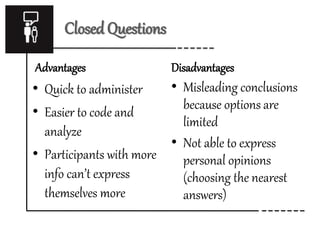
Closed Questions
Advantages
• Quick to administer
• Easier to code and
analyze
• Participants with more
info can’t express
themselves more
Disadvantages
• Misleading conclusions
because options are
limited
• Not able to express
personal opinions
(choosing the nearest
answers)
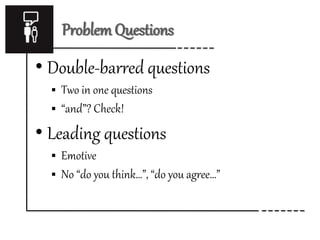
Problem Questions
• Double-barred questions
 Two in one questions
 “and”? Check!
• Leading questions
 Emotive
 No “do you think…”, “do you agree…”
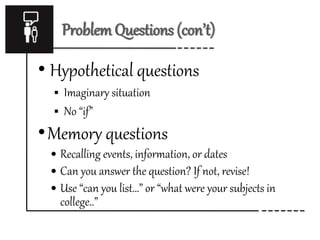
Problem Questions (con’t)
• Hypothetical questions
 Imaginary situation
 No “if”
•Memory questions
 Recalling events, information, or dates
 Can you answer the question? If not, revise!
 Use “can you list…” or “what were your subjects in
college..”
Problem Questions (con’t)
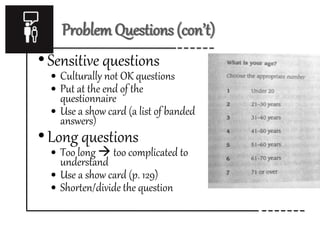
•Sensitive questions
 Culturally not OK questions
 Put at the end of the
questionnaire
 Use a show card (a list of banded
answers)
•Long questions
 Too long  too complicated to
understand
 Use a show card (p. 129)
 Shorten/divide the question
Problem Questions (con’t)
• Questions requiring
prior knowledge
 Takes time to answer
 If you can’t instantly answer
it, remove it or restate it
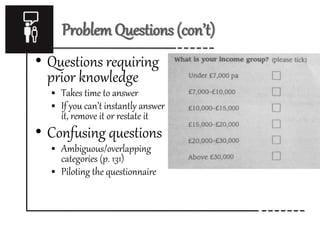
• Confusing questions
 Ambiguous/overlapping
categories (p. 131)
 Piloting the questionnaire
Problem Questions (con’t)
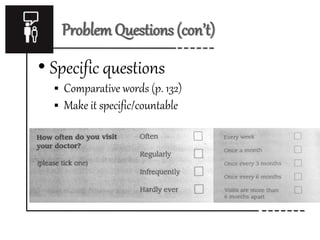
• Specific questions
 Comparative words (p. 132)
 Make it specific/countable
Presentation of Questionnaire
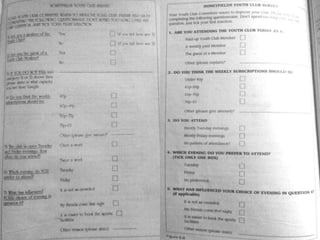
• See p. 133
• Package, package, package!
• Clearly printed
• Consistent in display
• Logically presented
• Plenty of space for reply
• Clear and unambiguous instructions
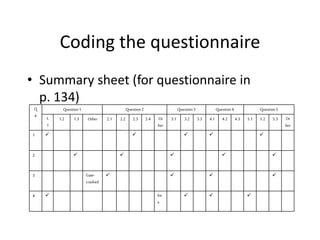
Coding the questionnaire
• Summary sheet (for questionnaire in
p. 134)
Q
#
Question1 Question2 Question3 Question4 Question5
1.
1
1.2 1.3 Other 2.1 2.2 2.3 2.4 Ot
her
3.1 3.2 3.3 4.1 4.2 4.3 5.1 5.2 5.3 Ot
her
1     
2     
3 Gate-
crashed
   
4  fre
e
  
Coding Data for Open-Ended Answers
• Simple coding
 Create a categorization
 Each time the answer refers to one of the category, write a number beside it
 Move the coded answer to the summary sheets
• Individual topic coding numbers
 Long, in-depth open-ended answers
 Important vs. unimportant answers
 Worth quoting?
 Steps:
o Different color for different subjects
o Papers with different headings (topics)
o Cut and paste the same topic answers to the heading paper
o Code the answers in the heading paper + reference to the page number
Coding the questionnaire (con’t)
• Use commercially available software
• Excel or SPSS
• Easy to do statistical analysis
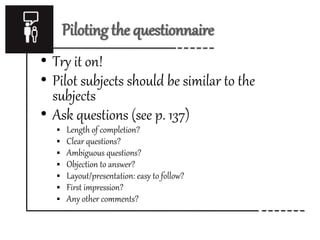
Piloting the questionnaire
• Try it on!
• Pilot subjects should be similar to the
subjects
• Ask questions (see p. 137)
 Length of completion?
 Clear questions?
 Ambiguous questions?
 Objection to answer?
 Layout/presentation: easy to follow?
 First impression?
 Any other comments?
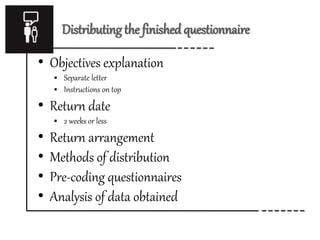
Distributing the finishedquestionnaire
• Objectives explanation
 Separate letter
 Instructions on top
• Return date
 2 weeks or less
• Return arrangement
• Methods of distribution
• Pre-coding questionnaires
• Analysis of data obtained

Questionnaires

  • 1.
  • 2.
    Stages of Questionnaires 1.Selecting the population 2. Designing the questionnaire a. Preparatory work b. Question content c. Questionnaire format d. Pre-testing 3. Training the interviewers 4. Coding the data 5. Analyzing the data
  • 3.
    Questionnaire should be… •Objectives  questions • Completion  easy and simple • Answers  data needed & data analysis • Good Questions  Clear  Explicit  No ambiguity • Wrong questions  Confusing  Wrong  Not crucial
  • 4.
    Open vs. ClosedQuestions • Number of subjects • Data analysis • Advantages & disadvantages (p. 126)
  • 5.
    Open-Ended Questions Advantages • Morefreedom to express opinion • Bias reduced (not limited to certain answers) • Can explain answers • More questions to clarify • Not influencing the answers Disadvantages • Analysis is time consuming • Longer time to carry out • Trainings for researcher • Answer may not be full for busy participants
  • 6.
    Closed Questions Advantages • Quickto administer • Easier to code and analyze • Participants with more info can’t express themselves more Disadvantages • Misleading conclusions because options are limited • Not able to express personal opinions (choosing the nearest answers)
  • 7.
    Problem Questions • Double-barredquestions  Two in one questions  “and”? Check! • Leading questions  Emotive  No “do you think…”, “do you agree…”
  • 8.
    Problem Questions (con’t) •Hypothetical questions  Imaginary situation  No “if” •Memory questions  Recalling events, information, or dates  Can you answer the question? If not, revise!  Use “can you list…” or “what were your subjects in college..”
  • 9.
    Problem Questions (con’t) •Sensitivequestions  Culturally not OK questions  Put at the end of the questionnaire  Use a show card (a list of banded answers) •Long questions  Too long  too complicated to understand  Use a show card (p. 129)  Shorten/divide the question
  • 10.
    Problem Questions (con’t) •Questions requiring prior knowledge  Takes time to answer  If you can’t instantly answer it, remove it or restate it • Confusing questions  Ambiguous/overlapping categories (p. 131)  Piloting the questionnaire
  • 11.
    Problem Questions (con’t) •Specific questions  Comparative words (p. 132)  Make it specific/countable
  • 12.
    Presentation of Questionnaire •See p. 133 • Package, package, package! • Clearly printed • Consistent in display • Logically presented • Plenty of space for reply • Clear and unambiguous instructions
  • 14.
    Coding the questionnaire •Summary sheet (for questionnaire in p. 134) Q # Question1 Question2 Question3 Question4 Question5 1. 1 1.2 1.3 Other 2.1 2.2 2.3 2.4 Ot her 3.1 3.2 3.3 4.1 4.2 4.3 5.1 5.2 5.3 Ot her 1      2      3 Gate- crashed     4  fre e   
  • 15.
    Coding Data forOpen-Ended Answers • Simple coding  Create a categorization  Each time the answer refers to one of the category, write a number beside it  Move the coded answer to the summary sheets • Individual topic coding numbers  Long, in-depth open-ended answers  Important vs. unimportant answers  Worth quoting?  Steps: o Different color for different subjects o Papers with different headings (topics) o Cut and paste the same topic answers to the heading paper o Code the answers in the heading paper + reference to the page number
  • 16.
    Coding the questionnaire(con’t) • Use commercially available software • Excel or SPSS • Easy to do statistical analysis
  • 17.
    Piloting the questionnaire •Try it on! • Pilot subjects should be similar to the subjects • Ask questions (see p. 137)  Length of completion?  Clear questions?  Ambiguous questions?  Objection to answer?  Layout/presentation: easy to follow?  First impression?  Any other comments?
  • 18.
    Distributing the finishedquestionnaire •Objectives explanation  Separate letter  Instructions on top • Return date  2 weeks or less • Return arrangement • Methods of distribution • Pre-coding questionnaires • Analysis of data obtained