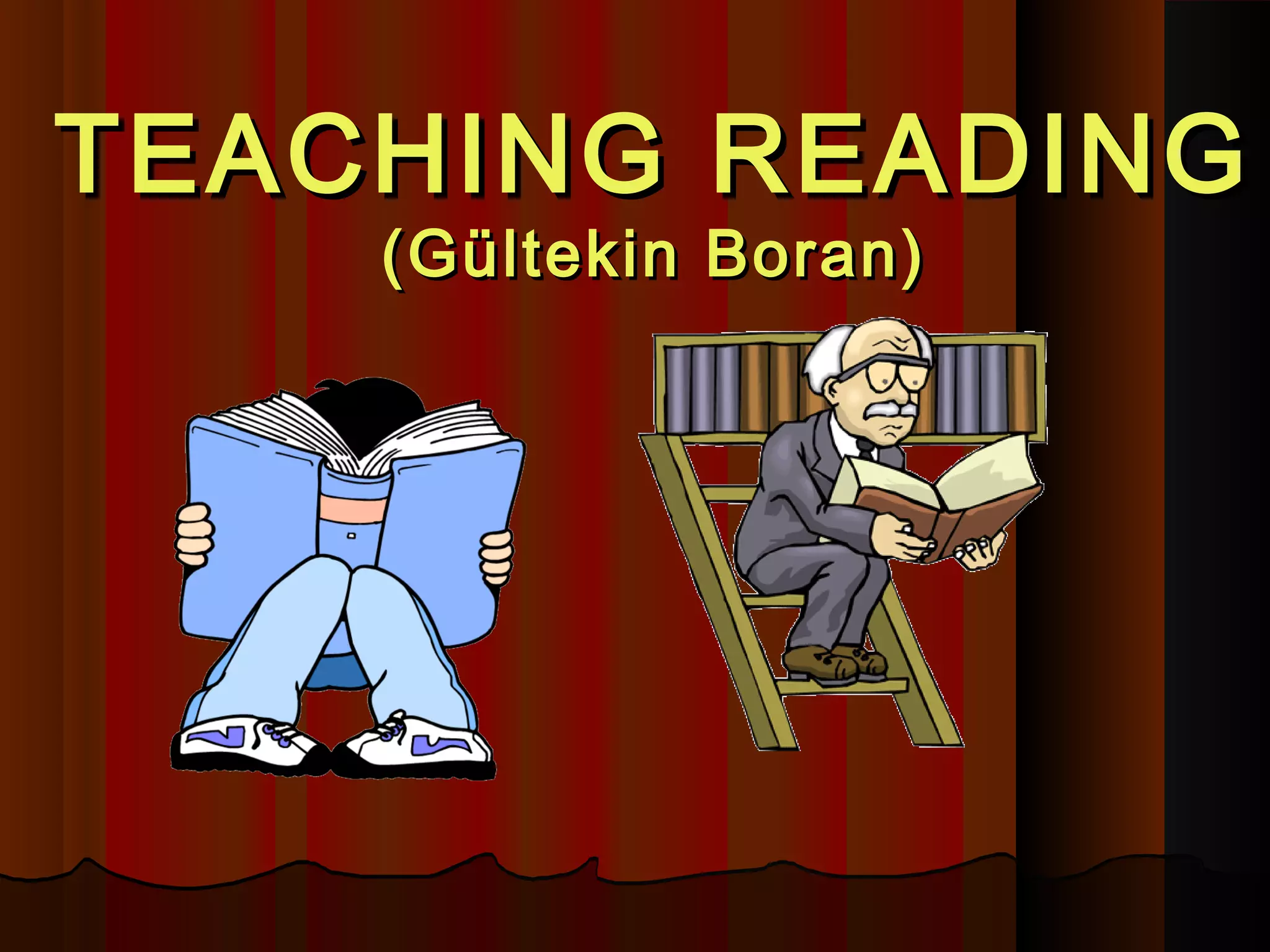
TEACHING READINGTEACHING READING
(Gültekin Boran)(Gültekin Boran)
PROBLEMSPROBLEMS
??????
Students don’t like readingStudents don’t like reading
 Lack of purposeLack of purpose
Texts (topics of the texts) don’t fitTexts (topics of the texts) don’t fit
students’ needs, interests and wants.students’ needs, interests and wants.
The language level of the texts are tooThe language level of the texts are too
much higher or lower than the students’much higher or lower than the students’
language levellanguage level (i+1) (Krashen)(i+1) (Krashen)
The teacher does not bring variousThe teacher does not bring various
genres (text types)genres (text types)
The teacher does not have theThe teacher does not have the
necessary methodologicalnecessary methodological
knowledge about how to teachknowledge about how to teach
reading.reading.
It is a national problem. ReadingIt is a national problem. Reading
has little value in the culture.has little value in the culture.
Students’ read ‘‘word by word’’.Students’ read ‘‘word by word’’.
Students don’t know usefulStudents don’t know useful
reading strategies.reading strategies.
REAL LIFE READING VS.REAL LIFE READING VS.
EFL CLASSROOMEFL CLASSROOM
READINGREADING
 What did you read in the last 48 hours?What did you read in the last 48 hours?
 Where did you read it/them?Where did you read it/them?
 Why did you read it/them? (purpose ??)Why did you read it/them? (purpose ??)
What did your students read in your lastWhat did your students read in your last
reading class?reading class?
Where and why did they read it/them?Where and why did they read it/them?
WHAT IS READING ?WHAT IS READING ?
(READING THEORIES)(READING THEORIES)
1)1) BOTTOM-UPBOTTOM-UP THEORYTHEORY
Reading starts from theReading starts from the
smallest unit, that is, the lettersmallest unit, that is, the letter
and goes to the largest, that isand goes to the largest, that is
the text.the text.
The rThe reader puts the letterseader puts the letters
together to make words andtogether to make words and
words to make phrases andwords to make phrases and
phrases to make sentences andphrases to make sentences and
sentences to make the wholesentences to make the whole
texttext..
2) TOP-DOWN2) TOP-DOWN TEORYTEORY
The reader has expectationsThe reader has expectations
about the text. He makesabout the text. He makes
predictions using his backgroundpredictions using his background
knowledge about the text. Heknowledge about the text. He
makes guesses about what themakes guesses about what the
authauthoor will say next. Reader’sr will say next. Reader’s
background knowledge, worldbackground knowledge, world
knowledge take active role in theknowledge take active role in the
reading process.reading process.
3) INTERACTIVE3) INTERACTIVE
MODELMODEL
The Reader uses both bottom-up andThe Reader uses both bottom-up and
top-down strategies. The message goes,top-down strategies. The message goes,
letter by letter, into the reader’s brainletter by letter, into the reader’s brain
then the message is matched with thethen the message is matched with the
existing knowledge in the brain in orderexisting knowledge in the brain in order
to facilitate the further processing of newto facilitate the further processing of new
information.information.
HOW SHOULD WE TEACH READING?HOW SHOULD WE TEACH READING?
THE THREE STEPS
1)1) PRE-READINGPRE-READING
2)2) WHILE-READINGWHILE-READING
3)3) POST-READINGPOST-READING
1)1) PRE-READINGPRE-READING
Why is “PRE-READING” important?Why is “PRE-READING” important?
What do we do in this phase?What do we do in this phase?
Reasons for PRE-READINGReasons for PRE-READING
1)1) In pre-reading phase, students areIn pre-reading phase, students are
motivated and a relation is setmotivated and a relation is set
between their real lives and the topicbetween their real lives and the topic
of the reading text.of the reading text.
Reasons for PRE-READINGReasons for PRE-READING
2)2) In pre-reading, students’ backgroundIn pre-reading, students’ background
knowledge (what they already knowknowledge (what they already know
about the topic) is activated. (This isabout the topic) is activated. (This is
necessary for them to do top-down)necessary for them to do top-down)
Reasons for PRE-READINGReasons for PRE-READING
3) There may be some grammar or3) There may be some grammar or
vocabulary problems that may hindervocabulary problems that may hinder
students’ comprehension of the text.students’ comprehension of the text.
These problems should be solvedThese problems should be solved
before the students start to read thebefore the students start to read the
text.text.
Reasons for PRE-READINGReasons for PRE-READING
4)4) You motivate your studentsYou motivate your students. You make. You make
themthem want to read the text by increasingwant to read the text by increasing
their curiositytheir curiosity
5) You create expectations about the5) You create expectations about the
topic of the text so that they can dotopic of the text so that they can do
better top-downbetter top-down
TECHNIQUES TO APPLY INTECHNIQUES TO APPLY IN
PRE-READING PHASEPRE-READING PHASE
1)1) Brain storming (The teacher asks what vocabularyBrain storming (The teacher asks what vocabulary
or ideas they remember about the topic)or ideas they remember about the topic)
2)2) Personalization (The teacher asks students real lifePersonalization (The teacher asks students real life
experiences about the topic of the text)experiences about the topic of the text)
3)3) Introducing the topic by using visual aids (pics,Introducing the topic by using visual aids (pics,
vids, graphs, .etc)vids, graphs, .etc)
4)4) Class discussion (The teacher and the whole classClass discussion (The teacher and the whole class
discuss the topic)discuss the topic)
5)5) Groups or pairs discussionGroups or pairs discussion
6)6) Listening to an audio recording related to the topicListening to an audio recording related to the topic
of the text.of the text.
2) WHILE-READING2) WHILE-READING
WHY IS WHILE-READING IMPORTANT?WHY IS WHILE-READING IMPORTANT?
WHAT DO WE DO IN WHILE-READINGWHAT DO WE DO IN WHILE-READING
PHASE?PHASE?
REASONS FOR WHILE-READING?REASONS FOR WHILE-READING?
1)1) Students read and comprehend the text.Students read and comprehend the text.
2)2) Students improve their reading sub-skillsStudents improve their reading sub-skills
during this phase by the help of questions orduring this phase by the help of questions or
other types of exercises.other types of exercises.
3) We give a purpose to students for reading with3) We give a purpose to students for reading with
while reading tasks.while reading tasks.
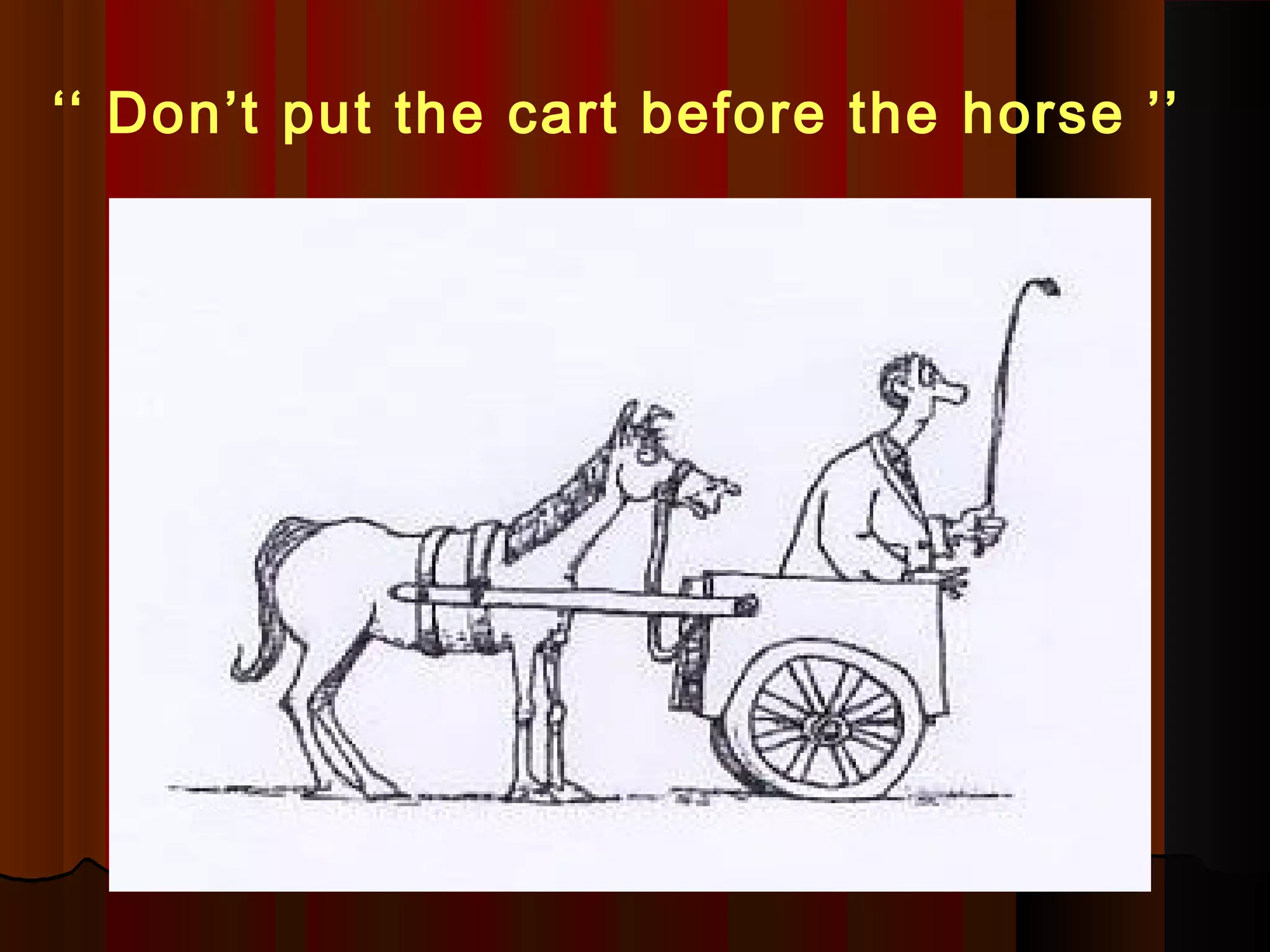
‘‘ Don’t put the cart before the horse ’’
READING SUB-SKILLSREADING SUB-SKILLS
1)1) Gist or Skimming (Global understanding)Gist or Skimming (Global understanding)
2)2) ScanningScanning (Reading a passage to find specific(Reading a passage to find specific
information)information)
3)3) Guessing unknown vocabularyGuessing unknown vocabulary (contextual(contextual
guessing)guessing)
4)4) Making inferencesMaking inferences (reading between lines,(reading between lines,
understanding implied ideas, understanding what is meantunderstanding implied ideas, understanding what is meant
but not stated in the text),but not stated in the text),
5)5) Understanding cohesive linksUnderstanding cohesive links (“(“It”It” refers to ……,refers to ……,
““They”They” refers to………, “She” refers to…….refers to………, “She” refers to…….
6)6) 6) Understanding coherence (Putting the6) Understanding coherence (Putting the
pieces of a text in the correct orderpieces of a text in the correct order .).)
3) POST-READING3) POST-READING
Why Post-reading?Why Post-reading?
What do we do in this phase?What do we do in this phase?
Reasons for POST-READINGReasons for POST-READING
1) In post-reading1) In post-reading phasephase, reading is, reading is
integrated with other language skills.integrated with other language skills.
Because reading is a receptive skill, it isBecause reading is a receptive skill, it is
integrated especially with productive skillsintegrated especially with productive skills
(i.e., writing and speaking). Students find a(i.e., writing and speaking). Students find a
chance to practise and improve theirchance to practise and improve their
writing and speaking skills.writing and speaking skills.
Reasons for POST-READINGReasons for POST-READING
2)2) Students have more practice for theStudents have more practice for the
vocabulary or grammar items which theyvocabulary or grammar items which they
learn in the while-readinglearn in the while-reading phasephase and theyand they
internalize them in speaking or writinginternalize them in speaking or writing
activities in the post-reading phase.activities in the post-reading phase.
SOME TIPSSOME TIPS
1)1) Never skip PRE-READING PHASE…!Never skip PRE-READING PHASE…!
2)2) Always start with a gist (globalAlways start with a gist (global
understanding) and encourage yourunderstanding) and encourage your
students for global understanding. Thenstudents for global understanding. Then
you can encourage them for fineryou can encourage them for finer
comprehension.comprehension.
3)3) Always try different genres such asAlways try different genres such as
booklets, poems, letters, (love letters),booklets, poems, letters, (love letters),
articles, diaries…etc.articles, diaries…etc.
SOME TIPSSOME TIPS
4)4) Use Authentic materials wheneverUse Authentic materials whenever
possible.possible.
5)5) Play music (soft music), while they arePlay music (soft music), while they are
reading. Music activates bothreading. Music activates both
hemispheres of the brain.hemispheres of the brain.
6)6) Always encourage your studentsAlways encourage your students toto readread
for pleasure.for pleasure.
7)7) Internet is a nice tool. Encourage yourInternet is a nice tool. Encourage your
students to surf on the English web-sites.students to surf on the English web-sites.
SOME TIPSSOME TIPS
8) Get your students to do extensive8) Get your students to do extensive
reading.reading.
9) Elicit ideas from students about how to9) Elicit ideas from students about how to
make reading more enjoyable.make reading more enjoyable.
10) Build a a classroom library and ask10) Build a a classroom library and ask
your students to donate books for thatyour students to donate books for that
library.library.
11) Give prizes to those students who do11) Give prizes to those students who do
much reading.much reading.
12 Give communicative reading tasks.12 Give communicative reading tasks.
CEF AND ELPCEF AND ELP BASEDBASED
READINGREADING
Reading has certain indicators inReading has certain indicators in
accordance with the criteria of theaccordance with the criteria of the
Common Reference Levels.Common Reference Levels.
In a CEFIn a CEF (Common European(Common European
Framework)Framework) and ELPand ELP (European(European
Language Portfolio) -Language Portfolio) - based readingbased reading
programme, certain features fulfilprogramme, certain features fulfil
the requirements concerning self-the requirements concerning self-
assessment and learner autonomy,assessment and learner autonomy,
as well as cultural diversityas well as cultural diversity
AUTONOMY IN READINGAUTONOMY IN READING
THE MAIN AIM IS TO PREPARETHE MAIN AIM IS TO PREPARE
LANGUAGE LEARNERS FOR REAL-LIFELANGUAGE LEARNERS FOR REAL-LIFE
READING IN THEIR TARGET LANGUAGE.READING IN THEIR TARGET LANGUAGE.
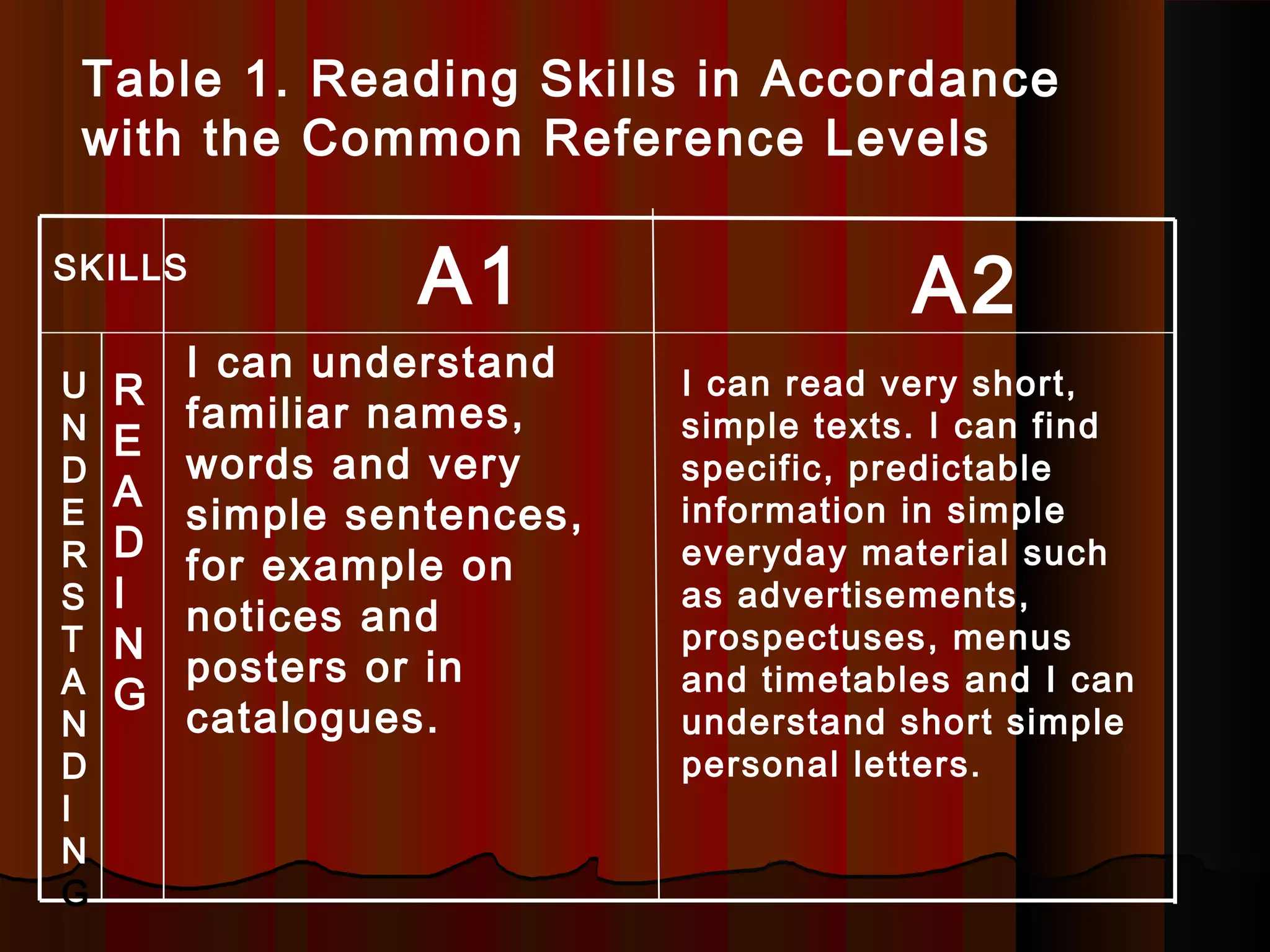
SKILLS
U
N
D
E
R
S
T
A
N
D
I
N
G
R
E
A
D
I
N
G
A1 A2
I can understand
familiar names,
words and very
simple sentences,
for example on
notices and
posters or in
catalogues.
I can read very short,
simple texts. I can find
specific, predictable
information in simple
everyday material such
as advertisements,
prospectuses, menus
and timetables and I can
understand short simple
personal letters.
Table 1. Reading Skills in Accordance
with the Common Reference Levels
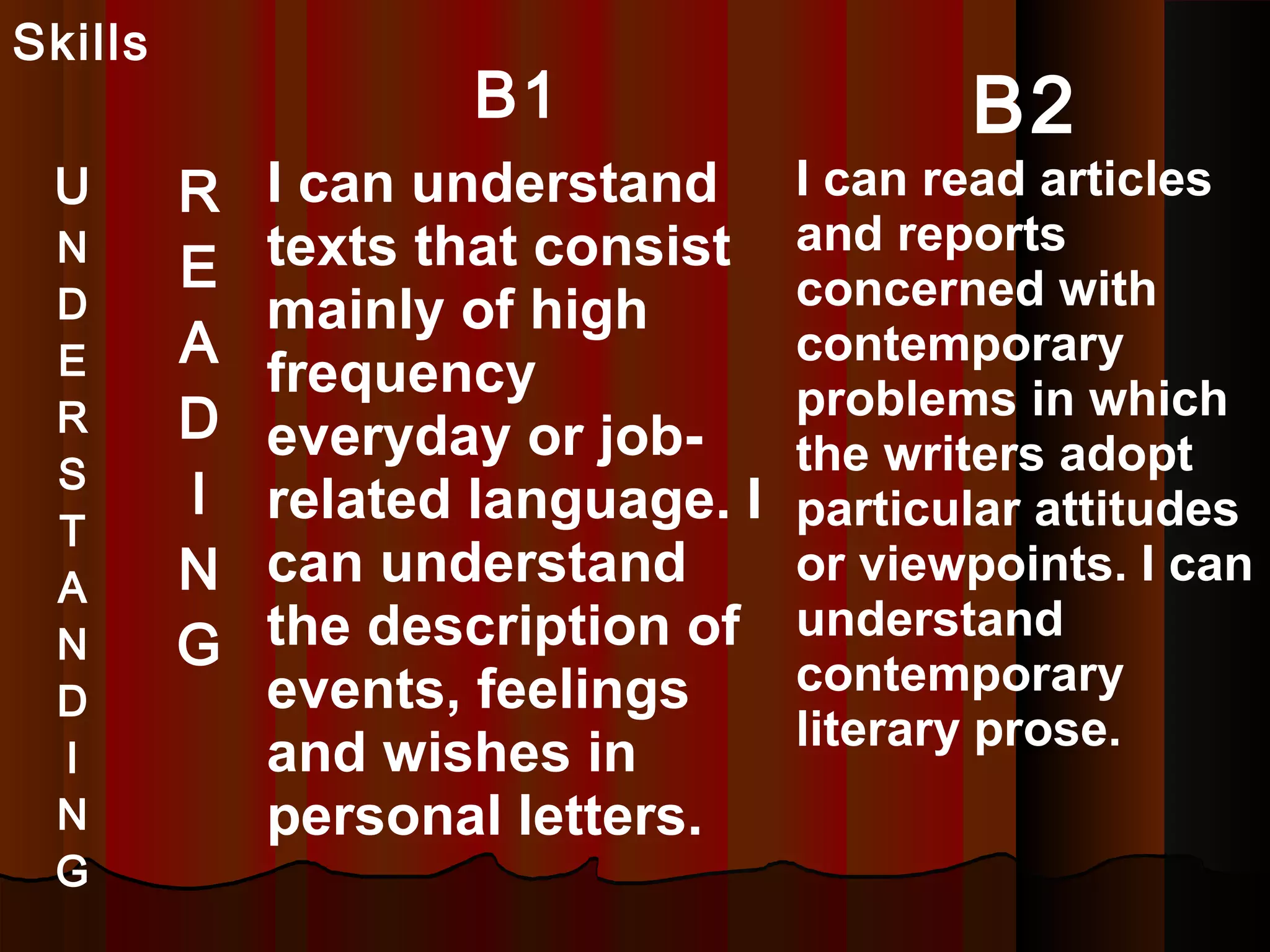
Skills
B1 B2
U
N
D
E
R
S
T
A
N
D
I
N
G
R
E
A
D
I
N
G
I can understand
texts that consist
mainly of high
frequency
everyday or job-
related language. I
can understand
the description of
events, feelings
and wishes in
personal letters.
I can read articles
and reports
concerned with
contemporary
problems in which
the writers adopt
particular attitudes
or viewpoints. I can
understand
contemporary
literary prose.
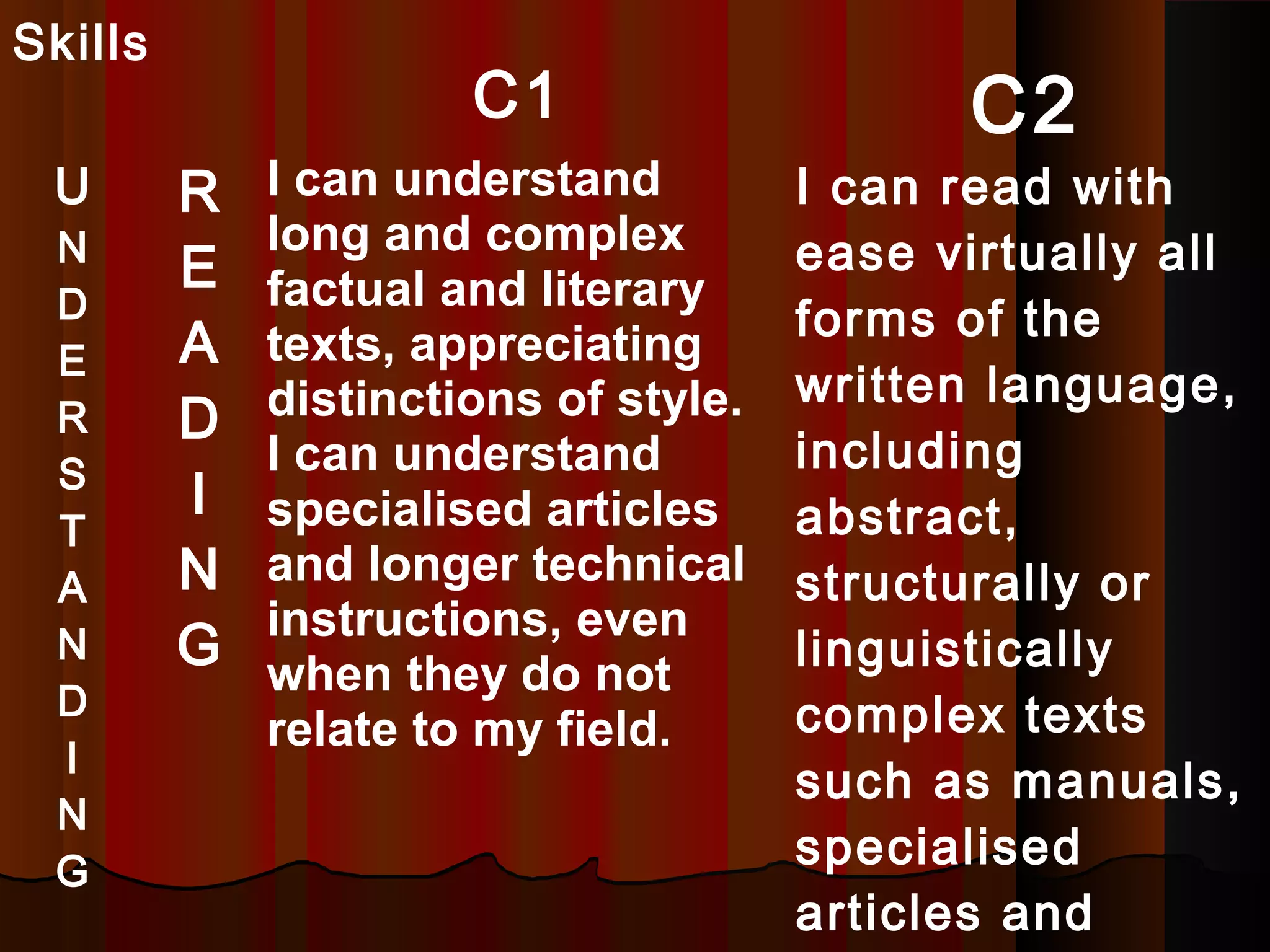
Skills
C1 C2
U
N
D
E
R
S
T
A
N
D
I
N
G
R
E
A
D
I
N
G
I can understand
long and complex
factual and literary
texts, appreciating
distinctions of style.
I can understand
specialised articles
and longer technical
instructions, even
when they do not
relate to my field.
I can read with
ease virtually all
forms of the
written language,
including
abstract,
structurally or
linguistically
complex texts
such as manuals,
specialised
articles and
In European Language Portfolio, thereIn European Language Portfolio, there
is a self-assessment grid,is a self-assessment grid,
THANK YOU FOR LISTENINGTHANK YOU FOR LISTENING

Teaching reading

  • 1.
  • 2.
  • 3.
    Students don’t likereadingStudents don’t like reading  Lack of purposeLack of purpose Texts (topics of the texts) don’t fitTexts (topics of the texts) don’t fit students’ needs, interests and wants.students’ needs, interests and wants. The language level of the texts are tooThe language level of the texts are too much higher or lower than the students’much higher or lower than the students’ language levellanguage level (i+1) (Krashen)(i+1) (Krashen) The teacher does not bring variousThe teacher does not bring various genres (text types)genres (text types)
  • 4.
    The teacher doesnot have theThe teacher does not have the necessary methodologicalnecessary methodological knowledge about how to teachknowledge about how to teach reading.reading. It is a national problem. ReadingIt is a national problem. Reading has little value in the culture.has little value in the culture. Students’ read ‘‘word by word’’.Students’ read ‘‘word by word’’. Students don’t know usefulStudents don’t know useful reading strategies.reading strategies.
  • 5.
    REAL LIFE READINGVS.REAL LIFE READING VS. EFL CLASSROOMEFL CLASSROOM READINGREADING  What did you read in the last 48 hours?What did you read in the last 48 hours?  Where did you read it/them?Where did you read it/them?  Why did you read it/them? (purpose ??)Why did you read it/them? (purpose ??)
  • 6.
    What did yourstudents read in your lastWhat did your students read in your last reading class?reading class? Where and why did they read it/them?Where and why did they read it/them?
  • 7.
    WHAT IS READING?WHAT IS READING ? (READING THEORIES)(READING THEORIES)
  • 8.
    1)1) BOTTOM-UPBOTTOM-UP THEORYTHEORY Readingstarts from theReading starts from the smallest unit, that is, the lettersmallest unit, that is, the letter and goes to the largest, that isand goes to the largest, that is the text.the text. The rThe reader puts the letterseader puts the letters together to make words andtogether to make words and words to make phrases andwords to make phrases and phrases to make sentences andphrases to make sentences and sentences to make the wholesentences to make the whole texttext..
  • 9.
    2) TOP-DOWN2) TOP-DOWNTEORYTEORY The reader has expectationsThe reader has expectations about the text. He makesabout the text. He makes predictions using his backgroundpredictions using his background knowledge about the text. Heknowledge about the text. He makes guesses about what themakes guesses about what the authauthoor will say next. Reader’sr will say next. Reader’s background knowledge, worldbackground knowledge, world knowledge take active role in theknowledge take active role in the reading process.reading process.
  • 10.
    3) INTERACTIVE3) INTERACTIVE MODELMODEL TheReader uses both bottom-up andThe Reader uses both bottom-up and top-down strategies. The message goes,top-down strategies. The message goes, letter by letter, into the reader’s brainletter by letter, into the reader’s brain then the message is matched with thethen the message is matched with the existing knowledge in the brain in orderexisting knowledge in the brain in order to facilitate the further processing of newto facilitate the further processing of new information.information.
  • 11.
    HOW SHOULD WETEACH READING?HOW SHOULD WE TEACH READING?
  • 12.
    THE THREE STEPS 1)1)PRE-READINGPRE-READING 2)2) WHILE-READINGWHILE-READING 3)3) POST-READINGPOST-READING
  • 13.
  • 14.
    Why is “PRE-READING”important?Why is “PRE-READING” important? What do we do in this phase?What do we do in this phase?
  • 15.
    Reasons for PRE-READINGReasonsfor PRE-READING 1)1) In pre-reading phase, students areIn pre-reading phase, students are motivated and a relation is setmotivated and a relation is set between their real lives and the topicbetween their real lives and the topic of the reading text.of the reading text.
  • 16.
    Reasons for PRE-READINGReasonsfor PRE-READING 2)2) In pre-reading, students’ backgroundIn pre-reading, students’ background knowledge (what they already knowknowledge (what they already know about the topic) is activated. (This isabout the topic) is activated. (This is necessary for them to do top-down)necessary for them to do top-down)
  • 17.
    Reasons for PRE-READINGReasonsfor PRE-READING 3) There may be some grammar or3) There may be some grammar or vocabulary problems that may hindervocabulary problems that may hinder students’ comprehension of the text.students’ comprehension of the text. These problems should be solvedThese problems should be solved before the students start to read thebefore the students start to read the text.text.
  • 18.
    Reasons for PRE-READINGReasonsfor PRE-READING 4)4) You motivate your studentsYou motivate your students. You make. You make themthem want to read the text by increasingwant to read the text by increasing their curiositytheir curiosity 5) You create expectations about the5) You create expectations about the topic of the text so that they can dotopic of the text so that they can do better top-downbetter top-down
  • 19.
    TECHNIQUES TO APPLYINTECHNIQUES TO APPLY IN PRE-READING PHASEPRE-READING PHASE 1)1) Brain storming (The teacher asks what vocabularyBrain storming (The teacher asks what vocabulary or ideas they remember about the topic)or ideas they remember about the topic) 2)2) Personalization (The teacher asks students real lifePersonalization (The teacher asks students real life experiences about the topic of the text)experiences about the topic of the text) 3)3) Introducing the topic by using visual aids (pics,Introducing the topic by using visual aids (pics, vids, graphs, .etc)vids, graphs, .etc) 4)4) Class discussion (The teacher and the whole classClass discussion (The teacher and the whole class discuss the topic)discuss the topic) 5)5) Groups or pairs discussionGroups or pairs discussion 6)6) Listening to an audio recording related to the topicListening to an audio recording related to the topic of the text.of the text.
  • 20.
  • 21.
    WHY IS WHILE-READINGIMPORTANT?WHY IS WHILE-READING IMPORTANT? WHAT DO WE DO IN WHILE-READINGWHAT DO WE DO IN WHILE-READING PHASE?PHASE?
  • 22.
    REASONS FOR WHILE-READING?REASONSFOR WHILE-READING? 1)1) Students read and comprehend the text.Students read and comprehend the text. 2)2) Students improve their reading sub-skillsStudents improve their reading sub-skills during this phase by the help of questions orduring this phase by the help of questions or other types of exercises.other types of exercises. 3) We give a purpose to students for reading with3) We give a purpose to students for reading with while reading tasks.while reading tasks.
  • 23.
    ‘‘ Don’t putthe cart before the horse ’’
  • 24.
    READING SUB-SKILLSREADING SUB-SKILLS 1)1)Gist or Skimming (Global understanding)Gist or Skimming (Global understanding) 2)2) ScanningScanning (Reading a passage to find specific(Reading a passage to find specific information)information) 3)3) Guessing unknown vocabularyGuessing unknown vocabulary (contextual(contextual guessing)guessing) 4)4) Making inferencesMaking inferences (reading between lines,(reading between lines, understanding implied ideas, understanding what is meantunderstanding implied ideas, understanding what is meant but not stated in the text),but not stated in the text), 5)5) Understanding cohesive linksUnderstanding cohesive links (“(“It”It” refers to ……,refers to ……, ““They”They” refers to………, “She” refers to…….refers to………, “She” refers to……. 6)6) 6) Understanding coherence (Putting the6) Understanding coherence (Putting the pieces of a text in the correct orderpieces of a text in the correct order .).)
  • 25.
  • 26.
    Why Post-reading?Why Post-reading? Whatdo we do in this phase?What do we do in this phase?
  • 27.
    Reasons for POST-READINGReasonsfor POST-READING 1) In post-reading1) In post-reading phasephase, reading is, reading is integrated with other language skills.integrated with other language skills. Because reading is a receptive skill, it isBecause reading is a receptive skill, it is integrated especially with productive skillsintegrated especially with productive skills (i.e., writing and speaking). Students find a(i.e., writing and speaking). Students find a chance to practise and improve theirchance to practise and improve their writing and speaking skills.writing and speaking skills.
  • 28.
    Reasons for POST-READINGReasonsfor POST-READING 2)2) Students have more practice for theStudents have more practice for the vocabulary or grammar items which theyvocabulary or grammar items which they learn in the while-readinglearn in the while-reading phasephase and theyand they internalize them in speaking or writinginternalize them in speaking or writing activities in the post-reading phase.activities in the post-reading phase.
  • 29.
    SOME TIPSSOME TIPS 1)1)Never skip PRE-READING PHASE…!Never skip PRE-READING PHASE…! 2)2) Always start with a gist (globalAlways start with a gist (global understanding) and encourage yourunderstanding) and encourage your students for global understanding. Thenstudents for global understanding. Then you can encourage them for fineryou can encourage them for finer comprehension.comprehension. 3)3) Always try different genres such asAlways try different genres such as booklets, poems, letters, (love letters),booklets, poems, letters, (love letters), articles, diaries…etc.articles, diaries…etc.
  • 30.
    SOME TIPSSOME TIPS 4)4)Use Authentic materials wheneverUse Authentic materials whenever possible.possible. 5)5) Play music (soft music), while they arePlay music (soft music), while they are reading. Music activates bothreading. Music activates both hemispheres of the brain.hemispheres of the brain. 6)6) Always encourage your studentsAlways encourage your students toto readread for pleasure.for pleasure. 7)7) Internet is a nice tool. Encourage yourInternet is a nice tool. Encourage your students to surf on the English web-sites.students to surf on the English web-sites.
  • 31.
    SOME TIPSSOME TIPS 8)Get your students to do extensive8) Get your students to do extensive reading.reading. 9) Elicit ideas from students about how to9) Elicit ideas from students about how to make reading more enjoyable.make reading more enjoyable. 10) Build a a classroom library and ask10) Build a a classroom library and ask your students to donate books for thatyour students to donate books for that library.library. 11) Give prizes to those students who do11) Give prizes to those students who do much reading.much reading. 12 Give communicative reading tasks.12 Give communicative reading tasks.
  • 32.
    CEF AND ELPCEFAND ELP BASEDBASED READINGREADING
  • 33.
    Reading has certainindicators inReading has certain indicators in accordance with the criteria of theaccordance with the criteria of the Common Reference Levels.Common Reference Levels. In a CEFIn a CEF (Common European(Common European Framework)Framework) and ELPand ELP (European(European Language Portfolio) -Language Portfolio) - based readingbased reading programme, certain features fulfilprogramme, certain features fulfil the requirements concerning self-the requirements concerning self- assessment and learner autonomy,assessment and learner autonomy, as well as cultural diversityas well as cultural diversity
  • 34.
    AUTONOMY IN READINGAUTONOMYIN READING THE MAIN AIM IS TO PREPARETHE MAIN AIM IS TO PREPARE LANGUAGE LEARNERS FOR REAL-LIFELANGUAGE LEARNERS FOR REAL-LIFE READING IN THEIR TARGET LANGUAGE.READING IN THEIR TARGET LANGUAGE.
  • 35.
    SKILLS U N D E R S T A N D I N G R E A D I N G A1 A2 I canunderstand familiar names, words and very simple sentences, for example on notices and posters or in catalogues. I can read very short, simple texts. I can find specific, predictable information in simple everyday material such as advertisements, prospectuses, menus and timetables and I can understand short simple personal letters. Table 1. Reading Skills in Accordance with the Common Reference Levels
  • 36.
    Skills B1 B2 U N D E R S T A N D I N G R E A D I N G I canunderstand texts that consist mainly of high frequency everyday or job- related language. I can understand the description of events, feelings and wishes in personal letters. I can read articles and reports concerned with contemporary problems in which the writers adopt particular attitudes or viewpoints. I can understand contemporary literary prose.
  • 37.
    Skills C1 C2 U N D E R S T A N D I N G R E A D I N G I canunderstand long and complex factual and literary texts, appreciating distinctions of style. I can understand specialised articles and longer technical instructions, even when they do not relate to my field. I can read with ease virtually all forms of the written language, including abstract, structurally or linguistically complex texts such as manuals, specialised articles and
  • 38.
    In European LanguagePortfolio, thereIn European Language Portfolio, there is a self-assessment grid,is a self-assessment grid,
  • 39.
    THANK YOU FORLISTENINGTHANK YOU FOR LISTENING