Being a Careful ObserverChapter Six
Observation VS. InterviewObservationInterviewTakes place in the setting where the phenomenon of interest actually occursData represents first hand encounter with the phenomenon of interestAnother location designated for interviewingSecond hand account of the world
Observation is a Research ToolSystematic-addresses a specific research questionWhen it is subject to the checks and balances in producing trustworthy results.Negative-highly subjective and therefore unreliable nature of human perception.
Training to be a Skilled ObserverLearning to pay attentionLearning how to write descriptivelyPracticing the disciplined recording of field notesKnowing how to separate detail from triviaUsing rigorous methods to  validate observations
Ways to PracticeBeing a complete observer in a public placeBeing a participant observer in your work or social settingsWatching films or video tapesApprentice yourself to be an experienced field researcher and compare his or her observations to yours
Reasons for ObservationsAs an outsider an observer will notice things that have become routine to the participants themselves.
Conducted to triangulate emerging findings(used in with interviewing and document analysis)
Observer sees things firsthand and uses own knowledge to interpret what is observed rather than relying on once-removed accounts from interviews.Reasons continuedObservations make it possible to record data as it is happening.
Used to provide knowledge of the context or to specific incidents.
People may not feel free to talk about or want to discuss all topics.
Best technique when an activity, event, or situation can be observed firsthand and a fresh perspective is desired.What to ObserveMost important is the researcher’s purpose in conducting the studyThe problem and the questions of interest determine what is to be observed.Observer can decide to focus on certain events, behaviors, or persons.
Where to start?The physical setting: The participants:Activities and interactions:Conversation:Subtle factors:Your own behavior:
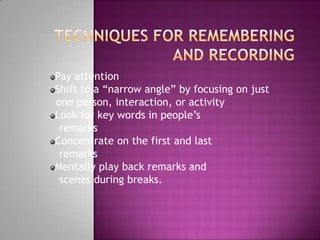
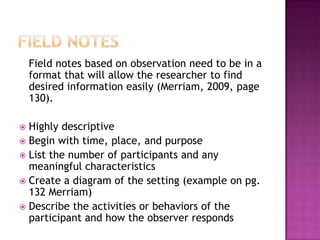
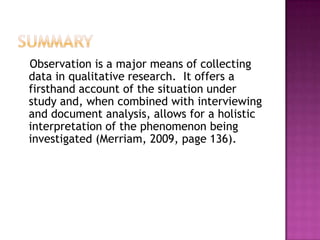
Things to remember	No ideal amount of time to spend observingRecommended to start  with sessions one hour or less.Also recommended to write up field notes as soon as possible.
The Process of collecting Data through ObservationEntry, Data collection, and Exit
EntryGain confidence and permission of those who can approve the activity.Mutual contactSome groups difficult to gain entryMost want answers to the following: What are actually doing?  Will you be disruptive?  What are you going to do with your findings?  Why us?  What will we get out of this?Bogdan and Biklen have some suggestions for the first few days in the field.
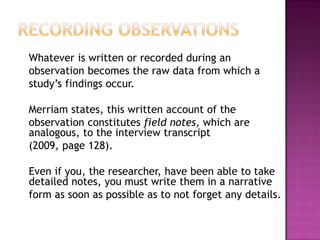
RECORDING OBSERVATIONSWhatever is written or recorded during an    observation becomes the raw data from which a    study’s findings occur.  Merriam states, this written account of the    observation constitutes field notes, which are analogous, to the interview transcript    (2009, page 128).Even if you, the researcher, have been able to take detailed notes, you must write them in a narrative    form as soon as possible as to not forget any details.

Merriam Ch 6_5.25.10

  • 1.
    Being a CarefulObserverChapter Six
  • 2.
    Observation VS. InterviewObservationInterviewTakesplace in the setting where the phenomenon of interest actually occursData represents first hand encounter with the phenomenon of interestAnother location designated for interviewingSecond hand account of the world
  • 3.
    Observation is aResearch ToolSystematic-addresses a specific research questionWhen it is subject to the checks and balances in producing trustworthy results.Negative-highly subjective and therefore unreliable nature of human perception.
  • 4.
    Training to bea Skilled ObserverLearning to pay attentionLearning how to write descriptivelyPracticing the disciplined recording of field notesKnowing how to separate detail from triviaUsing rigorous methods to validate observations
  • 5.
    Ways to PracticeBeinga complete observer in a public placeBeing a participant observer in your work or social settingsWatching films or video tapesApprentice yourself to be an experienced field researcher and compare his or her observations to yours
  • 6.
    Reasons for ObservationsAsan outsider an observer will notice things that have become routine to the participants themselves.
  • 7.
    Conducted to triangulateemerging findings(used in with interviewing and document analysis)
  • 8.
    Observer sees thingsfirsthand and uses own knowledge to interpret what is observed rather than relying on once-removed accounts from interviews.Reasons continuedObservations make it possible to record data as it is happening.
  • 9.
    Used to provideknowledge of the context or to specific incidents.
  • 10.
    People may notfeel free to talk about or want to discuss all topics.
  • 11.
    Best technique whenan activity, event, or situation can be observed firsthand and a fresh perspective is desired.What to ObserveMost important is the researcher’s purpose in conducting the studyThe problem and the questions of interest determine what is to be observed.Observer can decide to focus on certain events, behaviors, or persons.
  • 12.
    Where to start?Thephysical setting: The participants:Activities and interactions:Conversation:Subtle factors:Your own behavior:
  • 13.
    Things to remember Noideal amount of time to spend observingRecommended to start with sessions one hour or less.Also recommended to write up field notes as soon as possible.
  • 14.
    The Process ofcollecting Data through ObservationEntry, Data collection, and Exit
  • 15.
    EntryGain confidence andpermission of those who can approve the activity.Mutual contactSome groups difficult to gain entryMost want answers to the following: What are actually doing? Will you be disruptive? What are you going to do with your findings? Why us? What will we get out of this?Bogdan and Biklen have some suggestions for the first few days in the field.
  • 16.
    RECORDING OBSERVATIONSWhatever iswritten or recorded during an observation becomes the raw data from which a study’s findings occur. Merriam states, this written account of the observation constitutes field notes, which are analogous, to the interview transcript (2009, page 128).Even if you, the researcher, have been able to take detailed notes, you must write them in a narrative form as soon as possible as to not forget any details.