Chapter 7
OBSERVING LANGUAGE
CLASSROOMS
Definition
A classroom observation:
• is a formal or informal observation of teaching
while it is taking place in a classroom or
other learning environment.
• Typically conducted by fellow teachers,
administrators, or instructional specialists
• used to provide teachers with constructive critical
feedback aimed at improving their classroom
management and instructional techniques
Definition
• Pivotal (important because other
things depend on it) activity
• with a crucial role to play
• in classroom research,
• teacher’s personal professional growth,
• and school development as a whole
(Hopkins, 1993)
Definition
• Three categories:
– System-based/ethnographic/ad hoc (for
a particular purpose or need, esp. for
an immediate need) procedures
(Wallace, 1991)
– Systematic/structured/focused/open observation
(Hopkins, 1993)
– Binary structured/open distinction
(Seliger and Shohamy, 1989)
• Requires:
– Observer’s degree of participation
– Objectivity issue
– Inductive (heuristic) parameter
– Deductive (analytic) parameter
Heuristic: a method of learning or solving problems that allows people to
discover things themselves and learn from their own experiences
Analytic : involving the careful, systematic study of something
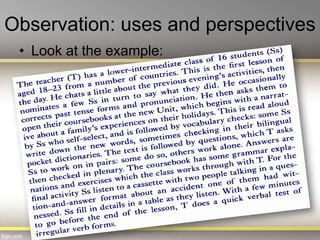
Observation: uses and perspectives
• Look at the example:
Observer:
• Course director
• Head/senior teacher
• Colleague/peer
• Trainee/junior teacher
• New/teacher
• Researcher from outside the institution
• External assessor
Goals
• Placement of students
• Evaluation of efficacy of materials
• Apprenticeship for novice/trainee staff
• Staff appraisal: formative/developmental
• Quality assurance and control
• Personal development
• Improvement in methodology
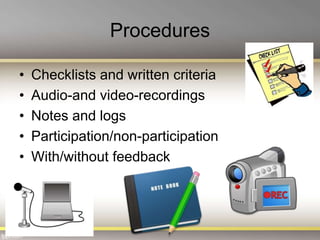
Procedures
• Checklists and written criteria
• Audio-and video-recordings
• Notes and logs
• Participation/non-participation
• With/without feedback
Observation for Research
1) Research to increasing knowledge and
understanding of phenomenon
2) Research to bring about change,
innovation and action
3) Research for personal-professional
development
Systematizing observation
• Using preplanned observational categories:
– Coding schemes or systematic observational
schedules
• The observer recognizes instances of particular
categories
• Notes them down as they occur
• Either live or from recording
Why systematize?
• Research observation is an intentional
activity, not reactive noticing
• Intentional observation implies planning
and the use of some previously
established categories
• Coding system is in widespread use:
checklist approach
The Advantages of a coding
system approach
1) Easier than paper recording
2) Enables comparisons with other studies and
generalization
3) Tailor made for a particular problem
4) Simple analysis
5) Established patterns of interaction and
development
6) Established personal patterns of a particular
teacher and learner
7) Possible to train observers
The Disadvantages of Coding
System Approach
1) Involves editing: reduction of the data
2) The preselected categories may not be
the relevant ones
3) Cannot take into account relevant but
unobserved shared knowledge
Kind of analysis
• High- Inference Categories
An observer has to make considerable effort
of judgment to decide whether a range of
behaviors constitute a category
Kind of analysis
• Low-Inference Categories
 Using a description of observable facts or
events, without interpretation.
 Uses a low degree of subjectivity.
 Just the facts, not an opinion.
 A factual observation, not a judgment.
Published or Invented
Categories
• There is no need to rely on published
literatures for categories
• A researcher can develop his or her own
for some particular research purpose
• For example: a teacher researcher might
be interested in the possible effects of
different strategies for giving oral feedback
or intervening about an error in spoken
performance.
Analysis of codings
Coded transcripts of classes can be
analyzed in several ways
1. By counting frequency:
 the relative frequency of each kind of
behavior is set out in tabular form
 Conclusion is drawn from the overall picture
2. By finding patterns
 Soliciting answers→nominating a pupil
→receiving an answer→checking with
another pupil→praise
Live Observation or Recording
• Any form of observation distorts normality
• Live observation
– Distract the attention of students and teacher
• Recording
– Distract attention
– Microphones are more limited than human ears
– Voices on the recording are less easy to identify
• Video
– Camera equipment also distract and possibly
invite strange behavior
Alternatives to Coding Schemes
• Recording and field notes
– Record a lesson and transcribe it using field
notes taken at the time of recording
• Text analysis
– makes qualitative research faster and easier
by highlighting important terms and
categorizing open-ended responses.
– The ability to analyze what respondents say
helps gain insight into their attitudes,
behaviors, concerns, motivations, and culture.
Alternatives to Coding Schemes
• Stimulated recall
– A recording is made of the lesson or class to
be observed
– Interpretation of the observation is made with
the teacher and students
– The researcher freezes the recording at a
point and ask them to memorize
Naturalistic Observation
• Naturalistic observation is:
– a research tool in which a subject is observed
in its natural habitat without any manipulation
by the observer.
– During naturalistic observation researchers
take great care to avoid interfering with the
behavior they are observing by
using unobtrusive methods.
Naturalistic Observation
• In contrast to analog observation which
is
– a research tool by which a subject is observed
in an artificial setting.
– Typically, types of settings in which analog
observation is utilized include clinical offices or
research laboratories,
– can be made in any artificial environment,
– even if the environment is likely to encounter
naturally.
Naturalistic Observation
• In contrast to
– Contrived
– Manipulated
– Experimental
• Data are based on
– Everyday lessons
– Usual participants
– In real time
Two corollaries
• First: Crucial context:
– It sites the phenomenon of study in space and
time
– It taps into fluctuating interactions and
relationship patterns
• Second: the naturalistic observer:
– Multiple perspectives of those observed
– Seek to interpret rather than avoid them
Corollary: something that results from something else
Dealing with Data
• To capture the natural setting:
– The techniques used will be at the open, less
structured end of the methodology
• The principal data-gathering instrument
will be description:
– The aim is producing thick data (as
comprehensive as possible) in terms of
individuals, interactions, behavior and setting
Analyzing Data
1. The data are examined and reexamined
to foreground recurrent patterns.
2. Description can be selective and focused
– For example: A teacher researcher may
have already decided that Student A is
problematic
– He/she takes descriptive notes in class
– Another teacher, unsure about its efficacy,
might invite a colleague to examine how
he/she sets up pair work

Sharing program chapter 7

  • 1.
  • 2.
    Definition A classroom observation: •is a formal or informal observation of teaching while it is taking place in a classroom or other learning environment. • Typically conducted by fellow teachers, administrators, or instructional specialists • used to provide teachers with constructive critical feedback aimed at improving their classroom management and instructional techniques
  • 3.
    Definition • Pivotal (importantbecause other things depend on it) activity • with a crucial role to play • in classroom research, • teacher’s personal professional growth, • and school development as a whole (Hopkins, 1993)
  • 4.
    Definition • Three categories: –System-based/ethnographic/ad hoc (for a particular purpose or need, esp. for an immediate need) procedures (Wallace, 1991) – Systematic/structured/focused/open observation (Hopkins, 1993) – Binary structured/open distinction (Seliger and Shohamy, 1989)
  • 5.
    • Requires: – Observer’sdegree of participation – Objectivity issue – Inductive (heuristic) parameter – Deductive (analytic) parameter Heuristic: a method of learning or solving problems that allows people to discover things themselves and learn from their own experiences Analytic : involving the careful, systematic study of something
  • 6.
    Observation: uses andperspectives • Look at the example:
  • 7.
    Observer: • Course director •Head/senior teacher • Colleague/peer • Trainee/junior teacher • New/teacher • Researcher from outside the institution • External assessor
  • 8.
    Goals • Placement ofstudents • Evaluation of efficacy of materials • Apprenticeship for novice/trainee staff • Staff appraisal: formative/developmental • Quality assurance and control • Personal development • Improvement in methodology
  • 9.
    Procedures • Checklists andwritten criteria • Audio-and video-recordings • Notes and logs • Participation/non-participation • With/without feedback
  • 10.
    Observation for Research 1)Research to increasing knowledge and understanding of phenomenon 2) Research to bring about change, innovation and action 3) Research for personal-professional development
  • 11.
    Systematizing observation • Usingpreplanned observational categories: – Coding schemes or systematic observational schedules • The observer recognizes instances of particular categories • Notes them down as they occur • Either live or from recording
  • 12.
    Why systematize? • Researchobservation is an intentional activity, not reactive noticing • Intentional observation implies planning and the use of some previously established categories • Coding system is in widespread use: checklist approach
  • 13.
    The Advantages ofa coding system approach 1) Easier than paper recording 2) Enables comparisons with other studies and generalization 3) Tailor made for a particular problem 4) Simple analysis 5) Established patterns of interaction and development 6) Established personal patterns of a particular teacher and learner 7) Possible to train observers
  • 14.
    The Disadvantages ofCoding System Approach 1) Involves editing: reduction of the data 2) The preselected categories may not be the relevant ones 3) Cannot take into account relevant but unobserved shared knowledge
  • 15.
    Kind of analysis •High- Inference Categories An observer has to make considerable effort of judgment to decide whether a range of behaviors constitute a category
  • 16.
    Kind of analysis •Low-Inference Categories  Using a description of observable facts or events, without interpretation.  Uses a low degree of subjectivity.  Just the facts, not an opinion.  A factual observation, not a judgment.
  • 17.
    Published or Invented Categories •There is no need to rely on published literatures for categories • A researcher can develop his or her own for some particular research purpose • For example: a teacher researcher might be interested in the possible effects of different strategies for giving oral feedback or intervening about an error in spoken performance.
  • 18.
    Analysis of codings Codedtranscripts of classes can be analyzed in several ways 1. By counting frequency:  the relative frequency of each kind of behavior is set out in tabular form  Conclusion is drawn from the overall picture 2. By finding patterns  Soliciting answers→nominating a pupil →receiving an answer→checking with another pupil→praise
  • 19.
    Live Observation orRecording • Any form of observation distorts normality • Live observation – Distract the attention of students and teacher • Recording – Distract attention – Microphones are more limited than human ears – Voices on the recording are less easy to identify • Video – Camera equipment also distract and possibly invite strange behavior
  • 20.
    Alternatives to CodingSchemes • Recording and field notes – Record a lesson and transcribe it using field notes taken at the time of recording • Text analysis – makes qualitative research faster and easier by highlighting important terms and categorizing open-ended responses. – The ability to analyze what respondents say helps gain insight into their attitudes, behaviors, concerns, motivations, and culture.
  • 21.
    Alternatives to CodingSchemes • Stimulated recall – A recording is made of the lesson or class to be observed – Interpretation of the observation is made with the teacher and students – The researcher freezes the recording at a point and ask them to memorize
  • 22.
    Naturalistic Observation • Naturalisticobservation is: – a research tool in which a subject is observed in its natural habitat without any manipulation by the observer. – During naturalistic observation researchers take great care to avoid interfering with the behavior they are observing by using unobtrusive methods.
  • 23.
    Naturalistic Observation • Incontrast to analog observation which is – a research tool by which a subject is observed in an artificial setting. – Typically, types of settings in which analog observation is utilized include clinical offices or research laboratories, – can be made in any artificial environment, – even if the environment is likely to encounter naturally.
  • 24.
    Naturalistic Observation • Incontrast to – Contrived – Manipulated – Experimental • Data are based on – Everyday lessons – Usual participants – In real time
  • 25.
    Two corollaries • First:Crucial context: – It sites the phenomenon of study in space and time – It taps into fluctuating interactions and relationship patterns • Second: the naturalistic observer: – Multiple perspectives of those observed – Seek to interpret rather than avoid them Corollary: something that results from something else
  • 26.
    Dealing with Data •To capture the natural setting: – The techniques used will be at the open, less structured end of the methodology • The principal data-gathering instrument will be description: – The aim is producing thick data (as comprehensive as possible) in terms of individuals, interactions, behavior and setting
  • 27.
    Analyzing Data 1. Thedata are examined and reexamined to foreground recurrent patterns. 2. Description can be selective and focused – For example: A teacher researcher may have already decided that Student A is problematic – He/she takes descriptive notes in class – Another teacher, unsure about its efficacy, might invite a colleague to examine how he/she sets up pair work